MentionBird for DeepSeek
Free report · no login

Be the brand DeepSeek already knows

DeepSeek answers hundreds of millions of questions a month, mostly outside the West, and mostly without showing its sources. MentionBird runs your prompts against it every day, so you can see whether it names you, names a competitor, or describes your brand wrongly. Start with a free report on what ChatGPT says about your brand today.
✓
5 questions × 3 runs
✓
Every answer quoted
✓
Shareable link
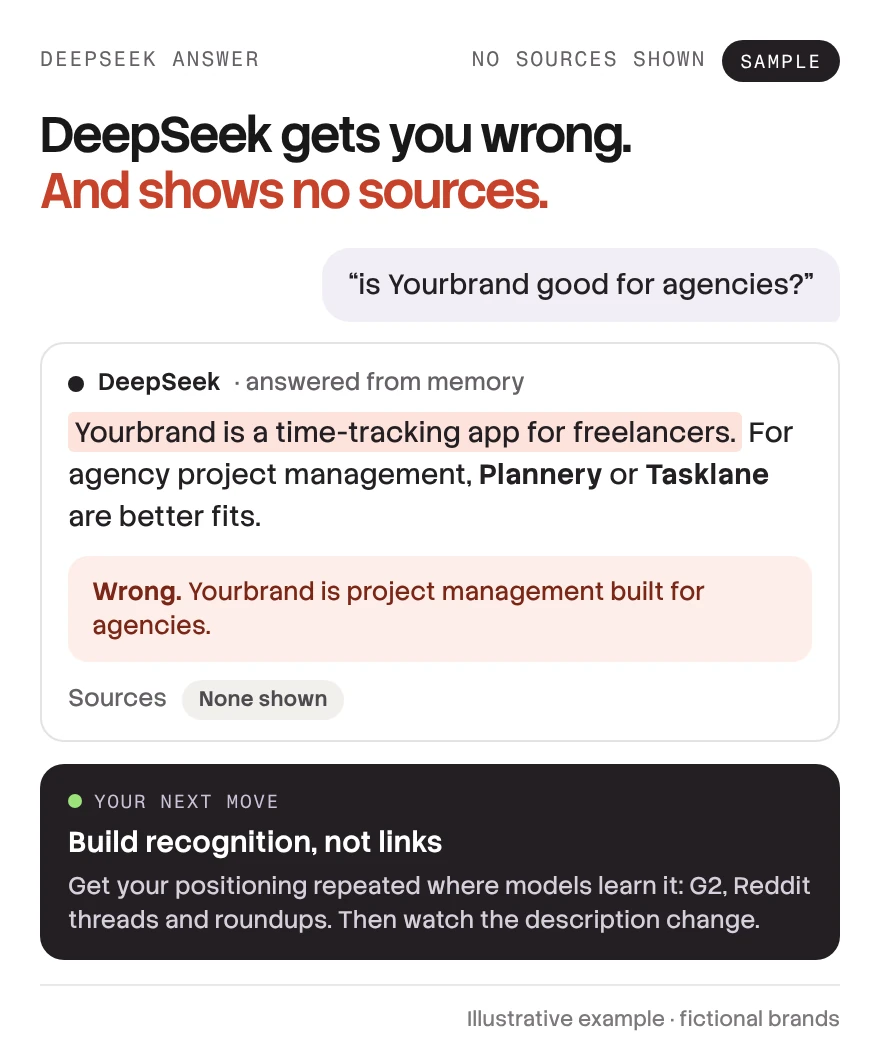
DeepSeek describes your brand wrongly, recommends two competitors instead, and shows no sources you could correct
Why DeepSeek matters

Your APAC buyers are getting an answer you have never seen

DeepSeek is one of the most used assistants in the world, and its users are mostly not where marketing teams are looking. China, India and Indonesia account for more than half of them. Most are on desktop, and a large share are developers, students and early-career professionals. If you sell into those markets, or you sell to technical buyers anywhere, DeepSeek is already answering questions about your category.

Its users are somewhere else
More than half are in China, India and Indonesia. If APAC or India is a market for you, this is a discovery channel you are almost certainly not measuring.
It usually answers without sources
There is often no link to inspect and no page to chase. What decides the answer is what the model already believes about your brand.
It runs inside other products too
DeepSeek's weights are open, so other companies build on the model. Being known to it reaches further than its own app.
Under the hood

How DeepSeek decides which brands to name

DeepSeek is an open-weight model, and most of what it says comes from what it learned in training rather than a live lookup. Switch search on and it will retrieve, but it shows sources far less consistently than Perplexity or Grok — one 2026 cross-platform measurement recorded almost no visible citations in its answers at all. That changes the job. On a citation-heavy engine you win by getting into a small set of pages. Here you win by being a brand the model already recognises: described the same way across many places, clearly tied to your category, and written about widely enough to have been learned in the first place. DeepSeek names brands it already knows, not pages it just found.
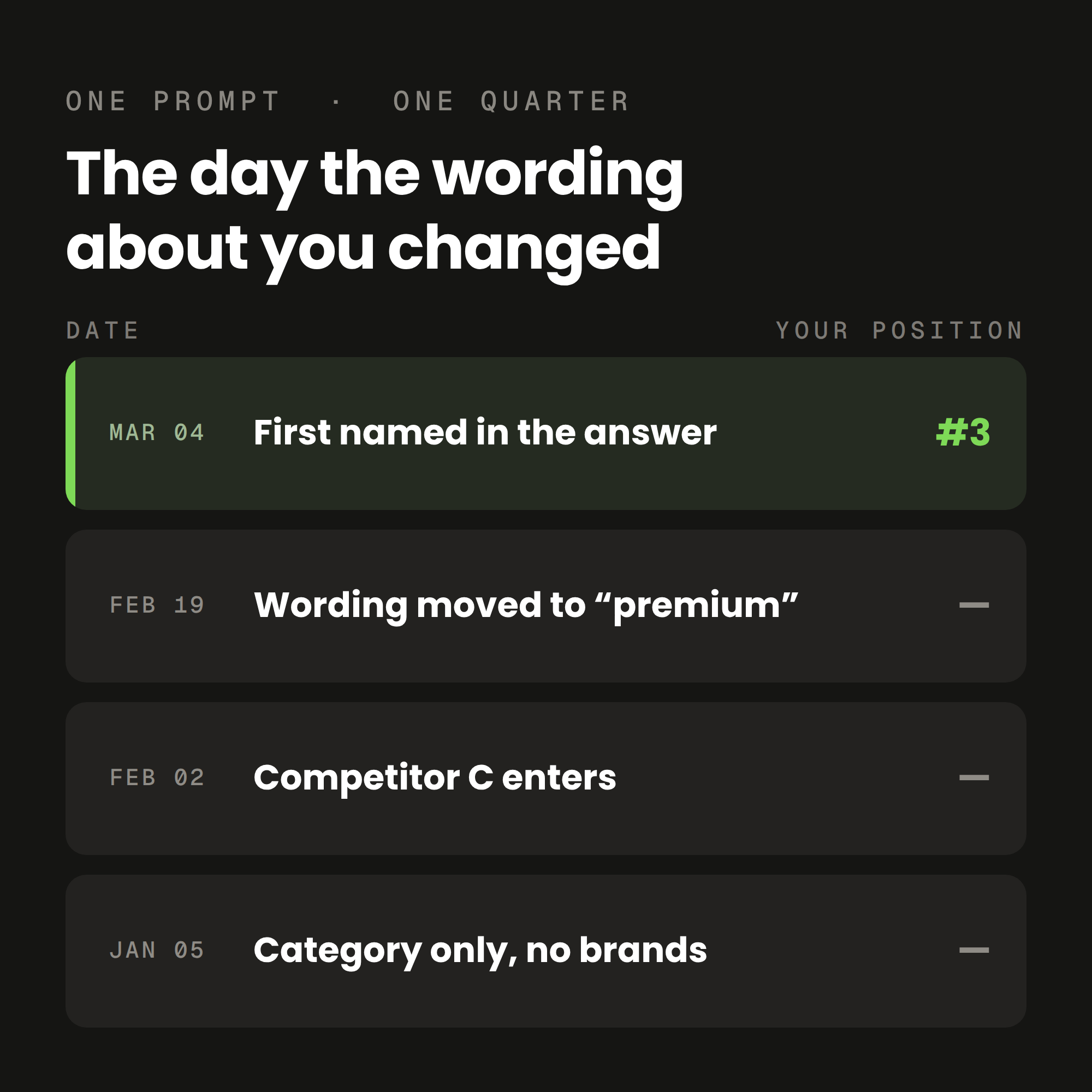
Answer history for one prompt, showing the day the wording changed and your brand first appeared
What we can and cannot show you

Mentions you can measure, even when there are no links

Because DeepSeek often answers with nothing to click, MentionBird measures what is actually there. Does it name you. Where in the answer. Which competitors sit beside you. How the answer describes your category and your brand. Every run stores the full answer text, with 365 days of history, so you can see the day a description changed.

Where sources do appear, they are recorded and broken down by type. Nicknames, abbreviations and misspellings are grouped under your brand, which matters more here than elsewhere, because your name may be transliterated or shortened.
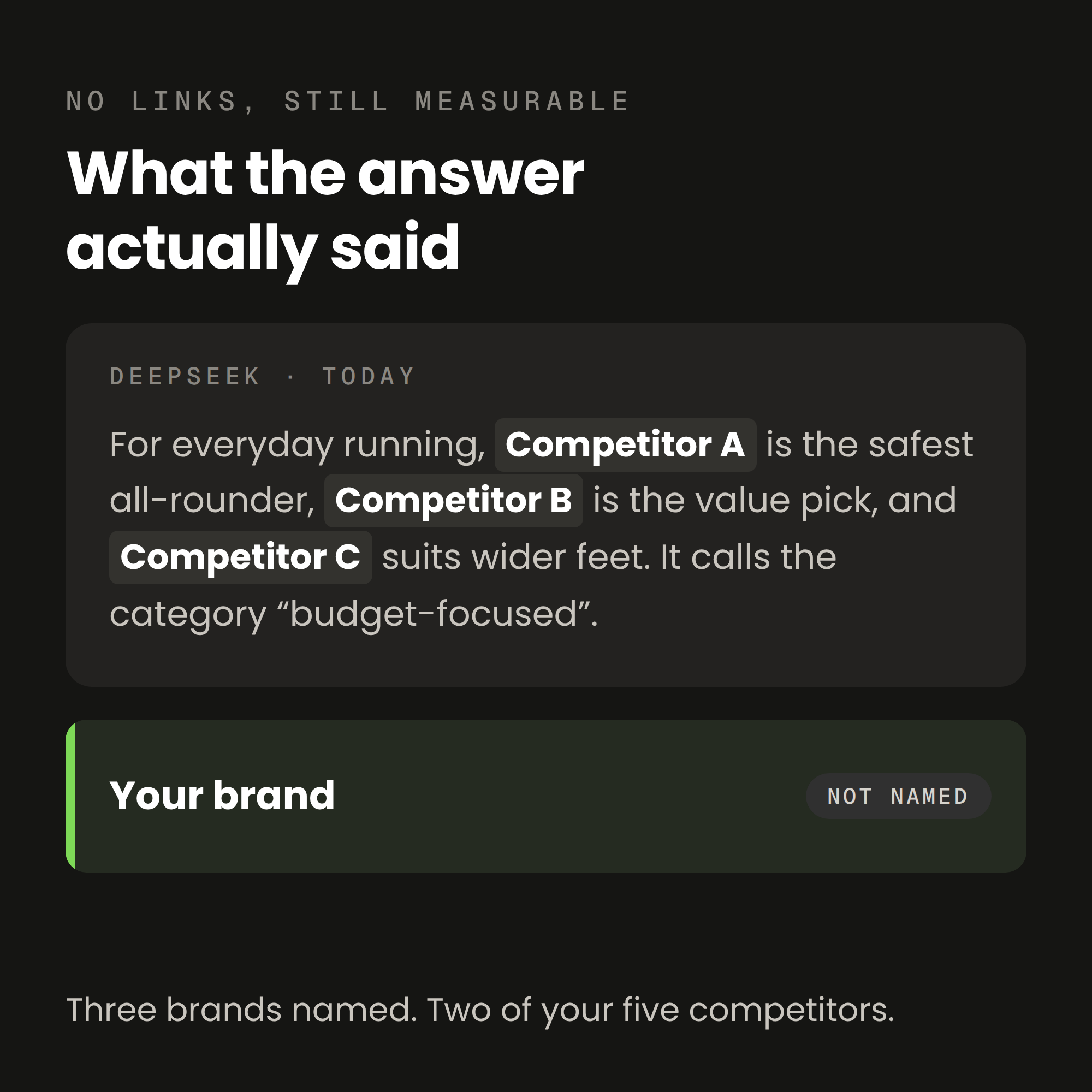
A DeepSeek answer naming three competitor brands, with your brand absent from it
What to do about it

You cannot pitch a page it never reads. So build recognition instead.

For every prompt where a competitor gets named and you do not, AI Ranking Advice reads the answer and whatever sources came with it, then writes out what to do. Each prompt carries a difficulty score and a search volume score out of ten, so you can start with what is cheapest to win.

Be known

Get described the same way everywhere

Same category words, same claims, across your site, your profiles, directories and reference sources. Consistency is what a model learns from.

Be covered

Get written about beyond your own site

Third-party coverage is what teaches the model. Your own pages, on their own, rarely do it.

Be checked

Catch what it gets wrong about you

Models keep saying the outdated thing until they are retrained. Finding it early is the difference between fixing it and living with it.

Asking DeepSeek yourself gives you one answer. MentionBird gives you the pattern.

You can open DeepSeek now and ask your category question. But you will ask it once, in one language, from one country, and get one answer with no sources to check. That cannot tell you the thing that matters: does it know your brand at all?

Asking DeepSeek yourself

—
One answer, whenever you remember to check
—
One country, one phrasing
—
Nothing to click, so nothing to record
—
You search each competitor's name separately
—
No way to know when a description changed

MentionBird

✓
Every prompt, checked every day
✓
Prompts targeted by country, so you see the answer your market gets
✓
The full answer text stored, with 365 days of history
✓
Which competitors were named, how often, and in what position
✓
The day a description changed, and what it said before

Questions? We're glad you asked.

Is DeepSeek worth tracking if I sell mainly in the US or Europe?

Often it is a lower priority than ChatGPT, Gemini or Perplexity, and we would rather say so. More than half of DeepSeek's users are in China, India and Indonesia, and the US is a single-digit share. Where it earns its place is if you sell into APAC or India, if you sell developer or technical products anywhere, or if you want to know what a very large non-Western audience is being told about your category. If none of those apply, start with the platforms your buyers actually use.

Which plan do I need to track DeepSeek?

DeepSeek is part of a Custom plan, which covers all 20 supported platforms and is priced on a quote. Starter at $79 a month covers ChatGPT and Gemini. Growth at $299 adds Perplexity and Claude. Custom also includes unlimited prompt runs, unlimited brands and competitors, and a dedicated account manager.

Does DeepSeek show its sources?

Usually not. It can retrieve from the web when search is switched on, but it displays sources far less consistently than Perplexity or Grok, and one 2026 cross-platform measurement recorded almost no visible citations from it. That is why this platform is measured on mentions rather than citations, and why the work is building recognition rather than chasing individual pages.

If it does not cite anything, what is there to measure?

The answer itself, which is what buyers actually read. MentionBird records whether DeepSeek names your brand, where in the answer it appears, which competitors are named alongside you, and how the answer describes your category. The full answer text is stored with 365 days of history, so you can compare what it says today against any point in the past year. Where sources do appear, they are recorded too.

Can I see the answer my market gets, not just mine?

Yes. Prompts can be targeted to a country, which matters more on DeepSeek than on any other platform because so much of its audience is outside the West. The answer someone gets in India is not necessarily the answer you get from your own desk.

My brand is not written about much in English. Does that matter?

It affects what the model learned, yes. It also makes name matching harder, which is why MentionBird groups nicknames, abbreviations and common misspellings under one brand. If your name gets transliterated or shortened in your markets, tell us during setup so those variants are counted as you from day one.

How do I actually get DeepSeek to name my brand?

By being recognisable rather than by being retrieved. Describe yourself the same way across your site, your profiles, directories and reference sources, so the model has one consistent picture rather than five. Then get written about somewhere other than your own domain, because third-party coverage is what a training corpus is made of. It is slower work than winning a citation-heavy platform, and it holds for longer once it lands.

How quickly can DeepSeek's answers change?

Slower than on Grok or Perplexity. Those platforms retrieve live, so a new page can show up within days. DeepSeek leans on what the model already knows, so a genuine change in how it describes you often waits for a retrain. The upside is stability: once it knows you correctly, it tends to keep saying so.

Isn't DeepSeek restricted in some countries and companies?

Yes, in several. A number of governments and organisations have restricted or banned its use, mostly on data protection and security grounds, and that is worth factoring into how much weight you give this platform. It still has well over a hundred million users, concentrated in markets where it is not restricted. Both things are true at once.

Do you cover the other AI assistants as well?

Yes. A Custom plan covers 20 platforms in total, including ChatGPT, Gemini, Perplexity, Claude, Grok, Google AI Overviews, Microsoft Copilot, DeepSeek, Google AI Mode, Meta AI and Qwen Chat.

You choose which platforms each prompt runs on, so you can watch DeepSeek closely, spread a prompt across all 20, or anything in between. Custom has no daily run cap, so that decision is about what is worth watching rather than what fits in your allowance.

DeepSeek is already answering for your category. Find out what it says.

First month $19 with code TRY19, then $79/mo. Cancel anytime.