For ecommerce
Free report · no login

Be the brand AI names when shoppers ask what to buy

A shopper asks ChatGPT for the best product in your category. Two or three names come back, and most people stop reading there. MentionBird runs that buyer query and every other one, every day across different AI platforms, shows which pages the answer was built from, and tells you what to change to get named. You ship the work. The answers change. Start with a free report on your own store.
✓
5 questions × 3 runs
✓
Every answer quoted
✓
Shareable link
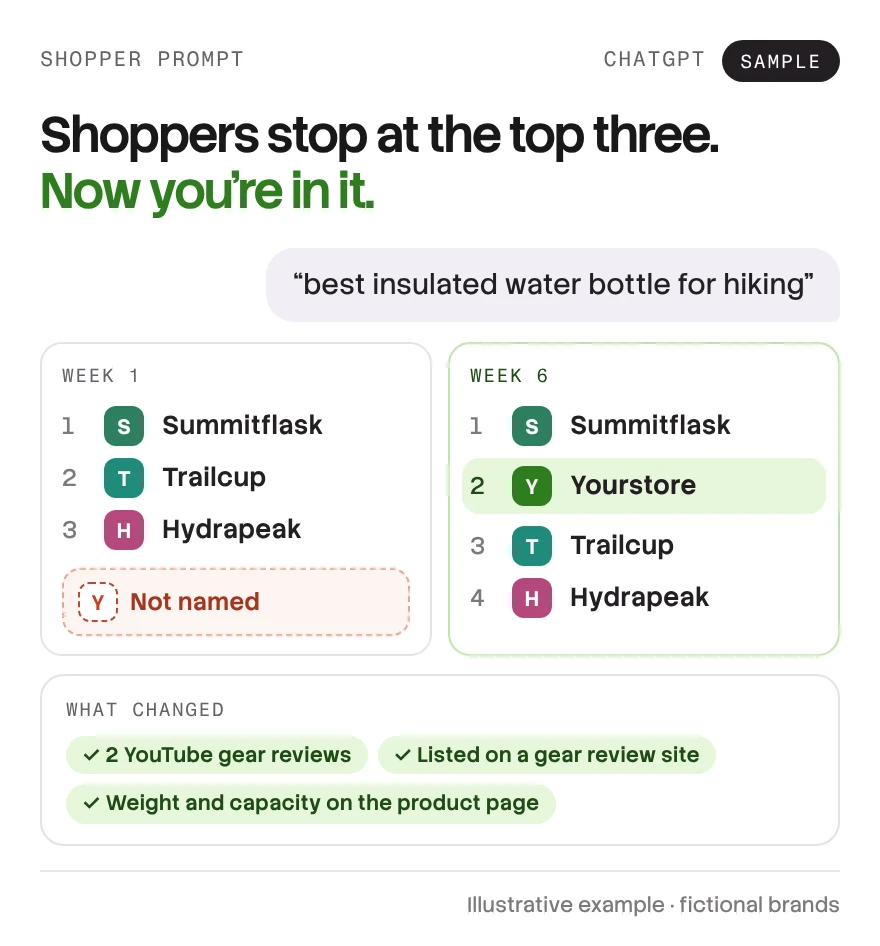
A shopper prompt tracked weekly: in week 1 ChatGPT names three other stores, by week 6 your store is the number two recommendation
The new buying journey

Your product page is not where the shortlist is made anymore

Shoppers used to open ten tabs and compare. Now they ask one question and never open a tab at all.

There is no second page
The answer is the whole shortlist. Nothing sits below it, nothing loads on scroll, and there is no next result to click through to. Whatever gets named in AI responses is the entire set of options that shopper will consider.
They ask about you without you
Shoppers ask whether your product is worth it, and how it compares to a competitor they already have in mind. Those answers get built from whoever wrote the better review or roundup. Often that is not you.
Nothing in your analytics shows it
No session, no cart, no source. A sale that never started leaves no trace in GA4, so the loss stays invisible until you look at the trend line.
What you actually see

The pages your next customer reads

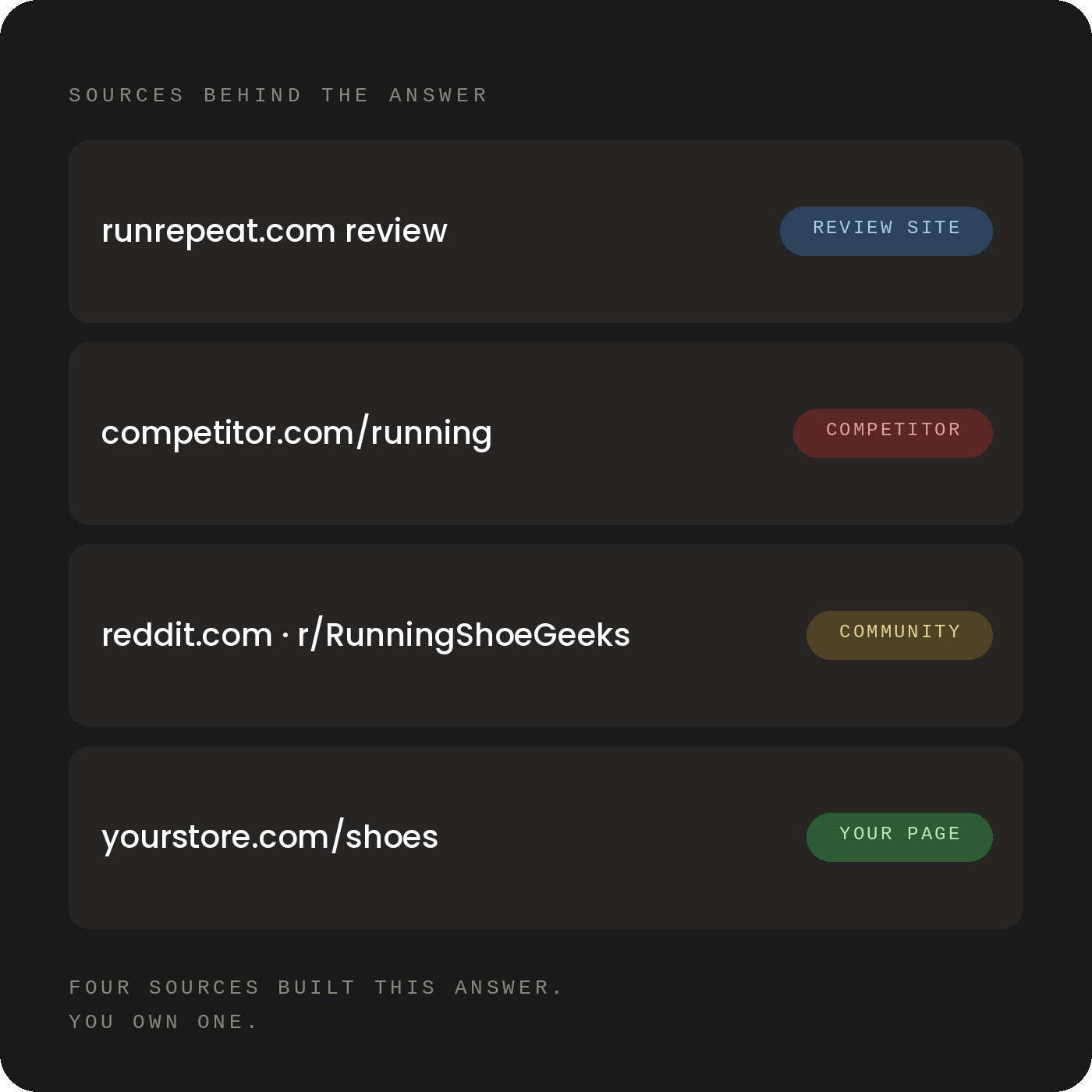
Behind most answers are a handful of pages the AI model or engine pulled from. Usually four or five, and usually not the ones you would expect. A review site you have never pitched, a competitor's collection page, a subreddit thread, and if you are lucky, one page of your own. MentionBird names all of them, for every prompt you track.
✓
See which pages every answer was built from by looking at the exact answer, and whether any of them are yours
✓
Check whether ChatGPT, Gemini, and Perplexity are naming the same set, or three different ones
✓
Get AI ranking advice based on real citation data and your brand's context
Four sources behind one AI answer about running shoes: a shoe review site, a competitor collection page, a running subreddit and your product page
Where the work goes

Three ways into the answer, cheapest first

Not every page behind an answer is worth chasing. Here is where to start.

Low effort · Fastest path

Fix the pages AI already reads

Product pages, collection pages, size guides, shipping and returns. AI quotes concrete specifics: materials, fit, price, delivery windows, return terms. Pages that stay vague get skipped for ones that commit to numbers.

Medium effort · You own it

Publish the buying guide it cannot find

If nobody has written an honest guide to the best product for your use case, an affiliate roundup or a marketplace answers that question instead. Category guides, comparison pages, and best for pages are the fastest way to own a prompt outright.

Higher effort · Long term value

Win the roundups and threads it cites

Review roundups, creator videos, and community threads carry real weight in shopping answers. Your outreach and seeding starts from the exact sources cited for your prompts, not from a guess.

What the first month looks like

WEEK 1

Find out which prompts you lose

Track the prompts closest to a purchase. See which brands get named, which sources each answer used, and where you sit. That is the baseline and the audit in one.

WEEK 2

Ship the work that is already scoped

Tighten the product and collection pages with real weight, drop and fit numbers, publish the comparison and sizing guide, apply product schema, and start outreach to the sources already being cited.

MONTH 1

Watch the answers move

Compare this month's answers and sources against the baseline. Keep doing what moved your mentions, and change what did not land.

Questions? We're glad you asked.

Does appearing in AI answers actually affect sales?

It affects which products get considered. The ones that are not named never reach the comparison stage, and since nothing was clicked, the effect shows up in category demand and branded search before it shows up in a source report.

Which prompts should an ecommerce team track first?

Start with the four that sit closest to a purchase: your category question, the best product for a specific use case, your product against a named rival, and alternatives to your product. Every prompt carries a difficulty score and a search volume score out of ten in MentionBird, so you can weigh what is winnable against what is worth winning.

Amazon and marketplaces outrank us for our own products. Can we see that in AI answers?

Yes, and it is one of the first things worth checking. Track the prompts for your own brand and you will see exactly which page the assistant used. If it is a marketplace listing or an affiliate roundup, the ranking advice will tell you what your own page needs to displace it.

AI is quoting an old price or a product we discontinued. Can we catch that?

Every run stores the full answer text, and the history is kept alongside it, so you can see what an assistant said about your products and when that changed. An outdated price or a discontinued variant surfaces there before it reaches a support ticket.

How is this different from the SEO tool we already pay for?

SEO tools tell you where a page ranks in search results. This tells you why an AI answer names one shoe and not another, and which source to win to change it. A product page can rank first on Google and still be missing from the answer, because the assistant may be building that answer from a review site or a thread instead.

Do we need to be on Amazon or in review roundups for this to work?

That depends on your category, and the source list settles it. Track your prompts and you will see what the answers use. In many retail categories third party coverage carries more weight than brand sites, and if that is true for yours, it will be obvious within a week.

Which plan do we need, and which assistants does it cover?

Most ecommerce teams should start on Starter at $79 a month. One store, one brand, and 100 prompt runs a day cover your buying prompts on ChatGPT and Gemini, which is where most shopping questions get asked.

Move to Growth at $299 a month when one of three things is true: you run more than one store or label, your catalog spans enough categories that 100 runs a day stops covering them, or you want Perplexity in the mix because it cites sources and sends actual clicks.

Growth gives you 400 runs a day, 3 brands with 10 competitors each, and 500 agent credits instead of 100. That last number matters because one ranking plan costs 5 credits, so Starter is roughly 20 plans a month, and Growth is roughly 100.

Custom is for tracking all 20 platforms, including Alexa for Shopping, with a dedicated account manager. Every plan includes every feature, so you are choosing volume, not capability.

Does MentionBird write the content for us?

No. MentionBird finds what's working in AI answers and gives you recommendations. You need to implement the changes along with your team.

Be the brand AI recommends

First month $19 with code TRY19, then $79/mo. Cancel anytime.