AI Keyword Tracking

Win the keywords AI searches before it answers your buyer.

When someone asks ChatGPT or Gemini what to buy, the chatbot doesn't search their question. It rewrites it into its own keywords, runs those searches against the live web, and builds the answer from whatever comes back. MentionBird records those keywords for every prompt you track. They're ordinary search terms — paste them into Search Console or Ahrefs and go rank for them. Start with a free report on the searches ChatGPT runs for your buyers' questions.
✓
$19 first month with code TRY19
✓
Then $79/mo, cancel anytime
✓
Tracks ChatGPT and Gemini daily
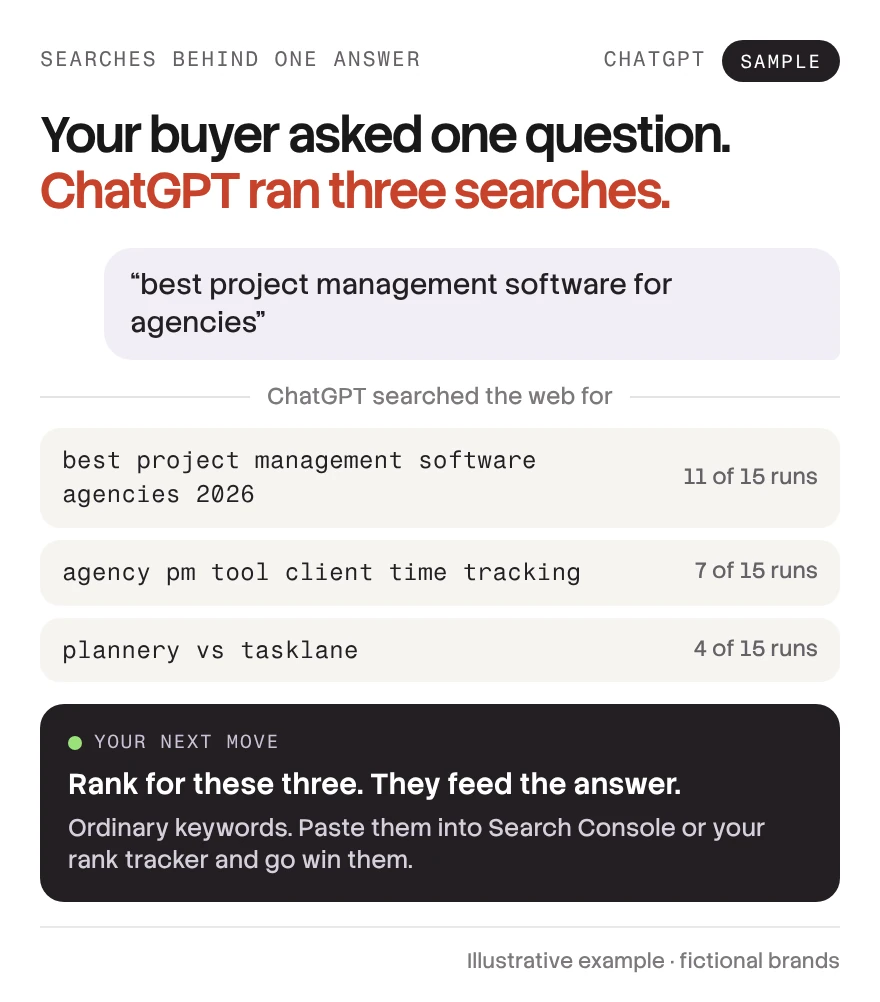
One buyer question turned into three web searches by ChatGPT, each a keyword you can rank for
The question isn't the keyword

Your buyer's question is not the search that decides the answer

Between the question and the answer there's a step nobody was measuring: the chatbot picks its own keywords.

What your buyer typed
"Which brand makes the best running shoes for marathons?" — conversational, brand-agnostic, and not a keyword anyone tracks. Nothing about it tells you what to publish.
What the chatbot searched
Gemini turned that one question into three searches, including one about different foot types — a topic the buyer never mentioned. Those three searches, not the question, went to the web.
What came back
Ten pages, and the answer was built from them. Change what ranks for those three keywords and you change the answer. That's the whole mechanism.
What you do with them

Three things a keyword list gives you that an answer never could

One prompt, one platform, one recorded set of searches.

Brief it

Content nobody knew to write

The foot-types keyword is a content brief you would never have commissioned. Every prompt you track produces keywords like it — specific, unglamorous, already deciding who gets recommended. Hand them to whoever writes your content and they'll know what to do.

Skip it

Prompts content can't win

Some runs come back with zero keywords. The chatbot answered from memory without searching, so no page you publish can change that answer. Knowing which prompts to skip is worth as much as knowing which to chase.

Fix it

A prompt asking wrong thing

When the keywords come back about something adjacent to your question, the prompt is mis-scoped. You learn that in a day from the keywords instead of a month from flat results.

Step 1 · The searches

See what the chatbot actually searched

Every run records the searches the chatbot ran before answering, in the order it ran them. For this prompt Gemini ran three. They aren't paraphrases or estimates — they're the strings it sent to the web, captured as it sent them.
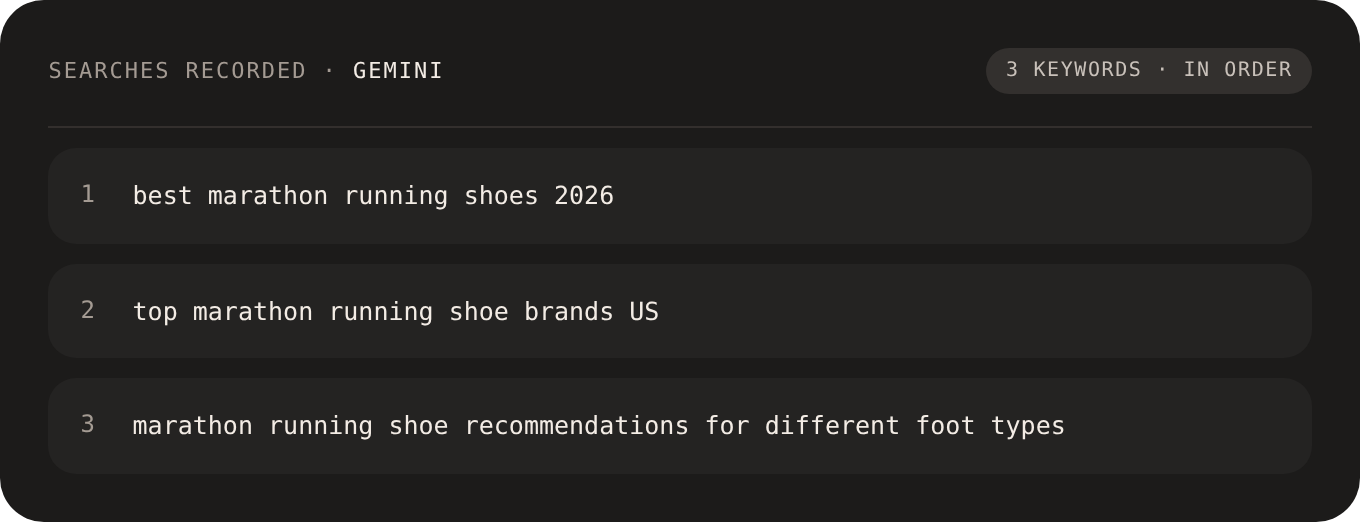
Three recorded search queries from one Gemini run, listed in the order the chatbot ran them
 Step 2 · The difference

Gemini led with Nike. ChatGPT led with ASICS.

Same prompt, one second apart, and the two chatbots asked the web six completely different questions. Not one keyword in common. Gemini went broad and added a foot-types angle. ChatGPT went narrow — it named five brands inside its own search string, then used a site: operator to pull World Athletics stack-height regulations before recommending anything.
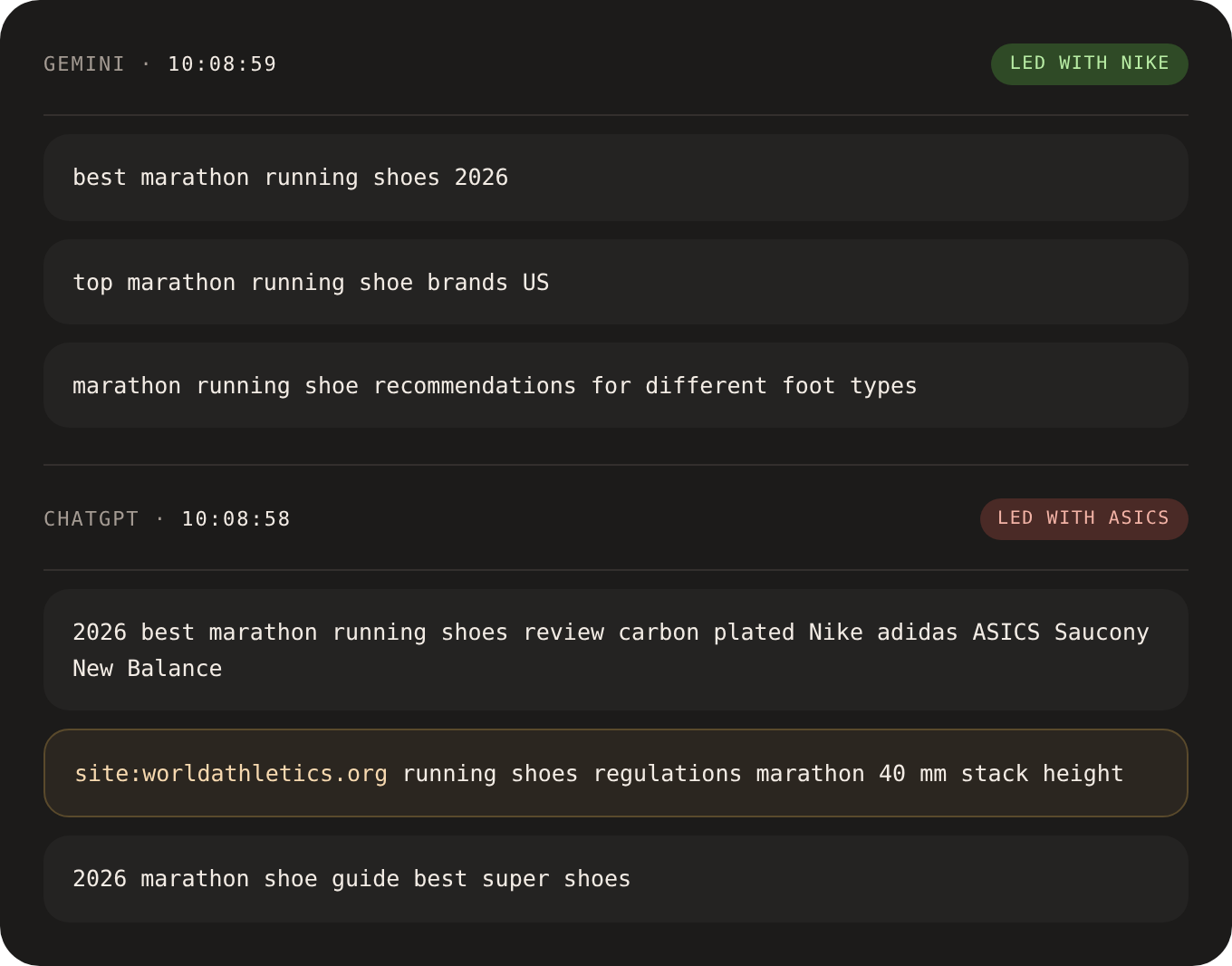
Chatbots use search operators. That's a keyword strategy nobody is planning for, and you can only plan for it once you can see it.
Three keyword targets from one prompt, with the foot-types keyword flagged as the one that pulled in two foot-care clinic websites
 Step 3 · The targets

These are keywords. You already know how to win keywords.

These are real searches against the live web, recorded exactly as the chatbot ran them. "best marathon running shoes 2026" is a keyword — it has volume, competitors, and pages ranking for it right now, and your team can go after it today with the tools already on their desk.
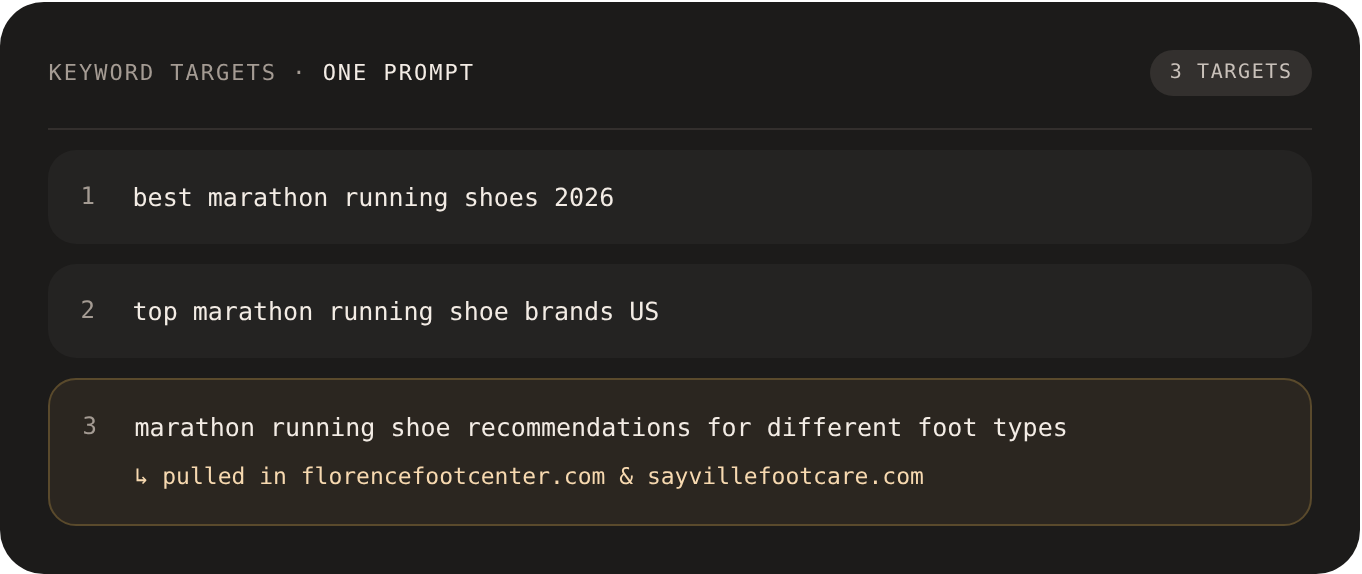
Then there's the third one. "marathon running shoe recommendations for different foot types" is why two foot-care clinics ended up as sources in a footwear answer. No brand team would have put foot types in a running-shoe keyword plan. It was invisible until the chatbot told you it mattered.
Domains ranked by how often AI cites them across all tracked prompts, each labelled by owner
Proof it's not guesswork

One question, two chatbots, almost nothing in common

Keywords are recorded on every run, so you can see which ones hold, which ones the chatbot swaps out, and whether ranking for one changed who got named.

Keywords shared →  0 of 6

Three searches each, and not one string in common. The two chatbots didn't just phrase it differently — they asked about different things.

Domains shared → 2 of 13

Thirteen distinct sources between them, and only irunfar.com and solereview.com appeared in both.

Lead brand → Nike vs ASICS

Both answers named both brands. Only one made each its headline recommendation — and the keywords are why.

Illustrative example. Results vary by category and effort.

 Why you can trust it

Recorded, not inferred

You're about to commission content off the back of these. They should hold up.

Captured as the chatbot ran them
The strings are recorded at run time, in order, repeats included. Nothing is reconstructed after the fact.
Zero is an answer, not a blank
When a run shows no keywords, the chatbot genuinely didn't search. That's a finding you can act on, and it's reported as distinct from missing data.
Coverage follows the platform
ChatGPT, Gemini and Grok publish the searches they ran, so MentionBird records them. Perplexity doesn't publish its own, so nobody can show them.

Other tools tell you the answer. MentionBird AI keyword tracking tells you the keywords behind it.

An answer report summarises what happened. A keyword list is brief.

Answer reporting

—
You were named, or you weren't
—
A score to explain to your team
—
Advice written for AI search
—
Silent when a prompt is unwinnable

MentionBird AI keyword tracking

✓
The searches that decided it, in the order they ran
✓
Keyword strings that paste into Search Console
✓
Work your SEO team already knows how to do
✓
Zero keywords tells you to stop trying

Questions? We're glad you asked.

Can I actually rank for these keywords?

Yes. They're real searches run against the live web, recorded exactly as they ran — not inferred, not estimated. "best marathon running shoes 2026" behaves like any other keyword: it has volume, competitors, and pages ranking for it today. If your page becomes a top result for it, it becomes a candidate source the next time a chatbot searches it.

What exactly is a chatbot keyword?

When someone asks a chatbot what to buy, the chatbot rarely searches their question as typed. It rewrites it into one or more search queries, runs them, reads the results, and builds its answer from those pages. Those queries are the chatbot keywords. MentionBird records them per prompt, per platform, per run, in order.

Which chatbots is this available for?

ChatGPT, Gemini and Grok — all three publish the searches they ran, and MentionBird records them. Perplexity does not expose its searches at all, so no tool can show them, including this one. Coverage follows what each platform makes available.

What does it mean when a prompt has zero keywords?

The chatbot answered from memory without searching the web. That's a finding, not missing data: if no search happened, no page could have influenced the answer, so content work won't move it. Track those prompts for awareness rather than targeting them with content.

Why do two chatbots pick different keywords for the same question?

Each rewrites the question with its own model and its own habits. On the example above, Gemini went broad and added a foot-types angle; ChatGPT named five brands inside its search string and used a site: operator to check governing-body regulations. Neither is wrong — they're different retrieval strategies, which is exactly why they led with different brands.

Do I get keywords for prompts I tracked before this launched?

Keywords are recorded on every new run from launch onward. Historical runs are being backfilled.

Can I use these in Ahrefs or Search Console?

Yes, and that's the point. They're plain keyword strings — export them into whatever you already use for volume, difficulty and rank tracking. No new workflow, no new vocabulary.

Do I still need AI Citation Tracking?

Keywords tell you which searches produced the answer. Citation Tracking tells you which pages came back and who owns each one. Together they close the loop: the keyword is what to rank for, the source list is who you have to beat. Every plan includes both.

Find out what AI is searching before it answers your buyers.

First month $19 with code TRY19, then $79/mo. Cancel anytime.