
Solutions
Free report · no login

Win the answers, whoever you're winning them for.

The method doesn't change between an in-house team and an agency. What changes is the scale you run it at, how often you report, and who you have to convince — so the setup should change with it. Start with a free report on your own brand, or a client's.
✓
5 questions × 3 runs
✓
Every answer quoted
✓
Shareable link
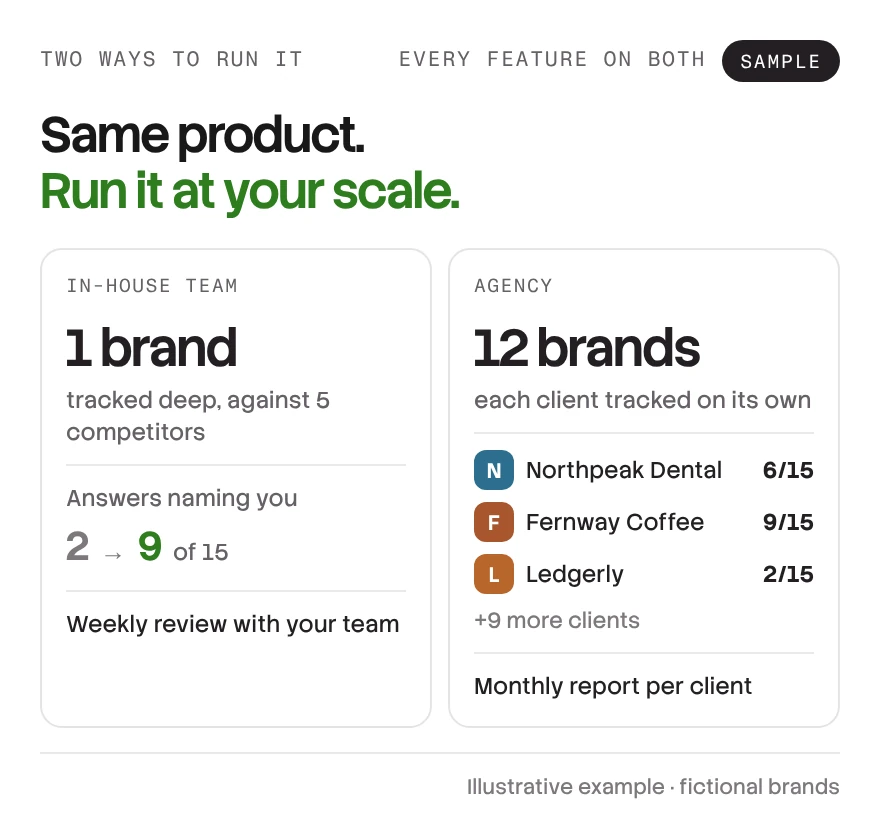
The same product run two ways: one brand tracked deep by an in-house team, and twelve client brands tracked separately by an agency
 Where the two diverge

Three things change. The product isn't one of them.

Every plan includes every feature. What differs between running this in-house and running it for clients is how you set it up and what you have to show at the end.

Scale

One brand deep, or many wide

In-house you go deep on one prompt set. An agency runs a dozen, each with its own competitors and its own source map — so they have to stay separate, not pooled.

Cadence

A monthly slide, or a weekly update

Internal reporting runs to the marketing cycle. Client reporting runs to the retainer, and needs to show movement often enough to justify it.

Proof

Convince a CMO, or a client who can leave

Both need before-and-after. The difference is that a client reads it without you in the room, so the number has to explain itself.

By team

Pick the one that sounds like your week

Both pages cover the same product. What differs is the setup each one recommends, the reporting it shows, and who the numbers have to convince.

In-house · One brand

AEO Teams

You own the brand, the backlog and the argument for budget. Go deep on one set of prompts and prove the work moved them.

✓
Prompts grouped by buying stage
✓
A next move per prompt, ranked
✓
Before-and-after proof for the board
Agency · Many brands

Agencies

You run the same play across a roster, and every client wants their own answer. Track each separately and report the gap you closed.

✓
 Each client tracked on its own prompts
✓
 Ranking advice from real citations
✓
Reporting a client can read unaided

AI visibility your team can act on and your client can read

Every tool in this category can hand you a dashboard. The question is whether anyone outside your team can read it.

Answer reporting tools

—
A score you still have to interpret
—
Brands pooled into one workspace
—
Screenshots pasted into a deck
—
No record of what caused the change

MentionBird

✓
A next move written for each prompt
✓
Every brand tracked on its own prompt set
✓
Before-and-after that explains itself
✓
The source that moved, named

Questions? We're glad you asked.

Is the product different for in-house teams and agencies?

No. Every plan includes every feature. The two pages differ in how you set the account up and what you report at the end — not in what the product can do.

How many brands can an agency track?

It depends on the plan: Starter covers one brand, Growth covers three, and Custom is sized to your roster. Each brand keeps its own prompts, competitors and source map rather than being pooled.

Can I give a client their own view?

Reporting is built to be read without you in the room — the gap, the source that moved, and the before-and-after on the prompts that matter to them. Talk to us about how you'd like it shared.

I want my industry, not my job title.

Browse by industry instead. Software, e-commerce and local services each face a different kind of gatekeeper, and those pages start from the source mix rather than the workflow.

Where should I start?

With prompt tracking, either way. Everything else needs a set of prompts to be about. Add the questions your buyers — or your client's buyers — ask before they pick a brand, then read what came back.

Start with one prompt. Yours or your client's.

First month $19 with code TRY19, then $79/mo. Cancel anytime.