ChatGPT and Gemini Replace 64% of Their Top Five Recommended Brands From One Answer to the Next
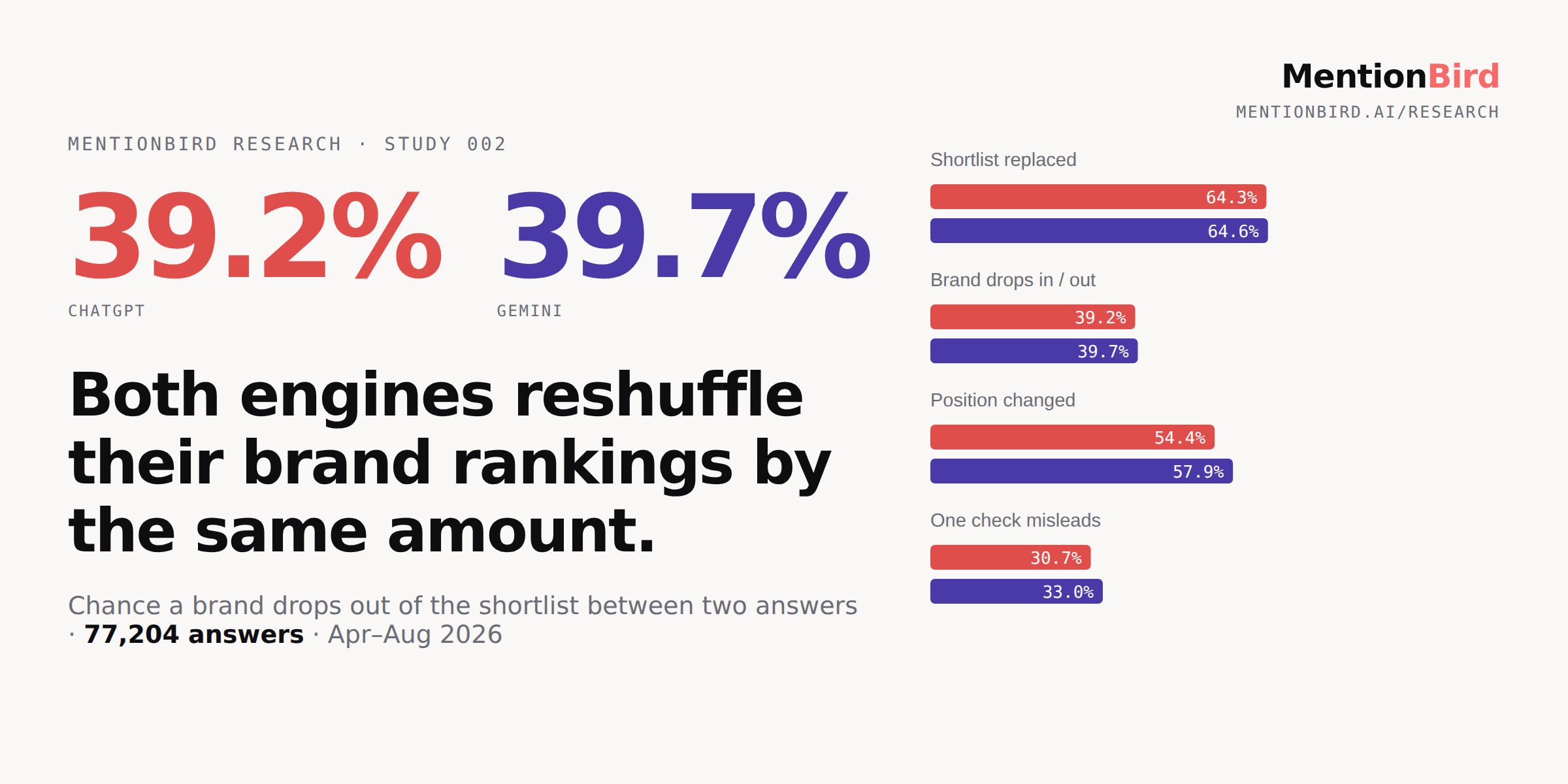
- Compared like for like on each answer’s top five brands, ChatGPT and Gemini are indistinguishable: a brand’s presence flips between consecutive runs on 39.2% of ChatGPT transitions and 39.7% of Gemini’s.
- Roughly two-thirds of the top five is replaced from one answer to the next — 64.3% on ChatGPT, 64.6% on Gemini.
- A single check disagrees with the four-month verdict 30.7% of the time on ChatGPT and 33.0% on Gemini, so one screenshot carries almost no information.
- The engine gap other studies report is a list-length artifact: Gemini ranks 8.13 brands per answer against ChatGPT’s 5.23, and the whole-list difference of 2.49 against 1.54 positions falls to 0.99 against 0.90 in the top five.
- Web search does not cause the churn and slightly reduces it: the flip rate falls from 43.7% on questions ChatGPT never researched to 36.7% on questions it always researched.
- Even brands present in 90%+ of a question’s answers still changed top-five position on 37.8% (ChatGPT) and 39.2% (Gemini) of consecutive appearances.
- The one real engine difference is surface area, not stability — a Gemini placement is easier to win and shared with more competitors; a ChatGPT placement is scarcer.
Ask ChatGPT or Gemini a question and it writes you a paragraph instead of a page of blue links. That is an AI answer engine. Ask it a buying question — “best tool for X” — and it will usually name some brands, often as a ranked list. Getting into that list is the job people now call AI visibility, or GEO.
Almost everyone treats that list the way they treat a Google ranking: as a fact you can look up. Check it, screenshot it, report it.
This study asks whether that assumption survives contact with the data. We put the same buying questions to both engines every day for four months. Then we watched what happened to the brands they named. Three terms carry the post:
- A run is one answer, from one engine, to one question, on one day. Ask again tomorrow and you get another run.
- The top five is the first five brands an answer ranks. We compare the engines on this. Gemini ranks more brands per answer than ChatGPT, so a whole-list comparison would not be fair.
- A contender is a brand that held a top-five spot often enough to count as a real competitor. Anything rarer is a one-off mention.
What we set out to answer
Almost every practice in AI visibility assumes an answer is a fact you can read off. Someone opens ChatGPT, sees their brand third in a list, screenshots it, and treats that as their position. Someone publishes a page, checks once, sees a mention, and books the win. An agency reports one check per prompt per month to a client.
We had already measured how often each engine goes and reads the web before answering, and the two could hardly be more different. ChatGPT returned no web citations on 29.7% of answers. Gemini, on 0.6%. So we asked the question that comes first. If you ask the same buying question twice, do you get the same answer at all?
How we measured it
One observation is one answer, from one engine, to one question, on one day. We used the same commercial-intent prompt panel as Edition 1. We narrowed it to 585 questions with at least 20 answers from both engines inside the window. So every comparison runs on identical questions over identical days.
That gives 38,374 ChatGPT answers and 38,830 Gemini answers between 27 April and 20 August 2026. That is roughly one run per question per engine per day.
We count the brands an answer actually ranks. Passing mentions in prose are left out, and that is 14% of all mentions. The two engines rank different numbers of brands per answer. So our headline figures compare each answer’s top five. It is the same unit on both engines, and where buyer attention sits.
A brand counts as a contender on a question if it held a top-five spot in at least a quarter of that question’s answers. Below that it is a one-off mention, not a competitor. On 80 of the 585 questions no brand cleared that bar, so the search-band analysis in Table 4 runs on the remaining 505.
The MentionBird AI Visibility panel is a standing set of buying questions that we put to eight AI answer engines on a fixed schedule. They are the questions real buyers ask in the categories our customers sell into, weighted toward ecommerce, SaaS and agency services. We do not publish the panel’s size, the prompts themselves, or the identity of the brands in it.
These are API models, not the consumer apps. The engines here are gpt-5-mini and gemini-2.5-flash, called through their APIs. ChatGPT.com and gemini.google.com are different products with different models and different retrieval rules. Read these figures as evidence about how the engines behave when developers call them.
Two-thirds of the shortlist is different next time
Picture an AI answer as a shortlist of brands. Ask the same question a day later and you get a new shortlist — not a slightly reordered one. About two-thirds of the names are different. Of the brands that survive, most have moved position.
Two measures, and they agree. 64.3% of ChatGPT’s top five is replaced between runs and 64.6% of Gemini’s. Narrow it to whether an individual brand drops in or out, and it is 39.2% on ChatGPT and 39.7% on Gemini. Every measure below lands within about three points, across two engines that source their answers completely differently.
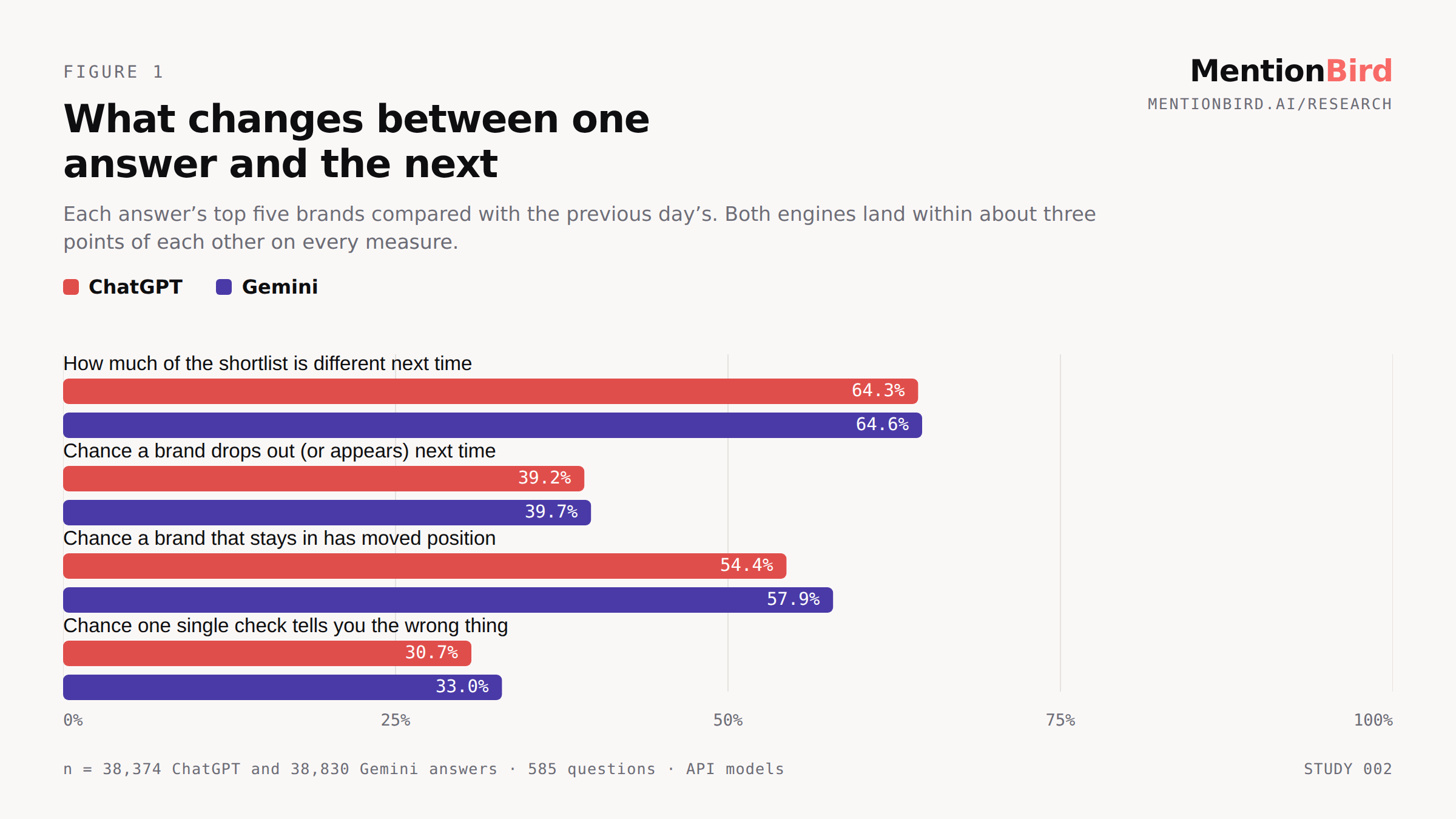
Table 1 — Top-five stability between consecutive runs. 585 matched questions, 27 April – 20 August 2026.
| Measure | ChatGPT | Gemini |
|---|---|---|
| Share of top five replaced | 64.3% | 64.6% |
| Brand drops in or out | 39.2% | 39.7% |
| Position changed, given it stayed in | 54.4% | 57.9% |
| Single check disagrees with the four-month verdict | 30.7% | 33.0% |
| Contender brand–question pairs | 2,413 | 3,279 |
The engine gap everyone reports is list length
Run the same analysis on each answer’s whole ranked list rather than its top five, and a large difference appears. It is the difference we would have published had we stopped there. On the whole list Gemini moves brands 2.49 positions per reappearance against ChatGPT’s 1.54. It is also nearly three times as likely to swing a brand across ten or more positions.
The mechanism is not subtle once stated. Gemini ranks 8.13 brands per answer; ChatGPT ranks 5.23. A longer list has more positions to move between, and a longer tail of marginal names to churn through. So any whole-list volatility metric scores it higher whether or not it is less stable. Normalize to five positions and the gap falls to 0.99 against 0.90 — inside the noise.
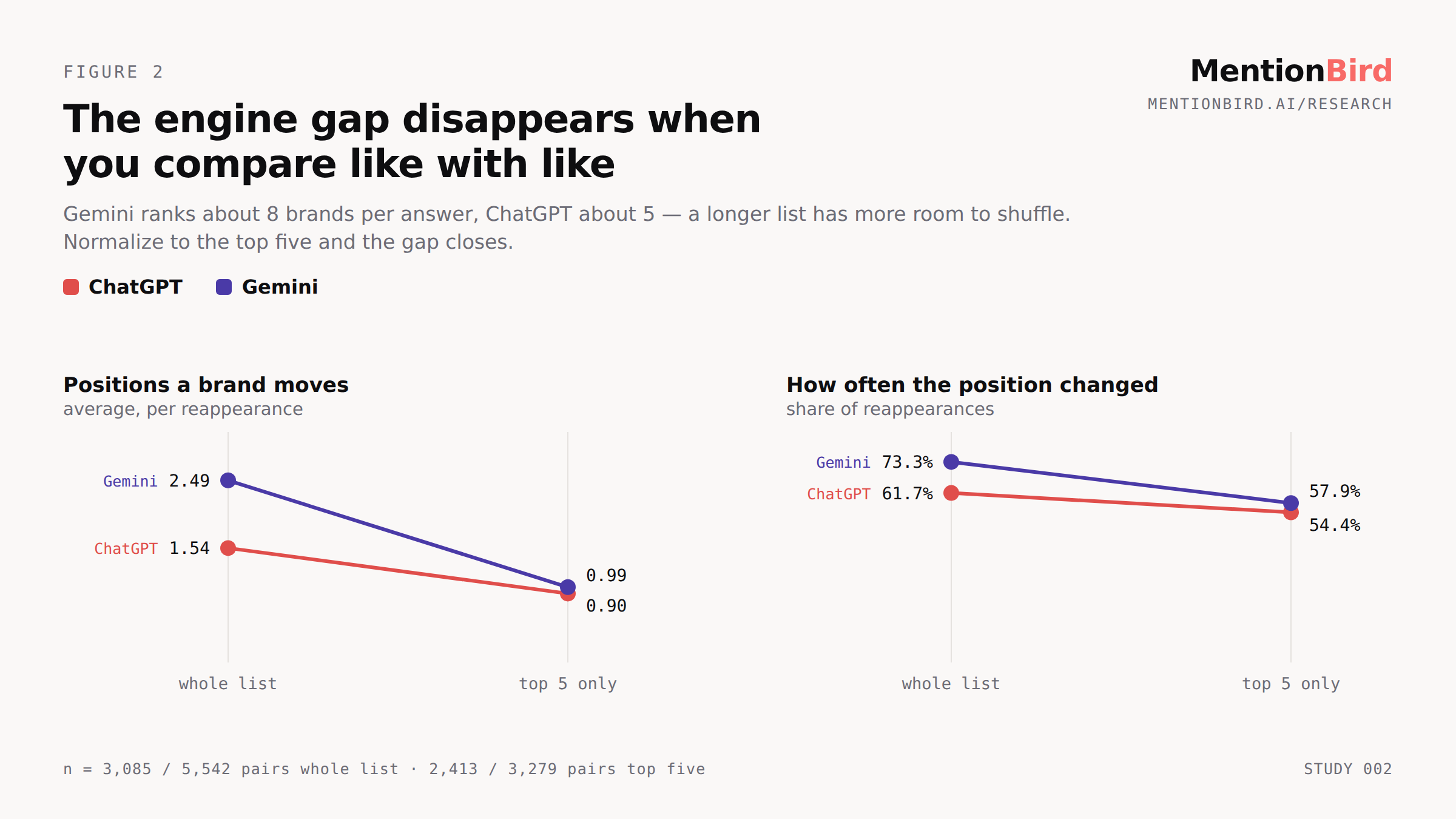
Table 2 — The same metrics on the whole ranked list and on the top five positions. n = 38,374 ChatGPT and 38,830 Gemini answers across 585 questions.
| Measure | ChatGPT whole list | Gemini whole list | ChatGPT top 5 | Gemini top 5 |
|---|---|---|---|---|
| Brands ranked per answer | 5.23 | 8.13 | 4.24 | 5.15 |
| Positions moved (mean) | 1.54 | 2.49 | 0.90 | 0.99 |
| Position changed | 61.7% | 73.3% | 54.4% | 57.9% |
| Contender brand–question pairs | 3,085 | 5,542 | 2,413 | 3,279 |
We are publishing this because it invalidates a comparison we were about to make ourselves. The same artifact sits inside any engine-stability comparison that does not normalize for list length. A volatility number without a stated list-length normalization is not evidence about the engine.
Salil Panikkaveetil, founder, MentionBird “Gemini names more brands in each answer than ChatGPT does. More brands means more room for them to move around between answers, so it can look less stable when it is not. If you are comparing two engines on how much their answers move, check that the comparison accounts for how many brands each one lists. Otherwise you are measuring list length.”
One look at one answer is wrong about a third of the time
For a contender brand we know its true long-run rate. It is the share of 60-plus runs in which the brand held a top-five position. So we can ask how often a single run, picked at random, would have misled you. Present when the brand is usually absent, or absent when it is usually present.
A single check gets it wrong 30.7% of the time on ChatGPT and 33.0% on Gemini. On a contested question, looking once tells you about as much as one coin flip tells you about a coin.
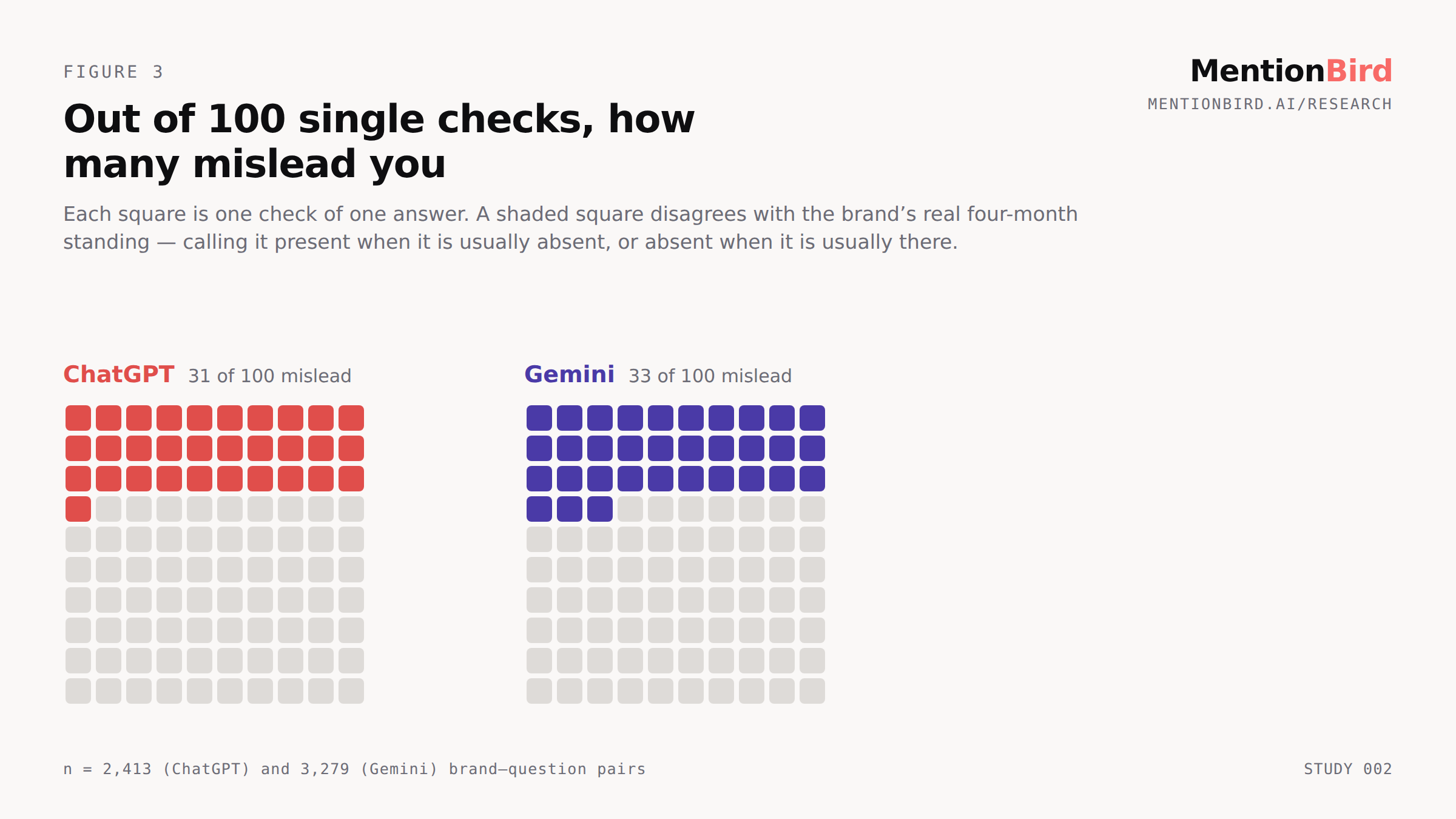
Table 3 — How much one check can mislead you, and how far a brand that is usually there still moves. n = 2,413 (ChatGPT) and 3,279 (Gemini) contender brand–question pairs, 27 April – 20 August 2026.
| Measure | ChatGPT | Gemini |
|---|---|---|
| Single check disagrees with the four-month verdict | 30.7% | 33.0% |
| First-named brand changed between consecutive runs | 58.4% | 64.3% |
| Incumbent’s rank moved, given it held a top-five spot | 37.8% | 39.2% |
| Contender brand–question pairs | 2,413 | 3,279 |
| Incumbent pairs (top five in 90% or more of answers) | 236 | 176 |
| First-named-brand transitions | 23,580 | 27,698 |
So the honest unit for AI visibility is not “am I mentioned”. It is “in what share of runs am I mentioned”. A brand whose presence flips on four transitions in ten cannot be tracked with one check a month. And a screenshot — yours or a competitor’s — carries almost no information.
Nor is this only the marginal brands thrashing at the edge of the list. Take the incumbents: brands holding a top-five position in 90% or more of a question’s answers. Their rank still moves on 37.8% of consecutive appearances on ChatGPT and 39.2% on Gemini. Being reliably mentioned and being reliably prominent are two different achievements, and only the first is attainable.
Salil Panikkaveetil, founder, MentionBird “The answers change a lot. We had noticed that no two runs come back quite the same, and we wanted to see how big the difference actually was. It is big enough that one look at one answer tells you very little. If you want to know whether an engine names your brand, the useful number is what share of runs name it, over a stated period. One answer on one day does not tell you that.”
Web search does not cause the churn — it slightly reduces it
The intuitive explanation is that the web moved. Pages get published, rankings shift, the engine retrieves different sources and names different brands.
Edition 1 gives us a clean test. It established that ChatGPT’s decision to search is a property of the question, not of chance. Across four months it never searched 8.4% of questions and always searched 26.8%. If retrieval drove the churn, the questions it answers from memory should be the stable ones.
They are the least stable ones.

Table 4 — ChatGPT’s top-five flip rate by how often it searched the question. n = 2,413 contender brand–question pairs across the 505 of 585 questions where at least one brand cleared the contender threshold. The ‘never’ band sits at our 100-pair reporting minimum; read it together with ‘rarely’, which gives 205 pairs at 43.6%.
| ChatGPT searched | Questions | Contender pairs | Presence flips between runs | Single check wrong |
|---|---|---|---|---|
| Never (0%) | 23 | 100 | 43.7% | 35.9% |
| Rarely (1–24%) | 42 | 205 | 43.6% | 33.4% |
| Sometimes (25–49%) | 36 | 172 | 40.7% | 31.2% |
| Often (50–74%) | 53 | 213 | 41.0% | 31.6% |
| Usually (75–99%) | 195 | 926 | 39.1% | 31.2% |
| Always (100%) | 156 | 797 | 36.7% | 28.4% |
The gradient runs the wrong way for the web-moved hypothesis, and it holds from the first band to the last — only the step from ‘sometimes’ to ‘often’ nudges back, by 0.3 points. The answers ChatGPT generates from its parameters alone are its least repeatable ones. Retrieving documents appears to anchor the answer, cutting the flip rate by about seven points.
The effect is modest. The direction is the finding. Whatever reshuffles the brand lineup happens inside the generation, not out on the web. So content cannot stabilize it. What content can move is the rate: how often you are in the answer at all. That is the number worth measuring and the number worth working on.
The one difference worth acting on
None of this makes the two engines interchangeable. They differ — just not in stability. A Gemini answer ranks 8.13 brands; a ChatGPT answer ranks 5.23. Gemini’s answer surface is about 55% larger, and that cuts both ways. Getting into a Gemini answer is easier. Each placement is also worth less, because it is shared with more competitors. A ChatGPT placement is scarcer and carries more of the answer. That is a difference in the size of the prize, not in how firmly you can hold it.
Bonus: Also read our blog on how to track brand visibility in ChatGPT, Claude, etc.
What to do about it
If an answer is a sample rather than a standing position, most of the current practice around it measures the wrong thing. Four changes follow.
Measure the share of runs you appear in, not whether you appear.
A single check disagrees with the four-month verdict 30.7% of the time on ChatGPT and 33.0% on Gemini. “Am I mentioned” is not a question a single answer can settle. “In what share of runs am I mentioned, over a stated period” is.
Run enough checks that your signal is bigger than the churn.
A brand whose presence flips on four transitions in ten cannot be tracked with one check a month. Whatever change you are hoping to see has to be larger than that, or you will read noise as movement in both directions. In practice, that means running the same prompts every day, which is what daily ChatGPT brand tracking and Gemini brand tracking give you.
Note: MentionBird's AI prompt tracking runs every tracked prompt daily on each platform you choose and reports your mention rate across all those runs, not one look.
Compare periods, not answers.
Two answers a day apart tell you almost nothing. Two months of runs tell you something. That applies to your own tracking and to any competitor claim built on a screenshot — including screenshots you take yourself.
Use content to move the rate, not the repeatability.
The churn is generated inside the answer, not retrieved from the web: the questions ChatGPT never researches are its least stable ones. So no amount of publishing will make an individual answer repeat. What publishing can move is how often you are in the answer at all, which is the number worth working on.
Distrust any engine-stability comparison that does not normalize for list length.
On the whole ranked list Gemini looks markedly less stable than ChatGPT. It ranks 8.13 brands per answer against 5.23, and a longer list simply has more positions to move between. Normalized to five positions the gap is 0.99 against 0.90 — inside the noise. A volatility number published without a stated list-length normalization is not evidence about the engine.
Check your brand across repeated ChatGPT answers
We run five buyer questions three times each, so you see how consistently ChatGPT names you, not just whether it did once. Free, no signup.
Get your free AI Visibility ReportWhat this does not prove
We cannot separate sampling noise from real-world change. Our runs are roughly daily, so two consecutive runs are a day apart. Some of the movement we measure is the web changing overnight rather than the model sampling differently. Figure 4 is our best evidence that sampling dominates: questions with no retrieval at all churn more, not less. But that is an argument, not a decomposition. A same-minute repeated-call study would settle it, and we have not run one.
We have not established why the engines land on the same number. That two very different retrieval designs both produce a ~39% flip rate is the finding. The mechanism behind the coincidence is untested here.
The top-five normalization is a choice, not a law. It is the right unit for comparing engines that rank different numbers of brands. A reader who cares about position eight should use the whole-list figures in Table 2 instead.
Rank is a position in a list, not a measure of endorsement, and brand extraction is imperfect. The engines name a long tail of entities, and our matching of near-identical names is not perfect. That tail sits below the top five and below the contender threshold, which is why both are in the design. It does inflate the whole-list churn figures, so read those as upper bounds.
Nothing here says an engine is malfunctioning. Sampling variety is a design choice, and a fully deterministic recommender would have its own pathologies. This study measures stability, not quality.
Limitations
This is a large but imperfect sample of the global market. Our question mix leans toward ecommerce, SaaS and agency services, and toward buying questions of the “best tool for X” kind. Categories dominated by two or three brands — regulated industries, single-vendor niches — will churn less than this. We would not extrapolate to news, health or law.
The panel is not a probability sample of the questions people ask AI engines, so we report no margin of error; one would be statistically meaningless here. We report percentages only for groups of 100 or more, and we flag the one band that sits at the threshold. Model versions were held constant across the window as far as we can observe. But we cannot detect a silent server-side update by either vendor within a version.
Frequently Asked Questions (FAQs)
- Which AI engine is more consistent, ChatGPT or Gemini?
Neither. Compared like for like on their top five ranked brands, presence flips between consecutive runs 39.2% of the time on ChatGPT and 39.7% on Gemini. Published comparisons that show a large gap are usually measuring list length rather than stability.
- If I check ChatGPT once and my brand is not there, is that bad news?
It is one data point, with roughly a one-in-three chance of disagreeing with the long-run answer. On a contested question a single absence is not evidence of a problem, and a single mention is not evidence of a win.
- Why does the answer change if I did not change anything?
The engine picks one ordering out of many plausible ones each time it answers. Our data shows this is not driven by the web: the questions ChatGPT never researches are its least stable ones.
- Does that mean publishing content is pointless?
No — it means content moves a different metric than people expect. Publishing cannot make an individual answer repeatable, because the variability is generated rather than retrieved. What it can move is the share of answers you appear in. Which content, and for which buyer question, is settled by what ChatGPT cites when it gives an answer.
- How many times should I run a prompt?
Enough that the change you are looking at is larger than the churn measured here. A brand whose presence flips on four transitions in ten cannot be tracked with one check a month. Compare periods of many runs rather than individual answers.
- Is being number one in ChatGPT worth anything?
It is worth knowing how often you are number one. The first-named brand changed on 58.4% of ChatGPT transitions and 64.3% of Gemini’s. A single top placement describes roughly four answers in ten, not a standing position.
- Which engine should I prioritize?
Not a stability question. Gemini ranks about 8 brands per answer against ChatGPT’s 5. So Gemini placements are easier to win and shared with more competitors, and ChatGPT placements are scarcer and carry more of the answer.
Data availability
Every figure behind the four charts is published in full in the tables above — those aggregate tables are the dataset. They may be republished with attribution and a link (CC BY).
We do not release question-level or per-brand records. The prompts in the panel are our customers’ commercial intelligence, and publishing them would expose which questions specific brands are competing on. Requests for additional aggregate cuts of this data — by category, by country, or by engine — are welcome. We will publish them as anonymized aggregates.
Separately from this study, our ChatGPT rankings pages show which brands ChatGPT currently names across ten software categories. They are a live tracker that moves as the engine moves, not findings from this study.
How to cite this study
MentionBird (2026), “ChatGPT and Gemini Replace 64% of Their Top Five Recommended Brands From One Answer to the Next”, MentionBird Research, Edition 2, retrieved from https://www.mentionbird.ai/research/chatgpt-vs-gemini-answer-stability on [date].
License: CC BY. Republication is permitted with attribution and a link.
Note: This is Edition 2 of MentionBird Research. Every edition is collected on our research page.
See how often AI actually names your brand — not whether it did once
First month $19 with code TRY19, then $79/mo. Cancel anytime.