Nearly 1 in 3 ChatGPT answers never touches the web

- Across 40,617 matched answer pairs between 27 April and 20 August 2026, ChatGPT returned no web citations on 29.7% of answers. Gemini returned none on 0.6%.
- When both engines answered the same prompt on the same day, Gemini cited an average of 11.58 sources per answer against ChatGPT’s 4.39 — 2.6 times as many, drawn from 10.12 distinct domains against 3.96.
- ChatGPT’s citation count never exceeded 15 in 40,617 answers. Gemini exceeded 25 sources on 2.6% of answers, reaching 58 at its maximum.
- The weekly gap moved between 25 and 36 points across 17 consecutive weeks, and it never closed. ChatGPT’s weekly grounding rate stayed within 63.5–75.1%; Gemini’s within 99.1–99.9%.
- ChatGPT is choosing whether to search, not how hard: when it does search it averages 6.25 sources regardless of question.
- The choice is a property of the question, not chance. Of 585 prompts run at least 20 times each, ChatGPT never searched on 8.4% of them and always searched on 26.8%.
- 23.4% of prompts are answered from ChatGPT’s training data almost every time. For those questions, a brand’s presence is set by what the model already learned, not by anything currently published on the web.
Ask ChatGPT or Gemini a question and it writes you a paragraph instead of a page of blue links. That is an AI answer engine. Sometimes it reads live web pages before answering. Sometimes it answers from memory — from what it absorbed when it was trained. When it does read pages, it usually lists them. Those listed pages are called citations.
Which of those two things happens matters more than almost anything else in AI search. If an engine read the web to answer a question, publishing a better page can change the answer. If it answered from memory, nothing you publish this month will touch it. You are arguing with a model’s training, not with a search index.
This study measures how often each engine bothers to look. Two terms carry the whole post:
- A grounded answer cites at least one live web page. The engine went and looked.
- An ungrounded answer cites nothing. The engine answered from memory.
What we set out to answer
“AI search” gets discussed as though it were one behavior. It is not. Some engines fetch documents and summarize them. Some answer from what they already know. Most do both, depending on the question.
That distinction decides something practical. Either publishing a new page can change what an AI says about your brand this week, or it cannot.
We wanted one number: how often does each engine actually go and look?
How we measured it
A grounded answer is one where the engine returned at least one citation to a live web source. An ungrounded answer returned none. It was written from the model’s parameters — from training — without fetching anything. Grounding is our stand-in for “used web search”. Its limits are set out under What this does not prove.
The design is matched. Every prompt went to both engines on the same day. We keep only the prompt-days where both engines produced an answer we could parse.
That removes the usual objection to engine comparisons: that one engine got the easier or more topical questions. Both engines saw the same 950 matched prompts on the same days — the subset that cleared that filter, not the size of the panel.
The MentionBird AI Visibility panel is a standing set of buying questions that we put to eight AI answer engines on a fixed schedule. They are the questions real buyers ask in the categories our customers sell into. We do not publish the panel’s size, the prompts themselves, or the identity of the brands in it.
We measured API models, not the consumer apps. The engines here are gpt-5-mini and gemini-2.5-flash, called through their APIs. ChatGPT.com and gemini.google.com are different products, with different models and different retrieval rules.
ChatGPT and Gemini disagree about whether to search at all
The single largest difference between the two engines is not the volume of sources. It is the existence of a decision.
Gemini behaves like a retrieval system with a language model attached. It searched on 99.4% of answers. The 0.6% that returned nothing look like failures, not choices.
ChatGPT behaves like a language model with retrieval available. On 29.7% of answers it returned nothing at all — a complete, confident, sourceless response. Across 40,617 matched pairs, that is roughly 12,000 answers in which ChatGPT told someone about a product category without reading a single page.
The shapes tell the story better than the averages do. Gemini’s is one broad hump around 9 or 10 sources, with a long tail to the right. ChatGPT’s is a spike at zero, then a narrow hump at 5 to 7, then nothing at all. It never once cited more than 15 sources.
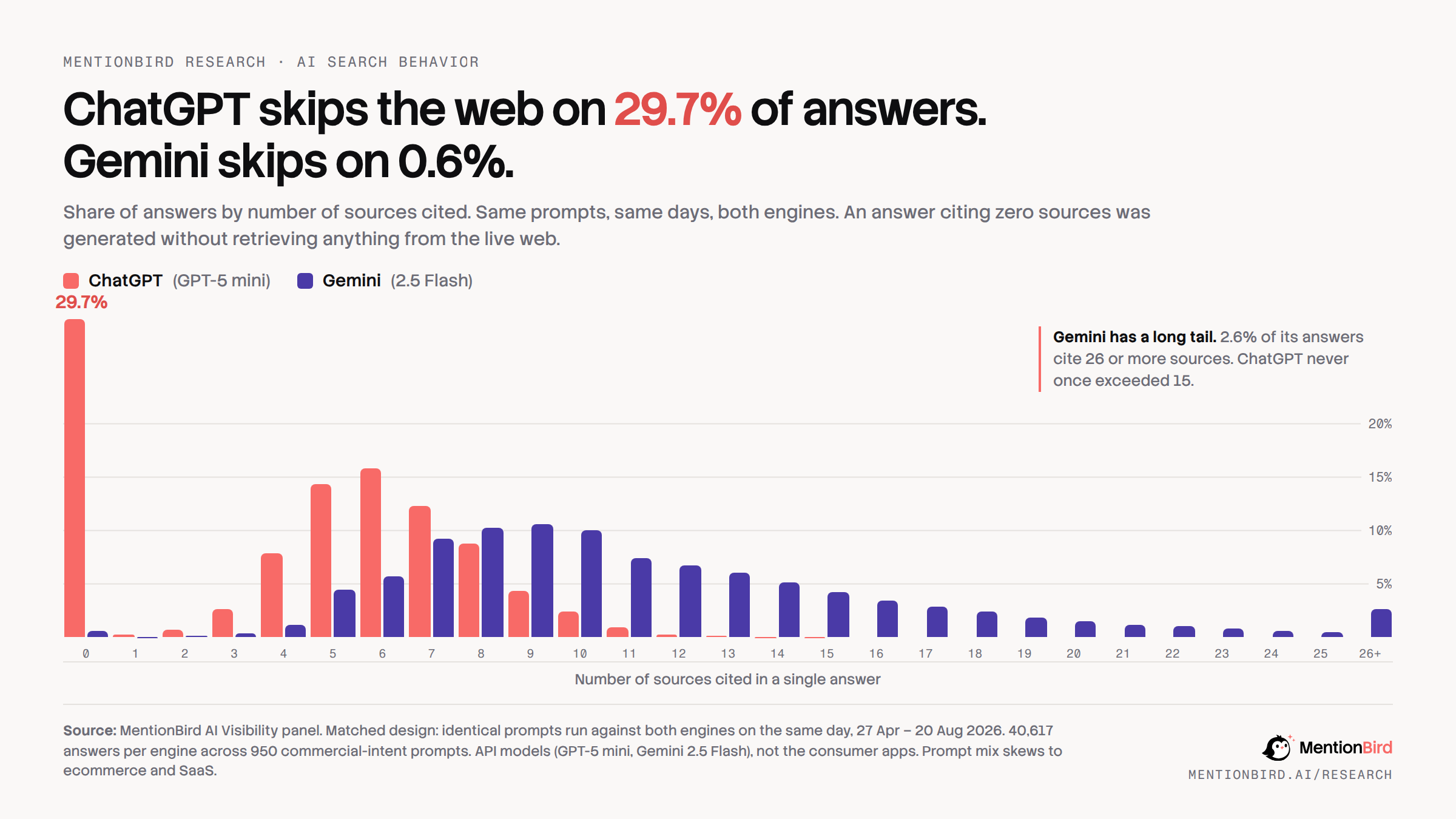
Table 1 — Distribution of sources cited per answer, with summary statistics. n = 40,617 matched answers per engine.
| Sources cited | ChatGPT | Gemini |
|---|---|---|
| 0 | 29.74% | 0.58% |
| 1–3 | 3.48% | 0.42% |
| 4–6 | 37.86% | 11.27% |
| 7–10 | 27.59% | 39.78% |
| 11–15 | 1.33% | 29.42% |
| 16–25 | 0.00% | 15.93% |
| 26+ | 0.00% | 2.57% |
| Median | 5 | 10 |
| 90th percentile | 8 | 18 |
| Mean | 4.39 | 11.58 |
Salil Panikkaveetil, founder, MentionBird: “We wanted to see how much each engine searches before it answers. What we found is that the more useful question is whether it searches at all. Gemini looks something up almost every time. ChatGPT either looks things up or it doesn’t, and when it does, the number of sources stays in a narrow band. So the thing to plan around is not how hard it searches. It is whether your question is one it searches for.”
ChatGPT is choosing whether to search, not how hard
The spike at zero drags the average down and hides the better result. Look only at answers where ChatGPT did search, and it cites 6.25 sources on average. That figure barely moves by question type. Gemini, on the same basis, cites 11.65. Both of those count grounded answers only; the means in Table 1, 4.39 and 11.58, include the answers that cited nothing.
So ChatGPT is not turning its research effort up and down. It makes one call at the start — do I need to look this up? — and, having said yes, does a consistent and fairly shallow amount of work. Almost all the variation in ChatGPT’s behavior sits in that first decision.
That matters, because a yes-or-no decision is predictable in a way that a dial is not. If the choice were random, every prompt would show a search rate near 70%. It does not.
The engine’s choice is a property of the question
We took the 585 prompts run at least 20 times each and measured how often ChatGPT searched for each one. If the 30% skip rate were noise, they would all cluster near 70%. Instead they pile up at both ends — lots of prompts it almost never searches, lots it almost always searches, and few in the middle.

Table 2 — Prompts grouped by how often ChatGPT cited at least one source. n = 585 prompts with 20 or more ChatGPT runs each.
| ChatGPT searched | Share of prompts |
|---|---|
| Never (0%) | 8.4% |
| Rarely (1–24%) | 15.0% |
| Sometimes (25–49%) | 6.8% |
| Often (50–74%) | 9.4% |
| Usually (75–99%) | 33.5% |
| Always (100%) | 26.8% |
About a quarter of prompts are answered from memory nearly every time. About a quarter always trigger a search. For the 8.4% at the far end, ChatGPT did not search once in the whole period — dozens of answers in a row, all from training data.
This is the finding with the sharpest consequence. For a question in that first band, nothing you publish this month will change what ChatGPT says. The answer is a readout of what the model absorbed during training. The brands it names are the brands that were already well established in the text it learned from.
Salil Panikkaveetil, founder, MentionBird: “ChatGPT answers a lot of questions from memory, without looking anything up. That matters for which prompts you choose to track. If you pick a very generic prompt, one where there is already a lot written about the topic, the answer is mostly coming from what the model already learned. Publishing more pages is unlikely to move it. The prompts worth tracking are the ones the engine still goes and reads for.”
The gap is structural, not a passing configuration
One measurement of engine behavior is close to worthless. Retrieval settings change, models get updated, and vendors ship without telling anyone. So the more useful result is the stability.
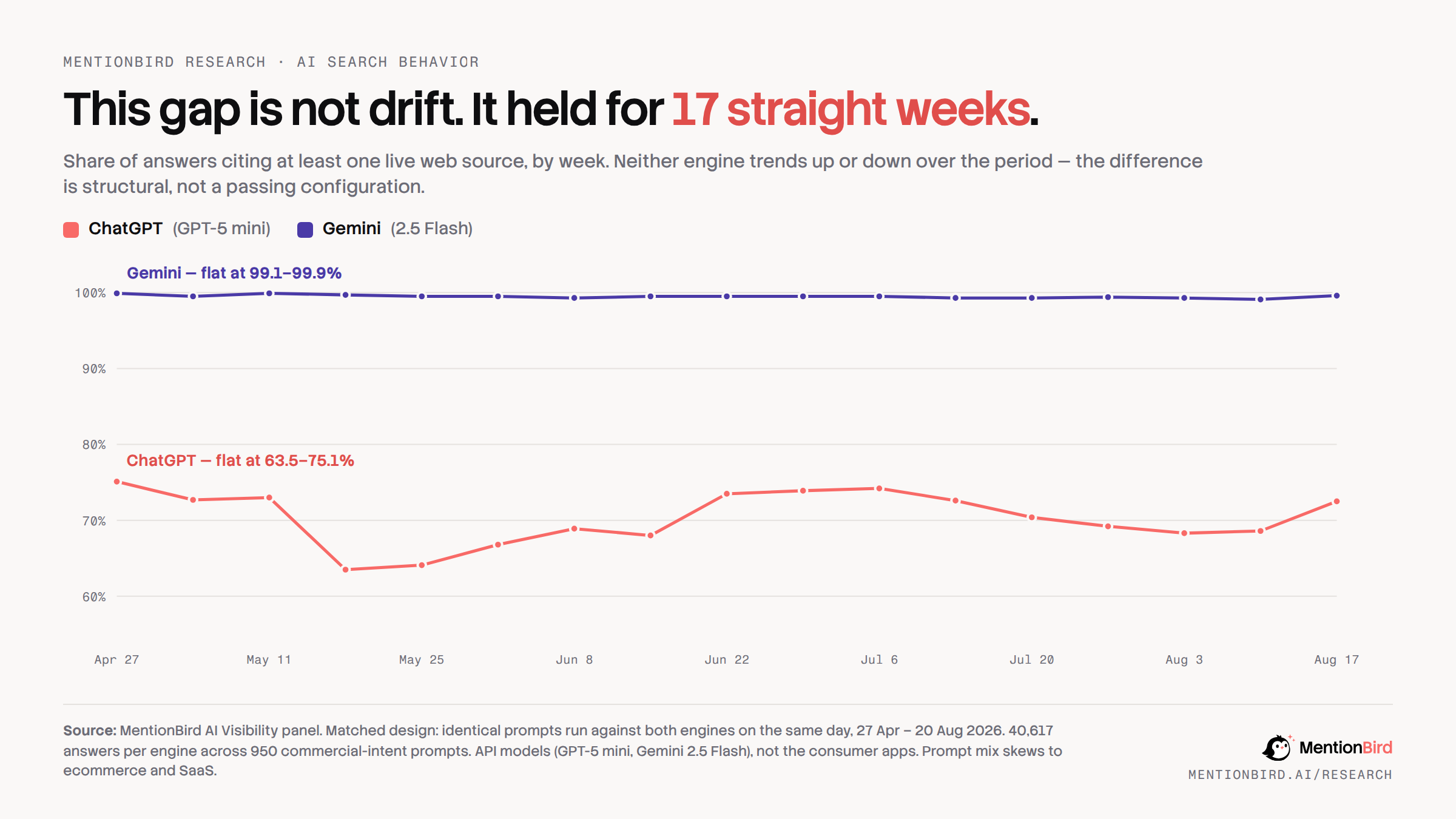
Table 3 — Weekly share of answers citing at least one source, 27 April to 20 August 2026. 17 consecutive weeks, the last of them running 17–20 August; n = 40,617 matched answers per engine across the window.
| Week starting | ChatGPT grounded | Gemini grounded |
|---|---|---|
| 27 Apr 2026 | 75.1% | 99.9% |
| 4 May 2026 | 72.7% | 99.5% |
| 11 May 2026 | 73.0% | 99.9% |
| 18 May 2026 | 63.5% | 99.7% |
| 25 May 2026 | 64.1% | 99.5% |
| 1 Jun 2026 | 66.8% | 99.5% |
| 8 Jun 2026 | 68.9% | 99.3% |
| 15 Jun 2026 | 68.0% | 99.5% |
| 22 Jun 2026 | 73.5% | 99.5% |
| 29 Jun 2026 | 73.9% | 99.5% |
| 6 Jul 2026 | 74.2% | 99.5% |
| 13 Jul 2026 | 72.6% | 99.3% |
| 20 Jul 2026 | 70.4% | 99.3% |
| 27 Jul 2026 | 69.2% | 99.4% |
| 3 Aug 2026 | 68.3% | 99.3% |
| 10 Aug 2026 | 68.6% | 99.1% |
| 17 Aug 2026 | 72.5% | 99.6% |
Across 17 consecutive weeks ChatGPT’s grounding rate stayed inside a 63.5–75.1% band. Gemini’s stayed inside 99.1–99.9%. Neither series shows a trend. The weekly average citation count was just as flat: ChatGPT between 3.76 and 4.81, Gemini between 10.67 and 12.25.
Across those four months Gemini stayed above 99% every week, and ChatGPT never once got above 76%. The weekly gap moved between 25 and 36 points, and it never closed. Whatever produces that is a design decision, not a setting that happens to be live this week.
What to do about it
Everything below depends on knowing which of the two buckets a prompt is in, and you cannot tell by reading the prompt.
Split your tracked prompts by whether ChatGPT searches for them.
Of the 585 prompts run twenty or more times, 26.8% always triggered a search and 23.4% were answered from training almost every time. Those two sets need different plans and different timelines. Sorting them is the first job. Prompt level ChatGPT brand tracking makes that sorting possible, because it keeps every answer along with the sources it cited, or the lack of them.
On the searched prompts, publishing works. That is where a content calendar belongs.
This is the fast lever. A better page can change the answer within a crawl cycle. If you want movement this quarter, this is the only set where you will see it.
On the memory-answered prompts, more pages will not move them. That is not a loss.
For the 8.4% ChatGPT never searched once in four months, the answer is a readout of training data. The lever is still there and it is slower: durable, widely repeated coverage that reaches the next training run. These are often the most generic and most valuable questions in a category, so the answer is a different tactic, not abandonment.
Do not measure content ROI on a memory-answered prompt.
This is the trap. Publish a page, track a prompt in the 23.4% band, see nothing move, and conclude that content does not work — when what you actually did was test the wrong prompt. Pick your proof-of-concept prompts from the searched set.
Note: Picking those prompts is easier with a history to look at. MentionBird's AI prompt tracking runs your prompts daily and keeps every answer, so you can see which set each one falls into before you test content on it.
ChatGPT’s citation list is short, so its slots are scarce.
When it does search it cites 6.25 sources, and it never exceeded 15 in 40,617 answers. Gemini cites 11.65 and reached 58. Being the eighth-best page on a topic can reach Gemini and miss ChatGPT entirely. On ChatGPT-priority questions, aim for the top handful rather than for presence. It also explains why a page can show up in your Gemini brand tracking well before it appears in ChatGPT, so check both engines before you judge a page.
One caveat on the bucket sizes. They come from our panel’s prompt mix, which leans to ecommerce, SaaS and agency services and to “best tool for X” questions. Your own split will differ. The instruction is to measure your own, not to assume thirty percent.
See what ChatGPT says about your brand
Run five buyer questions in your category and see whether ChatGPT names you, who it recommends instead, and the sources it cites. Free, no signup.
Get your free AI Visibility ReportWhat this does not prove
Grounding is a proxy, not a direct observation of tool use. We record whether an answer returned citations. An engine that retrieved a page and then declined to cite it would be counted as ungrounded here. We think that is rare in these APIs, but we cannot rule it out. The true ChatGPT search rate may be a little higher than 70.3%.
These are API models, not the consumer apps. gpt-5-mini and gemini-2.5-flash are not ChatGPT.com and gemini.google.com. The consumer products use different models, different retrieval rules and a different interface. Read these figures as evidence about how the engines behave when developers call them. That is how a growing share of AI answers reaches people, but it is not the same thing as the consumer app.
Nothing here says one engine is better. A model that answers a stable factual question from memory is not malfunctioning; it is being efficient. This study measures behavior, not quality.
We have not established why ChatGPT skips particular questions. The split at both ends shows the decision is systematic. It does not show what drives it. Query type, how time-sensitive a question looks, and the model’s own confidence are all plausible, and all untested here.
What these differences mean downstream is a separate question. We asked separately whether the two engines churn their brand recommendations at different rates, and found they do not. We also asked whether sourcing an answer differently means reading a different web, and found it does.
Limitations
This is a large but imperfect sample. Our prompt mix leans toward ecommerce, SaaS and agency services, and toward buying questions of the “best tool for X” kind. Results in news, health, law or consumer research may differ a great deal. We would not extrapolate to them.
The panel is not a probability sample of the questions people ask AI engines, so we report no margin of error; one would be statistically meaningless here. We report percentages only for groups of 100 or more, and counts below that.
Model versions were held constant across the window, but we cannot detect a silent server-side update by either vendor within a version.
Frequently Asked Questions (FAQs)
- Does ChatGPT always search the web?
No. In this study ChatGPT answered 29.7% of commercial-intent prompts without retrieving any web source, and for 8.4% of prompts it never searched once across four months.
- How many sources does Gemini cite?
Gemini cited a median of 10 sources per answer and a mean of 11.58, drawing on 10.12 distinct domains. Its most heavily-sourced answer cited 58.
- Which AI engine searches the web more, ChatGPT or Gemini?
Gemini, by a wide margin. It searched on 99.4% of answers against ChatGPT’s 70.3%. On the answers where both engines searched, Gemini cited 11.65 sources against ChatGPT’s 6.25 — 1.9 times as many. Counting every answer, including the ones ChatGPT left unsourced, it cited 2.6 times as many.
- If ChatGPT does not search, where does its answer come from?
From the model’s parameters — what it learned during training. This is why ungrounded answers tend to favor brands that were already widely written about before the training cut-off.
- Can I make ChatGPT cite my page?
Only for questions where it searches. For the quarter or so of prompts it answers from memory, publishing new content has no immediate effect. Presence in those answers is built the slow way — through durable, widely repeated coverage that reaches the next training run.
Data availability
Every figure behind the three charts is published in full in the tables above — those aggregate tables are the dataset. They may be republished with attribution and a link (CC BY).
We do not release prompt-level or per-brand records. The prompts in the panel are our customers’ commercial intelligence, and publishing them would expose which questions specific brands are competing on. Requests for additional aggregate cuts of this data — by category, by country, or by engine — are welcome and we will publish them as anonymized aggregates.
Separately from this study, our ChatGPT rankings pages show which brands ChatGPT currently names across ten software categories. They are a live tracker that moves as the engine moves, not findings from this study.
How to cite this study
MentionBird (2026), “Nearly 1 in 3 ChatGPT answers never touches the web”, MentionBird Research, Edition 1, retrieved from https://www.mentionbird.ai/research/chatgpt-vs-gemini-web-search on [date].
License: CC BY. Republication is permitted with attribution and a link.
Note: This is Edition 1 of MentionBird Research. Every edition is collected on our research page.
Find out which of your prompts ChatGPT answers from memory
First month $19 with code TRY19, then $79/mo. Cancel anytime.