ChatGPT and Gemini Overlap on 12.7% of the Domains They Cite for the Same Question

- Asked the same 517 commercial-intent questions across the same 17 weeks between 27 April and 23 August 2026, ChatGPT and Gemini cited the same domain 12.7% of the time and the same page 5.8% of the time.
- Seven of every eight domains in the two engines’ combined source list for a question were found by one engine and missed by the other.
- The pattern holds for every question, not a few odd ones: 78.3% of the 517 questions land between 20% and 50% agreement, and the most agreeable question in the whole panel still reaches only 83.3%.
- List length does account for part of the domain figure and we state it: the correlation between a question’s domain agreement and its combined list size is −0.32, weak-to-moderate, which is why the length-free measure (25.6% to 31.9%) is reported alongside it throughout.
- Watching longer does not fix it: 17× the observation, from 7 days to 119, grew each engine’s source list five- to six-fold and moved agreement 6.6 points, from 28.2% to 34.8%.
- Making ChatGPT search more does not fix it either: averaging each question’s own ratio, on questions it grounded 90%+ of the time agreement was 15.2%, against 11.6% on the rest — 3.6 points, on a gap that stays wide open.
- Forums are the one place the two engines meet: both engines cited 37.2% of question–domain pairs on forum and community sites, against 9.4% on blogs and publications.
An AI answer engine is what you get when you ask ChatGPT or Gemini a question and it writes you a paragraph instead of handing you ten blue links. To write it, the engine usually reads a few web pages first. Most engines then list the pages they used. Those listed pages are called citations, and they are the closest thing to a ranking that AI search has.
That has created a new job, usually called GEO or AEO: getting your pages into the set an engine reads and cites. It looks like SEO, and most people treat it like SEO. Publish good pages, get cited, done.
This study asks the question that comes first. If ChatGPT and Gemini both answer the same buying question, do they read the same pages? If they do, one content program serves both engines. If they don’t, a citation in one engine tells you very little about the other — and “we are visible in AI search” stops being a sentence that means anything on its own.
Four terms do the work below:
- A question is a real buying question, of the “best X for Y” kind, that we put to both engines every day.
- A grounded answer is one that cites at least one web page. ChatGPT often answers without citing anything at all.
- A source list is every page one engine cited for one question over the whole four months.
- Agreement is how much of one engine’s source list the other engine also read.
What we set out to answer
We asked earlier how often each engine reads the web before answering. The two source an answer in almost opposite ways. ChatGPT returned no web citations at all on 29.7% of answers. Gemini, on 0.6%. We then asked how much both engines churn their top-five recommendations. Despite that sourcing gap, the rate is identical. The one apparent difference between them dissolved once we corrected for how many brands each engine lists.
Both of those studies compared behavior. Neither asked what the behavior was pointed at. So: when ChatGPT and Gemini answer the same buying question, are they even reading the same web?
It matters because the whole content side of AI visibility assumes they are. A team publishes a page, sees it cited in one engine, and books the win for all of them. An agency reports “we got picked up by AI search”. A content plan is built from the sources one engine seems to like. All of it presumes a single pool of pages that the engines dip into at different rates — rather than two pools that happen to touch.
How to read these numbers
Three definitions do all the work in this study, and getting them straight up front means no finding below needs a footnote.
A source is a page an engine cited. We count agreement two ways, because pages and domains give very different answers. One is the exact page. The other is the domain it sits on — example.com, however many pages of it get cited. Domain agreement is always the more generous of the two numbers.
A question’s source list is every page that engine cited for it across the whole window — not one answer. This is the thing a content team actually competes against, and it is the most forgiving possible test: an engine gets credit for a page it cited once, in May.
“Agreement” can be measured two ways, so we always give both and say which. Here is the whole idea in one worked example. Say ChatGPT cited 60 domains for a question, Gemini cited 80, and 16 of them appeared on both lists:
- Share of the combined list. Either engine touched 124 different domains. Both touched 16. That is 12.9%. This is our headline number. It drops when either list grows — a real effect, which we measure in Table 2 instead of waving it away.
- Share of the smaller list. ChatGPT’s list is the shorter one at 60. Both engines touched 16 of those. That is 26.7%. This measure is deliberately generous. It cannot be moved by one engine simply citing more.
Each can be worked out two ways: across the two engines’ combined totals, or by averaging each question’s own ratio. The two answers differ by a few points, so we label which one every time. Where a spread is lopsided we print the median next to the average.
How we measured it
The design is matched: every question was put to both engines across the same 17 weeks.
- Unit of analysis: one answer, from one engine, to one question, on one day.
- Observations: 70,596 answers — 35,104 (ChatGPT), 35,492 (Gemini) — carrying 576,367 citations.
- Questions: 517. Each was seen on at least 15 separate days by both engines, with at least 5 grounded answers from each. That second rule matters. Without it, a question ChatGPT almost never searched would hand us a guaranteed zero. It also makes the headline more conservative rather than less — see Limitations.
- Window: 27 April – 23 August 2026. Model versions held constant throughout.
- Matching, precisely: matched at question and window level, not day by day. Observed day counts differ between the engines on 358 of the 517 questions, by up to 71 days on one. That is why every figure here compares whole-window source lists rather than paired same-day answers.
- Grounding: ChatGPT cited at least one page on 79.8% of its answers here. Gemini, on 99.8%. ChatGPT’s median across questions is much higher, at 95.7%, because it either searches for a question almost always or almost never — the split our first study described. Source lists use only grounded answers, so an answer citing nothing adds nothing rather than counting as a disagreement.
- Volume: ChatGPT cited 6.21 sources per grounded answer, Gemini 11.36 — a factor of 1.83.
We print a percentage only for groups of 100 or more. Smaller groups get a count, or a stated direction and no number. The panel is not a random sample of the questions people ask AI engines, so we report no margin of error. One would be meaningless here.
The panel. The MentionBird AI Visibility panel is a standing set of buying questions that we put to eight AI answer engines on a fixed schedule. They are the questions real buyers ask in the categories our customers sell into, weighted toward ecommerce, SaaS and agency services. We do not publish the panel’s size, the questions themselves, or the brands in it.
Domain authority. Domain authority comes from OpenPageRank, a public index scored 0 to 10, normalized to reflect domain authority on a 0-to-100 scale. It is the same 0-to-100 score MentionBird shows its own customers. Not every cited domain carries one, and the coverage gap is reported with the authority table.
These are API models, not the consumer apps. ChatGPT.com and gemini.google.com are different products with different retrieval rules. Read these figures as evidence about how the engines behave when developers call them.
Four months of the same question produces two different webs
Take one question. Collect every page ChatGPT cited for it over 17 weeks, and every page Gemini cited. Between them the two engines touched 239.5 distinct pages across 127.7 distinct domains, on average.
They agreed on 14.0 pages and 16.3 domains.
That is 5.8% of pages and 12.7% of domains, as a share of the combined list. Average each question’s own ratio instead and you get 6.2% and 13.8%. Either way, seven of every eight domains were found by one engine and missed by the other. Four months of asking the same question every day did not bring the two engines together.
What sits underneath that number inverts what most people believe about these two engines. Gemini cites 1.83× as many sources per answer. You would expect its four-month list to dwarf ChatGPT’s.
It does not. At the median, ChatGPT’s page list is the longer of the two — 111 against 109. Gemini’s average is higher, at 132.9 against 120.6, but that comes from a long tail. One question drew 984 pages from Gemini, against a ChatGPT maximum of 414. Gemini’s list is the longer one on just 241 of 517 questions.
The two engines spend their citations differently. Gemini went back to each page it found 5.86 times on average. ChatGPT, 2.79. Gemini keeps a standing core of 11.8 pages per question, cited in a quarter or more of its answers. ChatGPT keeps 4.2. Gemini cites more per answer and remembers where it has been. ChatGPT cites less and keeps moving. Two opposite habits, arriving at lists of almost the same size.
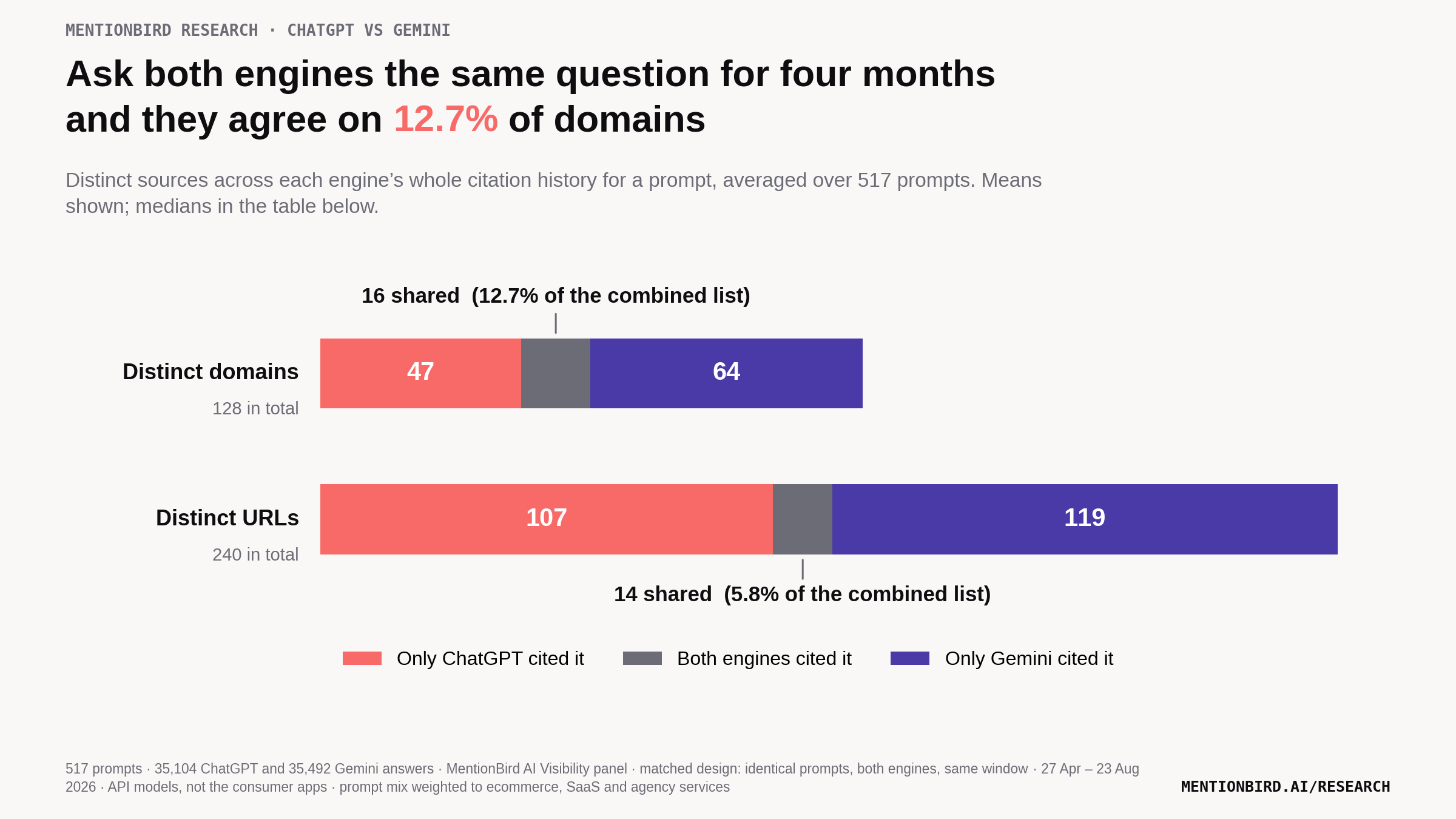
Table 1 — The combined source list for one question, split by which engine cited it. Means of counts, with medians where the distribution is skewed. n = 517 questions.
| Measure | Only ChatGPT | Both engines | Only Gemini | Combined | Shared share |
|---|---|---|---|---|---|
| Distinct domains (mean) | 47.3 | 16.3 | 64.1 | 127.7 | 12.7% |
| Distinct domains (median) | — | 16.0 | — | 114.0 | — |
| Distinct pages (mean) | 106.6 | 14.0 | 118.9 | 239.5 | 5.8% |
| Distinct pages (median) | — | 13.0 | — | 217.0 | — |
| ChatGPT domains / pages | 63.5 / 120.6 mean · 59 / 111 median | ||||
| Gemini domains / pages | 80.4 / 132.9 mean · 67 / 109 median |
Salil Panikkaveetil, founder, MentionBird: “We wanted to see how similar the two engines are in what they read. They are not similar. The lists come out about the same size, but they are different lists. Gemini cites more per answer and often goes back to pages it has used before. ChatGPT cites less and tends to go somewhere new. Same size, different habit.”
The explanations that don’t survive
An overlap this low invites three immediate objections. We went after all three, and we publish the coefficient that hurt as well as the ones that helped. The first two are here. The third needs a section of its own.
Objection 1: it’s an artifact of list length
Our second study’s central correction was that a raw volatility gap between the engines came from Gemini ranking more brands per answer; normalize for length and the gap vanished. Share-of-combined-list has the same weakness. It falls as either list grows, whatever the engines do.
It is real here, and partial. Compare each question’s domain agreement with the size of its combined list and the correlation is −0.32. Compare it with the ratio of Gemini’s list length to ChatGPT’s and it is −0.32 again. Both are weak-to-moderate. Both point the way the objection predicts. So the 12.7% is not a pure behavioral constant, and we will not present it as one.
What the objection cannot touch is everything else. Divide by the smaller list and length drops out. Agreement then reads 25.6% across the combined totals, or 31.9% as the average of each question’s own ratio, median 30.9%. On that measure the same two correlations fall to −0.17 and +0.19, as designed.
A quarter to a third of the shorter list is far more than an eighth of the combined one. It is still not two engines reading the same web.
And length explains least where agreement is worst. Page-level agreement is 5.8%, the lowest figure in the study. Its correlation with combined list size is −0.22, and only −0.10 on ranks.
We will not lean on the near-identical median page lists to prove that, because question by question the two lists are often far apart. The Gemini-to-ChatGPT page-list ratio runs from 0.45 to 2.52 between the 10th and 90th percentiles. The two differ by more than a quarter of the larger list on 321 of 517 questions. The average gap is 66.4 pages.
So here is the narrow claim, and it is the one we will defend: length accounts for part of the domain figure, less of the page figure, and none of the spread below.
Table 2 — Every correlation between per-question agreement and list size. Pearson, Spearman on ranks in brackets. n = 517.
| vs combined list size | vs Gemini/ChatGPT length ratio | |
|---|---|---|
| Domain, share of combined list | −0.32 (−0.24) | −0.32 |
| Domain, share of smaller list | −0.17 (−0.13) | +0.19 |
| Page, share of combined list | −0.22 (−0.10) | −0.27 |
| Page, share of smaller list | −0.15 (−0.07) | +0.04 |
A −0.32 is weak-to-moderate. Not strong, and not nothing — and we would rather print it than be corrected on it later.
Objection 2: it’s a handful of strange questions
It is not, and this is the part of the study that no measurement choice can rescue.
If divergence were confined to odd questions, agreement would be high for most and collapse for a few. Instead it holds steady: 405 of 517 questions (78.3%) sit between 20% and 50%. Seventy-one (13.7%) fall below 20%. Forty-one (7.9%) reach 50%. Three clear 70%. The single most agreeable question in the entire panel reaches 83.3% — and it is one question out of 517.
There is no category of question, and no measurement threshold, on which these two engines read the same web.
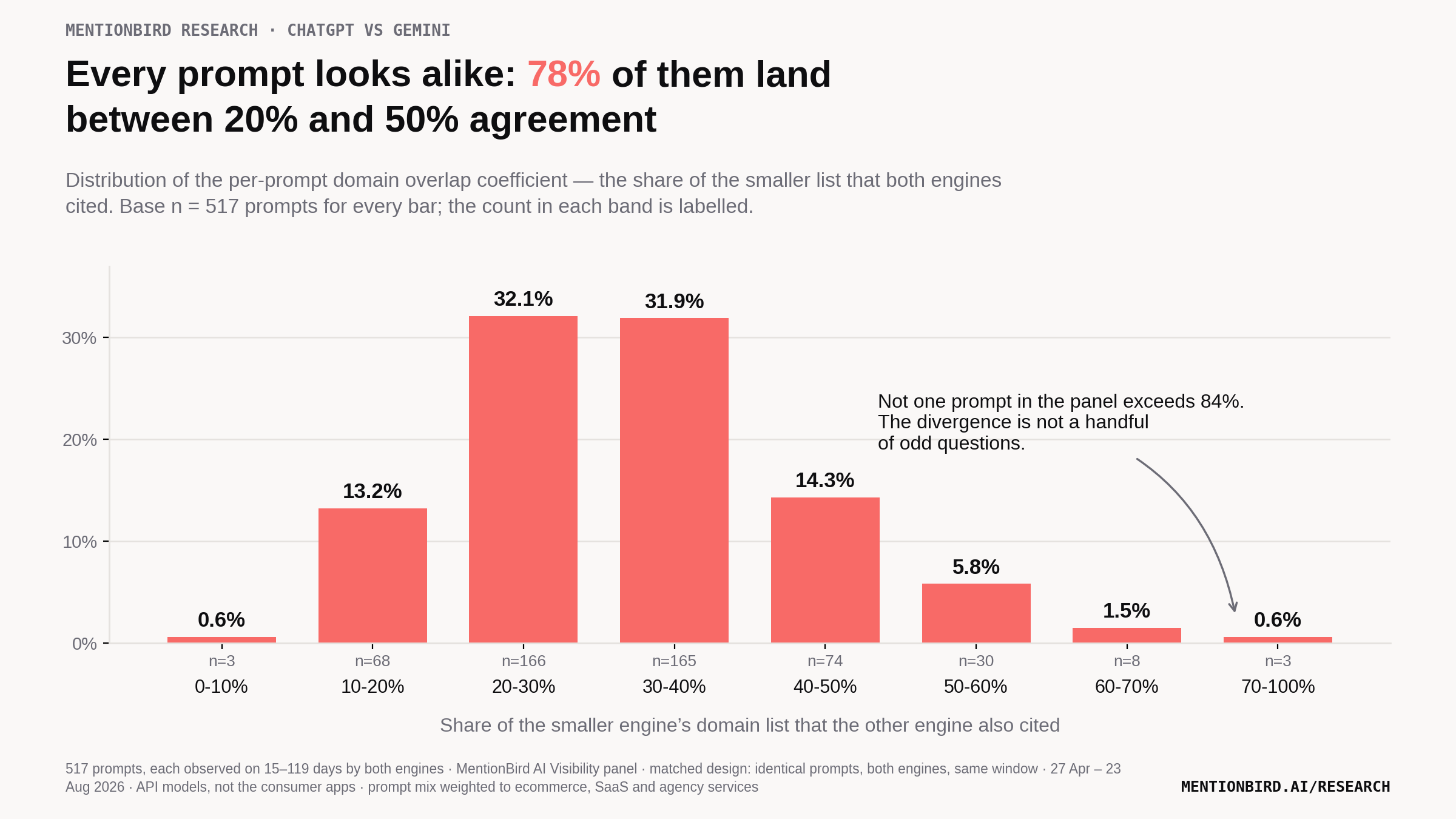
Table 3 — Distribution of per-question domain agreement (share of the smaller list). Base n = 517 questions.
| Agreement band | Questions | Share of 517 |
|---|---|---|
| 0–10% | 3 | 0.6% |
| 10–20% | 68 | 13.2% |
| 20–30% | 166 | 32.1% |
| 30–40% | 165 | 31.9% |
| 40–50% | 74 | 14.3% |
| 50–60% | 30 | 5.8% |
| 60–70% | 8 | 1.5% |
| 70–100% | 3 | 0.6% |
A longer window grows both source lists five- to six-fold and barely moves agreement
The third objection is the strongest, and it needs the most room. Each engine answers a question about once a day. Perhaps both are drawing from a shared pool and the two samples simply need longer to look alike.
We tested it on the 146 questions observed on 110 or more days by both engines, rebuilding each source list from only the first 7, 14, 28, 56 and 119 days.
Agreement does rise, and shared sources accumulate faster than exclusive ones — the shared count grows 7.2× against 5.8× for ChatGPT-only domains and 5.0× for Gemini-only. We say so because it cuts against the simplest reading of this study. But it rises from a very low base, and it rises slowly. Seventeen times the observation buys 6.6 points of agreement, from 28.2% to 34.8%. The curve is flattening.
Extrapolating a flattening curve is what this series does not do, and that cuts both ways. Agreement is still rising at the end of the window. These data cannot say whether it converges, or stalls somewhere in the thirties.
What they can say is the part that matters. Four months of asking the same question every single day still leaves two-thirds of the shorter source list unshared. No content program or reporting cycle runs on a longer horizon than that.
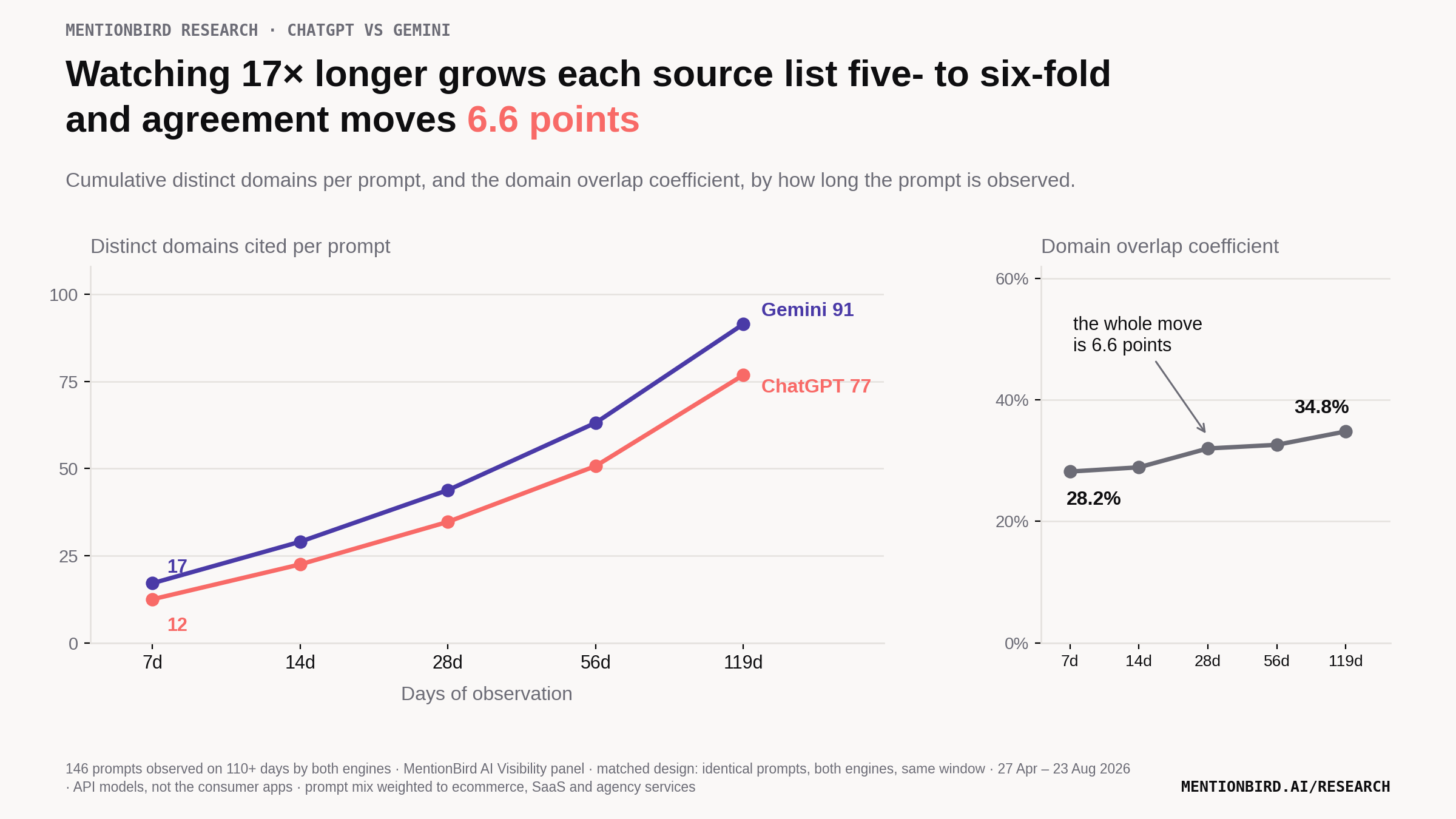
Table 4 — Source-list growth and agreement, by length of observation. 146 questions. Domain counts are means of counts; the agreement columns are means of each question’s own ratio.
| Days observed | ChatGPT domains | Gemini domains | Shared | Share of smaller list | Share of combined list |
|---|---|---|---|---|---|
| 7 | 12.5 | 17.1 | 2.9 | 28.2% | 11.5% |
| 14 | 22.5 | 29.0 | 5.1 | 28.9% | 12.1% |
| 28 | 34.7 | 43.8 | 8.7 | 32.0% | 13.9% |
| 56 | 50.7 | 63.1 | 12.9 | 32.6% | 14.3% |
| 119 | 76.8 | 91.4 | 20.9 | 34.8% | 15.9% |
Making ChatGPT search more narrows the gap by 3.6 points
There is a fourth objection worth its own section, because the honest answer is more interesting than the one we expected. Our first study showed ChatGPT skips the web on a large minority of answers. Perhaps low overlap is really low grounding wearing a disguise.
Sort the questions by how often ChatGPT searched, and agreement rises with it. Questions it grounded fewer than 90% of the time: 11.6% (n=208). Questions it grounded 90% or more: 15.2% (n=309). Both are averages of each question’s own ratio — the measure on which the whole panel reads 13.8%, not the pooled 12.7% of the headline. The trend keeps going down inside that lower band, but the group concerned holds 80 questions — under our reporting floor — so we give the direction and no rate.
So searching more does pull the engines together. It pulls them from 11.6% to 15.2% of the combined domain list. A ChatGPT that goes to the web on almost every answer still shares just 15.2% of its domains with Gemini. Whether ChatGPT searches and where it goes are two different questions. Only the second one explains this study.
One wrinkle, published because it is the kind of thing that gets spotted later. On the share-of-smaller-list measure, same base, the same split does not rise cleanly: 31.3% against 32.3% — either side of the panel’s 31.9% — and a three-band split dips to 29.1% in the middle.
The reason is that dividing by the smaller list switches which engine sits in the denominator. In the under-90% band ChatGPT’s list is much the shorter, 53.6 domains against Gemini’s 99.5. In the 90%-plus band the two are nearly equal, 70.2 against 67.5. Where the two measures disagree, share-of-combined-list is the one to read here.
Salil Panikkaveetil, founder, MentionBird: “The obvious explanation is that ChatGPT skips the web on a lot of answers, which is what our first study found. So we checked it. It accounts for only a few points of the gap. The engines are not disagreeing because one of them is not looking. They are disagreeing about where to look.”
Forums are the one place the two engines meet
If the engines diverge, the practical question is where they don’t — and the answer depends on the kind of page.
We sorted all 66,003 question–domain pairs by the kind of page each domain is. 636 could not be classified and are left out, leaving 65,367. Then we asked, for each kind, what share of pairs both engines cited rather than one. Forum and community pages come first at 37.2%. Review and comparison platforms follow at 21.1%. At the bottom: blogs and publications at 9.4%, academic sources at 6.9%. A forum page is four times likelier to reach both engines than a blog post is.
A note on what is being counted. These are shares of question–domain pairs — one row per domain per question — not shares of questions. Read them against each other, not against the per-question figures earlier.
A canonicality explanation fits the ranking. A forum thread on a buying question is a single destination — there tends to be one Reddit thread about the best tool for a job, and both engines find it. Editorial coverage of the same question is a thousand near-substitutable posts, and the two engines pick different ones. That is an interpretation of a ranking, not a demonstrated mechanism, and it is treated as such under What this does not prove.
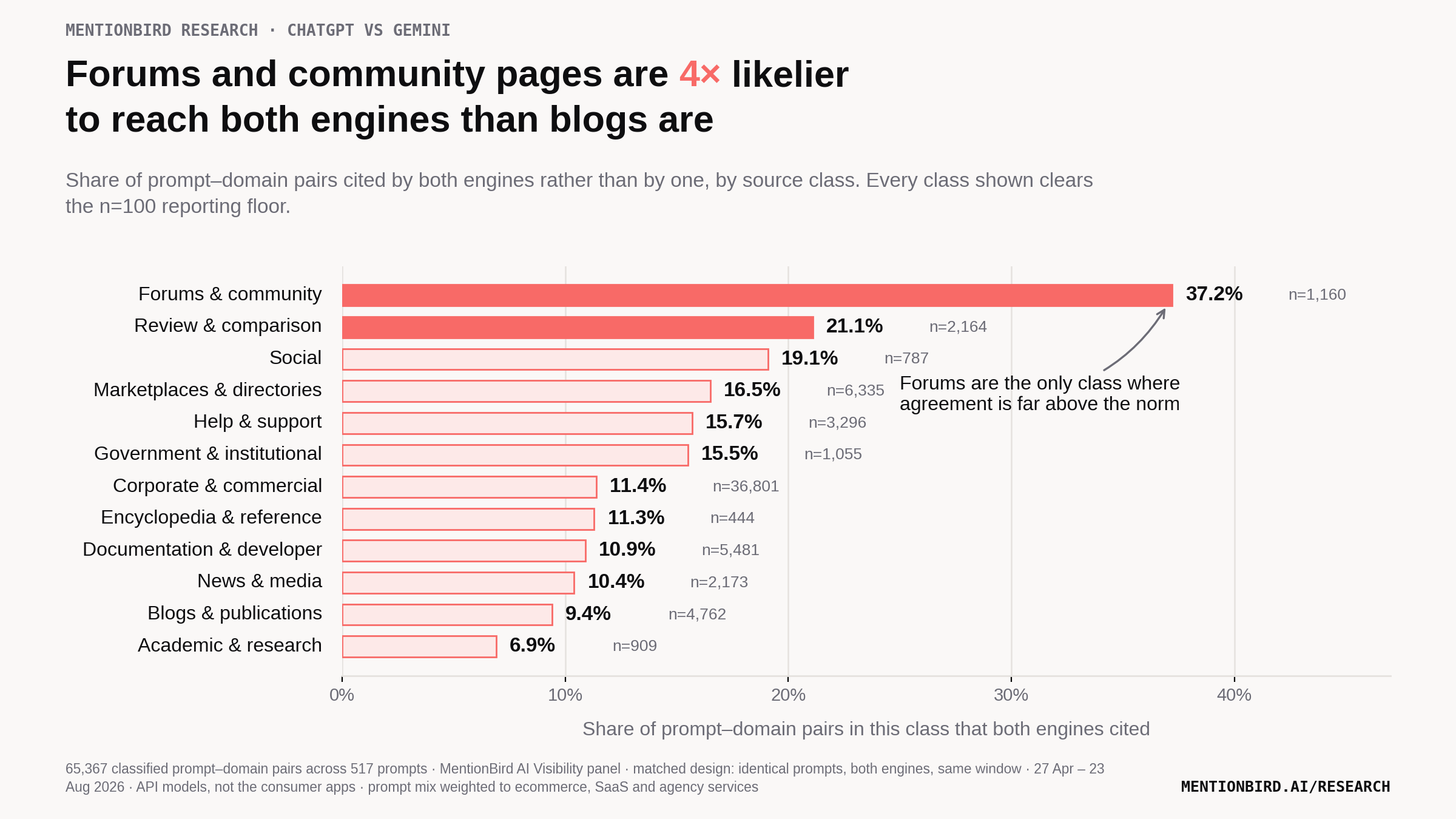
Table 5 — Share of question–domain pairs cited by both engines, by source class. 65,367 classified pairs.
| Source class | Both engines | Only ChatGPT | Only Gemini | Pairs (n) |
|---|---|---|---|---|
| Forums & community | 37.2% | 33.4% | 29.5% | 1,160 |
| Review & comparison | 21.1% | 48.4% | 30.5% | 2,164 |
| Social | 19.1% | 28.3% | 52.6% | 787 |
| Marketplaces & directories | 16.5% | 34.5% | 49.0% | 6,335 |
| Help & support | 15.7% | 44.4% | 39.8% | 3,296 |
| Government & institutional | 15.5% | 48.9% | 35.6% | 1,055 |
| Corporate & commercial | 11.4% | 34.1% | 54.5% | 36,801 |
| Encyclopedia & reference | 11.3% | 70.5% | 18.2% | 444 |
| Documentation & developer | 10.9% | 48.1% | 41.1% | 5,481 |
| News & media | 10.4% | 46.3% | 43.3% | 2,173 |
| Blogs & publications | 9.4% | 29.2% | 61.4% | 4,762 |
| Academic & research | 6.9% | 51.5% | 41.6% | 909 |
The exclusive columns describe two different reading habits. Where ChatGPT is alone, it leans on encyclopedia and reference pages — 70.5% of that class is ChatGPT-only against 18.2% Gemini-only — plus academic work, government sources and review platforms. Where Gemini is alone it is on blogs (61.4%), corporate sites and social platforms. ChatGPT’s private web looks like a reference library. Gemini’s looks like a feed.
The domains both engines keep returning to are platforms, not publications
Naming the destinations is more useful than naming the classes. These domains were shared on 100 or more of the 517 questions, leaving out any domain belonging to a brand in the panel: reddit.com (275 questions), apps.shopify.com (225), shopify.com (134), help.shopify.com (113), youtube.com (103) and community.shopify.com (101). Just below the line sit g2.com (79), support.google.com (57) and capterra.com (41).
Every one is a platform, a marketplace or a forum. Not one is an editorial publication.
One caution on scale. We asked separately what ChatGPT cites when it recommends software. Forums and communities are only 3.0% of its citations. So the page class most likely to reach both engines is also a small share of what either one reads. Being on it is worth more than its share suggests. It will not carry a content plan on its own.
Salil Panikkaveetil, founder, MentionBird: “The easy read is that you should go and post on Reddit. That is not what this shows. What reaches both engines is a page that has no substitute: the one thread everyone links to, the one marketplace listing, the one docs page. If your category has a page like that, being missing from it costs you on both engines, and being on it is the only work here that pays twice. If your category does not have one, you are running two separate content programs, and it is better to know that before you plan the quarter.”
Agreement is mildly enriched at the authoritative end
One more cut. We publish it because it complicates a claim this series has been kind to before — that AI engines are largely indifferent to domain authority.
Scoring every question–domain pair that carries a domain authority score: shared domains average 56, and both engines’ exclusives average 46. At the low end, 38.0% of shared pairs score below 46, against 53.7% of ChatGPT-only and 49.6% of Gemini-only.
Two caveats before anyone quotes that. These are pair-weighted, so they describe citation events rather than a population of domains. And coverage is uneven: the index scores 91.2% of shared pairs and 91.2% of Gemini-only pairs, but only 74.3% of ChatGPT-only pairs. The quarter of ChatGPT’s exclusive citations that carry no score are, almost by definition, obscure domains. ChatGPT’s true average is likely below the 46 shown, and the conditional below is flattered by the same gap.
The size of the effect is best seen as a lean, and a mild one. Shared pairs are 13.7% of all scored pairs. They are 18.2% of pairs scoring 91 or above, and 10.6% of pairs scoring below 46.
Turn it around and it is milder still. Among pairs scoring below 46, 89.4% were cited by one engine only. Among pairs scoring 46 or above, 83.3% were. Six points, not a different world — because the great majority of citations reach one engine whatever the score.
Table 6 — Domain authority by which engines cited the domain. Pair-weighted, over the scored pairs shown. The mean is the authority equivalent of each class’s mean index score, and the two band columns are cut at the index points that map to 91 and 46.
| Class | Pairs | Scored pairs | Mean authority | Authority 91 and above | Authority under 46 |
|---|---|---|---|---|---|
| Cited by both engines | 8,414 | 7,672 | 56 | 3.9% | 38.0% |
| Only ChatGPT | 24,436 | 18,166 | 46 | 3.8% | 53.7% |
| Only Gemini | 33,153 | 30,232 | 46 | 2.2% | 49.6% |
What to do about it
Everything below follows from one fact. A citation in one engine is weak evidence about the other, so a content program measured on a single engine is reporting on half its own work.
Track the two engines separately.
Across 517 questions the engines shared 12.7% of domains and 5.8% of pages. A report that says “we are visible in AI search” on the strength of one engine is a report about one engine. Split the tracking, and split the number you put in front of a client or a board. In practice, that means keeping ChatGPT brand tracking and Gemini brand tracking as two separate reports, read side by side rather than blended into one score.
Note: MentionBird's AI citation tracking lists the pages each engine cited for every tracked prompt, so you can compare the ChatGPT and Gemini source lists for your own questions.
Find the page in your category that has no substitute, and get on it.
Forum and community pages reached both engines on 37.2% of question–domain pairs, against 9.4% for blogs and publications. Every domain shared on 100 or more questions is a platform, a marketplace or a forum. That page is the only work here that pays twice.
Do not budget for the two engines converging.
Seventeen times the observation moved agreement 6.6 points, from 28.2% to 34.8%, on a flattening curve. Four months of daily asking still left two-thirds of the shorter source list unshared. No content plan runs on a longer horizon than that.
Do not expect a more diligent ChatGPT to close the gap.
On questions ChatGPT grounded 90% or more of the time, agreement was 15.2%. On the rest it was 11.6%. Whether ChatGPT searches and where it goes are two different problems, and only the second one is this one.
Write for two reading habits, not one.
Where ChatGPT is alone it is on reference, academic, government and review pages. Where Gemini is alone it is on blogs, corporate sites and social platforms. A page built for one engine’s habit is not automatically a page for the other’s.
See which sources ChatGPT trusts for your buyer questions
Run five buyer questions and get every cited URL, plus whether your brand is named and who is named instead. Free, no signup.
Get your free AI Visibility ReportWhat this does not prove
Neither engine is worse. Two engines can retrieve entirely different pages and produce equally good answers. Nothing here measures answer quality — only where the engines look, not how well they read.
We have not shown why they diverge. The source-class ranking is consistent with a canonicality explanation, but that is an interpretation of a correlation. Retrieval index differences, query rewriting and ranking would all produce similar-looking data, and we cannot separate them from outside.
The authority result is correlational, pair-weighted and confounded with source class. Forum and marketplace domains are both high-agreement and high-PageRank, so part of Table 6 is Table 5 wearing different clothes. The uneven authority coverage is a second confound. We have not decomposed either and would not trust a decomposition on this sample.
“Both engines cited it” is not “both cited it for the same reason.” A domain can appear on both lists via different pages, in different answers, months apart. Domain agreement is the loosest reading available, which is why the page figure of 5.8% sits beside it in every table and in the opening findings. The headline and title use the domain figure — a reader who takes only the title away has the more generous of the two numbers.
The grounding split is an observational split, not an experiment. Questions ChatGPT grounds often may differ from questions it grounds rarely in ways that also affect overlap. We have not controlled for that.
The window is a snapshot of a moving system. Model versions were held constant, but we cannot detect a silent server-side update by either vendor within a version.
Limitations
The panel is not a probability sample of the questions people ask AI engines, so we report no margin of error; one would be statistically meaningless here. Percentages appear only for groups of 100 or more.
This is a large but imperfect sample of the global market. Our prompt mix is weighted toward ecommerce, SaaS and agency services, and one platform ecosystem is over-represented in the shared-domain list as a result. We would not extrapolate to news, health or law, where canonical sources are far more concentrated and agreement is likely to be substantially higher.
The study is matched at question and window level but not day by day; observed day counts differ between the engines on 358 of 517 questions. Every figure is a whole-window comparison, and none is a same-day paired result.
The 15-day and 5-grounded-answer thresholds are judgment calls, both set before any overlap figure was computed. The grounded-answer floor makes the headline more conservative, not less: dropping it widens the cohort to 621 questions and moves pooled domain agreement from 12.7% down to 10.9%. We report the higher, stricter figure.
Table 2’s coefficients are computed across questions of very different list sizes, and the page grain in particular is not a matched-length comparison question by question. We claim only that length explains less at the page grain, not that it explains nothing.
Domain authority is OpenPageRank normalized to reflect domain authority on a 0-to-100 scale. Table 6 reports the authority equivalent of each class’s mean index score, not the mean of the individual domain scores. On a nonlinear scale those are not the same number.
Source classification is automated and imperfect at the margins; the 636 pairs whose class could not be determined are excluded from Table 5 rather than reported as a class. Table 4’s growth series and Table 6’s authority columns are reported as means without medians; both distributions are skewed.
Frequently Asked Questions (FAQs)
- If my page is cited by ChatGPT, will Gemini cite it too?
Probably not. Across 517 matched questions, 12.7% of the domains in the combined source list were cited by both engines, and 5.8% of exact pages. One engine’s citation is weak evidence about the other.
- Which engine should I optimize for?
Both, separately. There is no single list of sources that serves both engines, and the pages that reach one are mostly not the pages that reach the other.
- Is the low overlap just because Gemini cites more sources?
Partly, at the domain level: the correlation between a question’s domain agreement and its combined list size is −0.32, weak-to-moderate. But removing list length, by dividing by the smaller list, still leaves agreement at 25.6% to 31.9%. And at the page level the length correlation is weaker (−0.22) while agreement is lowest of all, at 5.8%.
- Would checking for longer show the engines converging?
Very slowly. Going from 7 days of observation to 119 grew each engine’s source list five- to six-fold and raised agreement 6.6 points, from 28.2% to 34.8%, on a flattening curve.
- Does it help if ChatGPT searches more often?
Yes, and not enough. Averaging each question’s own ratio, agreement rises from 11.6% on questions ChatGPT grounded under 90% of the time (n=208) to 15.2% where it grounded 90% or more (n=309).
- What kind of page has the best chance of reaching both engines?
Forum and community pages, by a wide margin: both engines cited 37.2% of question–domain pairs on forum and community sites, against 9.4% on blogs and publications. Marketplaces, review platforms and product documentation sit in between.
- Does domain authority help?
Modestly, and the evidence is correlational and pair-weighted. Shared pairs are 13.7% of all scored pairs, but 18.2% of those scoring 91 or above and 10.6% of those below 46, on a 0-to-100 authority scale.
- Does this mean ChatGPT and Gemini disagree about which brands to recommend?
A separate question, and an earlier study answered it: they churn brand recommendations at almost identical rates. Different sources do not necessarily mean different answers.
Data availability
Every figure behind the four charts is published in full in the tables above — those aggregate tables are the dataset. They may be republished with attribution and a link (CC BY).
We do not release question-level or per-brand records. The prompts in the panel are our customers’ commercial intelligence, and a question-level table can be re-identified by anyone who knows the category. Requests for additional aggregate cuts — by category, by country, or by engine pair — are welcome and we will publish them as anonymized aggregates.
Separately from this study, our ChatGPT rankings pages show which brands ChatGPT currently names across ten software categories. They are a live tracker that moves as the engine moves, not findings from this study.
How to cite this study
MentionBird (2026), “The two engines do not read the same web”, MentionBird Research, Edition 3, retrieved from https://www.mentionbird.ai/research/chatgpt-vs-gemini-source-overlap on [date].
License: CC BY. Republication is permitted with attribution and a link.
Note: This is Edition 3 of MentionBird Research. Every edition is collected on our research page.
Find out which sources each engine actually reads for your prompts
First month $19 with code TRY19, then $79/mo. Cancel anytime.