46.4% of ChatGPT’s B2B Software Citations Come From Vendor’s Own Website
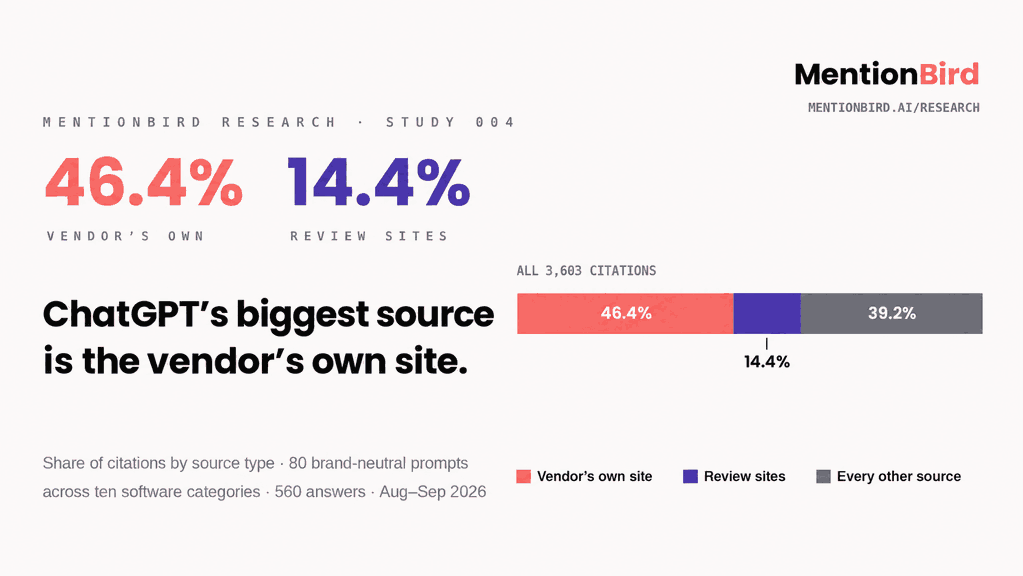
- Commercial vendor websites are 46.4% of all citations ChatGPT gave when recommending B2B sales software (n=3,603 citations). Review and comparison sites are 14.4%.
- Vendor-owned content was the largest source type in all 10 software categories tested, ranging from 36.6% to 65.7% (n=341 to 384 per category).
- At least one in four citations is a brand citing itself: 903 of the 1,671 vendor-site citations pointed to a brand named in that same answer, which is 25.1% of all citations.
- Every buyer intent is decided by a different page format. On price questions product pages are 54.1% of citations; on “best” questions they are 8.6% and roundups take 53.8%.
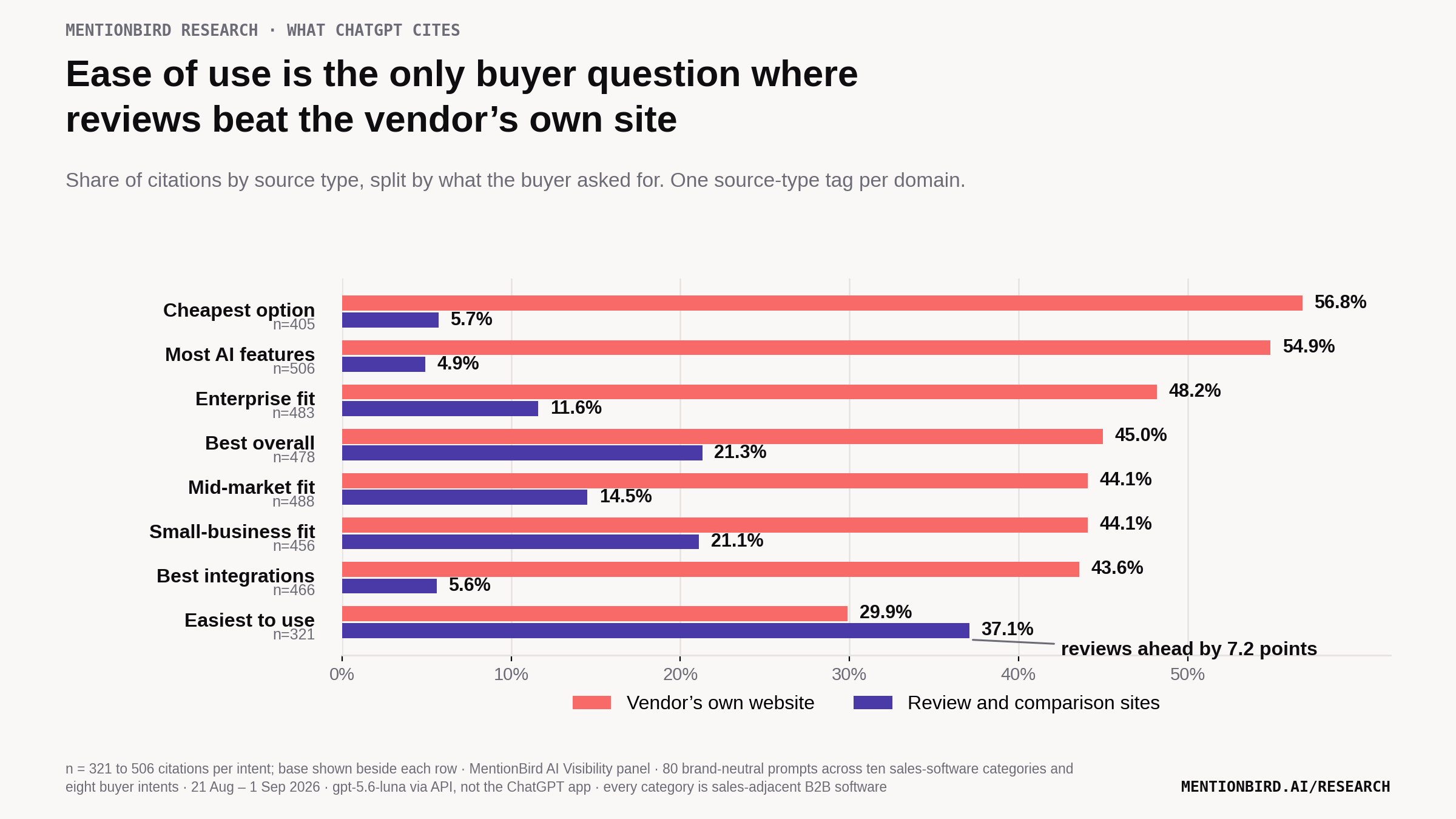
- Three intents are winnable from a vendor’s own site — price, AI features and integrations — where vendor sites are 43.6% to 56.8% of citations and review sites 4.9% to 5.7%.
- Ease of use is the one intent that is not: review sites are 37.1% of citations there and vendor sites fall to 29.9% (n=321).
- User reviews are cited on ease-of-use questions at 28.3%, against 1.5% to 2.1% on price and integration questions.
- Integration questions send ChatGPT to product documentation more than any other intent (15.9%); enterprise questions send it to analyst and research content more than any other (16.8%).
- Roundups are 34.4% of cited pages. Case studies are 0.2% — a gap of more than 170 times.
- Pricing URLs are 10.9% of citations and homepages 1.7%: a pricing page was cited more than six times as often as a homepage.
- Cited domains skew strong: of the 3,141 citations that reached a scored domain, 77.8% went to one scoring 50 or above out of 100 for authority, and 50.0% to one scoring 60 or above.
- But authority does not describe your position once you are cited. Across the 519 scored cited domains the rank correlation between authority and citation count is 0.17, and one citation in five still went to a domain scoring under 30 or carrying no score at all.
An AI answer engine is a tool that answers a question in prose instead of handing back a list of links. ChatGPT is one. Gemini is another.
When one of these tools answers a question, it often searches the web first. It then names the pages it used. Each named page is a citation. Citations are visible to the person reading the answer, and they are the closest thing we have to a paper trail for how the answer was built.
This study is about those citations. Not about which product wins. About what the engine reads before it decides.
Three terms we use throughout. A source type is what kind of site a citation points to: a company’s own site, a review site, a forum, and so on. A page format is what the cited page is: a roundup, a product page, a comparison, a set of docs. A buyer intent is what the person asking actually wants: the cheapest option, the easiest one, the one that fits a large company.
We sorted every question by intent, because we suspected the sources would change with it. They did, and by more than we expected.
What we set out to answer
Marketers are told to chase third-party validation to win AI recommendations. Get on the review sites. Get the analyst nod.
That advice has a research basis. Aggarwal and colleagues, in the peer-reviewed GEO study at KDD 2024, found that adding quotations and citations to a page raised its visibility in generative answers more than any other change they tested. Their work asks what a page should contain. Ours asks a question that comes before it: which pages does the engine pick up in the first place?
So we asked one thing. When ChatGPT recommends business software, what does it actually read?
How we measured it
The unit of analysis is one answer, generated for one prompt, on one collection date.
We ran 80 brand-neutral prompts covering 10 business software categories. The categories all sit in the sales and revenue software space: CRM, CPQ, proposal software, sales engagement, sales intelligence, lead intelligence, conversation intelligence, sales enablement, revenue operations, and outbound call tracking. These are the same ten categories whose live ChatGPT rankings we publish. Each category was asked about through eight buyer intents: the best option, the cheapest, the easiest, the most AI-capable, the best integrations, and the best fit for small, mid-market and enterprise buyers. No prompt named a brand.
That produced 560 answers between August 21 and September 1, 2026, carrying 3,603 citations. Two percent of answers came back with no citation at all, and those are counted in the 560. Answers that failed at the API or parsing stage are excluded.
We report shares pooled across all 560 answers rather than from one check per prompt. Our study of how often ChatGPT changes its answer between identical runs found a brand’s presence flips 39.2% of the time. One answer is not a measurement.
We measured an API model, not the ChatGPT app. The model was gpt-5.6-luna, called through the OpenAI API. ChatGPT.com is a different product with different retrieval behavior. Numbers from the app would differ.
A citation’s source type comes from the domain it points to, tagged once per domain. Its page format comes from the page, and a page can carry more than one format tag, so format shares do not sum to 100%. A citation counts as a self-citation when the domain matches a brand named in that same answer. That match is a conservative string comparison, so 54.0% is a floor, not a ceiling.
Domain authority comes from OpenPageRank, a public index scored 0 to 10, normalized to reflect domain authority on a 0-to-100 scale. It is the same 0-to-100 score MentionBird shows its own customers. 151 of the 670 domains ChatGPT cited, 22.5%, carry no score at all. Those are left out of the authority bands rather than treated as zero. Their count and their citations are reported alongside.
The authority figures carry their own date. Answers were collected 21 August to 1 September 2026. Authority was measured on 10 September 2026, and every authority number in this post is pinned to that snapshot. The index we query adds domains over time, so the same query run later returns slightly different counts.
We do not name individual brands, publishers or domains anywhere in this study. We report what kind of site was cited, not which one. We do not report a percentage for any group smaller than 100. Below that we report counts. Every percentage in this post carries its base n.
This is a large but imperfect sample. Every category we tested is sales-adjacent B2B software. Design tools, developer tools and consumer apps may behave differently, and we have not tested them.
Vendor-owned content is the largest source ChatGPT cites, in every category
Across 3,603 citations, 46.4% pointed to a company’s own commercial website. Review and comparison sites came second at 14.4%. Product documentation was 10.4%. Marketplaces and app stores were 8.2%. Forums and communities were 3.0%.
The result holds when we break it apart. Vendor-owned content was the top source type in all 10 categories. It ranged from 36.6% in one category to 65.7% in another. Base n runs from 341 to 384 citations per category, so each of those figures clears our reporting floor.
This is the finding that should change a plan. The advice to go win third-party validation is not wrong, but it describes a seventh of the evidence base. The largest share is content the company writes and controls.
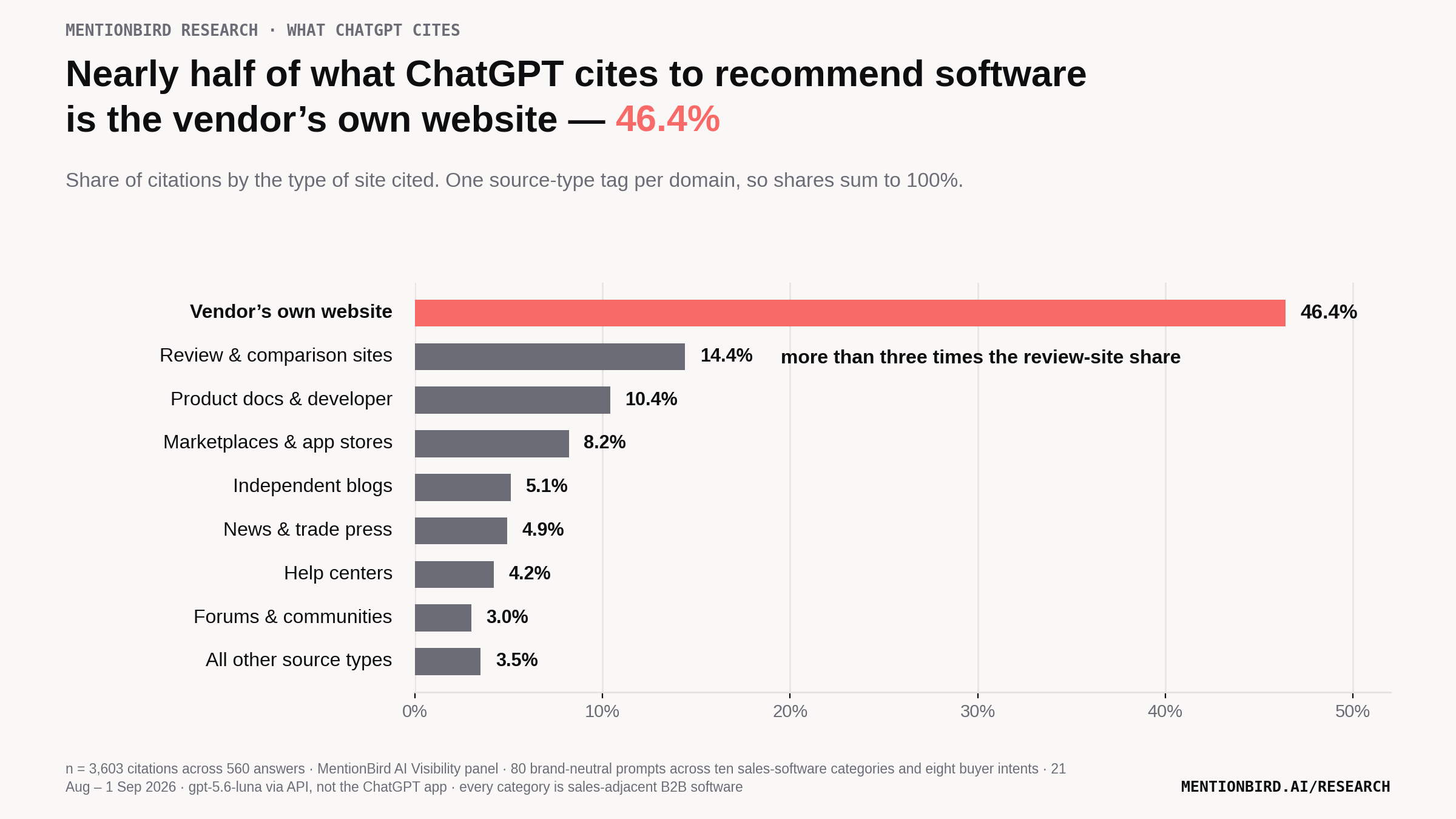
Table 1 — Share of citations by type of site cited. One source-type tag per domain, so shares sum to 100%. n = 3,603 citations.
| Source type | Citations | Share |
|---|---|---|
| Vendor’s own website | 1,671 | 46.4% |
| Review and comparison sites | 518 | 14.4% |
| Product docs and developer | 375 | 10.4% |
| Marketplaces and app stores | 297 | 8.2% |
| Independent blogs | 182 | 5.1% |
| News and trade press | 176 | 4.9% |
| Help centers | 151 | 4.2% |
| Forums and communities | 107 | 3.0% |
| All other source types | 126 | 3.5% |
Salil Panikkaveetil, founder, MentionBird: “We wanted to see what ChatGPT actually reads before it recommends a tool. Most of the advice in this market is about getting onto review sites. Review sites are in there, but the bigger share by some way is the vendor’s own website. That is worth knowing, because those are pages a founder can change this week without asking anyone’s permission.”
One in four citations is a brand citing itself
Of the 1,671 vendor-site citations, 903 pointed to the site of a brand that was named in that same answer (n=1,671). That is 54.0% of vendor citations and 25.1% of all citations.
So a quarter of the evidence ChatGPT offers for recommending a product comes from the company selling it. We used a conservative match, so the real figure is higher.
We are not claiming the engine was fooled. A pricing page is often the best source for a price. But it does mean a vendor’s own pages are load-bearing. If your product pages are thin, missing or hard to crawl, you have removed the source the engine reaches for first.
Three buyer intents are winnable from your own site. One is not.
The pooled number hides a useful pattern. Split the citations by what the buyer wanted, and the mix moves a lot.
Table 2 — Share of citations by source type, split by buyer intent. One source-type tag per domain.
| Buyer intent | Citations | Vendor site | Review sites |
|---|---|---|---|
| Cheapest option | 405 | 56.8% | 5.7% |
| Most AI features | 506 | 54.9% | 4.9% |
| Enterprise fit | 483 | 48.2% | 11.6% |
| Best overall | 478 | 45.0% | 21.3% |
| Mid-market fit | 488 | 44.1% | 14.5% |
| Small-business fit | 456 | 44.1% | 21.1% |
| Best integrations | 466 | 43.6% | 5.6% |
| Easiest to use | 321 | 29.9% | 37.1% |
Two ends stand out. On price, vendor sites are 56.8% and review sites are 5.7%. On ease of use, that reverses: review sites are 37.1% and vendor sites are 29.9%.
Price, AI features and integrations are the three intents where a vendor’s own site carries the evidence. Ease of use is the one thing a buyer will not take your word for.
Each buyer intent is decided by a different page format
This is the most useful table in the study. It says which page ChatGPT reaches for, question by question.
Table 3 — Share of citations by page format, split by buyer intent. A page can carry more than one format tag, so rows do not sum to 100%. Each column’s peak is in bold.
| Buyer intent | Citations | Roundup | Product page | Comparison | User review | Docs | Research |
|---|---|---|---|---|---|---|---|
| Cheapest option | 405 | 19.8% | 54.1% | 16.3% | 1.5% | 1.5% | 1.5% |
| Most AI features | 506 | 21.9% | 32.4% | 7.9% | 1.6% | 11.1% | 6.3% |
| Best integrations | 466 | 20.8% | 19.3% | 14.6% | 2.1% | 15.9% | 5.2% |
| Small-business fit | 456 | 47.6% | 18.0% | 23.9% | 8.6% | 2.9% | 6.1% |
| Easiest to use | 321 | 43.3% | 17.8% | 24.3% | 28.3% | 2.5% | 5.0% |
| Enterprise fit | 483 | 31.5% | 15.9% | 15.9% | 6.8% | 5.0% | 16.8% |
| Mid-market fit | 488 | 38.5% | 12.7% | 27.5% | 9.8% | 1.2% | 10.9% |
| Best overall | 478 | 53.8% | 8.6% | 26.4% | 12.8% | 1.5% | 13.8% |
Read down the product-page column. It runs from 54.1% on price questions to 8.6% on “best” questions, a spread of more than six to one. Your own product page is the primary evidence on price and close to irrelevant on “best”.
The other columns each have one clear peak. Documentation peaks on integration questions at 15.9%. User reviews peak on ease-of-use questions at 28.3%, more than thirteen times their level on any of the three self-serve intents. Research and analyst content peaks on enterprise questions at 16.8%. Comparisons peak on mid-market questions at 27.5%. Roundups peak on “best” questions at 53.8%.
None of these peaks is a surprise once you see it. All of them are invisible if you only look at the pooled average.
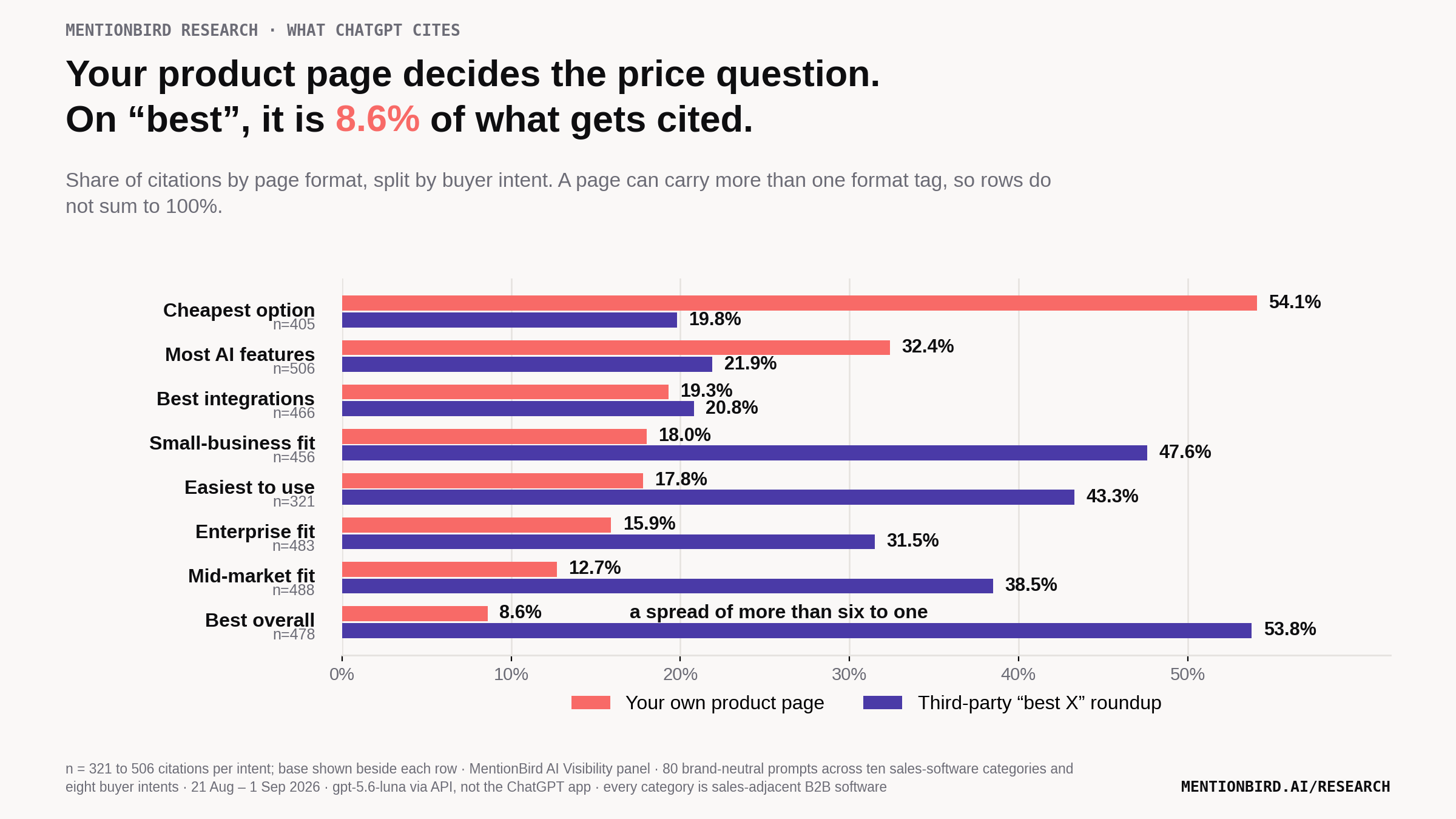
Salil Panikkaveetil, founder, MentionBird: “We had been treating this as one problem: publish the right kind of page and the engine picks you up. It is really eight problems, one for each thing a buyer asks for. The page that wins a question about price is not the page that wins a question about the best tool, and on that second one your own site counts for very little. If you run one content plan across all of it, you will do well on some questions and wonder why the others never moved.”
ChatGPT reads roundups and pricing pages, not case studies
Sorting cited pages by format gives a blunt ranking. Roundups are 34.4% of citations. Editorial articles are 24.0%. Product pages are 22.0%. Head-to-head comparisons are 19.4%. User reviews are 8.2%. Case studies are 0.2% (n=3,603 citations). A page can carry more than one tag, so these do not sum to 100%.
The URLs tell the same story. Citations whose URL contains “best” or “top” are 17.6%. Pricing URLs are 10.9%. Comparison URLs are 10.7%. Homepages, with no path at all, are 1.7%.
Two numbers deserve a marketing meeting. A pricing page is cited more than six times as often as a homepage. And pages built around the word “alternatives”, a staple of AI-visibility advice, are 2.0% of citations.
ChatGPT cites strong domains, but authority does not predict how often
ChatGPT cited 670 distinct domains across the 560 answers. The authority index scores 519 of them. Here is how those score, on the 0-to-100 scale our own product reports.
Table 4 — Cited domains and their citations by authority band. Covers the 519 cited domains the authority index scores, and the 3,141 citations they received. The other 151 domains carry no score and are counted in the text below. Authority snapshot 10 Sep 2026. n = 519 domains, 3,141 citations.
| Authority | Domains | Share of domains | Citations | Share of citations |
|---|---|---|---|---|
| Under 20 | 50 | 9.6% | 134 | 4.3% |
| 20–29 | 55 | 10.6% | 141 | 4.5% |
| 30–39 | 59 | 11.4% | 207 | 6.6% |
| 40–49 | 72 | 13.9% | 215 | 6.8% |
| 50–59 | 131 | 25.2% | 872 | 27.8% |
| 60 and above | 152 | 29.3% | 1,572 | 50.0% |
Cited domains are not a random sample of the web. They skew strong. Of the 3,141 citations that went to a scored domain, 77.8% went to a domain scoring 50 or above. Half went to a domain scoring 60 or above. The median scored domain sits at 52.
The counterweight for a small site is real, and smaller than that. Domains scoring under 30 took 275 citations, 8.8% of the scored total. A further 151 cited domains carry no score in the index at all, and they took 462 citations between them. Together that is 737 of all 3,603 citations, one in five, going to a domain with little or no measured authority.
The more useful finding is what authority does not do. Across the 519 cited domains that carry a score, the rank correlation between a domain’s authority and the number of times it was cited is 0.17. That is weak. The 20 most-cited domains average 69 for authority against 48 across the other 499 scored domains, so the very top of the list is stronger than the body of it. But within the pool of domains ChatGPT cited, knowing a domain’s authority tells you close to nothing about how often the engine came back.
So authority reads as a threshold rather than a dial. It is associated with being in the citation pool at all. It does not describe your position once you are in it.
One caution about the bands, and it cuts against us. The 0-to-100 scale is not evenly spaced. Most cited domains sit around the middle. There, a very small change in the underlying index moves a domain a whole band. So read the bands as a shape, not as hard lines. The rank correlation does not depend on the scale at all, which is why we put the weight on it.
What founders and marketers can do about it
Start from the intent you want to win, not from a content calendar. To see which intents you already win, track your brand mentions in ChatGPT across the questions buyers ask at each stage.
To win price questions, publish real prices.
Product pages are 54.1% of citations there and roundups only 19.8%. This is the most self-serve intent in the study. “Contact sales” removes you from the source the engine wants most.
To win integration questions, invest in your docs.
Documentation is 15.9% of citations on that intent, its highest anywhere, and review sites are 5.6%. Integration pages and a real API reference do the work here.
To win AI-feature questions, write product pages and docs.
Vendor sites are 54.9% of citations and review sites 4.9%. Buyers asking what your AI does get sent to you.
To win enterprise questions, you need third-party research.
Analyst and research content is 16.8% of citations there. This is the one intent where the analyst relationship is the lever.
To win “best” and small-business questions, get into the roundups.
Roundups are 53.8% and 47.6% of citations on those two intents, and your own product page is 8.6% and 18.0%. You cannot publish your way into these from your own domain.
To win ease of use, get reviews.
It is the only intent where review sites lead, at 37.1%, and user reviews hit 28.3%. Reviews are the lever there, and largely only there.
Treat forum pages as a small share here, and the only double-duty one.
Forums and communities are just 3.0% of ChatGPT’s citations. They are also the one page format that reaches both engines. Our study of where ChatGPT and Gemini’s sources overlap found 37.2% of cited forum pages were cited by both. For blogs and publications it was 9.4%. A small share, and the only work in this study that pays twice.
Build roundups and comparisons, not case studies.
Roundups are 34.4% of cited pages and case studies are 0.2%. Comparison content is 19.4% and peaks at 27.5% on mid-market questions.
Treat authority as a threshold, not a dial.
Of the citations that reached a scored domain, more than three-quarters went to one scoring 50 or above. So authority is associated with getting cited at all. But among domains that are cited, it barely predicts how often, at a rank correlation of 0.17. And one citation in five still goes to a domain scoring under 30 or carrying no score. Spend the effort on being citable, not on the score.
Note: To see which source types and page formats AI cites for your own buying questions, MentionBird's AI citation tracking breaks every cited page down by type, format, and domain authority.
Find out which pages ChatGPT cites in your category
Check whether your own site is among the sources ChatGPT reads for your buyer questions, and which competitors it names. Free, no signup.
Get your free AI Visibility ReportWhat this does not prove
We measured which pages ChatGPT cited alongside a recommendation. We did not measure which pages caused it.
A model can cite a page it barely used, and it can use knowledge from training without citing anything. So a high citation share is evidence that a source type is in the retrieval path. It is not proof that publishing that source type will get a product recommended.
The self-citation figure needs the same care. We matched a cited domain to a brand named in the same answer. We did not verify that the citation was offered as evidence for that brand.
The authority comparison is not causal either. The most-cited domains score higher on average, but they are also the large publishers whose business is publishing the exact page formats this study finds get cited. We cannot separate authority from format with this data.
Nor does this study replace the page-level work. The GEO study tested changes to a page and measured what happened to its visibility. We observed which pages an engine reached for and changed nothing. Those are different questions, and a content plan needs both answers.
Limitations
These are ChatGPT’s grounded answers only. Two percent of the answers here came back with no citation. That low rate is specific to this model and this prompt set: our study of how often ChatGPT searches the web before it answers measured gpt-5-mini on a broader panel and found no web citations at all on 29.7% of commercial-intent answers. Either way, a study of citations can only describe the answers that have them, so nothing here speaks to the ones the engine composes from memory.
One engine, one model. gpt-5.6-luna via API. Other models and the ChatGPT app may retrieve differently.
One slice of software. All 10 categories are sales-adjacent B2B tools. This is not a study of software in general.
A short window. All 560 answers come from between August 21 and September 1, 2026. We cannot say whether these shares are stable over months.
No subgroup below 100. Per-category and per-intent figures here are based on citations, where every group clears 100. We do not publish the full category-by-intent cross-tab, because those cells fall below the floor.
Source types are tagged by domain, not by page. A domain that publishes both marketing pages and independent editorial is tagged once. That blurs the line between vendor content and editorial on a handful of large sites.
Authority scores are incomplete, and the scale is a choice. 151 of the 670 cited domains carry no authority score. Leaving them out of the bands keeps the percentages honest. It also means Table 4 describes 3,141 of the 3,603 citations, not all of them. The 0-to-100 figures are OpenPageRank normalized to reflect domain authority — not a Google metric, and not Moz or Ahrefs. Other tools would rank these domains differently, and a different scale would move every band in Table 4 while leaving the rank correlation untouched.
The authority snapshot is a moving target. The index we query keeps adding domains, so the number of cited domains carrying no score shrinks over time. Ours are pinned to 10 September 2026. A reader who repeats the query later should expect small differences and should not read them as a change in ChatGPT’s behavior.
Frequently Asked Questions (FAQs)
- Where can I see which brands ChatGPT names in my category?
On our ChatGPT rankings pages, which cover these same ten categories and show which brands the engine names in each. Read them as a live tracker rather than as findings from this study. This post reports no per-category leaderboard, because a single category falls below the base we require for a percentage.
- Should I be chasing review sites, or fixing my own pages?
Both, and not in the proportion most advice implies. Your own site is 46.4% of what the engine cited and review and comparison sites are 14.4%. Reviews matter, and they lead on ease-of-use questions at 37.1%. A plan built only on them is working with a seventh of the evidence base.
- Which single change should I make first?
Publish real prices on a crawlable page. Product pages are 54.1% of citations on price questions, the highest concentration of any format on any intent, and it is entirely within your control. “Contact sales” removes you from the source the engine reaches for first.
- My domain is weak. Can I be cited at all?
Yes, though the odds are against you. 737 of the 3,603 citations went to a domain scoring under 30 out of 100 for authority, or carrying no score at all. One citation in five comes from a site like yours. The encouraging part is what happens next: among domains that do get cited, authority barely predicts how often, at a rank correlation of 0.17. Getting into the pool is the hard part, not climbing inside it.
- I write case studies. Are they doing anything here?
Almost nothing, on this evidence. Case studies are 0.2% of cited pages, against 34.4% for roundups and 22.0% for product pages. They may earn their place later in a sales cycle. They are not what this engine reads.
- I do not sell sales software. Does this apply to me?
Partly, and we cannot tell you how much. All ten categories we tested are sales-adjacent B2B software. The shape of the finding, that intent decides the page format, is likely to travel. The exact shares are not.
- Would the numbers look the same in the ChatGPT app?
Probably not. We measured an API model. The consumer app is a different product with its own retrieval behavior, and we did not test it.
- Does this tell me anything about what Gemini reads?
No. Our study of where the two engines’ sources overlap is the reason not to assume. It found they share only 12.7% of cited domains and 5.8% of exact pages. Everything in this study is ChatGPT.
Data availability
The aggregate tables are the dataset. Every number behind every chart in this post is on the page as a table, and every table is complete rather than a selection from a longer one. The source-type shares sum to 100%. The authority bands sum to the 519 scored domains and their 3,141 citations. The remaining 151 domains and their 462 citations are stated in the text. There is no layer underneath them that we have summarized and held back. They may be republished with attribution and a link (CC BY).
We do not release citation-level or per-domain records. Each row carries the domain it points to, and this edition deliberately does not name domains or brands. Releasing the rows would undo that choice, so the aggregates are where we stop. Requests for additional aggregate cuts are welcome, and we will publish them as anonymized aggregates that clear the same base we require here.
What we do publish, separately, is the current picture. Our ChatGPT rankings pages show which brands ChatGPT names in each of these ten categories right now. Those are a tracker, not a study. They move as the engine moves, and they are meant to. This post is pinned to its window and will not be restated.
How to cite this study
MentionBird (2026), “46.4% of ChatGPT’s B2B Software Citations Come From Vendor’s Own Website”, MentionBird Research, Edition 4, retrieved from https://www.mentionbird.ai/research/what-chatgpt-cites-for-saas on [date].
License: CC BY. Republication is permitted with attribution and a link.
Note: This is Edition 4 of MentionBird Research. Every edition is collected on our research page.
See which pages ChatGPT actually reads before it recommends your category
First month $19 with code TRY19, then $79/mo. Cancel anytime.