
AEO vs. GEO: Key Differences, Examples, and Which to Prioritize
- AEO gets your page returned as the direct answer; GEO gets your brand named inside an answer an AI writes from several sources.
- The two blur because Google now places an AI Overview above the featured snippet, so one query returns both kinds of answer.
- AEO is mostly on-page work you control. GEO depends on reviews, directories, and roundups you influence but do not own.
- Start with AEO because it is faster and because Google requires a page to be indexed and snippet-eligible before it can appear in AI Overviews.
- Measure visibility, accuracy, traffic, and business outcomes separately, since a mention, a citation, and a recommendation are three different wins.
AEO vs. GEO compares two overlapping approaches to getting your business into AI answers. Answer engine optimization aims to get your page quoted as the direct answer to a question. Generative engine optimization aims to get your brand mentioned inside the response an AI writes, whether or not it cites you.
In practice, both often involve the same pages, sources, and platforms, so the AEO vs. GEO question is not which acronym is correct but which outcome your business needs.
This guide explains the differences, shows where SEO fits between these two concepts, and helps you pick your next move.
What Are AEO and GEO?
Let’s understand what AEO and GEO mean.
What Is Answer Engine Optimization (AEO)?
Answer engine optimization (AEO) is the practice of formatting and structuring your content in a way so that an engine returns it as the direct answer to a question.
It mainly targets featured snippets, FAQs, People Also Ask, knowledge panels, and voice results.
For example: Take a page about heat pump installation. Retitle a section "How long does a heat pump installation take?" and answer it in the first 40 words: "Most installations take one to three days, depending on whether the existing pipework needs replacing." Put the detail below that. Now the engine can lift a complete answer without reading further.
What Is Generative Engine Optimization?
Generative engine optimization (GEO) is making your brand and content likely to be retrieved and cited when an AI writes an answer from scratch.
It mainly targets AI systems that build answers this way, including ChatGPT, Perplexity, Gemini, Claude, and Google AI Overviews.
For example: Find the pages AI keeps citing when buyers ask about your category. Usually that means the comparison roundups, Reddit threads, and Product Hunt listings, and a tool like MentionBird will show you which ones. Then get your product onto those pages, because that is what the engine is reading when it answers.
Why Do People Use AEO and GEO Interchangeably?
Three reasons, and all of them are fair:
- The surfaces overlap: AEO was coined for featured snippets and voice results, where the answer came from a single page. GEO describes engines that compose an answer from several sources at once. But Google now places an AI Overview above the snippet, so one query returns both kinds of answer on one page. The line between the terms no longer matches what a user sees.
- The work is identical: A featured snippet and an AI citation reward the same things: a direct answer near the heading, a structure the engine can parse, and claims specific enough to quote. A team optimizing for one is already optimizing for the other, which leaves little reason to run two programs.
- Nobody owns the definitions: GEO was formalized in a 2024 ACM SIGKDD paper. AEO came from practitioner usage, with no research behind it. Without an agreed standard, agencies and vendors use whichever label their audience recognizes.
AEO vs GEO: Key Differences
Below, we will explore the key differences between AEO and GEO.
A short product specification can support a generated comparison. Equally, a detailed guide can contain a useful direct answer. Therefore, choose the depth that resolves the reader's question rather than writing to an imagined AEO or GEO length.
AEO vs GEO vs SEO: How Do They Work Together?
Adding search engine optimization broadens the comparison to how people discover your business.
Google says existing SEO practices remain relevant to Google AI Overviews and AI Mode. Supporting links must meet its indexing and snippet eligibility requirements. It does not require special AI markup.
However, that guidance concerns Google Search. It does not establish how every chatbot chooses information. Keep your SEO program running, since it is what makes you eligible in the first place. Then check how the other platforms your buyers use actually answer their questions.
AEO vs. GEO vs. AIO vs. LLMO: What About the Other Acronyms?
Four more labels circulate for the same work. Here is where each came from and whether it means anything different.
The pattern is worth noticing. Every label except the last one describes the same job from a different angle: the surface, the model, the answer, or the engine. That is what happens to a discipline three years old with no standards body. Pick one, define it in your brief template, and stop relitigating it. Our AI visibility glossary can help with the definitions.
AEO vs. GEO: Examples Across Different Industries
We will now look at some hypothetical examples of how the same business can win an AEO answer and a GEO answer, and why the two rarely come from the same place.
E-commerce
AEO: A shopper searches "what is a return window." Google lifts a two-sentence definition from your policy page.
GEO: A merchant asks ChatGPT for the best inventory tool for a multi-warehouse store. It reads G2 reviews, a Shopify community thread, and two roundups, then names three tools. Your own site never enters the answer.
SaaS
AEO: A buyer searches "what does per seat pricing mean?" Google expands a People Also Ask box with a definition from your pricing glossary.
GEO: A team lead asks Claude which project tools handle client billing well. It weighs Capterra reviews, a Reddit thread, and two comparison posts, then names four tools and cites a review site for the billing detail.
Local Services
AEO: A homeowner asks a smart speaker, "How long does a heat pump installation take?" It reads the one-sentence range from your service page FAQ.
GEO: A homeowner asks for well-reviewed installers in their city. The AI Overview pulls from your Google Business Profile, a trade directory, and recent reviews, shortlisting three firms on reputation rather than site copy.
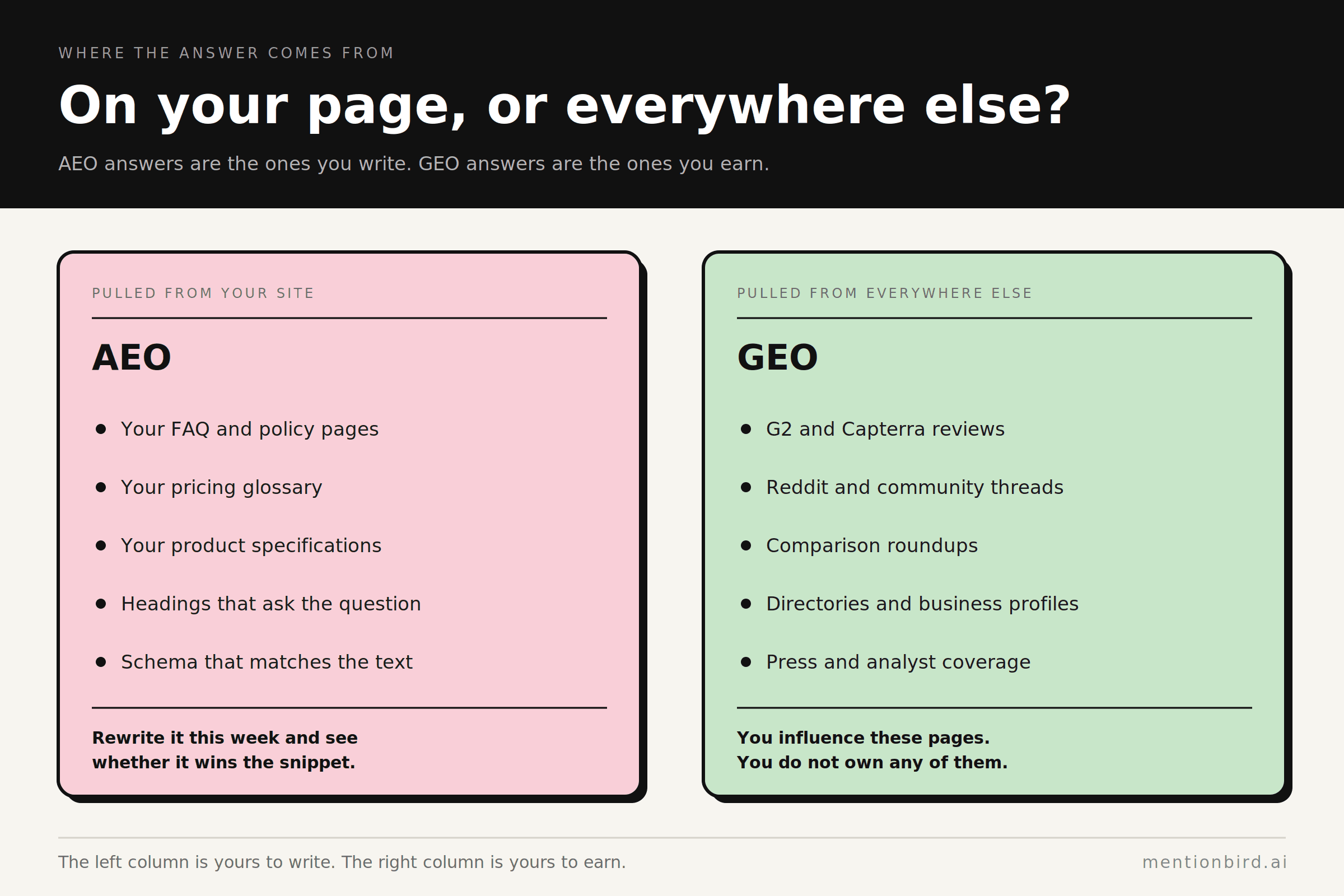
Note: Through the examples above, we were trying to highlight that AEO answers generally come from a page you control, while the GEO answers often come from reviews, directories, and roundups you do not own. GEO is less about any single page and more about your brand identity, meaning what the rest of the internet says about you when an engine goes looking.
AEO vs GEO: Which Should You Prioritize?
Start with AEO, then build GEO alongside it. This is a sequencing call, not a ranking, and the two compound each other once both are running.
- AEO is faster: It is on-page work you control. Rewrite a page this week and see if it wins the snippet. GEO depends on reviews and mentions you have to earn, which takes quarters.
- AEO is the entry ticket: Google requires a page to be indexed and snippet-eligible before it can appear as a supporting link in AI Overviews.
- Search is still bigger, but AI converts better: Shopify said AI traffic and orders tripled year over year in Q2 2026, while search still drove about a third of storefront sessions. Outside retail, Microsoft Clarity found AI-referred visitors to 1,200 publisher sites converting at 1.66% against 0.15% from organic. Fewer visits, higher intent.
Move GEO up your list if:
- Your category is heavily compared, so buyers weigh specs and alternatives before buying.
- You already own your snippets, leaving little left for on-page work to win.
- Competitors get named in AI answers, and you do not. Run your top queries through ChatGPT and Perplexity to check.
- Your reviews and directory listings are thin, since that is what engines read when your site is not enough.
How to Build One Strategy for AEO and GEO
Once you have chosen a priority, use this workflow to turn it into specific work.
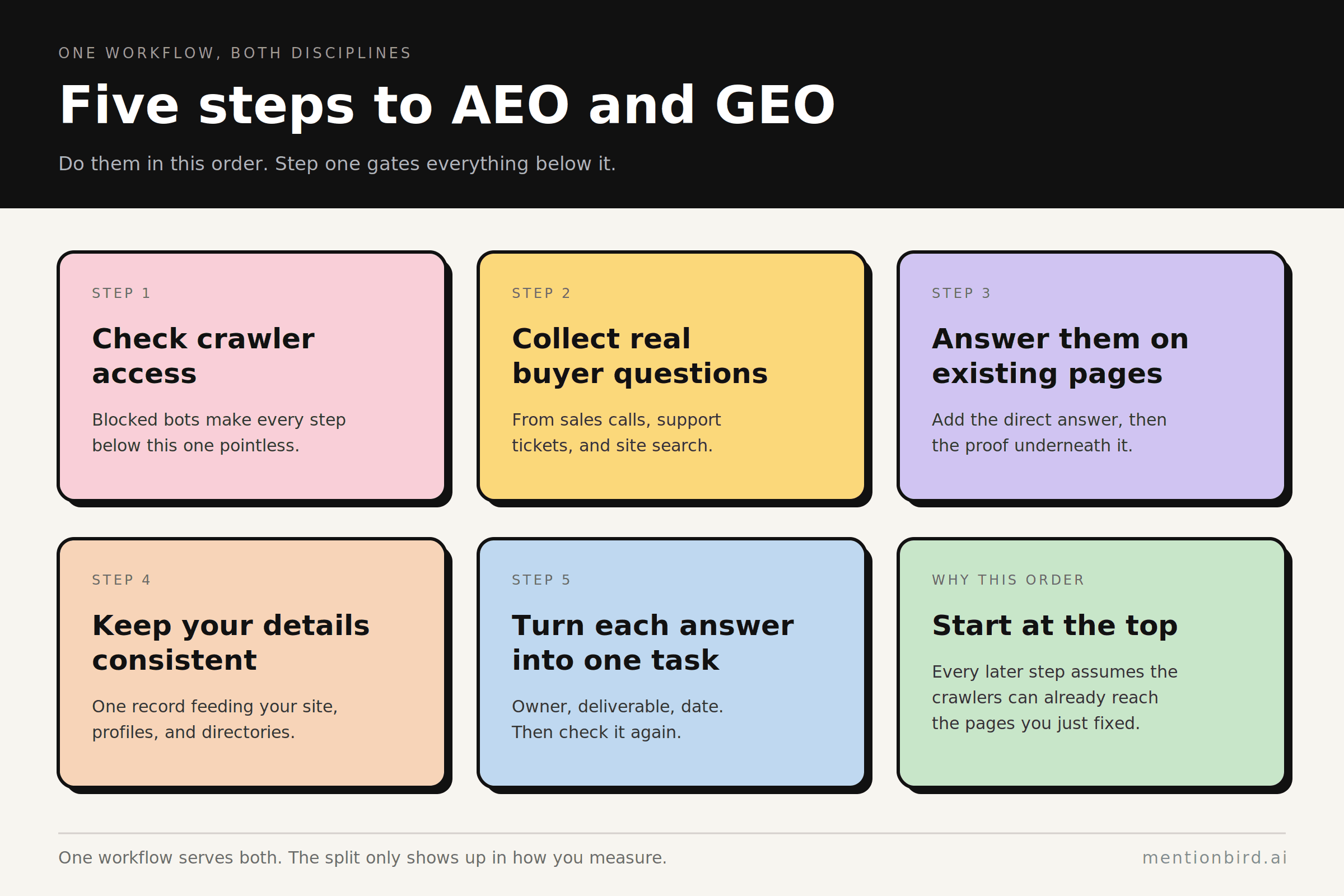
1. Check crawler access
Have a developer review robots.txt, firewall rules, response codes, and rendering on priority pages. Or start with MentionBird's free AI crawler accessibility checker, which tests 14 AI crawlers against both your robots.txt and a live fetch. That second check matters, because a permissive robots.txt tells you nothing if a firewall rejects the crawler by user agent before the file is ever read.
Treat each crawler separately. OpenAI runs four, and the settings are independent. OAI-SearchBot governs whether you appear in ChatGPT search, GPTBot governs training, and blocking OAI-SearchBot means your site will not show in ChatGPT search answers. Check that your structured data matches the visible text, which Google recommends directly.
2. Collect the questions buyers actually ask
Pull them from sales calls, support tickets, and site searches, then group them by the decision they support: suitability, cost, or implementation. Leave your brand out of discovery questions, since buyers would not know it yet, and include it when testing comparisons. Keep the set small and tied to what you actually sell.
3. Add answers and evidence to existing pages
Match each question to a page you already have. Create a new one only when nothing fits.
Before: "We offer fast shipping to keep your business moving."
After: "We dispatch stocked items within two business days. Custom orders take longer, so check the delivery estimate before paying."
The revision names what the promise covers and where it stops. Where a claim needs proof, add the test, specification, or named expert. Keep essential facts in readable text, even when an infographic shows them too.
4. Keep your business details consistent everywhere
Maintain one internal record of product names, plan details, and service coverage, then use it to update your site, business profiles, and directories. If a review contains an error, request a factual correction with evidence. Offer reviewers product access without asking for favorable coverage.
5. Turn each answer review into one task
Read the full response and open its citations. Separate what you can verify from guesses about why a source was picked. Write one task with an owner, a deliverable, and a date, so later reviews can tell your change from unrelated movement.
Note: For a more detailed, step-by-step version of this workflow, see eSEOspace’s GEO and AEO guide.
AEO vs. GEO Tools: What Do You Actually Need?
You do not need two stacks. In general, AEO work is on-page, and GEO work is off-page, but the tools have caught up, and several now cover both sides in one place.
MentionBird is one such option. It tracks your prompts daily across ChatGPT, Gemini, Claude, Perplexity, etc., shows which of your pages get cited and which competitors get named instead, and turns the actual answers into specific fixes for the pages behind them.
Other tools worth considering in this space include Otterly AI, Profound, and Peec AI.
Helpful resources for MentionBird:
- How MentionBird Works
- AI Search Fundamentals
- Reading Your Reports
- AI Ranking Advice on MentionBird
- AI Keyword Tracking on MentionBird
- Best GEO tools
- Best AEO tools
How to Measure AEO and GEO Results
Track four things, in this order.
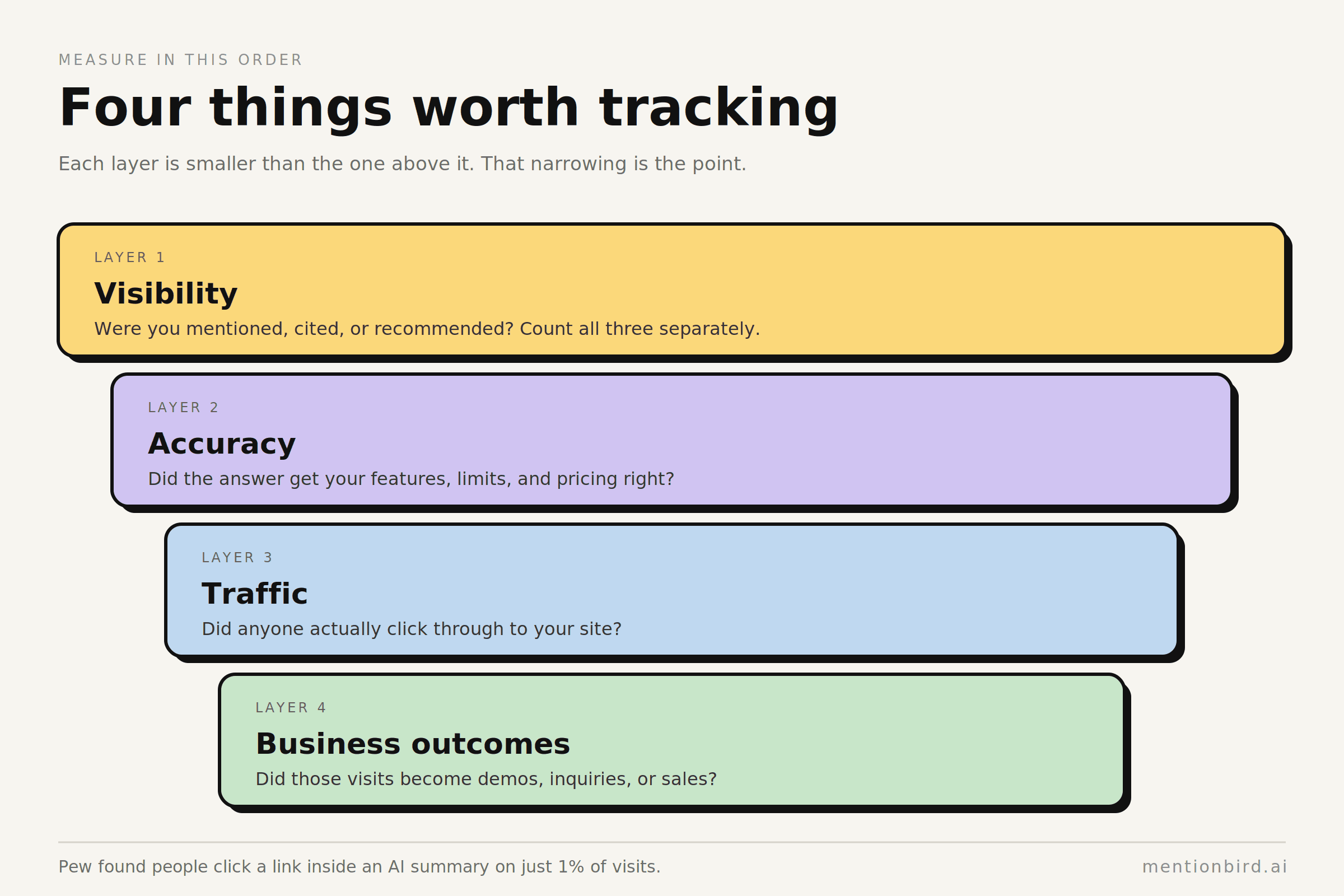
Visibility: Were you mentioned?
Count three outcomes separately:
- Mention: The answer names your brand.
- Citation: The answer links to your site.
- Recommendation: The answer puts you on the shortlist.
They are not the same win. An answer can cite your research and still recommend a competitor. Use the same prompts and settings each time, and keep branded and unbranded questions apart.
Accuracy: Did the answer represent you correctly?
Check what the answer says about your features, limits, and pricing. Log real errors one by one. An average score hides the one wrong claim that costs you a deal.
Traffic: Did anyone visit your website?
Check your analytics for AI referrals and where they landed. Expect gaps, because showing up does not mean getting clicked. Pew studied 900 US adults and found people clicked a link inside an AI summary on just 1% of visits.
Business outcomes: Did those visits help?
Track demos, inquiries, and purchases. When attribution is unclear, add a discovery source question at signup, since analytics will not tell you that a buyer arrived after reading an AI answer that never linked to you.
Bonus: Also watch our YouTube video on AEO vs. GEO
Conclusion
AEO and GEO are two names for the same shift: buyers now get answers instead of links. Write pages clear enough to be quoted, earn mentions in the places engines read, and you are doing both.
FAQs
1. Does GEO mean generative engine optimization or geographic targeting?
Both, depending on context. In AI search, it means generative engine optimization. In older marketing writing, geo means location targeting.
2. Which is better for brand visibility, AEO or GEO?
Both, in different places. AEO puts your name on the search results page, in snippets and People Also Ask boxes. GEO decides whether engines name you inside an AI answer, often without a link back to your site. Together they cover the two places buyers now look.
3. Does schema markup help with GEO?
Indirectly. Google requires no special markup for AI answers, but schema helps engines understand your entities and earns rich results.
4. Does E-E-A-T affect whether AI cites you?
Not as a score. But named authors, original data, and third-party coverage are exactly what makes a page worth quoting.
5. How long does GEO take to show results?
Months, usually. Your position moves only when the reviews, roundups, and directories that engines read get updated first.
6. Is AEO just voice search optimization renamed?
It started there. Siri and Alexa were the first engines returning one answer. The discipline now covers snippets and AI blocks too.

Win both AEO and GEO with MentionBird
First month $19 with code TRY19, then $79/mo. Cancel anytime.