
10 Best Generative Engine Optimization Tools in 2026

- AI recommendations can define buyer shortlists, making GEO tracking useful for brands seeking visibility in AI answers.
- MentionBird suits teams needing prompt-specific ranking advice across multiple markets, with up to 20 platforms available on Custom.
- Profound fits enterprises, Goodie AI supports ecommerce visibility, and Otterly.ai offers smaller teams an affordable starting point.
- Generative engine optimization tools with free plans, such as Siftly, LLMrefs, and iBeacon AI, let you see where your brand stands in AI answers before you invest your marketing budget in full-fledged monitoring.
- Choose a GEO tool based on tracking costs, relevant platform coverage, workflow needs, and data portability.
- Start with 25 to 50 commercially relevant prompts. Use the first month as your baseline.
Looking for the best generative engine optimization tools? You are in the right place. This guide covers and compares 10 software apps across features, AI platform coverage, prompt limits, pricing, and other factors.
Keep reading to find the best fit for your brand and boost AI visibility.
TL;DR: What Are the Best Tools for Generative Engine Optimization Right Now?
- MentionBird: For teams that want clear GEO recommendations for each buyer question where their brand misses out.
- Profound: For enterprises connecting AI search visibility with marketing agents and governance controls.
- Otterly.ai: Ideal for solo marketers and founders testing a small set of prompts before expanding their GEO budget.
What Are Generative Engine Optimization (GEO) Tools?
Generative engine optimization tools measure how AI answers mention, recommend, and cite your brand, along with the sentiment of those mentions and the referral traffic they send. They run buyer questions on a set schedule across platforms such as ChatGPT and Gemini, then compare your results with those of your competitors.
Beyond tracking, they suggest content changes, technical fixes, and outreach opportunities that can improve your presence in future answers. While answer engine optimization (AEO) has traditionally focused on featured snippets and quick answer boxes, GEO targets the conversational responses that large language models build from multiple sources, though many platforms now handle both.
Bonus: Read our blog on AEO vs. GEO
How We Picked the Best Generative Engine Optimization Tools in This Guide
We considered these factors when picking the top GEO tools for this guide:
- AI platform coverage: Tracks the platforms your buyers use, such as ChatGPT, Gemini, Perplexity, and Google AI Overviews.
- Actionable recommendations: Tells teams what to fix or publish next.
- Citation data: Reveals which websites shape AI answers and where you can earn coverage.
- Competitor benchmarking: Shows which rivals AI engines recommend for the prompts you miss, so you can study what earns them the mention and close the gap.
- Integration options: Connects with analytics, content, reporting, and workflow platforms so GEO data is easier to act on.
- User reviews: Positive feedback on independent review sites signals reliable data and responsive support.
Generative Engine Optimization Tools Comparison: Coverage, Prompts, and Pricing
| Tool | Pricing | AI platform coverage | Prompt allowances | Ranking advice | Citation data | Competitor analysis | Integration options |
|---|---|---|---|---|---|---|---|
| MentionBird | From $79/month Custom available |
Starter: ChatGPT and Gemini. Growth adds Perplexity and Claude. 20 in total on Custom: ChatGPT, Gemini, Perplexity, Claude, Grok, Google AI Overviews, Microsoft Copilot, DeepSeek, Google AI Mode, Mistral Vibe, Qwen Chat, Meta AI, Kimi AI, You.com, Ask Brave, Alexa for Shopping, Doubao, ERNIE, Poe, and Duck.ai | Starter: 100 daily runs Growth: 400 daily runs Custom: tailored, unlimited option |
Yes, using agent credits | Yes | Yes | MCP for ChatGPT and Claude connections |
| Cognizo | From $499/month (Growth). Pro $999/month. Enterprise custom | Up to 10: ChatGPT, Google AI Overviews, Google AI Mode, Gemini, Claude, Perplexity, Microsoft Copilot, Meta AI, Grok, and DeepSeek. | Growth: 150 prompts Pro: 350 Enterprise: Custom |
Yes | Yes | Yes | MCP and API from Growth tier, custom integrations on Enterprise |
| Profound | Free trial and then custom pricing | Up to 9: ChatGPT, Perplexity, Google AI Mode, Gemini, Copilot, DeepSeek, Claude, AI Overviews, and Exa Search. | Enterprise: Custom Trial: 50 daily prompts for 7 days |
Yes | Yes | Yes | Google Analytics, Akamai, AWS, Cloudflare, Vercel, WordPress, etc. |
| Peec AI | Starts at $95/month Enterprise plan available |
Choose 3 models on self-service plans; up to 13 available overall. Additional coverage depends on the package. | Starter: 50 prompts Pro: 150 prompts Advanced: 350 prompts Enterprise: Custom |
Yes | Yes | Yes | Google Analytics, Google Cloud CDN, WordPress, AWS, and others |
| Surfer | Content plans with tracking from $119/month; standalone tracking also available | 5 overall: ChatGPT, Perplexity, Google AI Mode, AI Overviews, and Gemini. Standard tracks ChatGPT. | Standard: 25, refreshed weekly Pro: 50, refreshed daily Peace of Mind: 100, refreshed daily |
Yes | Yes | Yes | WordPress, Google Docs, Contentful, Zapier, and API |
| Semrush AI Visibility Toolkit | Starts at $99/month per domain | Report-dependent coverage across ChatGPT, Google AI search, Gemini, and Perplexity. Custom tracking differs by engine. | Base: 25 daily prompts Extra 50 prompts: $60/month |
Yes | Yes | Yes | CSV exports and Semrush reporting workflows |
| Otterly.ai | Paid tiers from $29/month Custom plan available Enterprise from $1,000/month |
7 overall: ChatGPT, Google AI Overviews, Perplexity, Microsoft Copilot, Claude, Google AI Mode, and Gemini Any 3 tracked on each plan |
Lite: 20 prompts Standard: 160 prompts Premium: 535 prompts Enterprise: Custom |
Yes | Yes | Yes | Looker Studio, API, and MCP on Standard+ |
| Goodie AI | Core: $354/month Pro: $1,198.80/month Enterprise: Custom |
Core: 5 models Pro: 8 Enterprise: up to 13, including shopping experiences |
Core: 110 prompts Pro: 250 Enterprise: 500+ / tailored |
Yes | Yes | Yes | Google Analytics, Search Console, Bing Webmaster Tools, MCP; API on Enterprise |
| Trakkr | Growth: $100/month Scale: $500/month Enterprise: Custom |
8: ChatGPT, Claude, Gemini, Perplexity, Google AI Overviews, Grok, DeepSeek, and Meta AI | Growth: 50 for 1 brand Scale: 50 each for 10 brands Enterprise: Unlimited |
Yes | Yes | Yes | Looker Studio, MCP, API, and more |
| GetCito | Free self-hosted plan Managed plans from $599/month |
Self-hosted: ChatGPT and AI Overviews. Managed Growth: 4 engines. Enterprise: 9 listed live; Grok planned. | Growth: 50 monthly prompts Scale: 100 monthly prompts Enterprise: Unlimited |
Yes | Yes | Yes | Custom CRM, analytics, BI, and marketing-stack integration |
Best Generative Engine Optimization Tools for 2026, Reviewed
Here is our generative engine optimization tools list, with the strengths, limits, and practical fit of each option.
1. MentionBird
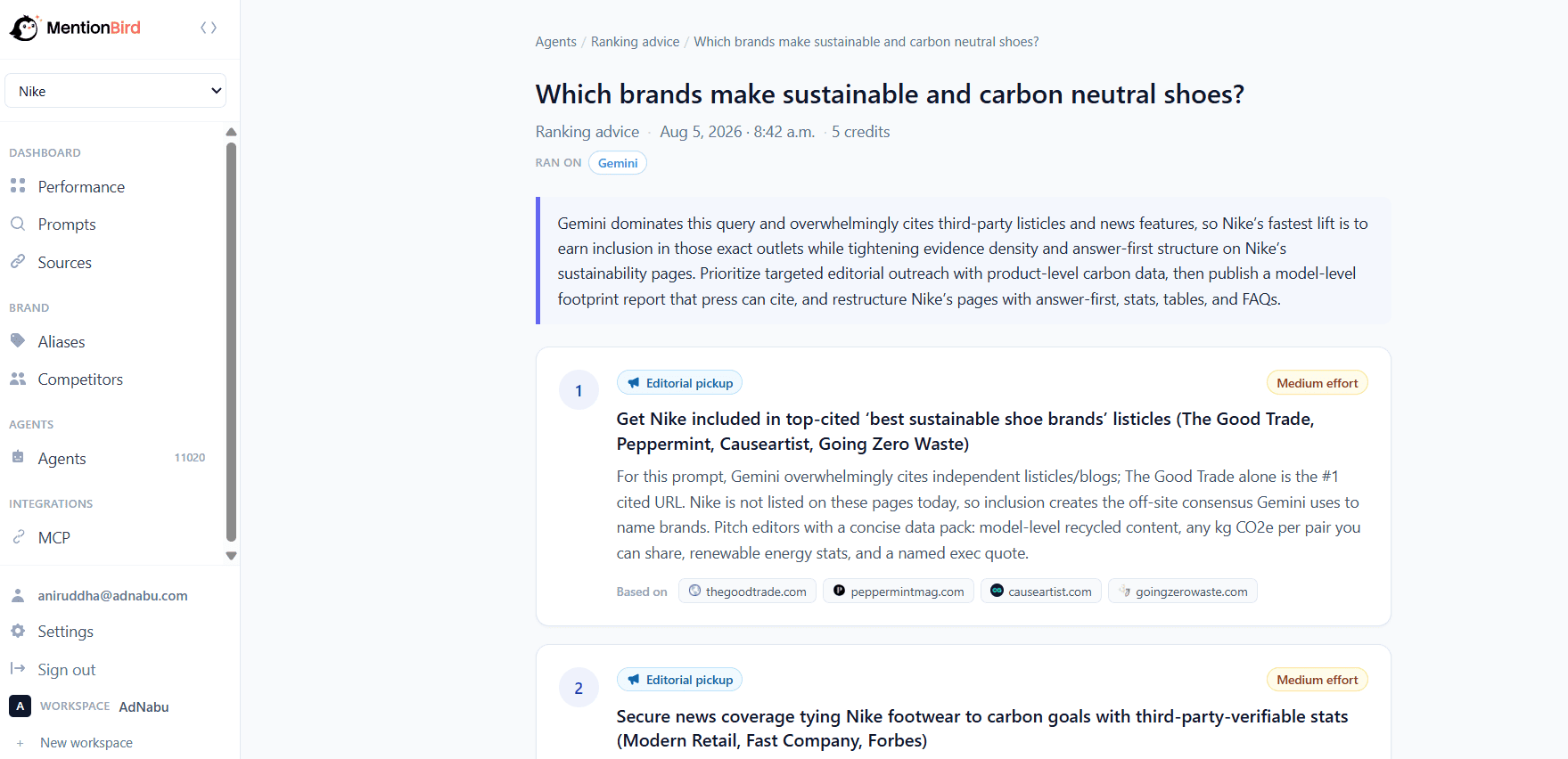
MentionBird is a generative engine optimization tool that shows where your brand stands across AI answers, including which buyer questions you currently win. For prompts where your brand still misses out on citations, it gives you specific ranking advice from both an AEO and a GEO perspective.
Key features:
- Daily prompt tracking across up to 20 AI platforms overall, with coverage determined by your plan
- On-page, off-page, and even technical SEO and GEO suggestions through to help you get more AI and organic traffic, which also make it one of the most complete and best GEO tools for AI search visibility improvement out there
- Citation data by page type, content format, and authority
- Query fan-out, which shows which keywords AI platforms use to generate answers
- Targeting supported across 50+ countries on all plans
- Competitor AI visibility tracking and benchmarking
- MCP integration
Pricing: Starter costs $79/month for 100 daily prompt runs across ChatGPT and Gemini. Growth costs $299/month for 400 daily runs across four platforms. Custom supports all 20 platforms with tailored limits. Starter includes 100 monthly agent credits, enough for up to 20 ranking plans at five credits each.
User interface: Its main dashboard is structured and intuitive and includes clear graphs for visibility and prominence scores in comparison with your brand competitors, along with prompt performance.
What users say: An early Product Hunt reviewer highlighted getting useful insights and clear actions together from the product.
Pros:
- Ten seats on the entry plan support easier team collaboration
- Flexible distribution of daily runs across selected platforms
- Easy to set up, so you can start tracking required buyer prompts within an afternoon
Cons:
- Doesn’t offer content generation or production capabilities.
Best suited for:
- Agencies and AEO teams serving industries such as SaaS and e-commerce
Once your first MentionBird report lands, these explain what each number is telling you
2. Cognizo
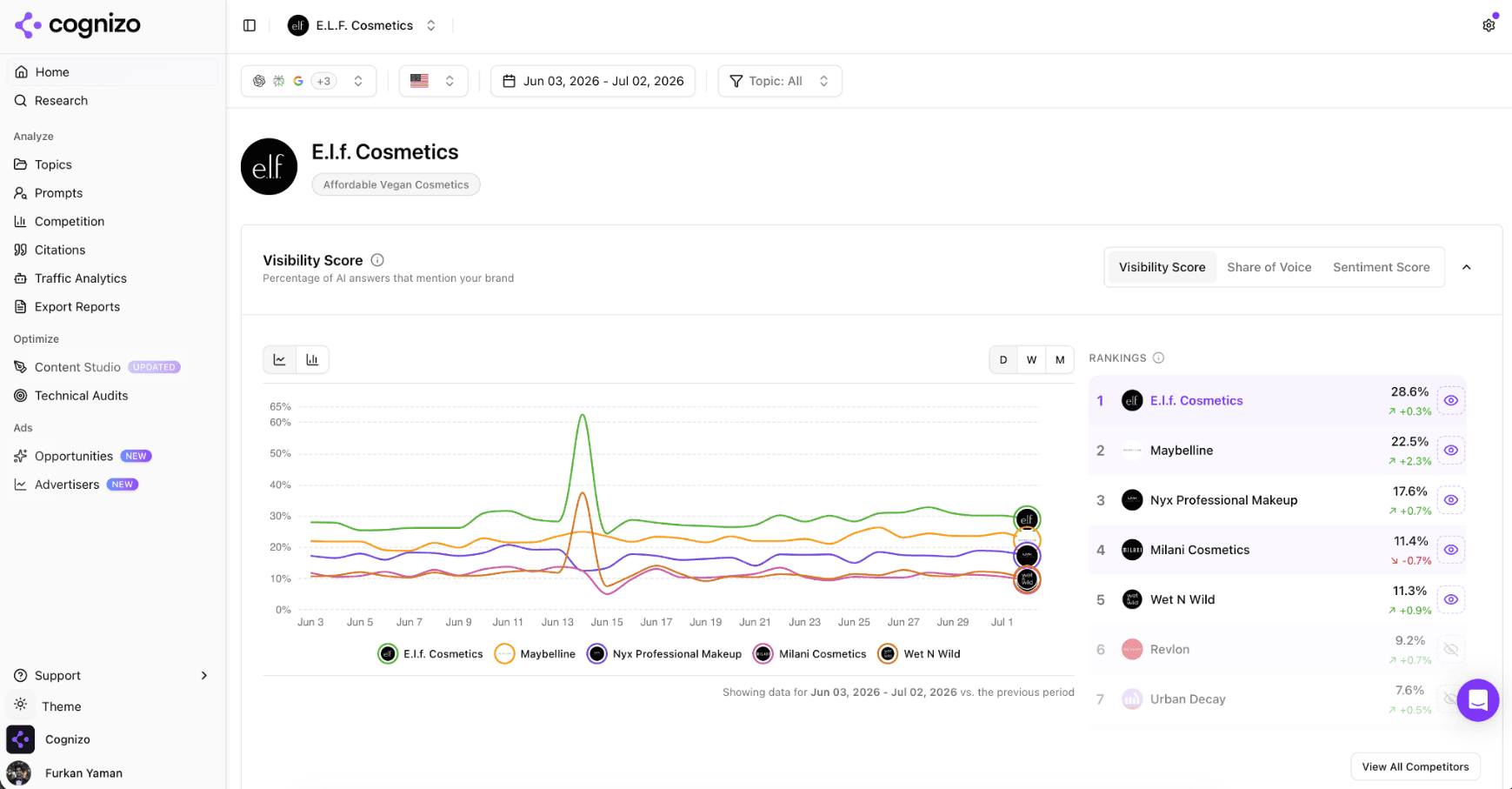
Cognizo is an AI visibility and answer engine optimization platform that pairs tracking with content execution. Instead of handing your team a list of fixes, it researches prompts, drafts content, and publishes it for you.
Key features:
- An automated content agent that handles drafting and publishing, included from the Growth tier.
- Measures source mention rate and positioning accuracy alongside core visibility metrics.
- Captures the rendered answer a buyer actually sees, not just API sampled responses.
- Expands a starting question set into relevant buyer topics.
- Connects GPTBot, ClaudeBot, and OAI-SearchBot activity to referral sessions and conversions.
- Tracks paid placements alongside organic visibility.
Pricing: Growth costs $499/month for 150 prompts and eight articles, while Pro costs $999/month for 350 prompts and 20 articles. Enterprise pricing is custom.
User interface: Overall, it is clean, with visibility, share of voice, and sentiment scores alongside competitor trend charts, plus insights and optimization tools in the sidebar.
What users say: G2 reviewers value responsive support and practical guidance. Some note that measurable results take time.
Pros:
- Growth includes a customer success partner to support implementation
- Agency partnerships offer branded reporting and consolidated billing
- Pro increases content capacity without requiring an Enterprise contract
Cons:
- Even for $999/month, it only supports tracking across 5 AI platforms.
- Its overall pricing is expensive
- The interface can be overwhelming due to all the data that is available
Best suited for:
- Startups, small-to-medium-sized businesses (SMBs), enterprise marketing teams, and digital marketing/PR agencies
3. Profound
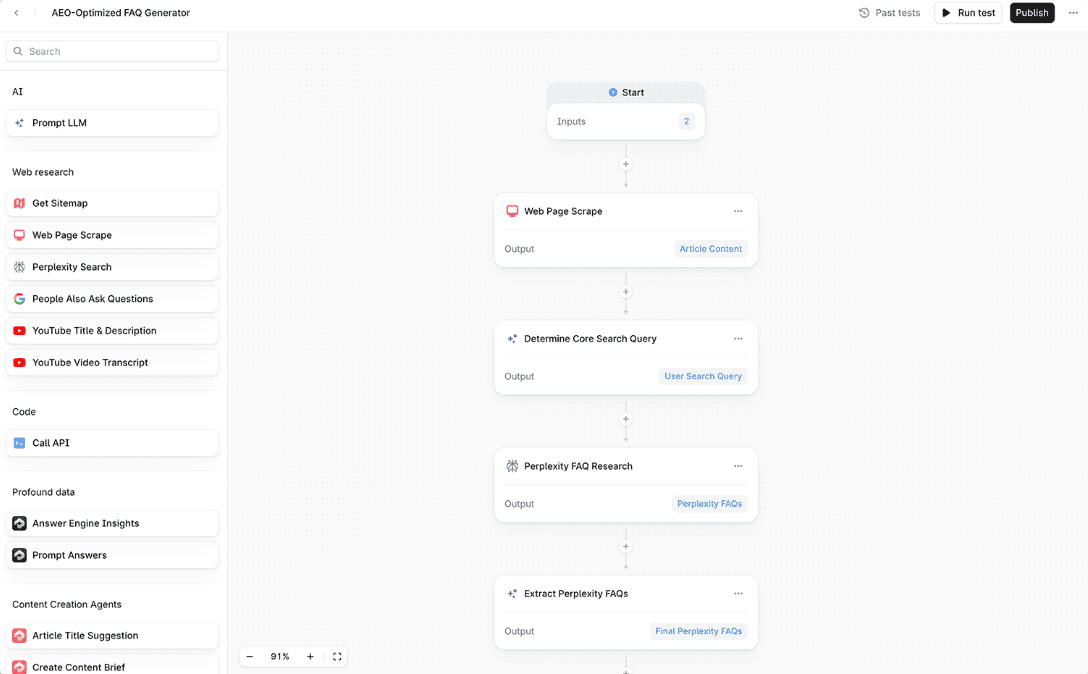
Profound is a GEO platform; it helps brands track and improve AI search visibility across ChatGPT, Perplexity, Google AI Overviews, and other answer engines.
Key features:
- Answer Engine Insights that break down visibility by persona, region, and topic, showing how different buyer groups see your brand
- Prompt Volumes that estimate how often real users ask each question, so you can prioritize prompts by demand
- Agent Analytics that flags crawler errors and supports AI traffic attribution for visits from answer engines
- Agents that create content grounded in your Brand Hub and knowledge bases, keeping messaging consistent across teams
Pricing: Free trial and then custom quotes.
User interface: Well organized and polished, with tabs for prompts, regions, personas, and citations above a visibility score chart, ranked asset table, and bulk answer exports.
What users say: G2 reviewers appreciate analytical depth and agent workflows. Some find the volume of data difficult to navigate initially.
Pros:
- Rated 4.5/5 from over 1,100 G2 reviews
- Offers SOC 2, SSO, and role-based access for enterprise teams
Cons:
- Pricing is available only through sales calls, and G2 reviewers often describe it as expensive, unlike many Profound alternatives that publish their plans.
Best suited for:
- Enterprise brands and agencies that need secure GEO reporting and formal procurement reviews
Also read:
4. Peec AI
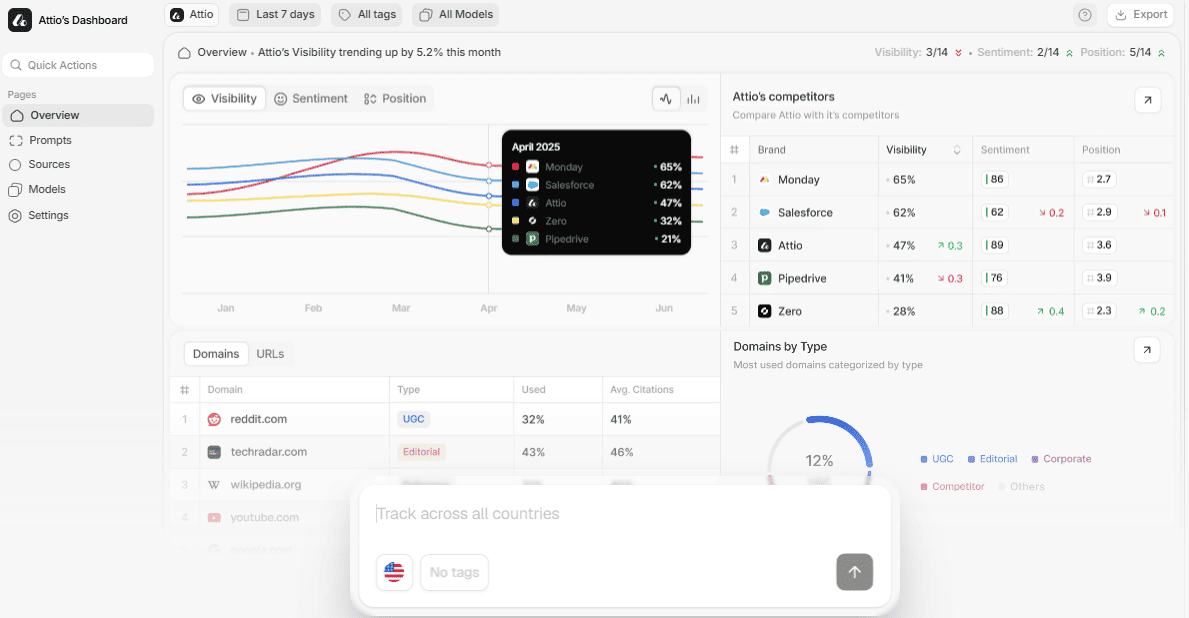
Peec AI is an AI search analytics platform that shows how your brand appears in AI answers and which sources shape them. Its research-focused approach makes it one of the best analytical generative engine optimization tools for comparing performance across brands, websites, and markets.
Key features:
- Prompt suggestions based on your website, giving you a relevant starting question set without manual research
- Historical answer views that show how AI recommendations for the same prompt shift over time
- Source analytics that pinpoint the domains and pages behind each answer, useful for planning outreach
- Prompt classification by branded intent, commercial intent, and topic
- Actions that rank opportunities to improve AI visibility and group them into earned media and owned content, so teams know where to focus first
Pricing: Starter costs $95/month for 50 prompts and three models, Pro costs $245/month for 150 prompts, and Advanced costs $495/month for 350 prompts. Enterprise pricing is custom.
User interface: Straightforward and data-rich, with one overview pairing brand rankings by visibility, sentiment, and position with top cited domains labeled by type.
What users say: G2 reviewers find source discovery useful. Some struggle to connect individual content changes with later visibility gains.
Pros:
- Self-service signup makes it practical to launch a small pilot
- Unlimited users on every tier
- Daily tracking across all self-service plans
Cons:
- Self-service plans include three active models, which is restrictive compared to the other top GEO platforms covered in this guide; additional coverage increases the subscription cost, which is one reason teams look at Peec AI alternatives
- Starter includes one project, which limits separate reporting for additional owned brands
Best suited for:
- Mid-Market to Enterprise Companies
- International & Multilingual Brands
Also read:
5. Surfer
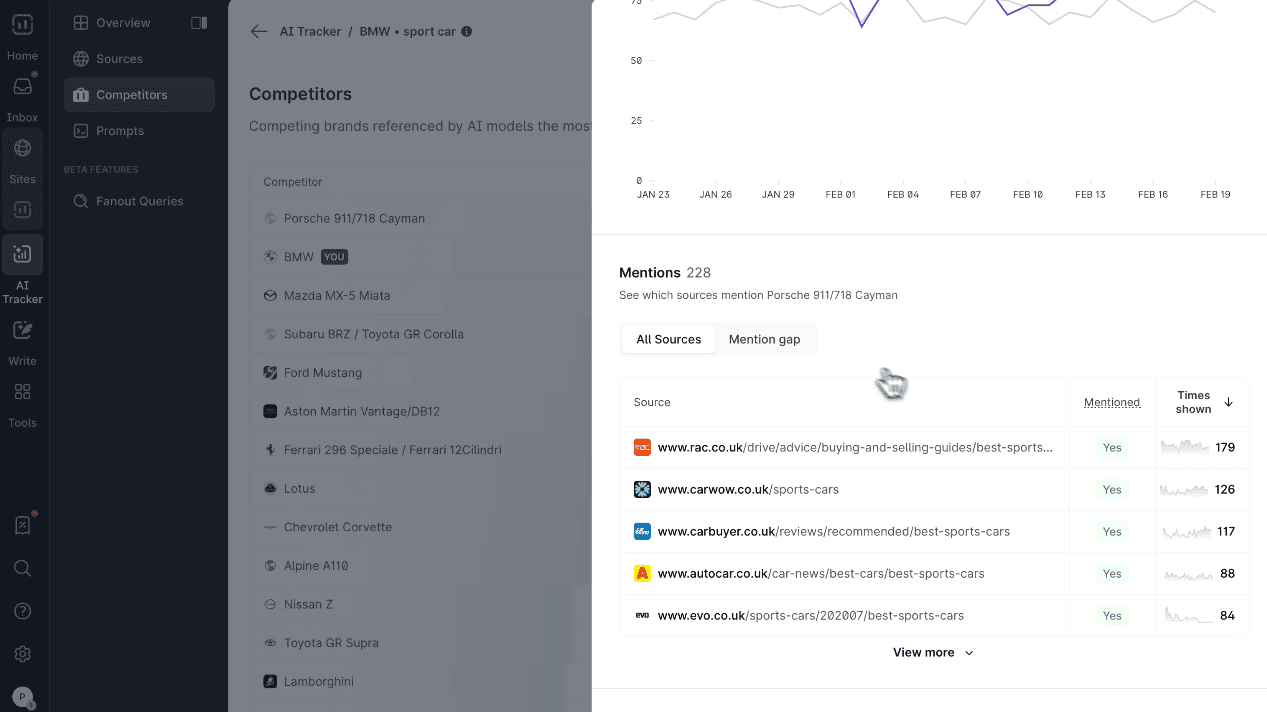
Surfer adds GEO tracking to its content creation and optimization workspace, making it one of the few generative AI SEO tools that let you spot gaps in AI answers and fix the relevant pages in one place.
Key features:
- AI Tracker for visibility score, mention gaps, share of voice, and sentiment
- Content Editor with live guidelines and a Content Score
- Content Audit that flags ranking drops and quick win refreshes
- Topical Map for planning content clusters
- One-click internal linking and content optimization
- AI writing assistant, detector, and humanizer
Pricing: Standard costs $119/month for 25 weekly ChatGPT prompts, Pro costs $219/month for 50 daily prompts, and Peace of Mind costs $359/month for 100 daily prompts. Standalone AI Search Analytics costs $95/month.
User interface: Easy to scan, with competitor comparisons, prompt scores, and top cited sources visible at a glance, alongside the content tools in the same workspace.
What users say: G2 reviewers like the editor and scoring guidance. Some question subscription costs for smaller publishing teams.
Pros:
- Offers extensive knowledge and help-based resources through the Surfer academy which make product usage and understanding easier
- Plagiarism detection and cannibalization reports support editorial quality checks beyond AI tracking
Cons:
- Covers five platforms but excludes Claude, Copilot, Grok, and DeepSeek
- The Standard tier, even at $119 per month, refreshes prompts weekly; daily tracking requires a different package
Best suited for:
- Content-led SaaS companies
- Businesses relying heavily on inbound marketing
Out of every 100 prompts, how many answers came back with no web citations?
ChatGPT
29.7%
Gemini
0.6%
Each dot is one prompt; filled dots returned no web citations. Based on our study of 40,617 matched answers. Read the full study
6. Semrush AI Visibility Toolkit
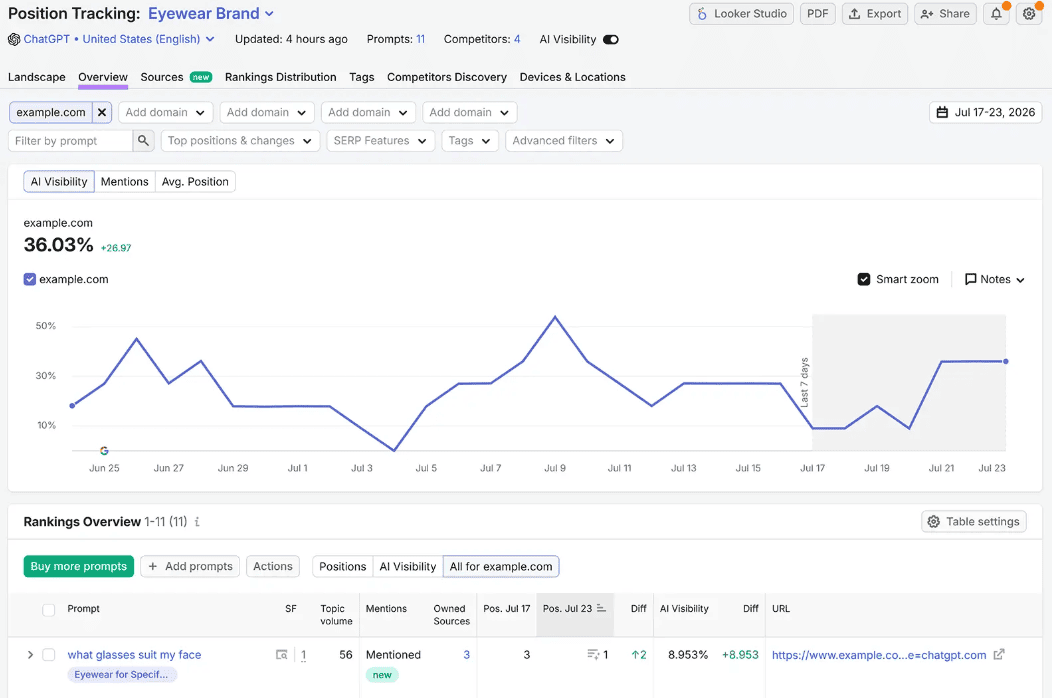
The Semrush AI Visibility Toolkit adds GEO capabilities to the Semrush ecosystem, placing AI search insights beside SEO and technical reports. It extends your existing SERP rank tracking and improvement setup instead of adding another platform to manage.
Key features:
- Visibility Overview built on a broad prompt database for category discovery
- Brand Performance reports covering how AI perceives your brand in each market
- Narrative Drivers that reveal the themes shaping how AI describes your brand
- Questions report showing what users ask AI about your brand
- AI Search Site Audit for up to 100 pages
- Worldwide and region-specific visibility benchmarking
Pricing: Base costs $99/month per domain; 50 extra prompts cost $60/month; extra domains or user licenses cost $99/month each.
User interface: Familiar for existing Semrush users, with country and platform filters, side-by-side competitor scores, and insight cards suggesting topics to target.
What users say: Reviewers like how the sentiment analysis turns AI answers into clear metrics and how My Reports produces presentation-ready slides. Some question how scores like market share are calculated.
Pros:
- Prompt Tracking supports over 220 countries and territories
Cons:
- Base limits custom tracking to 25 prompts
- Brand Performance refreshes weekly, so it should not replace daily prompt-level checks
- Multi-domain and multi-user setups can become expensive, which is why many teams compare Semrush AI Visibility Toolkit alternatives
- Its GEO recommendations can feel a little broad and generic.
Best suited for:
- In-house SEO teams expanding established keyword and competitor research into AI search
Also read:
7. Otterly.ai
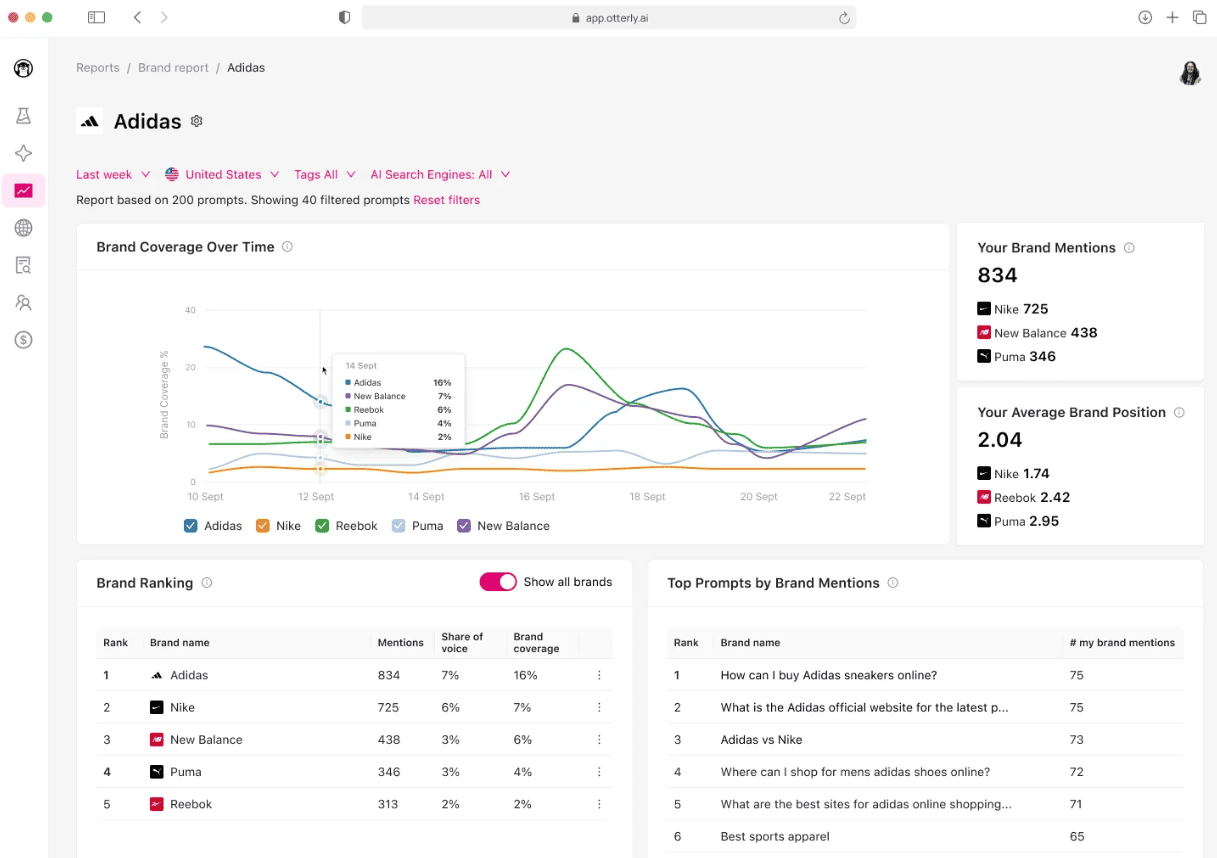
Next in our list of best generative engine optimization tools is Otterly. It is an affordable generative engine visibility tracking and optimization platform for teams starting with a small prompt set.
Key features:
- Brand Visibility Index that rolls mentions and coverage into one KPI tracked over time
- Link citation analysis that monitors which URLs AI engines cite and how their positions shift each week
- Covers crawlability, content structure, PageSpeed, and AI readiness, which make it one of the finest GEO audit tools in the industry
- Client workspaces, each with its own members, prompts, and reports
Pricing: Lite costs $29/month for 20 prompts, Standard costs $189/month for 160 prompts, and Premium costs $489/month for 535 prompts. Enterprise starts at $1,000/month. Every plan tracks any 3 of Otterly's 7 AI platforms.
User interface: Beginner-friendly, with brand coverage over time, mention counts, and average position shown against competitors, plus the prompts driving the most mentions.
What users say: G2 reviewers value quick setup. Some want more advanced filtering and flexible historical reporting.
Pros:
- Includes unlimited team members and brand reports on every plan
- Supports more than 65 countries for regional tracking
Cons:
- Every self serve plan tracks only 3 of its 7 engines at a time, and each Claude answer uses 3 credits, which is where many teams start comparing Otterly AI alternatives
- Lite supports just one workspace and three weekly recommendations
- API, MCP, and Agent Analytics are unavailable on Lite
- Lite cannot buy extra credit packs
Best suited for:
- Solo marketers and smaller teams starting GEO monitoring
Also read:
8. Goodie AI
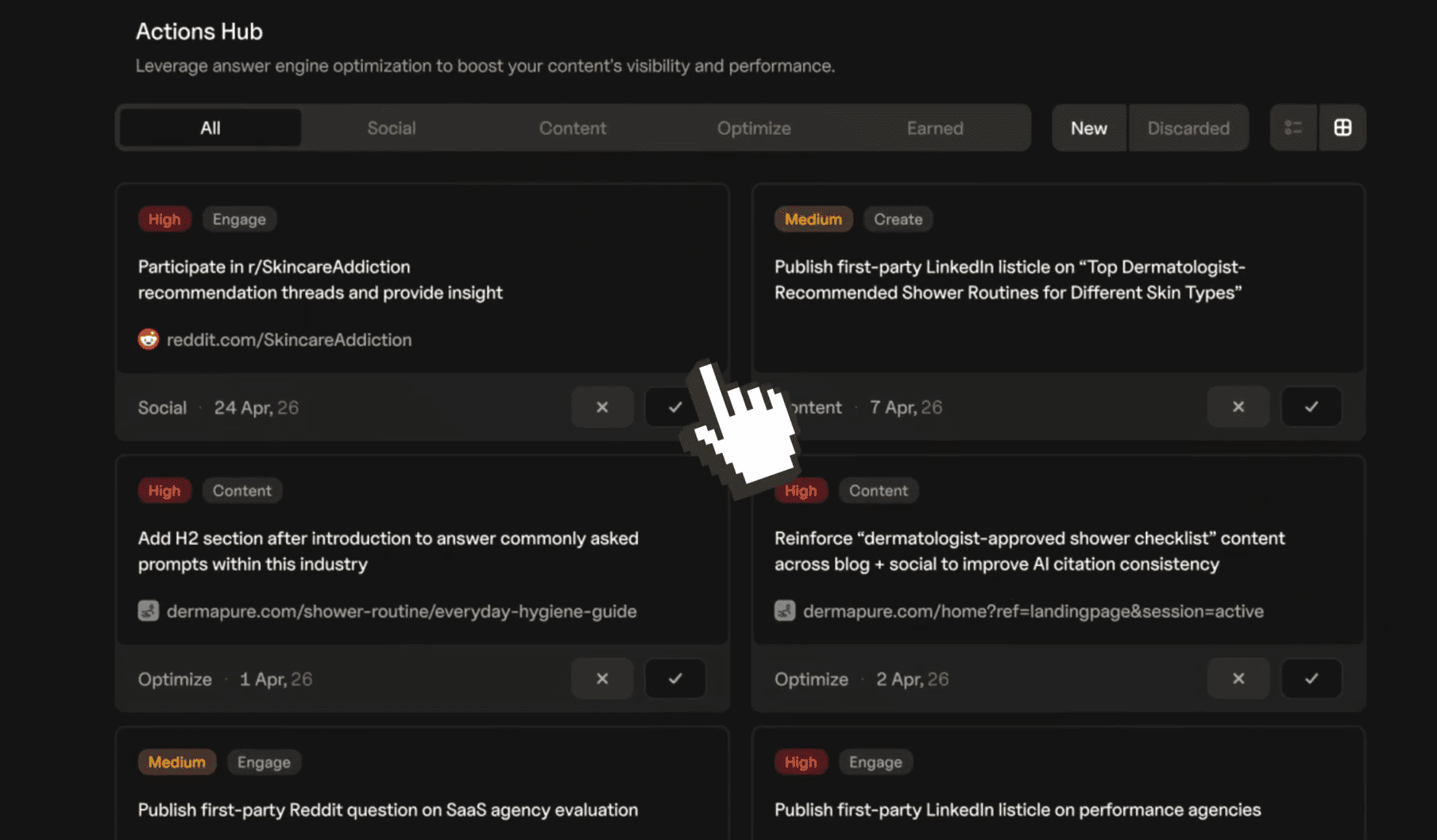
Goodie AI is one of the top generative engine optimization tools that connects AI visibility tracking with content, technical fixes, and revenue measurement.
Key features:
- Agentic Commerce Suite that tracks product visibility by SKU across ChatGPT Shopping, Amazon Rufus, Perplexity Shopping, and Google AI Mode Shopping
- Revenue attribution through Google Analytics, linking AI visibility to sessions, leads, and conversions
- Technical Agent that repairs llms.txt files and sitemaps
- Outreach and Social agents that extend GEO work beyond your own website
- Page Visibility Scorecard for rating individual pages on AI readiness
Pricing: Core costs $354/month for 110 prompts across five models, and Pro costs $1,198.80/month for 250 prompts across eight models. Enterprise pricing is custom.
User interface: Intuitive and modern, with monitoring and content creation workflows that are easy to follow even for first-time users.
What users say: G2 reviewers rate Goodie 4.9/5, praising its revenue measurement, its tracing of citations back to specific sources, and its hands-on onboarding support. Some mention that a few features are still in beta.
Pros:
- One of the best generative engine optimization tools with AI tracking supported across 13 models
- Country and location-based GEO analytics are available across all plans
Cons:
- Agencies switching between client workspaces often have to sign out and back in
- Several users report that the tool launches too many new features, due to which it can be hard to keep up with it
- Pricing sits at the higher end of the self-service tools on this list
Best suited for:
- Established brands treating AI search as a measurable acquisition channel
- E-commerce teams tracking product visibility across AI shopping experiences
9. Trakkr
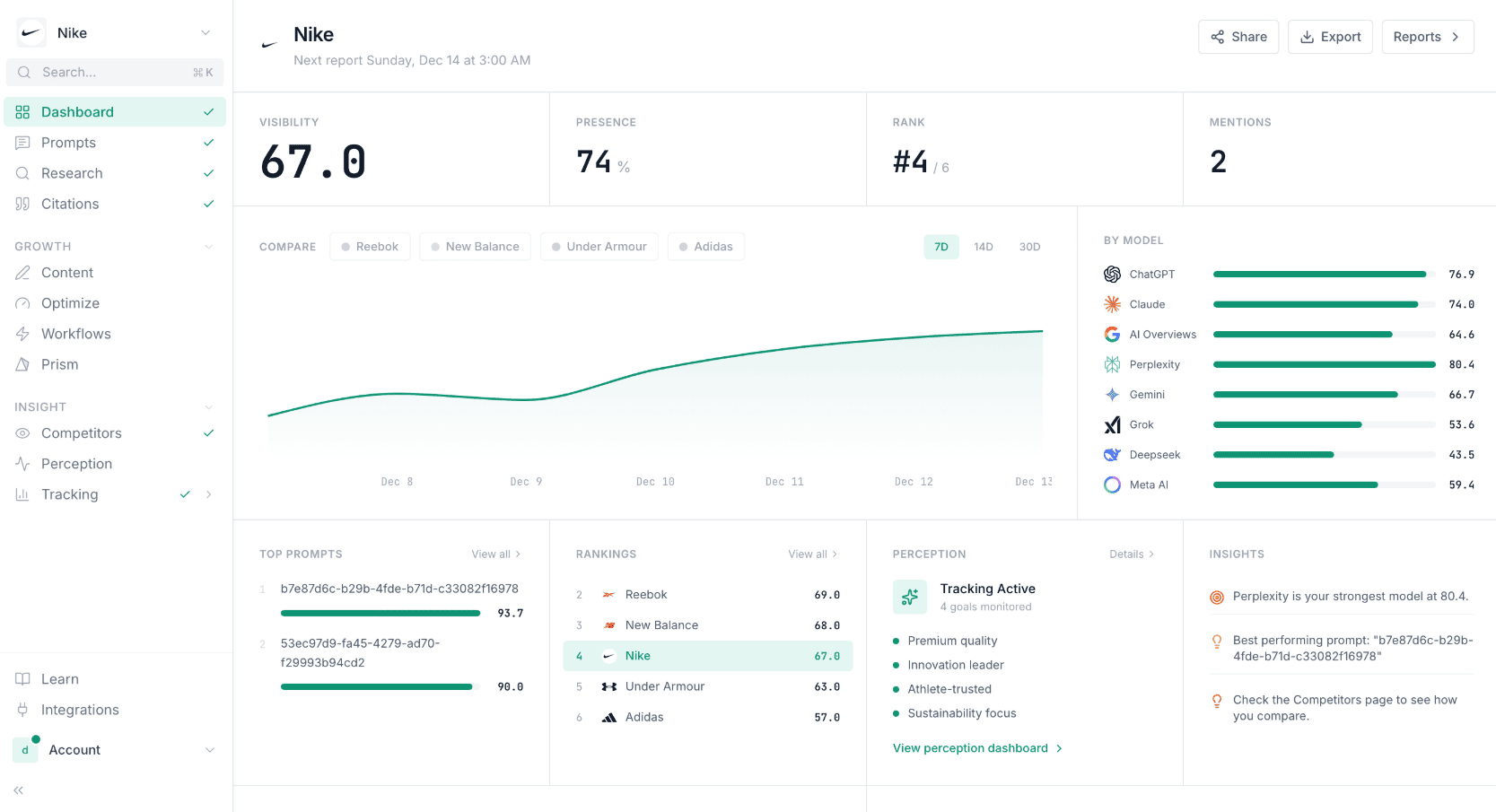
Trakkr is the next GEO tool in our list. It pairs AI brand mention monitoring with site optimization. Its flat pricing and full model coverage on every plan make costs easy to predict as you scale.
Key features:
- Reddit intelligence that shows which community discussions influence AI answers about your brand
- Perception analysis across 20 dimensions, including trust, quality, innovation, and value
- AI crawler optimization and technical recommendations for your site
- Automations and Google Sheets sync for recurring reporting
- White-label client portals on Scale
Pricing: Growth costs $100/month for one brand and 50 prompts. Scale costs $500/month for ten brands with 50 prompts each. Enterprise uses custom pricing.
User interface: Thoughtfully designed, with key metrics, competitor standings, prioritized actions, and site health brought together so you can see what changed and what to fix next.
What users say: Public reviews are limited so far, but the one verified G2 review praises how Trakkr turns unpredictable AI model behavior into clear daily visibility scores.
Pros:
- All eight AI models included on every plan, with no extra fees for models
- Scale provides full history and unlimited alerts for ongoing client reviews
Cons:
- Self-service plans cap tracking at 50 prompts per brand, which can restrict larger product catalogs
- Moving from Growth to Scale raises the monthly subscription from $100 to $500
Best suited for:
- Brand marketing teams, product marketing teams, demand generation teams, growth-focused founders, and marketing agencies
10. GetCito
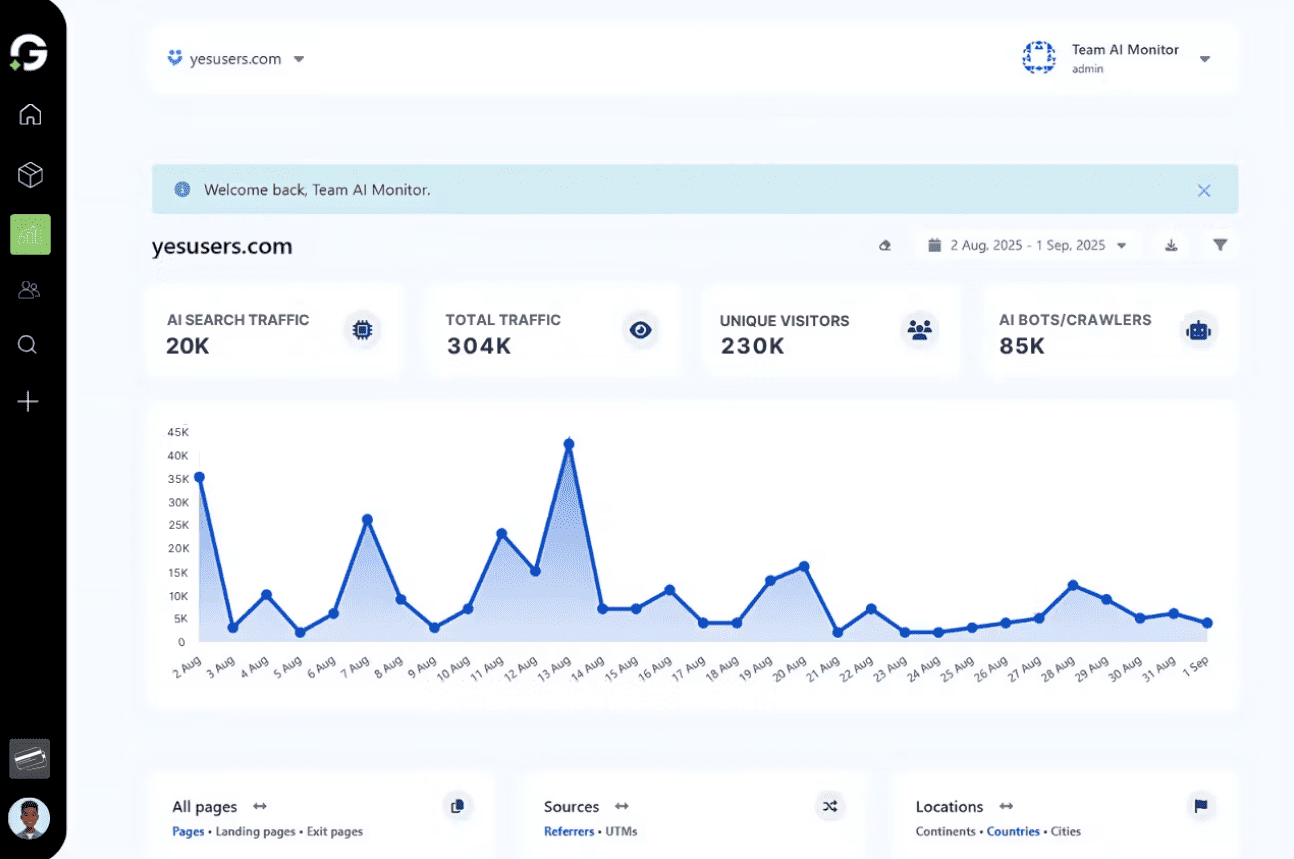
GetCito is one of the few open-source generative engine optimization tools that allow you to inspect, customize, and host the code yourself.
Key features:
- Open-source checker under the MIT license
- Competitor radar across your prompt set
- Crawl clinic that reviews schema and structure
- Hallucination detection that flags misinformation in AI responses about your brand
- Specialist-led service plans that handle GEO execution on your behalf
- Custom connections with CRM, analytics, BI, and marketing tools on Enterprise
Pricing: The self-hosted version is free when you provide the API keys. Growth costs $599/month, while Scale costs $999/month. Enterprise pricing is custom.
User interface: Functional and no-frills, focused on getting tracking data in front of you rather than on visual polish.
What users say: Users on G2 praise its quick setup, easy-to-read reports, and fast customer support. Though, a common complaint is the lack of a mobile app.
Pros:
- Managed plans include human content, technical, and community specialists, which is quite rare in our list of best generative engine optimization tools.
Cons:
- Growth includes 50 monitored prompts for $599/month and covers one region
- Self-hosted data refreshes weekly, not daily
- You pay your own API costs
Best suited for:
- Technical teams and SEO engineers
- Enterprises & Global Brands
Best GEO Tools by Industry
| Industry group | Best picks | Why they fit |
|---|---|---|
| Best GEO tools for ecommerce brands | Goodie AI | Shows which SKUs assistants like Amazon Rufus recommend, not just whether the brand appears. |
| Best GEO tools for B2B SaaS | MentionBird | Monitors feature and pricing comparisons daily, with advice for winning queries rivals own. |
| Best GEO tools for healthcare | Profound | SOC 2, SSO, and role-based access support compliance and legal reviews. |
| Best GEO tools for fintech brands | Goodie AI | Links answer engine referrals to signups, vital when each lead is costly. |
| Best GEO tools for cybersecurity companies | Peec AI | Catches outdated or wrong capability claims before they spread. |
Top Free Generative Engine Optimization Tools
- Siftly: Its free plan includes 100 AI responses a month, enough to build a quick visibility baseline.
- LLMrefs: Starts free at $0/month, with a $79 Pro plan available once you need more tracking.
- iBeacon AI: Offers a free forever plan for ongoing basic AI visibility monitoring.
GEO Tools That Did Not Make This List
These options serve additional workflows beyond this ten-tool shortlist. Compare their current fit before ruling them out:
- HubSpot AEO: Its ongoing tracking product still carries a beta label and offers AI search visibility tracking only across 3 platforms.
- Brandlight: Focuses on enterprise brand intelligence, commerce, and wider AI discovery programs.
- ZipTie.dev: Limits every standard plan to one seat and doesn’t track Claude or Gemini.
How to Choose the Right GEO Tool
Here is how to finalize one solution from the above shared list of best generative engine optimization tools:
- Start with your workflow: Decide whether you need tracking, technical audits, content execution, or a combined SEO and GEO workspace.
- Fit your marketing budget: Factor in add-ons and annual commitments, not just the advertised starting price.
- Check setup time: You should be able to add prompts, competitors, and markets within a day.
- Match platform coverage: Track the AI platforms your buyers use. If X is your main channel, for example, choose a tool that supports Grok.
- Check refresh frequency: Daily tracking catches shifts in AI answers that weekly updates can miss.
- Ask how data is collected: Tools that capture the answer a buyer actually sees can report different results from those that query models through an API.
- Plan for growth: Confirm the tool can add prompts, brands, seats, and markets as your program expands.
- Review support quality: Test response times and onboarding help before committing.
- Assess the vendor’s track record: In a young category like AI search visibility, favor tools with steady updates and positive long-term reviews.
Also read:
Final Thoughts on the Best GEO Tools
AI answers now decide which brands make a buyer’s shortlist, and the generative engine optimization tools above each offer a different route to earning that spot. Whichever you choose, the real gains come from acting on what the data reveals, not just watching scores move.
Get your GEO baseline before you pick a tool
Check whether ChatGPT names your brand for five buyer questions, which competitors it recommends, and which pages it cites. Free, no signup.
Get your free AI Visibility ReportFrequently Asked Questions
- What is the difference between GEO tools and SEO tools?
SEO tools measure search rankings, backlinks, and website performance. GEO tools analyze brand mentions, recommendations, citations, and competing brands within generated AI answers.
- I manage a growing brand and need a GEO platform that explains where we are missing from AI answers. What tools can help?
MentionBird identifies missed buyer prompts and provides GEO tips. Cognizo adds automated publishing, while Peec AI helps investigate sources and competitive gaps across projects.
- What GEO tools do Reddit users recommend?
Reddit commenters mention Otterly.ai, Peec AI, and Profound. Recommendations vary by budget. Check contributors’ affiliations and look for detailed testing evidence before choosing.
- Which GEO tool is best if I need security reviews, SSO, and role-based access?
Profound Enterprise is a strong starting point for security reviews, SSO, and role-based access. Request its current security documentation and confirm permissions before purchasing.
- Which AI search optimization/GEO platforms track AI model versions, like GPT-4 versus GPT-4o?
Peec AI distinguishes some named models, including Claude Sonnet and GPT Search options. Exact version comparisons require model-level records; platform labels alone cannot establish version tracking.
- What are the best-regarded tools for managing Amazon GEO strategies for enterprise sellers?
Goodie offers Amazon shopping and Walmart Sparky coverage on eligible plans. Enterprise sellers should verify marketplace support, SKU matching, and reporting access before choosing a package.
- Can I export ranking data for commerce teams from AI search optimization/GEO platforms?
Yes, most GEO tools offer that functionality. For example, MentionBird supports CSV exports, while Profound Enterprise offers CSV, JSON, and API access.
- What GEO visibility tools easily connect with Google Analytics?
Goodie and Profound offer Google Analytics connections for AI referral analysis. Confirm GA4 permissions and conversion setup, since prompt visibility does not prove a specific referral journey.
- Is SEO dead now with AI?
No. Crawlable pages, useful content, and established authority still support discovery. GEO adds measurement of generated answers, helping teams assess visibility beyond traditional search rankings.

Start Winning More AI Recommendations
First month $19 with code TRY19, then $79/mo. Cancel anytime.