AI Sentiment
AI sentiment is the tone an AI answer engine uses when it describes your brand, from an enthusiastic recommendation to a neutral listing to a warning about weaknesses.
- AI sentiment is about the words around your name: whether AI praises you, lists you plainly, or adds a warning.
- Most brand mentions in AI answers are neutral, so the bigger opportunity is earning endorsements rather than avoiding criticism.
- AI forms its view from reviews, comparison articles, community threads, and news, and it gives outside voices more weight than your own claims.
- The phrases that keep showing up next to your name, like "expensive" or "hard to set up," point to exactly what needs fixing, especially when rivals are described more warmly.
- MentionBird scores sentiment across up to 20 AI platforms, with a label on each mention and a net score from minus 100 to plus 100 for every prompt.
What AI sentiment sounds like
Two answers can both name your brand and leave buyers with opposite impressions. The difference is in the words around your name.

Sentiment is rarely stated outright. It shows up in small choices: whether AI calls you the best pick or just an option, which strengths it repeats, and whether it adds a "but" after your name.
The real problem is neutral, not negative
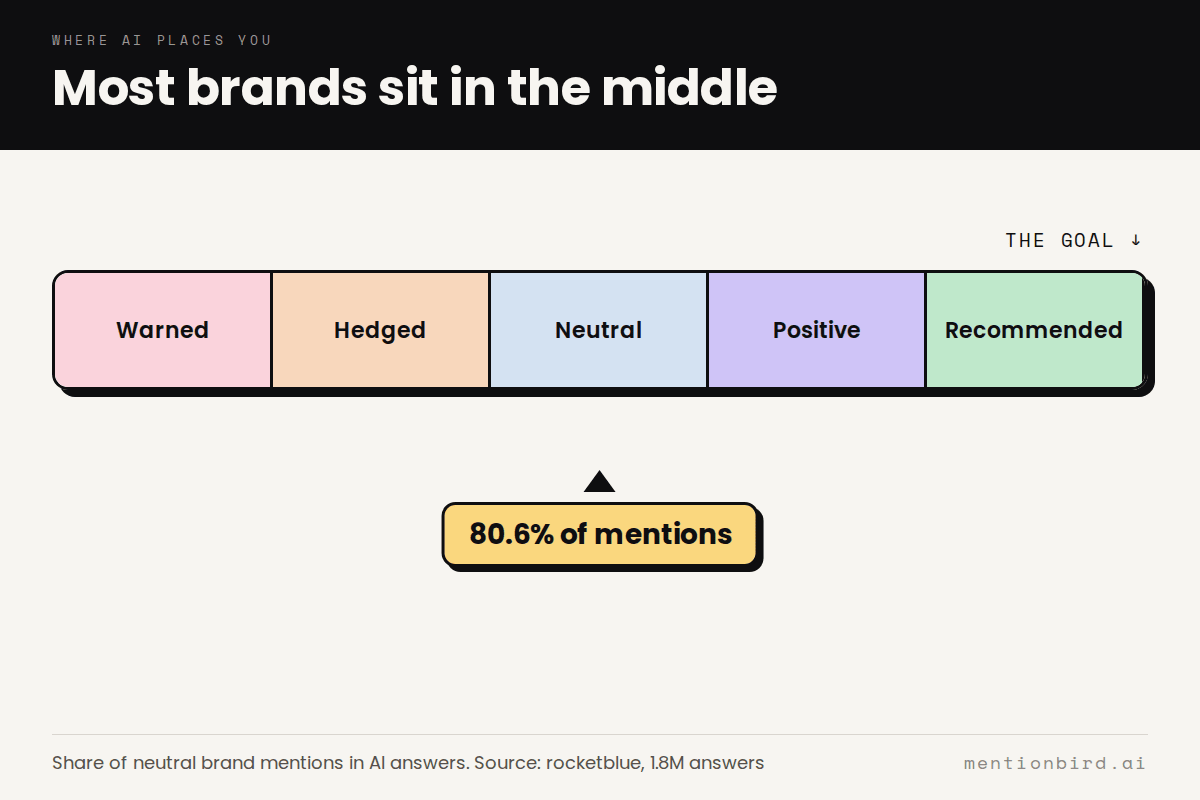
Openly negative answers are uncommon. In a rocketblue analysis of 1.8 million AI answers that named a brand, 80.6% of mentions were neutral, 18.4% were positive, and only about 1% were negative.
That means most brands are named without being endorsed. A neutral mention keeps you on the list but gives buyers no reason to choose you, so the goal is to move up the scale, not just avoid the bottom of it.
Where AI gets its opinion
- Reviews and ratings: Patterns across review sites, both praise and complaints, often become the strengths and weaknesses AI repeats.
- Comparison articles: How third party roundups rank and describe you shapes whether AI calls you a leader or an alternative.
- Community threads: Forum discussions add the informal verdicts, like "great support" or "hard to set up," that AI likes to quote.
- News and controversy: Outages, lawsuits, or bad press can attach a warning to your name long after the story fades.
- Your own claims: AI reads your site too, but it tends to weigh what others say about you more heavily than what you say about yourself.
How to measure AI sentiment
- Collect the answers that name you: Use the same set of buying prompts on each platform so the answers can be compared.
- Place each mention on the scale: Mark it as recommended, positive, neutral, hedged, or warned.
- Log the caveats: Note the exact phrases that follow your name, like "expensive" or "limited integrations." Repeated phrases point to what needs fixing.
- Compare against competitors: A neutral score means more when you can see whether rivals are described more warmly.
Read what ChatGPT actually says about you
Get the full answer text for five buyer questions, see whether you are named, who is named instead, and which sources shaped the answer. Free, no signup.
Get your free AI Visibility ReportHow to improve AI sentiment
- Fix the caveat at its source: If AI keeps repeating a complaint, find the reviews or articles it comes from and address them.
- Close the gap behind the criticism: When a weakness is real, fixing the product does more than any content change.
- Publish proof for your strengths: Case studies, benchmarks, and customer stories give AI specific reasons to describe you positively.
- Update outdated complaints: If an old problem is solved, say so clearly on your site and in your listings so newer pages outweigh older ones.
- Encourage detailed reviews: Specific reviews that explain why customers chose you give AI better language to work with than star ratings alone.
How MentionBird helps track and improve AI sentiment
Here's how MentionBird helps to see how AI frames your brand and what you can do about it:
- A label on every scored mention: Each brand named in an answer gets a Positive or Negative pill on the run card. Hover over it to read why that label was chosen.
- A net sentiment score per prompt: The prompt table shows one number per prompt, from minus 100 to plus 100, rolled up from every mention in range. All positive framing scores plus 100, all negative scores minus 100, and an even split sits near zero.
- Neutral stays quiet: A plain shortlist mention is the resting state of an AI answer, so it carries no badge. Only positive and negative framing gets flagged, which keeps the signal readable.
- A dash is not a zero: An empty cell means a prompt has not been scored yet. MentionBird also shows the share of each prompt's mentions that carry a label, so you can tell a thin reading from a settled one.
- Sentiment and visibility side by side: A brand named first but called the expensive option and a brand named third but recommended outright can have identical visibility and opposite sentiment. Seeing both shows which problem you actually have.
- Available wherever your data goes: Sentiment is available through MCP and the API, for individual mentions as well as the per prompt score.
Additionally, you can see the response of every tracked prompt in full, along with the sources it cited. So when a Negative pill appears, you can read the exact words behind it and see which page AI took them from. That way, you know exactly which review, article, or listing to fix first (if possible.)
FAQs
1. Is AI sentiment the same as social media sentiment?
No. Social sentiment measures what people post. AI sentiment measures how an AI assistant summarizes your brand, which blends many sources into a single verdict.
2. Can AI describe my brand negatively even with good reviews?
Yes. AI may lean on older reviews, a single widely shared complaint, or a comparison article that favors a rival.
3. Does sentiment affect whether AI recommends me?
It can. Brands described with clear strengths are more likely to be named as a top pick rather than one option among many.
4. Can I ask AI to change how it describes my brand?
Not directly. Feedback buttons exist, but lasting change comes from the sources AI reads, not from requests.
5. How often should I review AI sentiment?
Monthly is a good rhythm for most brands, and right away after a launch, a price change, or negative press.
Read how every AI platform describes your brand
First month $19 with code TRY19, then $79/mo. Cancel anytime.