10 Best AI Visibility Tools To Try in 2026 [Free + Paid]
- AI answers shape buyer shortlists, making brand mentions, citations, and competitor visibility important performance signals.
- MentionBird suits AEO teams, agencies, and brands in the SaaS, e-commerce and local service industries needing prompt-level ranking advice, broad platform coverage, and competitor insights.
- Profound supports enterprises requiring scalable reporting, crawler data, conversion attribution, and governance controls making it ideal for the healthcare and legal industry.
- Peec AI offers clear competitor benchmarking, while AirOps connects visibility insights with automated content production.
- The best free AI visibility tools include Siftly, iBeacon AI, etc.
- Choose a tool based on platform coverage, setup time, total costs, customer support, and team requirements.
- To improve your brand's LLM presence, track buyer-intent questions, record a baseline, review complete answers and cited sources, and make changes accordingly.
Looking for the best AI visibility tools? You are in the right place. In this blog, we will cover 10 such platforms and compare them based on their features, pricing, pros, cons, AI platform coverage, integrations, and other key parameters.
By the time you reach the end of this guide, you will know exactly which AI visibility monitoring platform is right for you and also whether you need a simple visibility tool for AI search or a complete suite that also tells you what to fix.
Are you ready? Let’s start.
TL;DR: Best AI Visibility Tools
- MentionBird: For AEO teams and agencies that want more than mention and citation tracking and need ranking advice on every prompt.
- Profound: Built for enterprise brands wanting visibility measurement at scale along with automated execution with agents.
- Peec AI: A robust AI visibility platform for multi-engine tracking with strong competitor benchmarking.
- AirOps: When you want to connect AI search visibility data with automated content execution.
What Are AI Visibility Tools?
AI visibility tools track whether AI answers generated by platforms like ChatGPT and Gemini mention, recommend, or cite your brand, how competitors appear, and which sources shape those answers. Many tools also recommend next steps in marketing to win more answers.
How Do AI Visibility Tools Work?
- Set up tracking: Add your brand, competitors, buyer questions, and markets.
- Collect answers: The tool runs prompts across ChatGPT, Perplexity, Gemini, and other AI engines on a schedule.
- Analyze responses: It flags brand mentions, citations, position, and sentiment.
- Compare results: Dashboards show changes across prompts, platforms, competitors, and dates.
- Suggest improvements to enhance AI presence: Based on the generated answers, cited sources, and other factors, tools then recommend actions like adding schema markup, updating existing content, etc., so that your brand can also make it into those answers. For example, a running shoe brand might get a recommendation to publish a guide on "Best Running Shoes for Flat Feet" if competitors dominate related AI answers.
How Did We Select the Leading AI Visibility Optimization Tools Covered in this Guide?
We took into consideration several different factors while shortlisting each AI visibility platform covered in this blog:
- Platform coverage: How many AI platforms does the tool allow you to track your visibility across?
- Total number of prompts you can monitor: What’s the total number of prompts you can track across it?
- Citation analysis: Do you get to know which sources AI models are using to answer user queries?
- Competitor data: We handpicked the best AI visibility tools with competitor analysis features so that you know which brands appear alongside or in place of you and why.
- What happens next: Do they stop at just reporting AI visibility, or do they share optimization recommendations as well?
Comparison of the Best AI Visibility Platforms
This table gives you a quick comparison of the best AI visibility tools in 2026 across coverage, prompts, citations, integrations, and fit.
| Tool | Total AI platforms supported (overall) | Max prompts tracked across any plan | Citation sources shared | Competitor data | Tells you what to fix | Integrations | Best suited for |
|---|---|---|---|---|---|---|---|
| MentionBird | 20 in total on Custom: ChatGPT, Gemini, Perplexity, Claude, Grok, Google AI Overviews, Microsoft Copilot, DeepSeek, Google AI Mode, Mistral Vibe, Qwen Chat, Meta AI, Kimi AI, You.com, Ask Brave, Alexa for Shopping, Doubao, ERNIE, Poe, and Duck.ai | Unlimited on Custom | Yes, by type, format, and domain authority | Yes | Yes, AI Ranking Advice | MCP server and API | Effort-based action plans to improve both AI search and organic visibility |
| Profound | 9 | Custom on Enterprise | Yes | Yes | Yes, through the “Aim” agent | Google Analytics, WordPress, Cloudflare, Vercel, AWS, Akamai; API on Enterprise | Building agent-based AEO workflows |
| Peec AI | 13 (3 on self-serve plans) | Custom on Enterprise | Yes | Yes | Yes, via the “Actions” feature | Looker Studio (Advanced), Google Analytics, WordPress, Cloudflare, Vercel; API on Enterprise | Comparing brand positioning across topics, engines, and markets |
| Otterly AI | 7 (any 3 per plan) | Custom | Yes | Yes | Yes, via “Recommendations” | API, MCP, Looker Studio connector (Standard and above) | AI visibility, ChatGPT ads and shopping card monitoring |
| SE Visible | 5 | 1,000 on the top tier | Yes, domains and URLs | Yes | You can use the available insights and manually plan the next actions | SE Visible API, SE Ranking platform | Sharing brand-performance checks across multiple departments |
| AirOps | 7 | Custom on the top tier | Yes | Yes | Yes | Google Search Console, GA4, Webflow, WordPress, Contentful, Sanity, Strapi, Semrush, Ahrefs | Large-scale SEO and content production based on AEO data |
| Evertune | 11 | Custom | Yes, through “Sources Analysis” | Yes | Yes | No public integrations listed | Learning which brands AI prefers, based on thousands of sampled answers |
| Semrush AI Toolkit | 4 | 25, custom on Enterprise | Available | Yes | Yes, shares AI-generated guidelines | Google Search Console, Google Analytics, Looker Studio, Semrush MCP | AI + SEO workflows within the same tool |
| Yext Scout | 5 | Not available | Yes | Yes, 20 competitors | Yes, via Action Center | Yext MCP and API, Yext Knowledge Graph, 200+ publisher network | Finding branches that underperform in AI visibility within a larger location network |
| Trakkr | 8 | Unlimited on Enterprise | Yes | Yes | Yes | MCP on all plans, REST API on Scale | Citation analysis and source optimization |
Note: All the numbers and features shared above were verified from the tool developer’s official website and reflect the latest data.
10 Best AI Visibility Tools
Let’s now look at the tools that can help you track AI visibility as well as improve it.
1. MentionBird
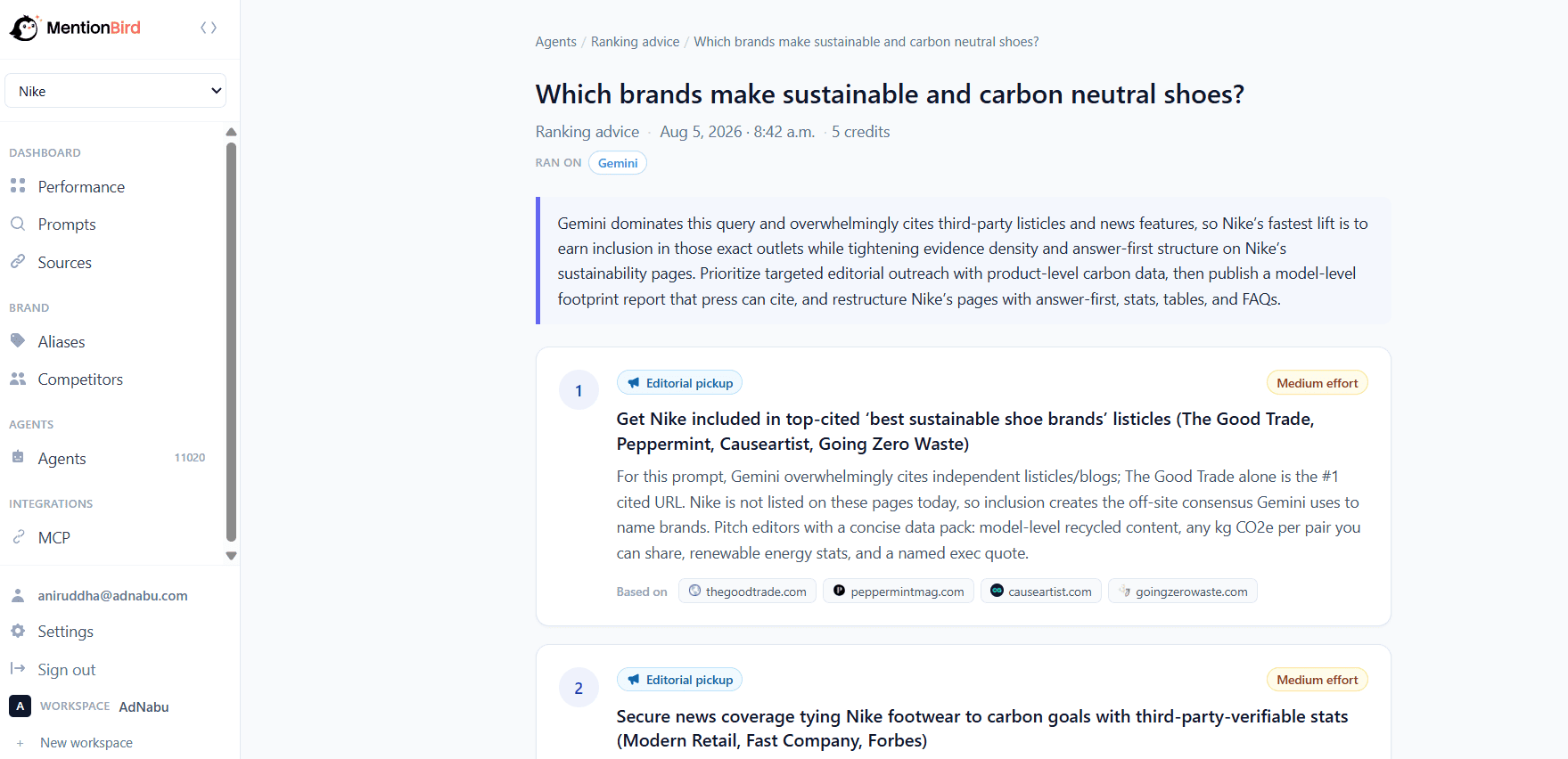
MentionBird is an answer engine optimization software. It shows where your brand stands in AI answers, which sources AI models use, and gives clear ranking advice for the prompts you are not earning mentions for but can easily win.
Key features:
- Daily prompt tracking across up to 20 AI platforms
- On-page and off-page marketing recommendations to enhance your brand presence across LLMs, which also makes it one of the best AI visibility tools for AEO as well as GEO
- Access to queries AI engines use to generate answers
- AI visibility and prominence score in comparison with your competitors
- Your share of mentions, mention rate, average position alongside competitors
- Citation data by type, format, and domain authority
- AI visibility across 50+ countries available on all plans
Pricing: Starter is $79 a month for 100 daily prompt runs and 2 platforms. Growth is $299 and allows you to track 400 prompts. Custom covers all 20.
Supported AI platforms: Up to 20 AI platforms in total on Custom, including ChatGPT, Gemini, Claude, Perplexity, Grok, DeepSeek, Microsoft Copilot, Google AI Overviews, and Google AI Mode.
Pros:
- Split prompt runs across the platforms you care about.
- 10 seats on the entry plan.
- Provides other unique features such as summaries of frequently cited YouTube videos, historical data, prompt suggestions, etc.
- Also offers multiple free tools to analyze and enhance your website’s AEO readiness.
Cons:
- No free trial.
Best suited for:
Agencies and AEO teams across e-commerce, healthcare, SaaS, or any other industry
2. Profound
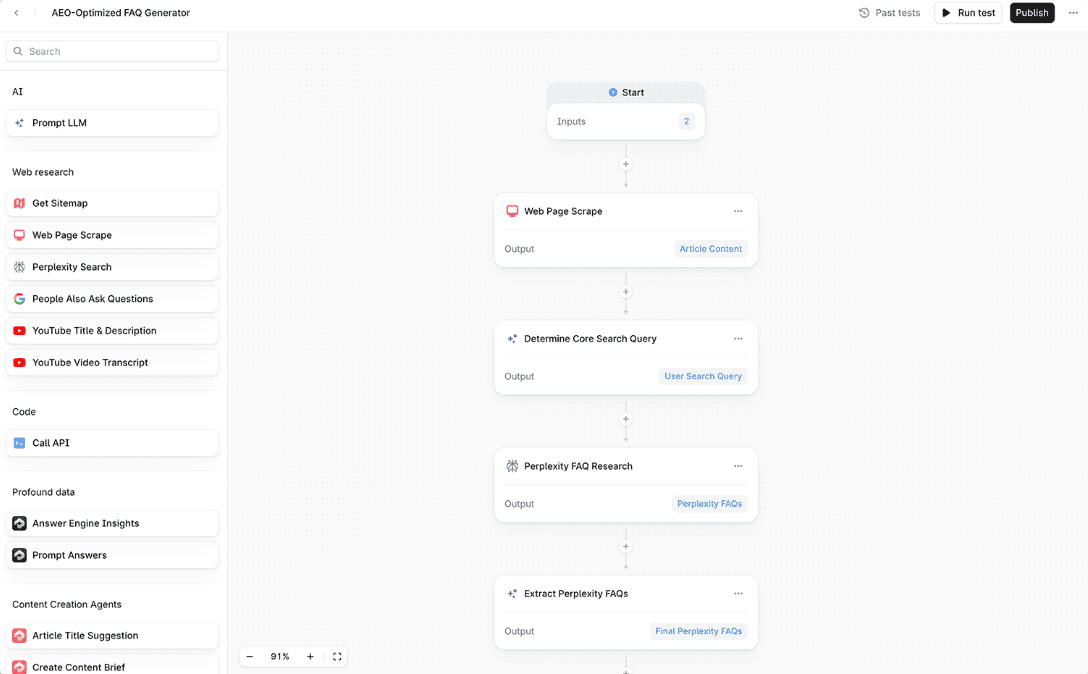
Profound is among the best AI visibility tools for enterprise teams. It suits brands with complex reporting, governance, and collaboration needs.
Key features:
- Verifies factual AI claims against your approved brand knowledge and identifies sources associated with inaccuracies.
- Uses server and CDN records to show which AI agents visit your website.
- Connects answer-engine visits with downstream website conversions through Agent Analytics.
- Makes Profound citation data available inside G2’s AI Visibility Dashboard.
- Supports SSO, SAML, and role-based permissions for managing account access.
Pricing: A free trial tracks 50 prompts daily across ChatGPT, Gemini, and Google AI Overviews for 7 days. Ongoing tracking moves to custom Enterprise pricing.
Supported AI platforms: ChatGPT, Perplexity, Google AI Mode, Gemini, Microsoft Copilot, DeepSeek, Claude, Google AI Overviews, and Exa Search.
Pros:
- Browser-sourced (front-end) responses help you understand actual customer experiences
- Daily runs reduce misleading response fluctuations
Cons:
- There is no self serve paid plan, so ongoing tracking usually needs a custom Enterprise quote, unlike many Profound alternatives that publish their plans
- We found it to be “expensive” which many other users also report on G2
- Not ideal for SMBs due to the extensive features it offers
Best suited for:
- Established teams with dedicated AEO budgets
- Retailers managing large product catalogs
Also read: MentionBird vs. Profound
3. Peec AI
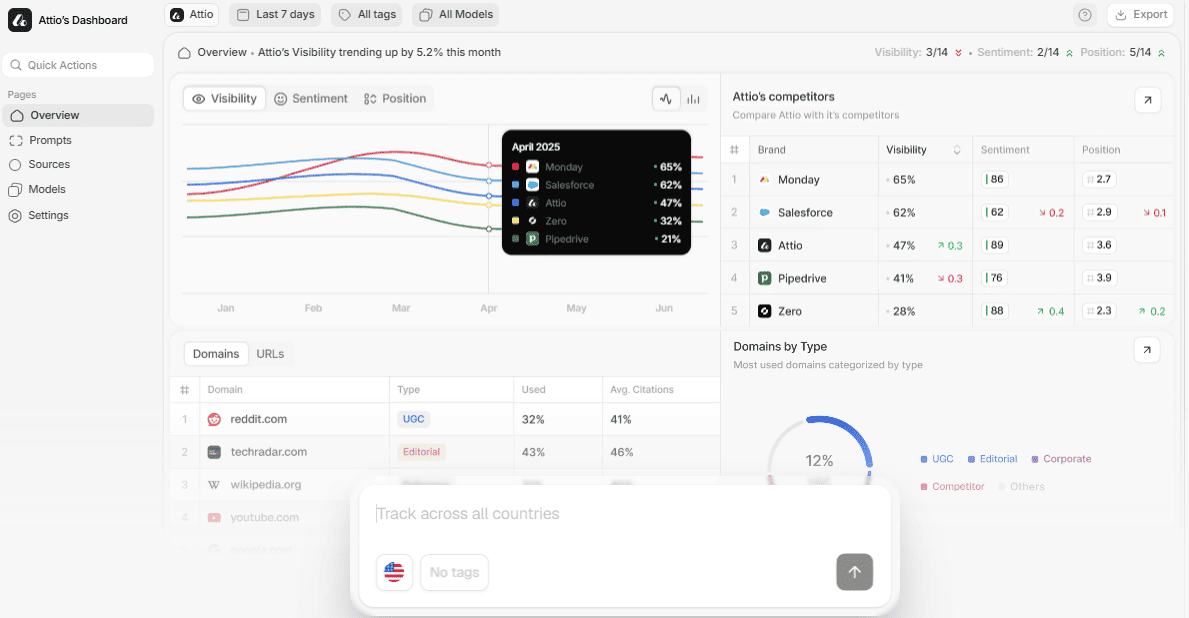
Peec AI is an AI search visibility and analytics platform. It records how often you, your products, and named competitors turn up inside AI answers, and what those answers actually say about each of you.
Key features:
- Side-by-side comparison against chosen competitors
- Answer history you can compare week to week
- Detailed citation sources behind every response
- CSV exports and flexible project allocation
- Checks robots.txt access and blocklists across 40+ AI crawlers/bots
- Automatically runs all the prompts every 24 hours across selected AI models
Pricing: The $95 plan covers 50 prompts across three models. Pro runs $245, and Advanced hits $495 with multi-country tracking.
Supported AI platforms: ChatGPT, Google AI Mode, Google AI Overviews, Microsoft Copilot, Gemini, Naver AI, Perplexity, Claude, Grok, DeepSeek, Qwen, Mistral, and Meta Spark.
Pros:
- Shares prioritized “Actions” along with opportunity scores to help you enhance your AEO efforts
- Self-serve signup skips the mandatory sales call
Cons:
- Only supports 3 AI models on each self-serve plan, which is one reason teams compare Peec AI alternatives
- Can be hard to use and set up, with their navigation being “noisy”
Best suited for:
- SEO and content teams measuring AI search performance
- Agencies managing multiple client brands through one account
Also read: MentionBird vs. Peec AI
4. Otterly AI
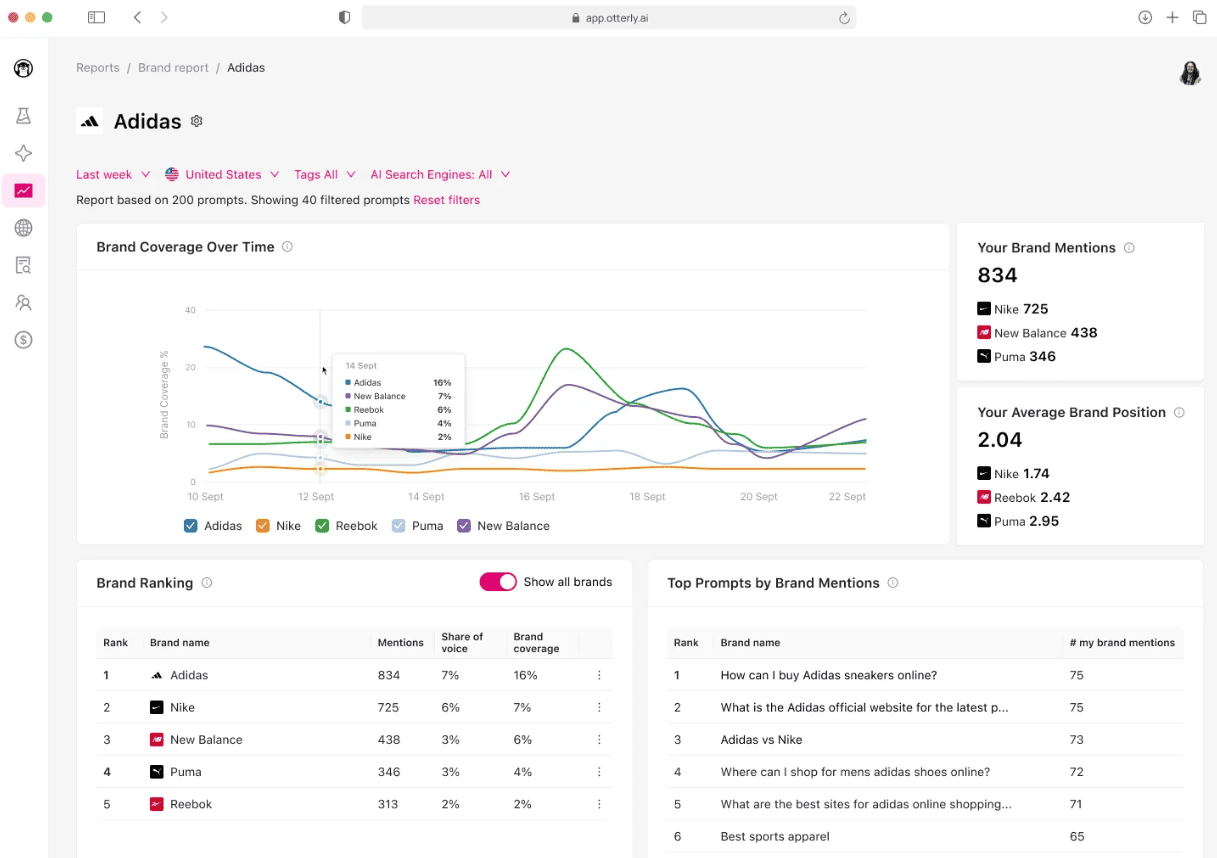
Otterly AI is an AI search monitoring and optimization platform built around a low entry price and quick setup, which also makes it one of the best AI visibility tools for startups.
Key features:
- Benchmarks domain rankings against selected market competitors
- Combines brand appearance frequency and positioning into a unified 0–100 score
- Audits page crawlability and AI readiness factors
- Monitors ChatGPT advertisements and shopping card appearances
- Records AI crawler and agent activity on-site
Pricing: Lite costs $29 monthly for 20 prompts. Standard costs $189 for 160 prompts, while Premium costs $489 for 535 prompts. Every plan tracks any 3 of Otterly's 7 AI platforms. There’s also an Enterprise plan.
Supported AI platforms: ChatGPT, Google AI Overviews, Perplexity, Microsoft Copilot, Google AI Mode, Gemini, and Claude
Pros:
- Daily prompt tracking and data refreshes come with every paid plan
- Unlimited members simplify access for wider teams
- Lite supports tracking across more than 65 countries
Cons:
- Lite provides only three weekly recommendations
- Every self serve plan tracks only 3 of its 7 engines at a time, and each Claude answer uses 3 credits, which is where many teams start comparing Otterly AI alternatives
Best suited for:
Small teams and solo founders who have just started to maneuver in the domain of AI visibility tracking
Also read: MentionBird vs. Otterly AI
5. SE Visible
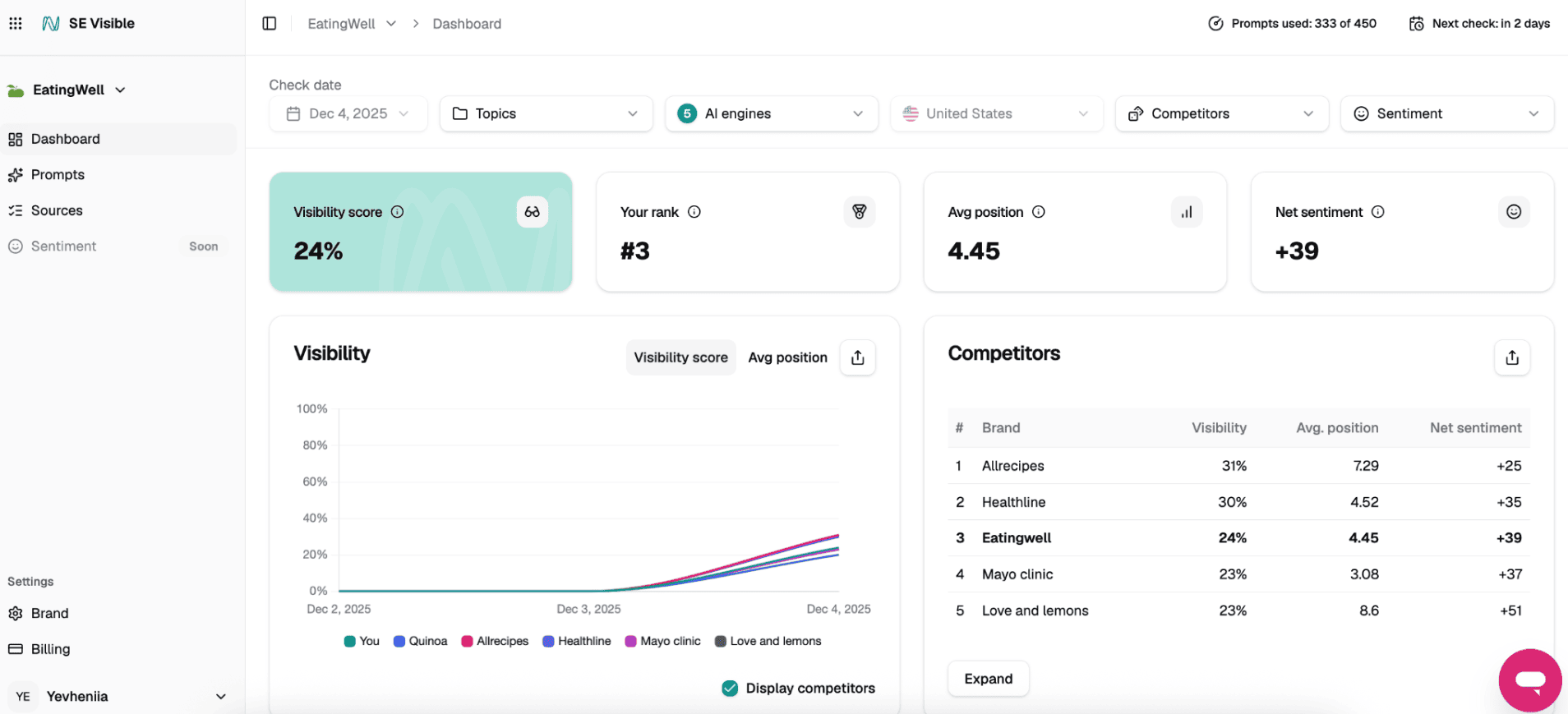
SE Visible is a standalone AI visibility platform from SE Ranking. It turns complex AI search data into clear business insights and is suitable for teams that would rather read findings than dig through charts.
Key features:
- Sorts cited sources into categories like media, blogs, and forums
- Turns frequently cited sources into outreach targets
- Localized topic and prompt suggestions in five languages
- Answer snapshots that show the tone and context of every mention
- Filters results by date, topic, and AI engine
Pricing: Basic costs $99 monthly for 200 prompts. Core costs $189 for 450 prompts, while Plus costs $355 for 1,000 prompts.
Supported AI platforms: ChatGPT, Gemini, Perplexity, Google AI Overviews, and Google AI Mode
Pros:
- Unlimited users remove extra seat charges
- 10-day free trial supports hands-on evaluation
Cons:
- Coverage excludes Claude, Copilot, Grok, and DeepSeek
- Country support currently stops at seven markets
Best suited for:
- Marketing teams managing several brands or projects in B2B SaaS, ecommerce, or professional services across the US, UK, Canada, and other European markets
6. AirOps
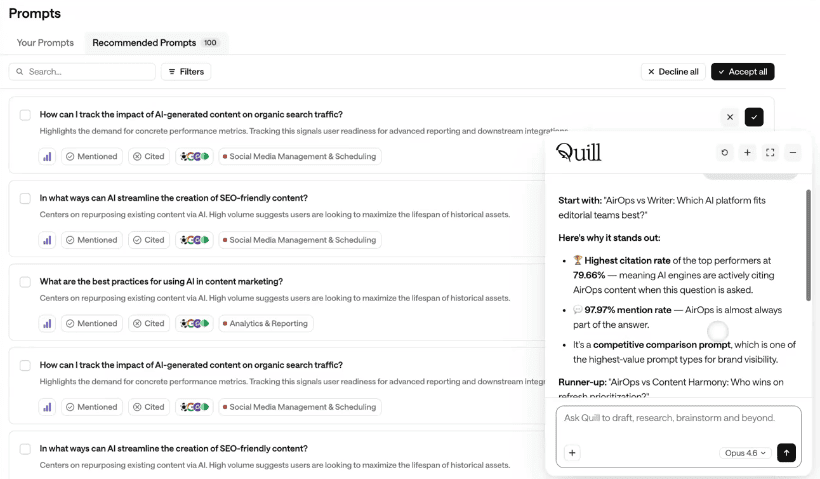
AirOps is an AI visibility platform with built-in content workflows. It shows which pages AI engines cite, then turns the gaps into content you can publish.
Key features:
- Coordinates content creation and refresh work through reusable Playbooks.
- Runs research and production workflows across many pages in a spreadsheet-style workspace.
- Applies approved tone, terminology, audience guidance, and brand expertise to generated content.
- Routes drafts through editorial checkpoints before publishing.
- Sends approved content directly to systems including WordPress, Webflow, Contentful, Sanity, and Strapi.
Pricing: Insights and Solo plans start for free. Solo tracks 100 prompts and pages. Pro tracks 250 of each. You also have an enterprise plan.
Note that AirOps doesn’t highlight specific monthly subscription quotes on their pricing page.
Supported AI platforms: ChatGPT, Gemini, Perplexity, Google AI Overviews, etc.
Pros:
- Reviewers praise responsive and collaborative customer support
- Reusable workflows save hours on repeated tasks
- Flexible setup adapts across clients and use cases
Cons:
- On the Solo plan, only ChatGPT tracking is supported, which can be restrictive compared to other tools like MentionBird
- Task usage can make costs harder to forecast
- Large data jobs may slow platform performance, as reported by users on G2
- Generated facts and content still need careful human review
Best suited for:
- Managing editors, content operations teams, and agencies looking for a tool that helps manage both AI visibility and content operations.
7. Evertune
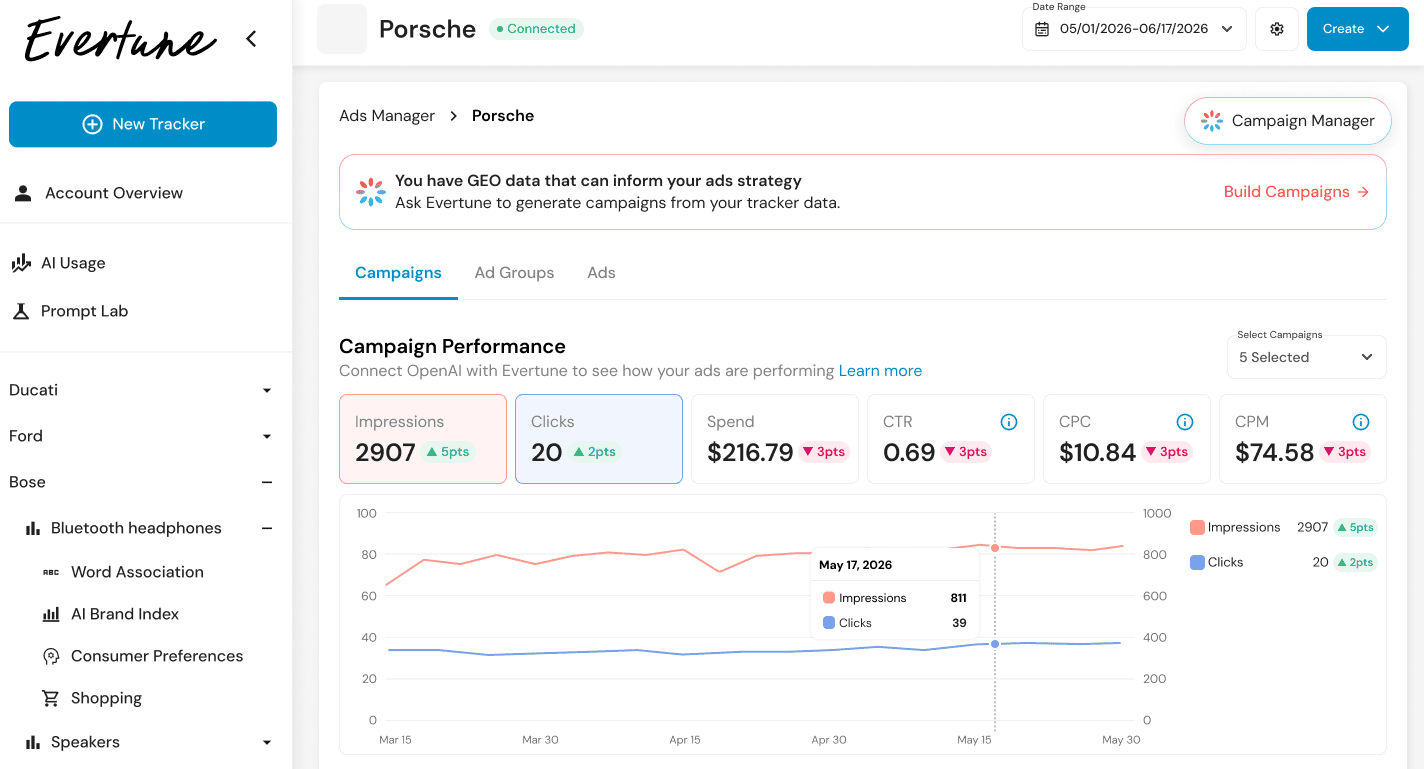
Evertune measures which brands AI prefers and the purchase attributes behind those choices.
Key features:
- Uses more than 150 million real AI conversations to research category questions and buyer behavior.
- Measures how your category’s audience uses AI and which models they turn to.
- Identifies the descriptive words AI most frequently associates with your brand.
- Links influential source domains with affiliate platforms and publisher networks for campaign activation.
- Supports advertising to audiences after their AI research sessions.
Pricing: Starter costs $60/month, billed annually, with 5,000 monthly prompt credits. Pro costs $800/month, billed annually, with 100,000 credits and 11 models. Enterprise pricing is custom.
Supported AI platforms: ChatGPT, Gemini, Google AI Mode, Google AI Overviews, Claude, Meta Llama, Microsoft Copilot, Perplexity, and DeepSeek, with base model and consumer app versions tracked separately for ChatGPT and Gemini
Pros:
- Samples each prompt up to 100 times per model, so the data shows real patterns rather than one-off spot checks
- Goes beyond LLM visibility tracking with AI-optimized articles, affiliate advertising partnerships, and AI retargeting
Cons:
- No free trial, and the gap between the first tier at $60/month and the next tier at $800/month is steep, with nothing in between.
- Reports can take several hours to generate because of the sampling scale involved
Best suited for:
- Enterprise consumer brands
- Retail, automotive, travel, and technology marketers
8. Semrush AI Visibility Toolkit
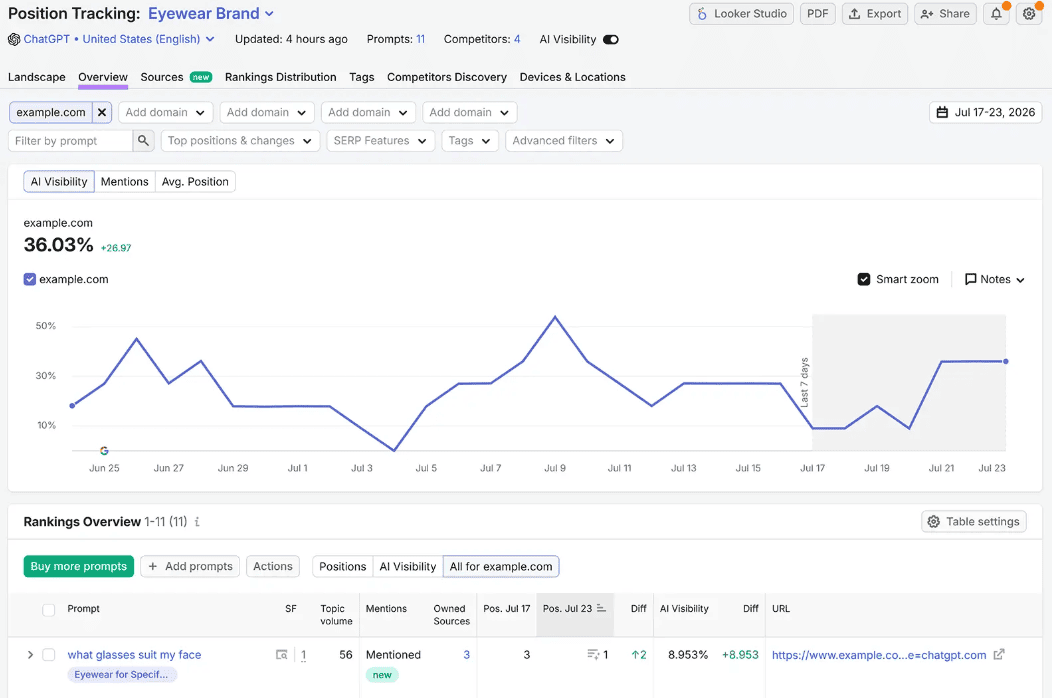
The Semrush AI Visibility Toolkit is an AI search add-on inside the wider Semrush suite, which makes it a natural pick if you want an SEO tool with AI visibility tracking under the same hood. It reports your brand’s LLM mentions and citations beside the keyword data your team might already be reviewing each week.
Key features:
- Assesses any brand using Semrush’s database of more than 317 million prompts and responses.
- Groups related questions into AI search topics with estimated volume, difficulty, and intent.
- Generates branded and non-branded questions from a domain and location for weekly Brand Performance reports.
- Checks whether eight named AI crawlers can access your site and flags technical barriers.
- Combines toolkit reports with GSC, GA4, and other connected data in client-ready reporting.
Pricing: The standalone toolkit costs $99/month for one project and 25 tracked prompts. Another toolkit license for a subuser costs $99/month. An extra 50 prompts cost $60/month.
Supported AI platforms: ChatGPT, Gemini, Google AI, and Perplexity.
Pros:
- Their interface is easy to use and understand, which can be a plus point if you are already using Semrush for SEO
- Brand performance reports provide access to insights that can help improve AI visibility
Cons:
- Users, domains, and additional prompts can increase the base subscription cost.
- Claude and Microsoft Copilot are not included in the documented toolkit coverage, a gap that several Semrush AI Visibility Toolkit alternatives cover.
Best suited for:
Digital marketing agencies and in-house marketing teams.
Also read:
9. Yext Scout
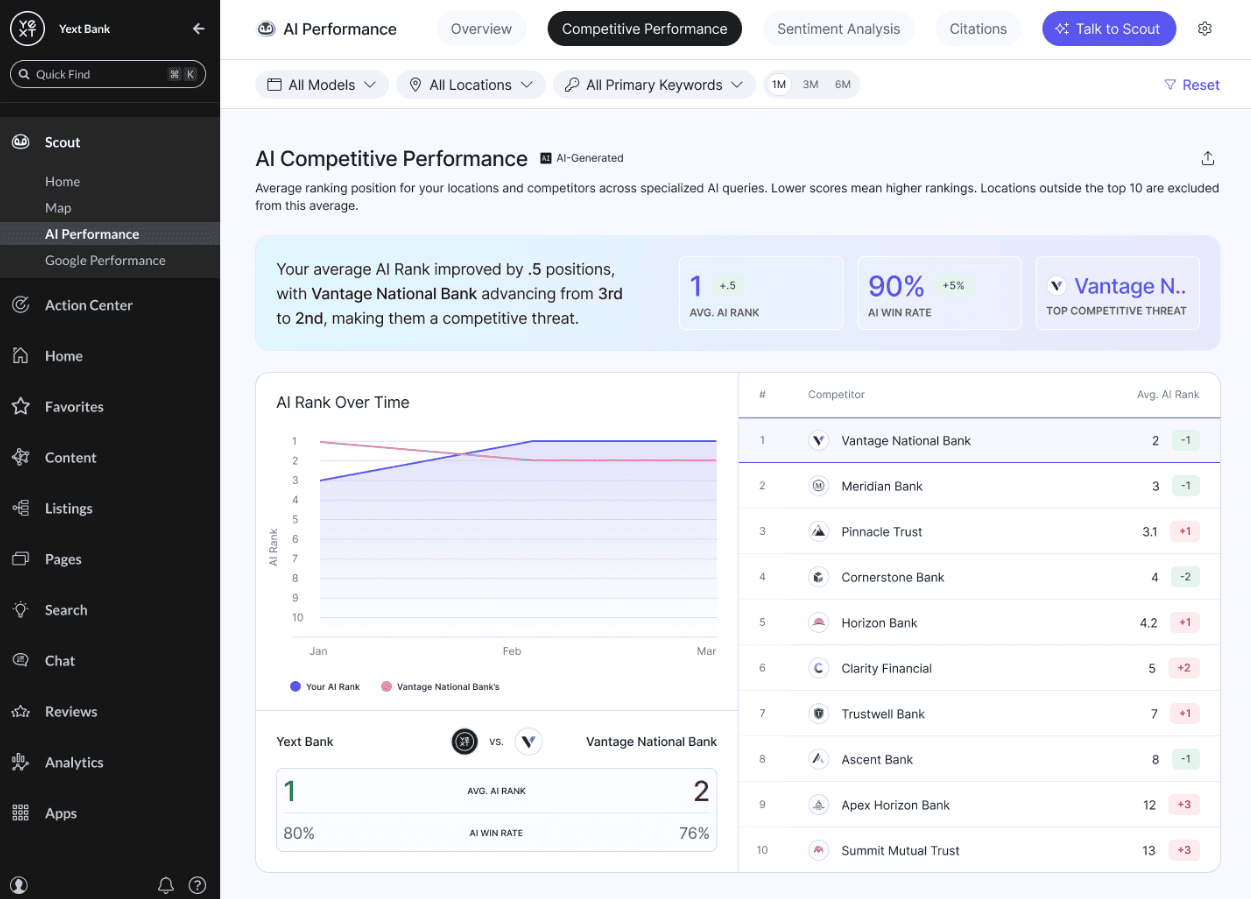
Yext Scout is an AI search visibility and competitive intelligence tool. It tracks how multi-location brands appear across Google and leading AI platforms such as ChatGPT, Gemini, and Claude.
Key features:
- Benchmarks each location against 20 nearby competitors, making it one of the best AI tools for local business visibility in 2026
- Blends Google and AI performance into one score
- Maps visibility from national level to individual locations
- Turns detected gaps into prioritized location tasks
- Updates verified business facts across 200+ publishers
Pricing: Yext does not publish Scout pricing. Businesses must request a demo and receive a custom quote.
Supported AI platforms: Google AI Overviews, ChatGPT, Gemini, Perplexity, and Claude, alongside Google Search and Google Maps
Pros:
- Mobile access helps local teams act quickly
- MCP and API access support external AI workflows
Cons:
- Pricing remains private and requires sales contact
- Full execution depends on other Yext products
- Local focus offers less for online brands
Best suited for:
- Heavily optimized for location-based physical businesses, which makes it less useful for other industry businesses such as e-commerce
10. Trakkr
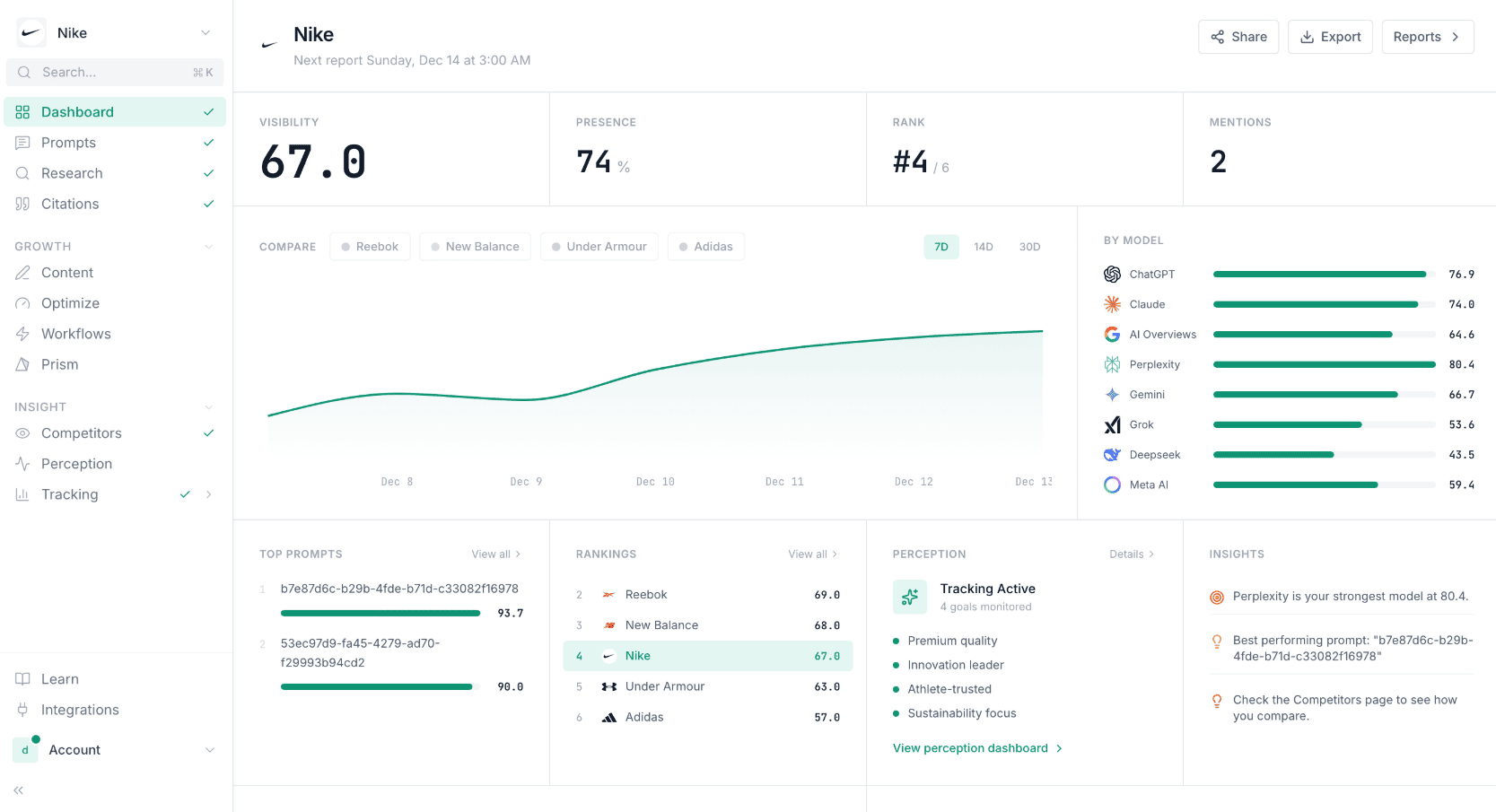
Trakkr is an AI model monitoring tool that helps brands detect visibility changes, identify optimization opportunities, and track traffic from AI search. It also offers automated workflows to help teams act on these insights.
Key features:
- Monitors over 60 AI-related triggers and starts automated workflows when visibility changes.
- Offers an AI agent that investigates performance changes and prepares recommendations using website and tracking data.
- Provides AI Pages optimization to improve how AI crawlers access and interpret website content.
- Tracks AI referral traffic, landing pages, conversions, and revenue through Google Analytics 4.
- Offers white-label client portals for agencies to share branded reports.
Pricing: Growth costs $100 monthly for one brand and 50 prompts. Scale costs $500 for 10 brands. Enterprise starts at $1,000.
Supported AI platforms: ChatGPT, Claude, Gemini, Perplexity, Google AI Overviews, Grok, DeepSeek, and Meta AI.
Pros:
- Tracking across all 8 models, including DeepSeek and Meta AI, comes with every plan
- 14-day trial allows hands-on testing
Cons:
- The lower tier restricts usage to just 50 prompts per brand, which fills up fast.
- Tracking across 1 additional region costs $300/month, making it one of the most expensive AI-powered visibility solutions
Best suited for:
- Consumer-brand marketers, in-house growth teams, and agencies supporting multiple accounts.
List of Best Free AI Visibility Tools
If you are specifically looking for the best free AI visibility monitoring tools, then these 3 are worth checking out:
- Siftly: Tracks 10 prompts across two engines, refreshes weekly, and stores 30 days of results.
Pricing: Free includes 100 monthly responses. Starter costs $79, Growth $249, and Scale $599 monthly.
- Serpstat LLM Brand Monitor: Checks prompts across ChatGPT, Claude, Gemini, and over 140 other models. You can also review complete responses in Chat Mode.
Pricing: Free includes 10 monthly checks across two projects. Pro costs $39 monthly, while extra credits cost $0.25 each.
- iBeacon AI: Tracks 10 AI prompts on demand for one project and adds live SEO audits, keyword research, and content audits to the free plan.
Pricing: Free forever for 1 project and 10 prompts. Growth costs $79 monthly for 200 prompts with weekly scans, while Agency costs $249 monthly for 25 projects.
Check your AI visibility before you pick a tool
Enter your brand, country and what you sell. See whether ChatGPT names you, which competitors it recommends instead, and which pages it cites. Free, no signup.
Run the free scanBest AI Visibility Tools by Industry
Let’s look at the best AI visibility tools for ecommerce, B2B SaaS, local businesses, and regulated industries:
| Industry | Tool | Why it fits |
|---|---|---|
| B2B SaaS, ecommerce, and local businesses | MentionBird | Lets you track prompts across all stages of a buyer journey, track AI visibility for multiple products, get insights into competitor visibility, see which sources are cited from Reddit to YouTube videos, and what to do next (e.g., work on an alternatives blog) to win more mentions. |
| Healthcare, legal, and other trust-driven industries | Profound | A wrong AI claim here is a compliance risk. Profound flags inaccurate answers, traces their sources, and offers SSO and SOC 2 for strict security reviews. |
| Restaurants, hotels, banks, and retail chains | Yext Scout | A national average hides the branch nobody mentions. Scout reports visibility for each location separately. |
Best Visibility Tools For AI Search by Team Size
Here is how the best AI visibility tools for small businesses, agencies, and large teams compare:
| Team size | Tool | Why it fits |
|---|---|---|
| Solo founders and small teams | Otterly AI | $29 a month tells you whether you appear at all, with unlimited members on every plan. |
| Growing marketing teams | SE Visible | 450 prompts on Core and no seat charges, so the whole team can work from one dashboard. |
| Agencies and AEO teams | MentionBird | Multiple brands sit in one account; white-label reports are available on request, with 24/7 support. |
| Enterprises | Evertune | Sampling at large scale suits brand, SEO, and marketing teams working together. |
Best AI Visibility Tools by Budget
Here are practical starting points for comparing AI visibility tools pricing in 2026. Prices use monthly billing unless stated otherwise.
| Budget | Tool | Why it fits this budget |
|---|---|---|
| Free | iBeacon AI | Lets you prove AI search matters to your business before you spend anything. |
| Under $50 a month | Otterly AI | Covers any 3 of its 7 engines for $29, which is usually enough to test whether AI search matters before you spend more. |
| $50 to $99 a month | MentionBird | You pay for guidance as well as tracking, so a small team does not need an outside consultant to decide what to fix. |
| $100 to $500 a month | Trakkr | Published tiers make the bill easy to forecast, as long as you stay within your included regions. |
| Custom or high volume | Profound | Worth it once AI search is a channel you report on to leadership, since pricing scales with teams, prompts, and agent usage. |
How to Choose the Right Tool for Visibility Tracking Across LLMs?
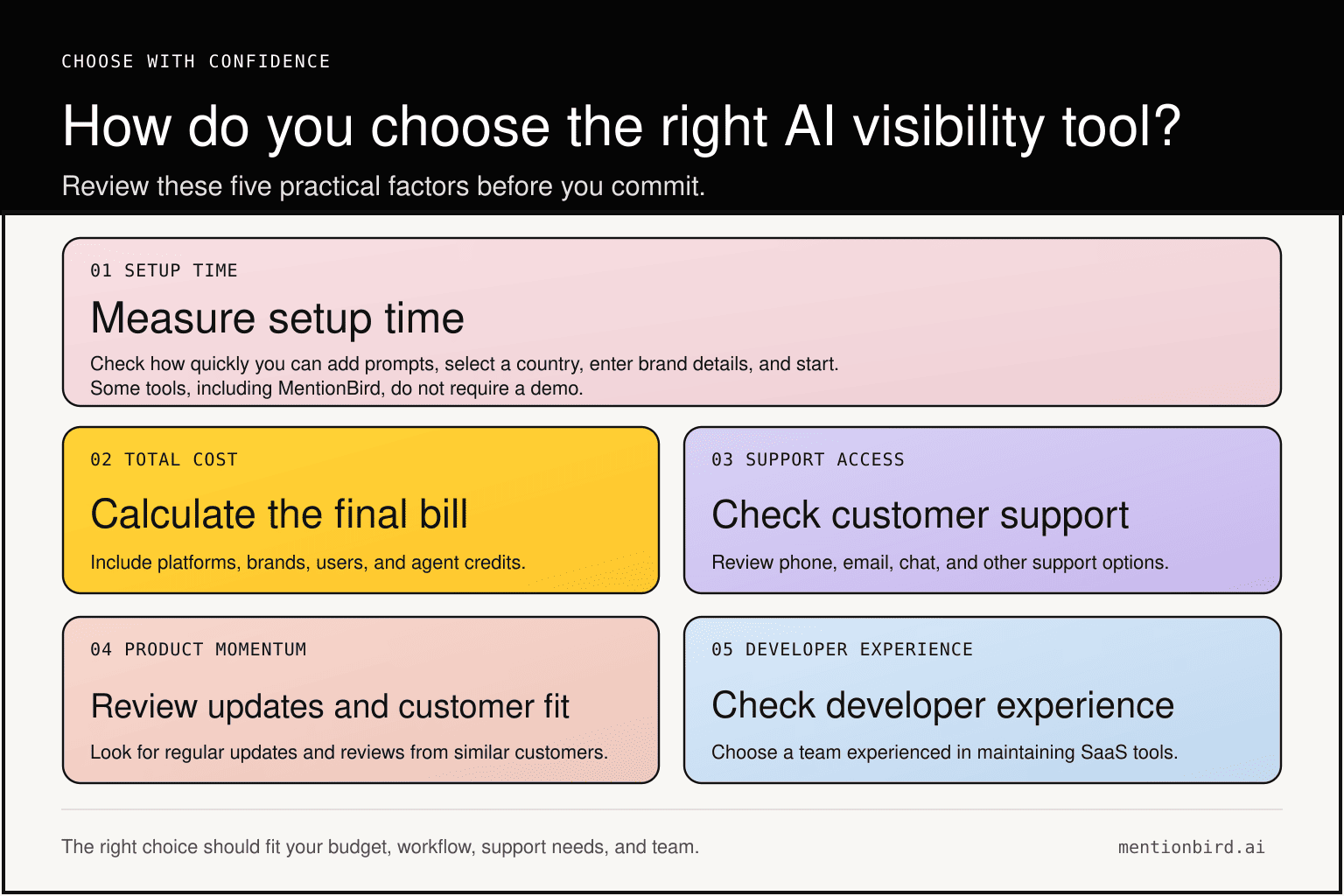
Use these checks to compare AI visibility tracking tools against your business requirements and pick the right tool:
- Measure setup time before buying: Some tools are easy to set up. Add prompts, select a country, enter brand details, and start without a demo. MentionBird is one such tool.
- Calculate the final bill: Calculate costs for platforms, tracked brands, added users, and any agent credits you may need.
- Check customer support before committing: Check whether you can contact support through phone, email, chat, or other channels. You may need frequent help with this new category of AI visibility tracking.
- Review recent updates and customer fit: Ensure the tool receives regular updates and has positive reviews from similar customers.
- Check the developers’ experience: The vendor should have experience building and maintaining SaaS tools.
How to Increase AI Visibility?
- Choose useful prompts: Add questions buyers ask during research, comparison, and purchase stages. Avoid broad questions with little business value.
- Create a baseline: Record current results before changing anything. This baseline helps you measure improvement over time.
- Correct unclear facts: Keep product specifications, prices, business details, and availability accurate. Clear information gives AI systems better material to reference.
- Study cited sources: Identify the pages shaping each answer. Improve your pages or pursue relevant coverage from trusted external websites.
- Act and test again: Update content, strengthen brand information, and rerun prompts. Compare results over several weeks, not one day.
Remember, picking one of the best AI brand visibility tools will not improve your LLM presence on its own. A tool shows you where you stand, but your brand only gets mentioned more often once you act on what it finds.
Is It Worth Paying for an AI Visibility Tool, or Can You Track It Manually?
Manual tracking works well for an initial AI visibility audit with a small prompt set. Run the same questions in fresh conversations with chat memory turned off, and record the engine, date, mentions, and citations.
Paid monitoring starts to make sense when repeated checks eat into the time you could spend acting on the results. More markets, client accounts, and reporting deadlines all add to that workload.
| Situation | Manual tracking | Paid monitoring |
|---|---|---|
| Initial baseline | Practical for a handful of buyer questions | Faster when you need several engines or markets from day one |
| Recurring checks | Needs consistent logging and repeat runs | Collects answers automatically on a set schedule |
| Answer swings | A single run can show a misleading result | Repeated runs reveal the real trend |
| Competitor comparisons | You spot and record each appearance yourself | Share of voice and position are calculated for you |
| Team reporting | You maintain a shared spreadsheet | Shared dashboards and integrations cut preparation time |
| Accuracy checks | You compare claims against approved facts by hand | Some tools flag inaccurate claims and trace their sources |
A simple rule of thumb: once you track more than 20 prompts, two engines, or one brand, the best AI visibility audit tools usually pay for themselves in saved hours.
Final Thoughts On The Best AI Search Visibility Monitoring Tools
AI answers now decide which brands make a buyer's shortlist, and you cannot influence what you cannot see. Pick the tool that matches your budget, your team size, and the engines your buyers actually use, then start improving before your competitors widen the gap.
To start off, MentionBird can be worth trying for the extensive AI visibility monitoring and improvement features it offers.
FAQs
- What are the best AI visibility tools?
MentionBird, Profound, Peec AI, and AirOps lead the list. MentionBird suits teams wanting to know what to do next in marketing and advertising to enhance their presence in AI answers; Profound is ideal for large brands; Peec AI is strong on competitor benchmarking; and AirOps combines visibility with content production.
- How much do AI visibility tools cost?
Anywhere from free to over $1,000 a month. A handful run permanent free plans covering around 10 prompts. Paid entry tiers start at $29, midrange plans sit between $189 and $500, top published tiers reach $800 to $1,000, and enterprise pricing is quoted on request.
- How are AI visibility tools different from traditional SEO tools?
SEO tools report your position in a list of links. AI visibility tools report whether you are named inside the answer itself, which sources the model quoted, and how you compare with competitors in that same response.
- Why do two AI visibility tools show different scores for the same brand?
Each tool runs a different prompt set, samples at a different frequency, and weights engines differently. Compare a tool against its own history rather than against a competitor's number.
- What are the best AI-powered SEO visibility tracking tools?
Semrush, Ahrefs, SE Ranking and Serpstat lead here. All four track organic rankings and search visibility scores, with AI handling keyword clustering, content briefs, and prioritizing which audit fixes to tackle first.
- What are the best AI search visibility tools for SEO agencies?
Semrush and Serpstat both bolt AI visibility onto full SEO suites, and AirOps pairs tracking with content production. For AEO-only work across client accounts, MentionBird includes ten seats on its $79 plan.
- How many prompts should I track when starting out?
10-20 is enough to spot a pattern. Choose questions buyers ask before they know your brand exists, rather than ones containing your name. Expand the list only once you know which prompts actually shift.
- What are some Otterly AI alternatives for tracking AI visibility?
MentionBird, Peec AI, SE Visible, and Trakkr are alternatives. Compare their included engines, prompt allowances, reporting connections, and improvement support before switching.

See which AI answers your brand is missing and get a plan to win them.
First month $19 with code TRY19, then $79/mo. Cancel anytime.