10 Best Answer Engine Optimization Tools Compared For 2026
- AI answers now influence buyer shortlists, making brand mentions and citations essential visibility signals.
- AEO software runs your buyers’ questions through AI engines and records whether each answer names, cites, or ignores your brand.
- MentionBird, one of the best AEO tools, provides prompt-specific guidance for turning missed AI answers into actionable improvements.
- Otterly AI suits smaller budgets, with GEO URL audits and tracking across 65+ countries.
- Profound supports enterprises that need deep reporting, crawler analytics, and automation at scale.
- Choose an AEO tool based on your goals, buyer platforms, entry plan coverage, and total seat costs.
- To get results with any AEO tool, track prompts with commercial intent, improve pages where competitors appear instead, and judge performance only after about six weeks.
Looking for the best answer engine optimization tools? A few worth shortlisting are MentionBird, Profound, Peec AI, and Otterly AI. Each one solves a different problem. MentionBird tells you how to win more AI answers, while Profound suits enterprise brands that need large-scale tracking and automation.
Keep reading to compare the 10 tools on features, pricing, pros, and cons, and find the right solution for your business needs.
What Are AEO Tools?
AEO tools are platforms that show how AI engines like ChatGPT, Gemini, and Perplexity answer your buyers’ questions, and whether those answers mention, cite, or recommend your brand. AEO stands for answer engine optimization, which is why these platforms are also called AEO software or AEO trackers.
Most of them collect data by sending prompts through the live AI interface, the way a person would. A few call the model API instead, which can return cleaner answers than real users see, so ask vendors which method they use.
Core features of AEO software apps include:
- Prompt monitoring
- Citation breakdown
- Competitive benchmarks
- Sentiment tracking of AI answers
- Optimization recommendations
Also read: AEO vs. GEO
How We Selected the AEO Tools in This Blog
We shortlisted answer engine optimization software that met these criteria:
- Tracking across multiple AI platforms, including ChatGPT, Perplexity, Google AI Overviews, Gemini, and Claude
- Rich integrations with tools your team may already use, such as Google Analytics, Claude, and Looker Studio
- Answer engine optimization tools that give recommendations or advice on what to do to win more AI answers and prompts were prioritized
- A reasonable cost for the prompts and engines you get
- A support team you can actually reach
- Multi-country and language coverage, if you sell in more than one market
Best AEO Tools Comparison at a Glance
This AEO software comparison places all 10 platforms side by side on starting price, engine coverage, ranking advice, and competitor data.
The 10 Best Answer Engine Optimization Tools in 2026
Here is a closer look at the top answer engine optimization software, with features, pricing, pros, and cons for each.
1. MentionBird
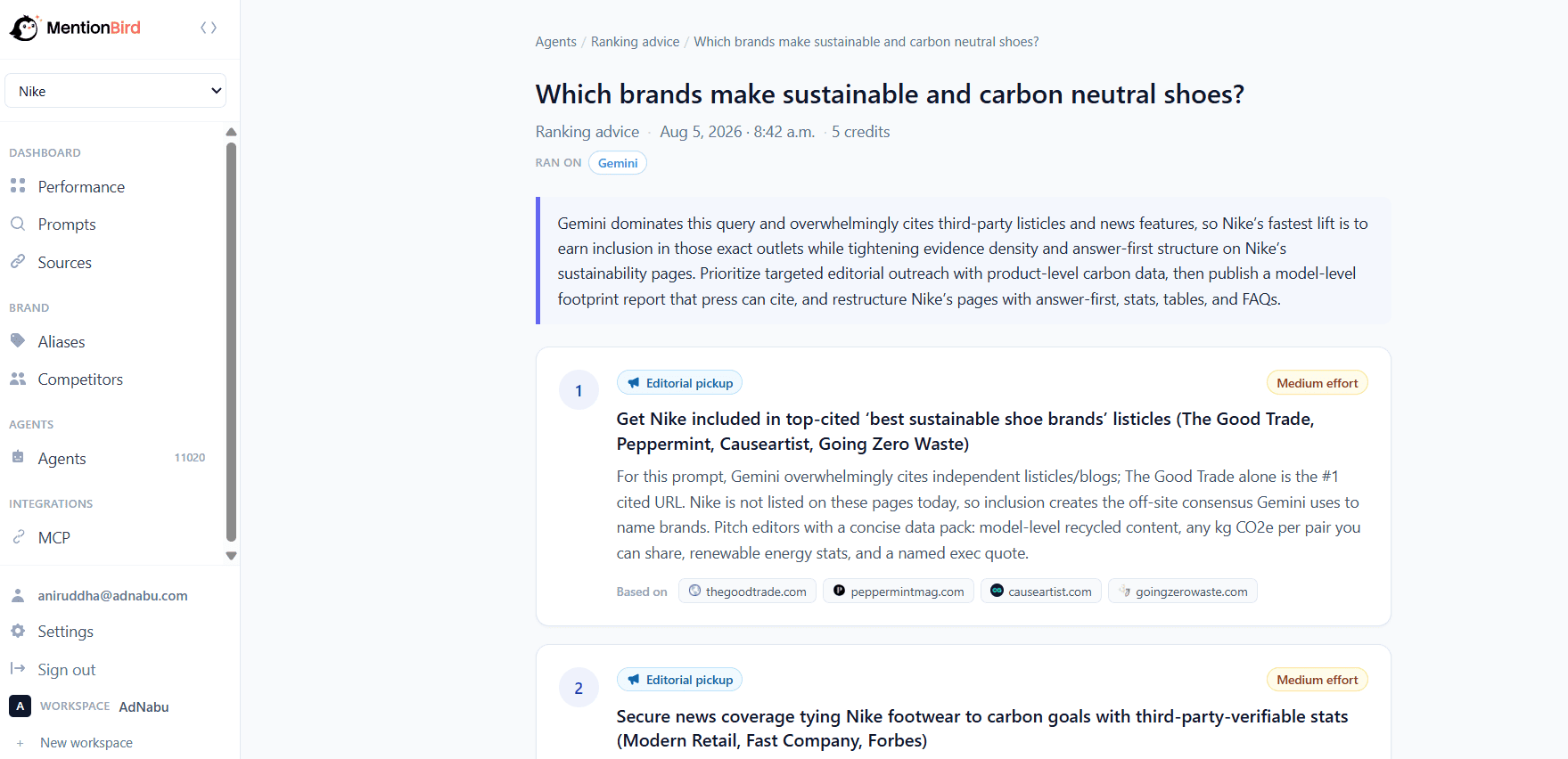
MentionBird helps brands track and improve their visibility across up to 20 AI platforms, from ChatGPT, Gemini, Perplexity, and Claude on self serve plans to Grok, DeepSeek, Microsoft Copilot, Google AI Overviews, Google AI Mode, and more on Custom. It shows exactly where you stand in AI answers and which of your pages engines cite, then hands you a ranking plan for prompts you are missing but can realistically win.
Key features:
- Daily prompt tracking across the platforms, countries, and buying stages you choose
- Query fan-out tracking that reveals the background searches each engine runs before it writes an answer
- On-page and off-page marketing recommendations to enhance LLM presence
- Citation tracking broken down by source type, format, and domain authority
- Competitor tracking with mention share, average position, and visibility trends
- Sentiment analysis showing how AI answers describe your brand
- MCP integrations with Claude and ChatGPT
- The exact answer text for every run
Pricing: Starter costs $79 a month for 100 daily prompt runs, two platforms, and 100 agent credits. Growth costs $299 for 400 daily runs, four platforms, and 500 credits. The Custom plan covers all 20 AI platforms and adds a dedicated account manager.
Pros:
- Assign platforms to each prompt individually, keeping daily runs focused on relevant engines
- Agent add-ons are available so that you don’t have to forcefully upgrade
- Ten seats on the entry tier make collaboration across teams easy
Cons:
- No free plan or trial period
2. Profound
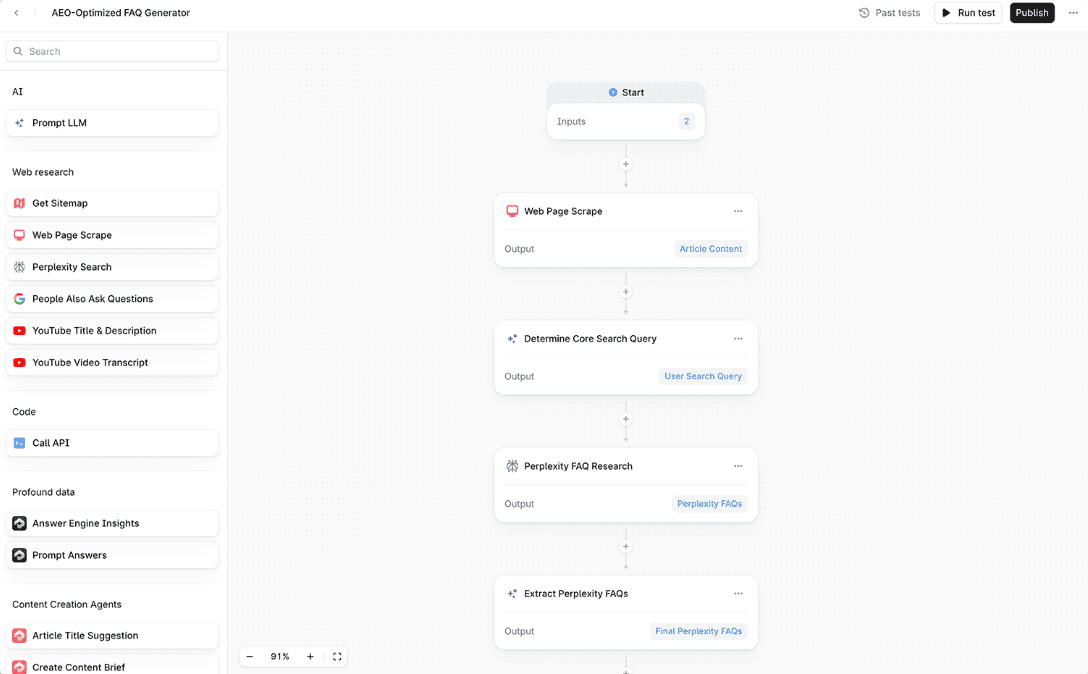
Profound is an AI visibility platform built for large brands with complex reporting needs. It brings prompts, citations, competitor data, and agent-driven automation into one workspace.
Key features:
- Agent Analytics that tracks AI crawlers reaching your pages
- Conversation Explorer built on a real prompt dataset
- Prompt volume data to prioritize by demand
- Supports AI search visibility tracking on up to nine engines on the Enterprise tier
- A FactCheck Agent that traces inaccurate AI claims back to outdated sources and drafts correction outreach
- SKU-level tracking for products recommended inside ChatGPT Shopping
Pricing: A 7-day free trial tracks 50 prompts daily across ChatGPT, Gemini, and Google AI Overviews. Ongoing tracking moves to custom Enterprise pricing.
Pros:
- SOC 2 Type II compliance simplifies enterprise security reviews
- Agents turn insights into ready content briefs
Cons:
- Pricing is hidden behind sales calls, unlike many Profound alternatives that publish their plans
- As answer engine optimization software, Profound is built around enterprise budgets and workflows, so small and many midsize businesses may end up paying for features they never use
Also read: MentionBird vs. Profound
3. Peec AI
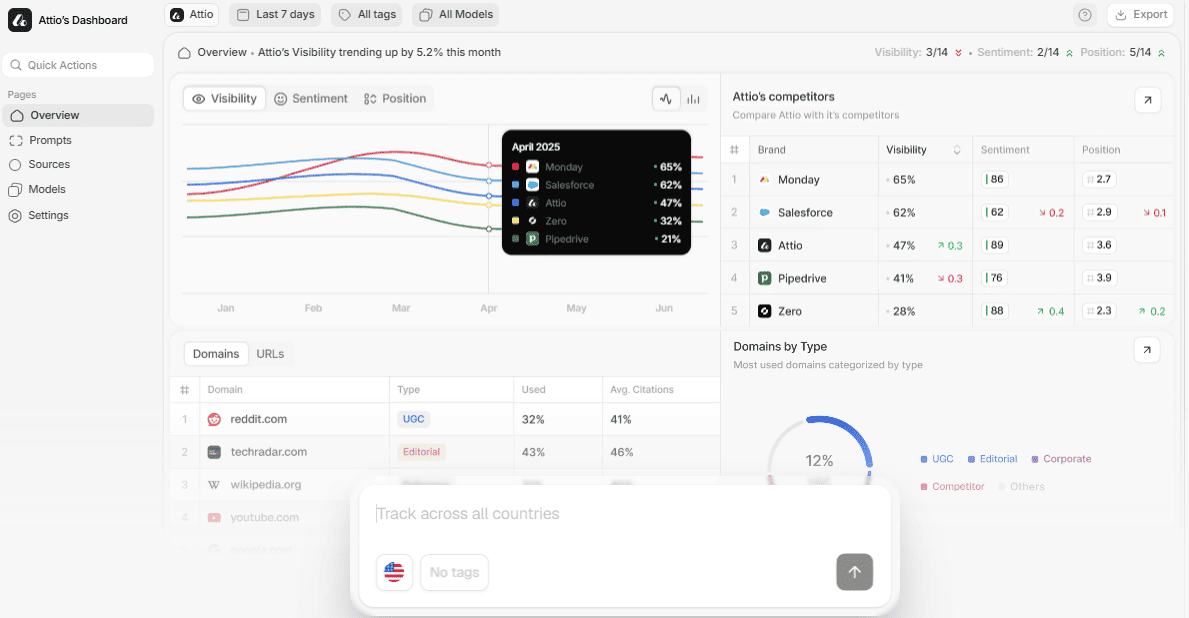
Peec AI is an AI search analytics tool that breaks your visibility down by topic, market, persona, and funnel stage.
Key features:
- AI Shopping analytics for product catalog performance into AI answers
- Brand Perception reports covering the attributes AI links to you
- Actions that condense hundreds of cited URLs into a short, prioritized task list
- A crawlability audit that compares your AI bot rules with competitors’ and includes a URL tester
- Direct integration with Looker Studio for customized agency client dashboards
Pricing: Starter costs $95 a month for 50 prompts. Pro costs $245 for 150 prompts, and Advanced costs $495 for 350 prompts.
Pros:
- A free trial lets you test the tool before committing
- The interface is intuitive, and the data is easy to read, as one user reports on G2
Cons:
- Self-serve tiers track only three of seven engines, and extra engines add $35 to $165 monthly, which is expensive compared with other Peec AI alternatives
- Prompt suggestions that the tool gives can be better, as many of them overlap with each other, causing repetition
4. Cognizo
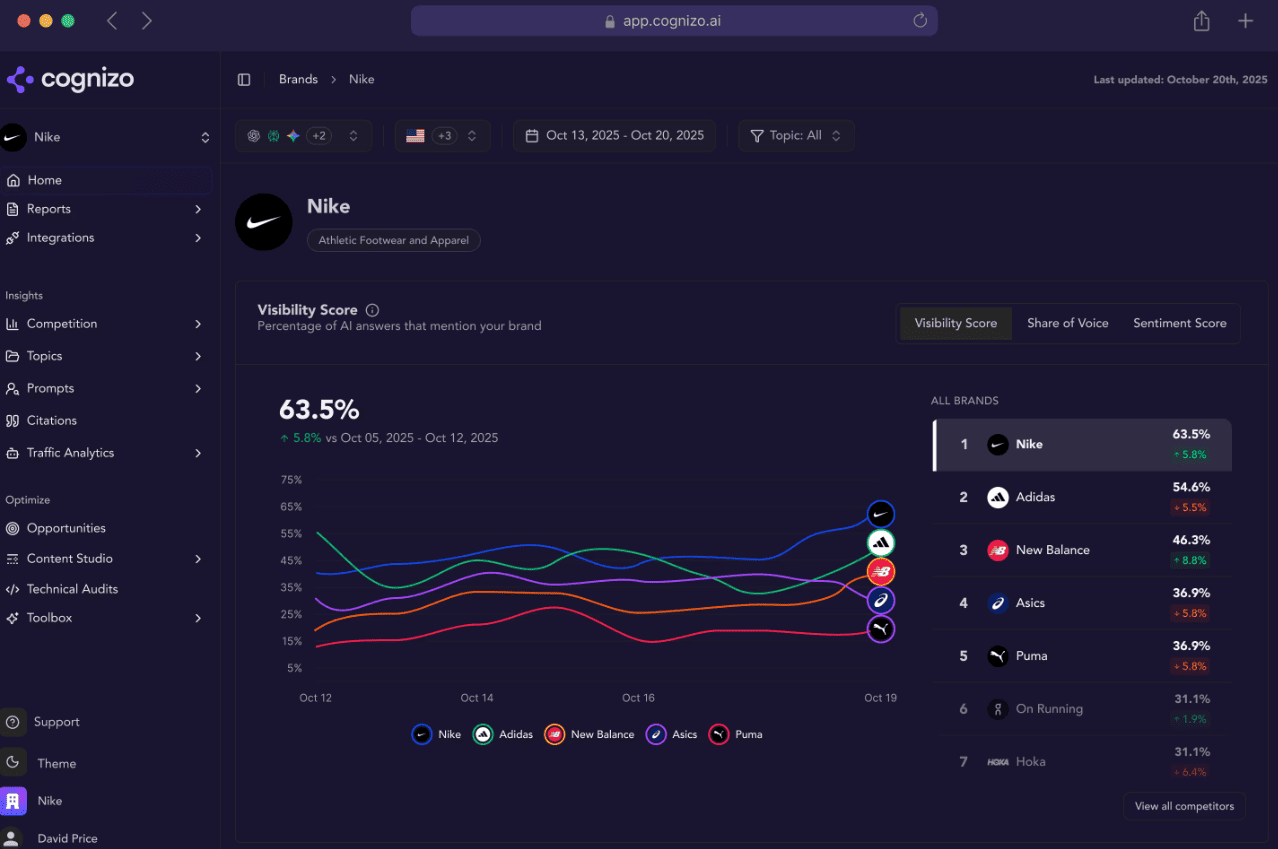
Cognizo is an AEO platform that connects AI visibility measurement with content execution, so teams can handle research, optimization, and attribution without switching tools.
Key features:
- Managed services on Enterprise
- AI traffic analytics, including human visits referred by AI
- YouTube and Reddit source breakdown available
- Generates AI-optimized articles
- Unlimited regions, languages, and competitors across all tiers
Pricing: Growth costs $499 a month for 150 prompts, five platforms, and 8 AI-optimized articles. Pro costs $999 for 350 prompts and 20 articles. Enterprise is custom.
Pros:
- Users describe the customer service as excellent
- The CMS is intuitive, and reporting is straightforward
Cons:
- Entry pricing exceeds most standalone trackers
- Five platforms on a $499 base plan offer less value than tools covering more engines for less
5. Geoptie
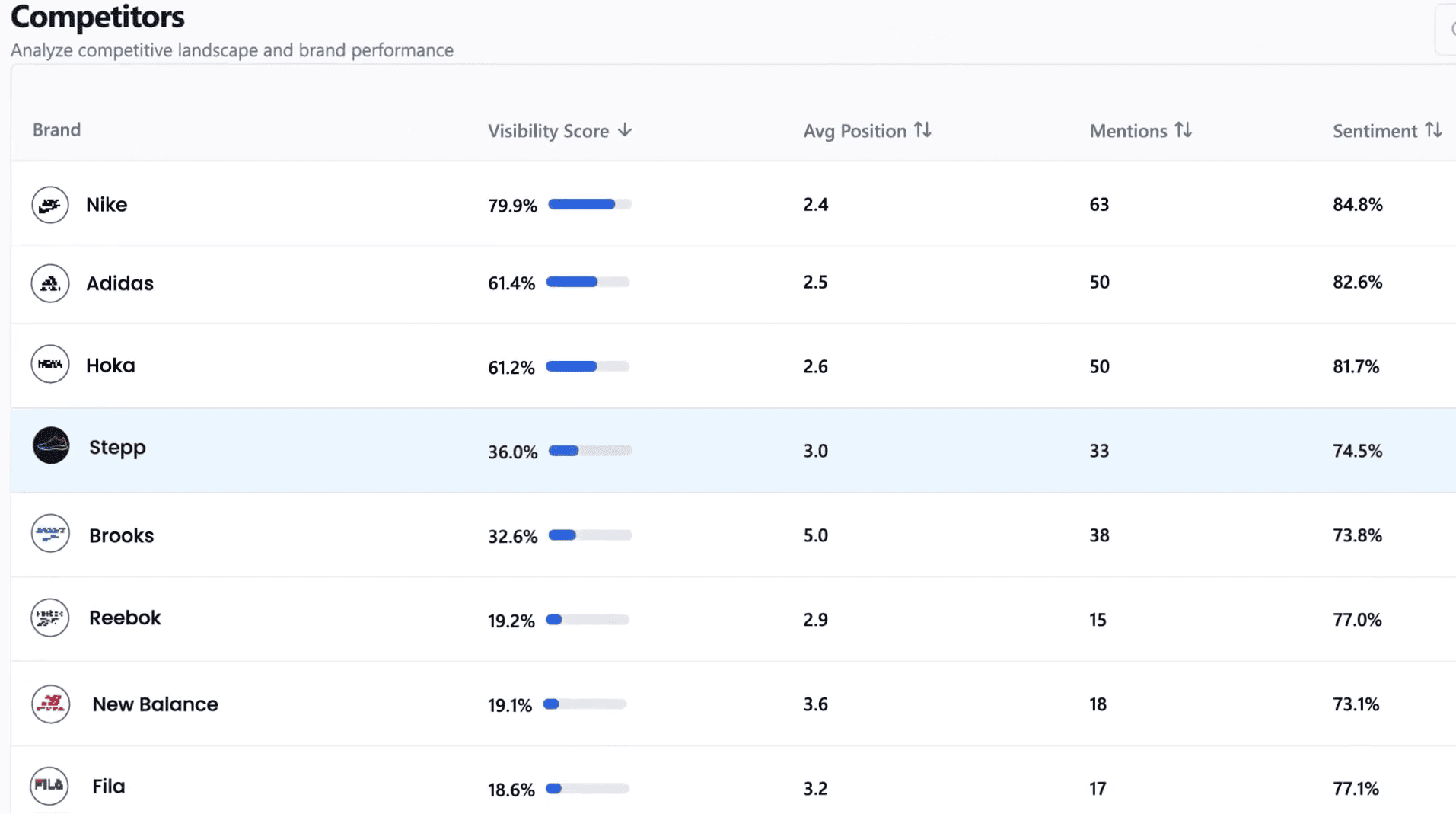
Geoptie focuses on page-level readiness. Rather than stopping at visibility scores, it diagnoses why individual pages get picked up or ignored by AI engines, then helps you fix them.
Key features:
- Reviews content structure, schema, authority, and freshness, effectively an AEO audit for each page
- White-label reporting for client deliverables
- Finds citation sources and backlink outreach targets
- A cannibalization checker that flags pages on your site competing for the same prompts
- Competitive Radar, which compares detection rate, position, and sentiment against rivals
Pricing: Starter costs $49 monthly. Professional costs $99, while Enterprise costs $399.
Pros:
- Certain features like unlimited content generation and targeting across 123 countries are available on all plans
- Fast self-service onboarding with free scan tools available
Cons:
- You can only track 4 AI platforms such as ChatGPT, Claude, etc., even on the $399/month plan
- Extra monitoring prompts are only available on the Enterprise tier, so once you outgrow your plan’s prompt limit, the only option is forcefully upgrading
6. Otterly AI
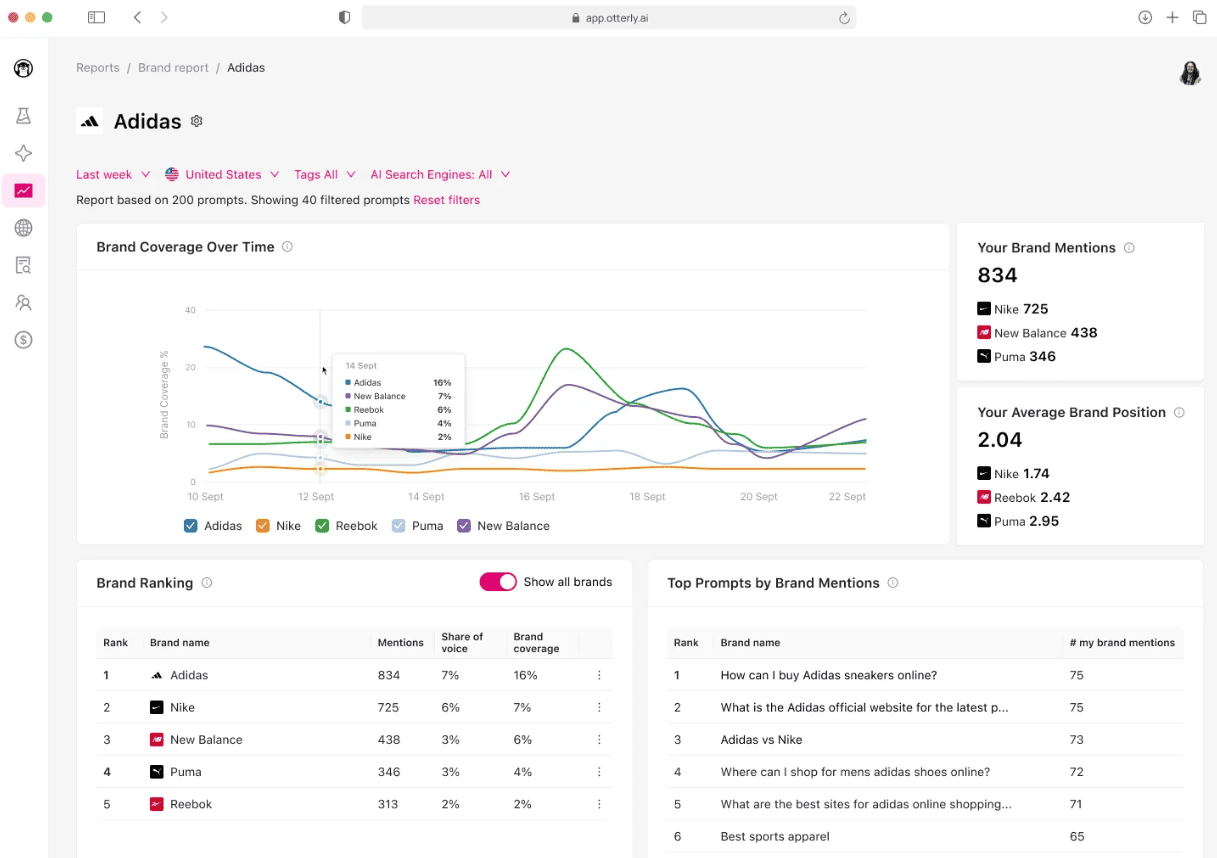
Otterly AI is one of the most affordable GEO tools for small teams. Its reports show where your brand appears in AI answers and which competitors show up alongside you.
Key features:
- Unlimited team members on every tier
- Country tracking across 65+ countries
- Three weekly optimization recommendations on Lite
- Funnel stage tagging that separates branded from non-branded and top-of-funnel from bottom-of-funnel prompts
- PDF and CSV report exports for clients and stakeholders
Pricing: Lite costs $29 monthly for 20 prompts. Standard costs $189 for 160 prompts, while Premium costs $489 for 535 prompts. Every plan tracks any 3 of Otterly's 7 AI platforms. Enterprise starts at $1,000 monthly.
Pros:
- Setup is easy, with strong onboarding support
- Lite includes 1,000 monthly GEO audits, a Brand Visibility Index, and domain rankings
Cons:
- Lite covers only 20 prompts and cannot buy extra credit packs, so outgrowing it means upgrading
- Every self serve plan tracks only 3 of its 7 engines at a time, and each Claude answer uses 3 credits, which is where many teams start comparing Otterly AI alternatives
- The low number of recommendations on the entry plan can force an upgrade
7. Scrunch AI
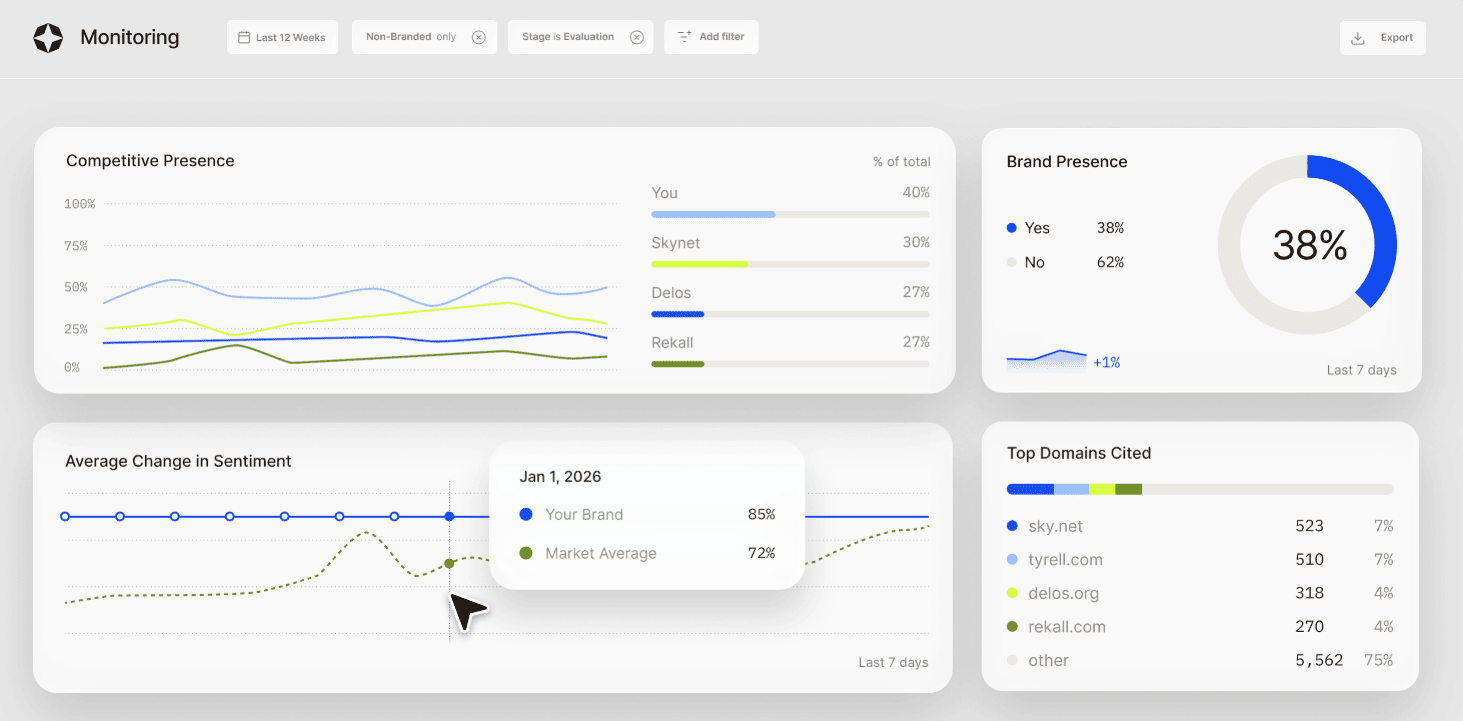
Scrunch AI is one of the best generative engine optimization software platforms out there for brands that want to shape how AI agents read their site, not only track what AI says about them. It connects prompt performance with site audits and agent traffic, so teams can see why their visibility moves.
Key features:
- AXP (Agent Experience Platform), which serves lightweight, information-rich versions of your pages to AI agents without changing what visitors see
- Real-time signals that flag visibility shifts, explain the likely cause, and suggest a fix
- AI search trends that reveal key behaviors and patterns
- Sitemaps that show how AI sees your site
- Monitors AI crawlers and referral traffic
- Prompt-level visibility metrics
- Site diagnostics that audit technical health and content structure for AI readability
Pricing: The Core plan starts at $250 a month, and a custom plan is available.
Pros:
- Users value its actionable insights for improving AI visibility
- Agencies get prepopulated data for managing clients and prospects
Cons:
- The pricing can prove to be very high, which leads some teams to look at Scrunch AI alternatives
- Answer engine optimization recommendations may not be specific or actionable enough, and Scrunch isn’t primarily a content-generation tool
8. AthenaHQ
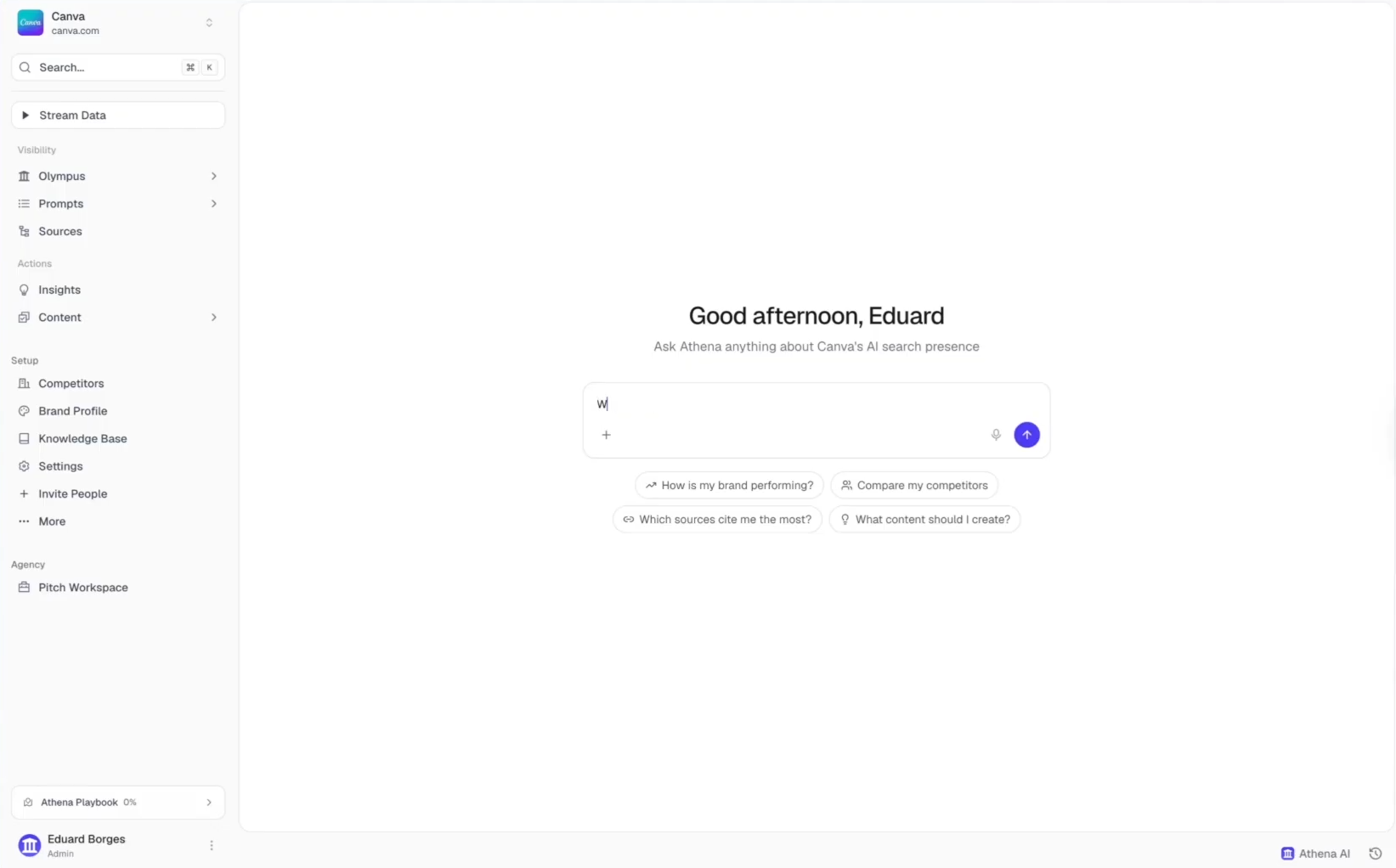
AthenaHQ pinpoints what shapes each AI answer about your brand, then turns those findings into governed action across content, PR, and technical workflows.
Key features:
- Detects missing or inaccurate brand information
- Integrations with Shopify, Google Analytics, and more
- An Action Center that recommends targeted on-page and off-page fixes
- AI press kits and real-time mention alerts built for PR teams
- Persona targeting that shows how answers change for each buyer role
Pricing: Essential is free with 300 credits. Starter costs $295 monthly with 3,600 credits. Enterprise pricing is custom.
Pros:
- Tracks more than 11 AI models at once, including Meta AI and Mistral
- Ecommerce revenue attribution ties AI visibility directly to product sales
Cons:
- Credit-based pricing makes scaling costs harder to predict than with several AthenaHQ alternatives
- Features such as prompt volume data need improvement
9. Semrush AI Visibility Toolkit
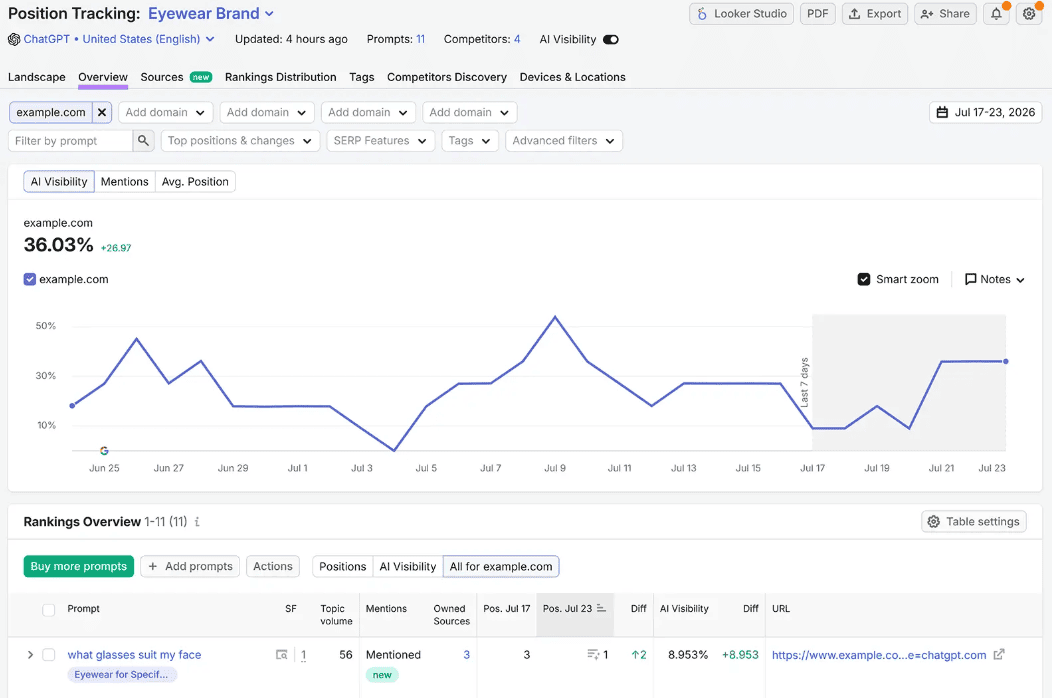
Semrush AI Visibility Toolkit brings AI search monitoring into the wider Semrush platform. Teams already relying on it for traditional SEO can therefore run their SEO and AEO tools under one login.
Key features:
- Scores domains against industry visibility benchmarks
- Reveals prompt volume, difficulty, and user intent
- Competitor research
- Detects technical barriers blocking AI crawler access
Pricing: Base costs $99 per domain per month with annual billing. Enterprise pricing is custom.
Pros:
- Prompt tracking supports more than 220 markets
- Daily updates reveal visibility changes quickly
Cons:
- AEO optimization tips can feel broad and generic, unlike Semrush AI Visibility Toolkit alternatives such as MentionBird, which share clear, specific plans for each prompt (topic) you track
- Add-ons such as extra domains (at $99/month), seats, etc., are quite expensive and might not suit small to mid-sized businesses
Also read: MentionBird vs. Semrush AI Visibility Toolkit
10. Ahrefs Brand Radar
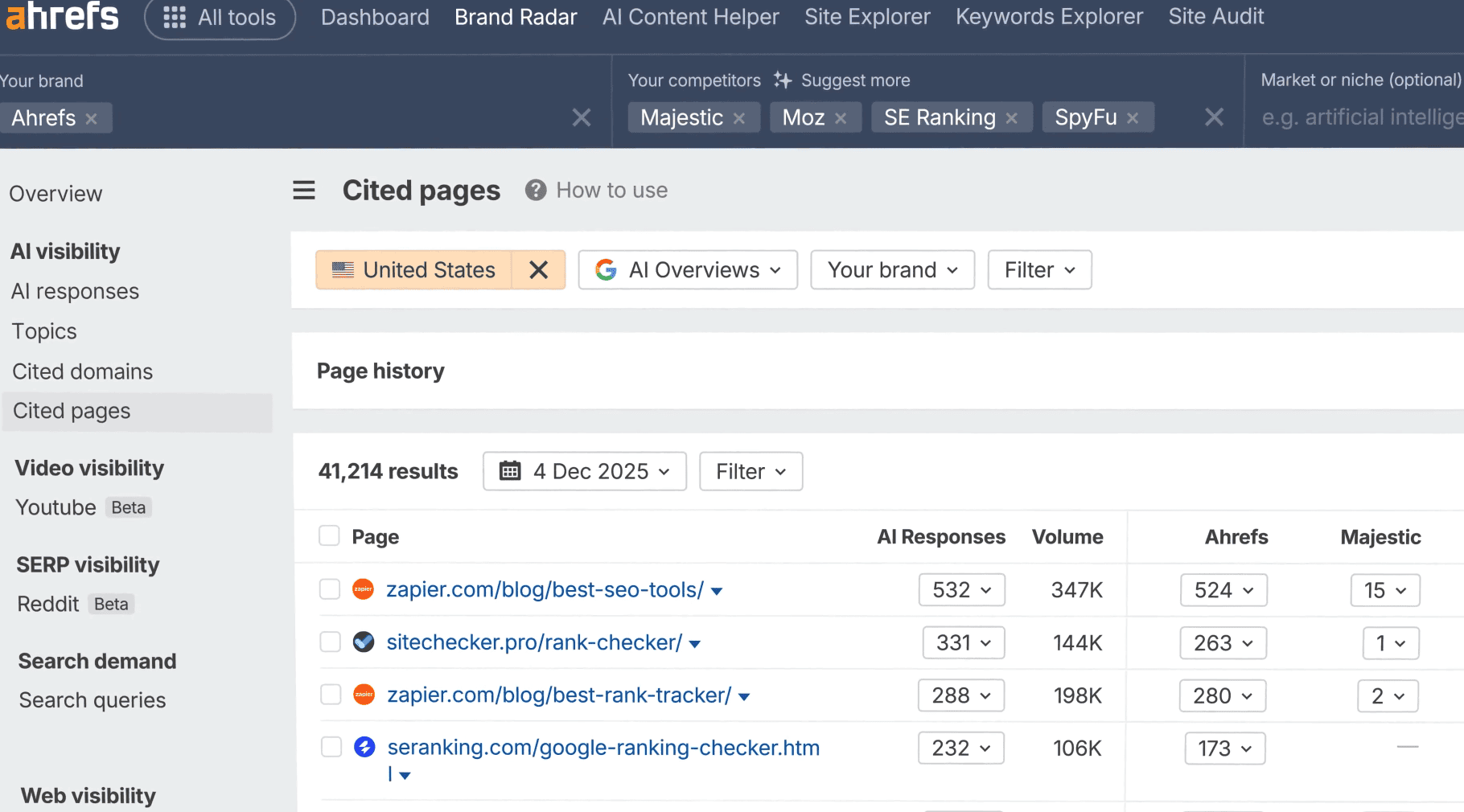
Ahrefs Brand Radar is Ahrefs’ AI visibility module, built on a pre-indexed library of prompts modeled on real search keywords. Since the answers are already collected, you can benchmark any brand or competitor the moment you subscribe, with no tracking setup.
Key features:
- Searches over 481 million prompts modeled on real queries
- Maps visibility across AI, search, video, and social
- Measures AI share of voice weighted by search demand
- Letaido Integration that supercharges Brand Radar with bulk prompt tagging, automated alerts, custom KPIs, and conversational querying
- Exports reports through API and Looker Studio
Pricing: Brand Radar costs $199 per platform monthly or $699 for all platforms including ChatGPT, Gemini, and Copilot. Custom prompt tracking starts at $50 monthly on top of the standard Ahrefs plans.
Pros:
- Historical answers appear immediately after subscribing
- If your team already relies on Ahrefs for keywords, backlinks, and Site Explorer, Brand Radar avoids adding another disconnected platform
Cons:
- AI chatbot indexes refresh only once a month
- It is primarily a diagnostic platform. It shows visibility gaps and citations, but provides limited built-in recommendations, workflow automation, or action prioritization, a gap several Ahrefs Brand Radar alternatives fill
Also read: MentionBird vs. Ahrefs Brand Radar
Free Answer Engine Optimization Software Tools to Try Before You Pay
If you are not ready to fully commit, below we are sharing some of the best free answer engine optimization tools that you might find useful:
Free AEO Checkers and Audit Tools
- MentionBird: Offers multiple free tools:
- AI Visibility Report: A free scan that shows which rivals ChatGPT recommends instead of you, and which pages it cites.
- AI Crawler Accessibility Checker: A quick AEO audit tool that confirms whether AI bots can reach your pages.
- AI Content Score: Rates how well a page is structured for AI answers.
- Keyword to Prompt Generator: Turns your target keywords into the conversational prompts buyers type into AI tools.
- HubSpot AEO Grader: Scores how ChatGPT, Perplexity, and Gemini describe your brand out of 100, free and with no usage limits.
Comprehensive AEO Tools With Free Plans or Trials
- Siftly: The free plan tracks 10 prompts across two engines, refreshes weekly, and stores 30 days of results.
- iBeacon AI: It is free forever for one project and 10 prompts, with SEO audits, keyword research, and content audits included.
- Serpstat LLM Brand Monitor: The free plan includes 10 monthly checks across two projects, covering ChatGPT, Claude, Gemini, and 140+ other models.
Best AEO Tools by Industry
Note: Running a local service business? See how MentionBird works as AEO software for dentists, lawyers, plumbers, chiropractors, and real estate.
Best AEO Tools by Use Case
Best Answer Engine Optimization Tools by Team Size
What AEO Tools Really Cost
How much does AEO cost? The list price is only the starting point, because real AEO software pricing builds up from several factors:
- Base plan: Entry tiers range from $29 to $499 a month, and enterprise tiers are quoted on request.
- Extra engines: Peec AI charges $35 to $165 a month for each additional engine, with other platforms offering varying charges.
- More prompts: Semrush charges $60 a month for every 50 extra prompts.
- Additional brands or domains: Each extra Semrush domain adds another $99 a month.
- Usage credits: AthenaHQ bills by credits, so heavier tracking means a higher bill.
As a result, the real bill can end up far above the list price. Peec AI's $95 Starter plan, for example, includes three engines, and adding three more at $35 each takes it to $200 a month, roughly double the list price.
Though annual billing works in the other direction: MentionBird and Geoptie both give two months free, while Otterly AI takes 15% off. Either way, when you are planning a marketing budget for AEO, account for the full figure, not the advertised one.
How to Select the Right AEO Tool
Use these checks before you commit to any platform:
- Define the job first: Decide whether you need AEO alone, or AEO and SEO in one place. That single answer removes half the list before you compare a single feature.
- Match the engines to your buyers: Coverage across ten platforms adds little if your customers only use three of them.
- Read the entry plan, not the top tier: Vendors advertise full coverage but often sell a fraction of it at the starting price.
- Check how many seats you get: Per-user charges can double your monthly cost once stakeholders request access.
- Test the competitor depth: Many AEO competitor analysis tools stop at share of voice. Prefer ones that also show which sources rivals win and their average position, since that reveals what to fix.
- Trial it on your own prompts: Demo data hides gaps that appear the moment you add real buyer questions.
Which AEO Tools Did Not Make the List
Three platforms appeared during research but fell outside our criteria and thus didn’t make our master list of best answer engine optimization tools:
- Brandlight: It publishes no pricing, trial details, or plan limits, so we could not verify what each tier includes.
- Bluefish AI: It is built around agentic commerce and AI advertising, placing it closer to a marketing suite than an AEO tracker.
- HubSpot AEO: Capable starter tool, but its coverage is narrow with AI tracking supported only for 3 engines.
How to Use AEO Tools Effectively
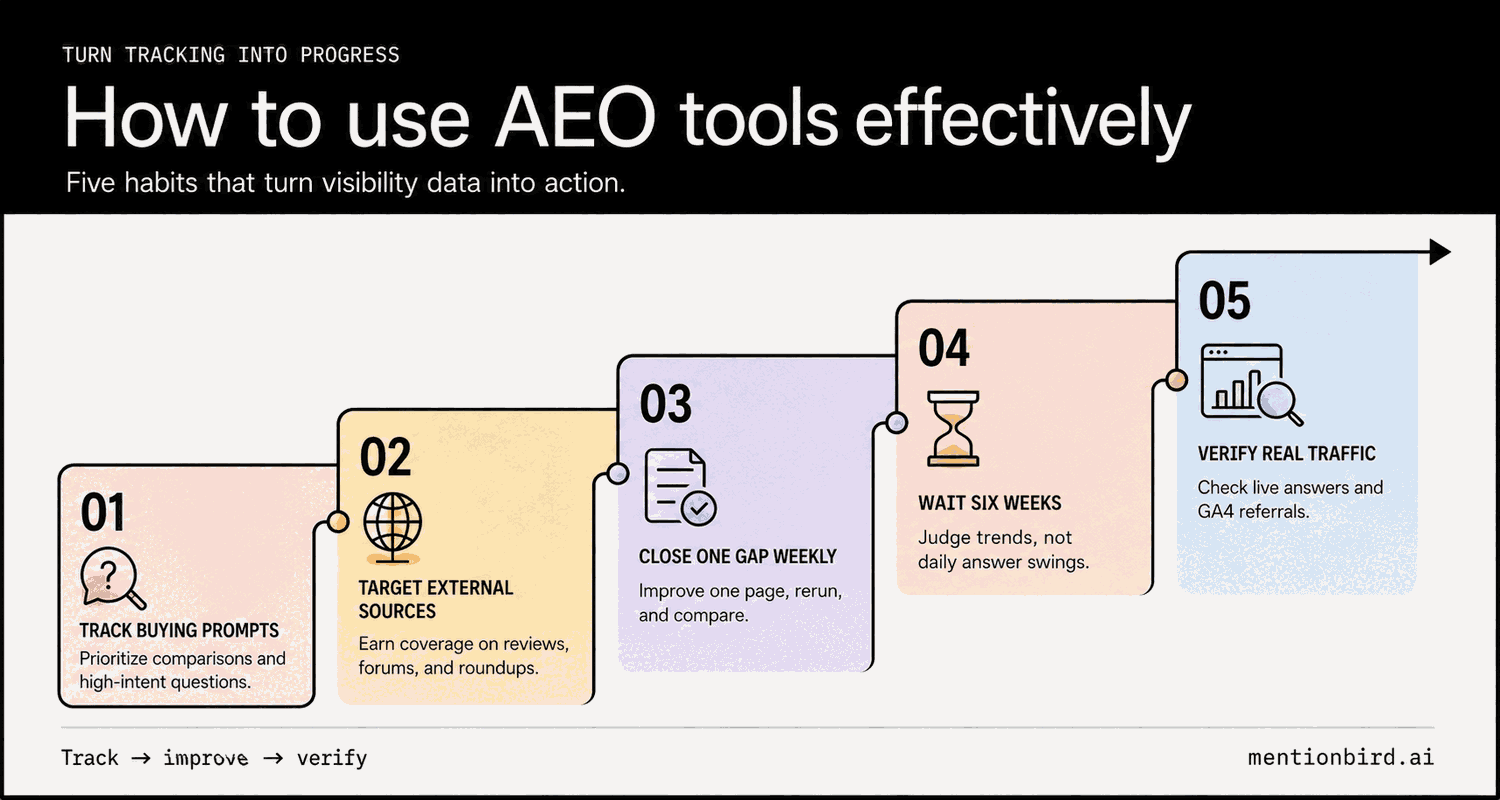
A tool only shows you the data. These five habits turn that data into better AI search visibility:
- Track buying prompts, not brand prompts: Queries like “best CRM for small teams” reveal far more than searches for your own name.
- Monitor and target sources you do not own: Review sites, forums, and third-party roundups influence citations, so your own content cannot close every gap alone.
- Close one gap each week: Choose a prompt a rival wins, improve the page, then run it again. Steady progress beats a quarterly audit.
- Allow six weeks before judging: AI answers shift daily, which makes short-term movement unreliable.
- Verify results manually: Search key queries yourself and check GA4 for AI referrals to confirm your AEO visibility matches what the platform reports.
AEO Tools vs. Traditional SEO Tools
The main AEO vs. SEO tool differences come down to what gets measured and how stable that data is:
Also read: Best AI SEO tools
Final Thoughts on the Best AEO Software Tools
The right tool is the one that matches the engines your buyers use, the prompts you need to track, and the budget you can sustain. Whichever you pick, act on what it shows you, because tracking alone never wins an AI answer.
Frequently Asked Questions
- What is the difference between AEO tools and GEO tools?
AEO tools track whether AI engines name, cite, or recommend your brand when they answer a buyer’s question. Generative Engine Optimization (GEO) tools focus on how generative engines describe and position your brand across longer, synthesized responses. Most platforms cover both. - Is SEO dead now with AI?
No. AI engines still pull many answers from pages that rank well in search, so strong SEO keeps feeding the sources AEO depends on. - Can small businesses benefit from AEO tools?
Yes. Tracking even 15 to 50 buyer prompts shows whether AI engines recommend you or a rival, and a few entry plans cost less than $50 a month. - Which AEO tool tracks the most AI engines?
Of the tools in this list, MentionBird covers the most, with up to 20 AI platforms on its Custom plan. Peec AI lists 13 models, though self serve plans include three, and AthenaHQ tracks 11+. - Which AEO tool has the best UI?
It depends on your workflow. G2 reviewers praise Peec AI’s intuitive layout, while MentionBird puts visibility trends and prompt-level results on one clean dashboard for quick daily reviews. - Are dedicated AEO tools necessary if I already use Ahrefs or Semrush?
Not always. Both handle basic AI monitoring well. A dedicated tool earns its place when you need wider engine coverage, fresher data, or prompt-level recommendations. - Which AEO tools monitor Google AI Overviews?
MentionBird, Otterly AI, Peec AI, Profound, and Ahrefs Brand Radar all track Google AI Overviews, though Google AI Mode coverage depends on the plan you choose. - Can AEO tools track Amazon Rufus?
Some can. Goodie AI (not covered in this article) covers Amazon Rufus and Walmart Sparky on its Enterprise plan, while most AEO tools still focus on chat assistants and Google. - What are the best tools for AEO keyword research?
Start with your existing SEO keywords, then rewrite them as conversational prompts. MentionBird’s free Keyword to Prompt Generator automates this, and Semrush adds prompt volume and difficulty. - Should I hire an agency for AEO or use tools?
Most teams need both. A tool shows where you lose AI answers, while an agency supplies the content and outreach to fix them if you lack bandwidth in-house.

Your buyers are already asking AI engines. Start winning the answers.
First month $19 with code TRY19, then $79/mo. Cancel anytime.