10 Best AthenaHQ Alternatives for 2026

- AthenaHQ's Starter plan costs $295 a month for 3,600 credits, where one credit equals one AI response, and tracking across multiple regions requires Enterprise.
- MentionBird suits teams that want action plans for each prompt from $79 a month, Otterly AI is the cheapest entry point at $29 a month, and Profound fits enterprise teams with custom pricing.
- Rankscale AI has the broadest engine coverage in this list with 17+ AI engines. Peec AI and Promptwatch limit entry plans to three or four selected models, while Visby.ai runs on a 4 engine catalog with no Perplexity or Copilot at any tier.
- Siftly, ZipTie, and LLMrefs are worth a look if your budget is under $100 a month.
- Estimate your real cost with prompts × AI platforms × checks per month, and run your old and new tools in parallel for two to four weeks when you switch.
Looking for the best AthenaHQ alternatives to track and improve your brand's AI visibility? You're in the right place. This guide compares 10 AthenaHQ competitors across pricing, prompt allowances, optimization support, and key limitations. It also explains how to evaluate recommendations and switch tools without losing your reporting baseline.
TL;DR: What are the best AthenaHQ alternatives?
- MentionBird: Best for prompt-level action plans that help win more citations and mentions; starting at $79/month.
- Otterly AI: Ideal for affordable monitoring of a focused set of prompts; starting at $29/month.
- Profound: Best for enterprise teams that need deep AI search analytics and agent workflows, with custom pricing.
What AthenaHQ Offers and Why Compare Alternatives
AthenaHQ tracks brand visibility, competitors, sentiment, and cited sources across AI answers. It also offers content recommendations and optimization agents.
Its free Essential plan includes 300 credits. Starter costs $295 monthly with 3,600 credits across 11 models. One credit equals one AI response. API access costs extra on Starter, while multi-region tracking requires Enterprise.
You may compare alternatives for:
- Lower costs: Pricing that better matches your tracking volume.
- Broader market access: Multi-region or multi-country tracking without moving to the highest tier.
- Recommendation access: G2 users report that AthenaHQ's recommendation engine is limited to higher-priced plans.
- Different workflows: Better page guidance, content creation, or SEO integrations.
- A smoother software experience: Some users also report occasional bugs that affect workflow.
How We Shortlisted the Top Alternatives to AthenaHQ
We shortlisted tools based on the features and support teams need for ongoing AI visibility work.
- Key AI platform coverage: The tool should track major AI platforms where buyers research brands such as ChatGPT, Claude, etc.
- Actionable output: It should provide recommendations, tasks, or insights teams can act on.
- Competitor visibility data: We looked for tools that compare brand performance against relevant competitors.
- Positive user feedback: Strong reviews helped us assess product quality and day-to-day usability.
- Good customer support: Reliable support matters when teams need help with setup or reporting.
- Useful source insights: The tool should show which websites, pages, or citations influence AI answers.
- Regular product updates: Active development matters in a fast-changing AI search market.
- Scalable workflows: The platform should support larger tracking needs as usage grows.
AthenaHQ Alternatives Comparison at a Glance
| Tool | Starting price | AI platform coverage | Prompts on entry plan | Optimization support | Best suited for | Standout feature | Main limitation |
|---|---|---|---|---|---|---|---|
| MentionBird | $79/month | Two on Starter; four on Growth; 20 in total on Custom: ChatGPT, Gemini, Perplexity, Claude, Grok, Google AI Overviews, Microsoft Copilot, DeepSeek, Google AI Mode, Mistral Vibe, Qwen Chat, Meta AI, Kimi AI, You.com, Ask Brave, Alexa for Shopping, Doubao, ERNIE, Poe, and Duck.ai | Up to 100 prompts; 100 runs/day | Prompt-level ranking plans | Prioritizing marketing work for specific buyer questions | Ranking advice, Source ownership, and query fan-out insights | No free trial |
| Otterly AI | $29/month | 7 (any 3 per plan) | 20, checked daily | Specific recommendations based on cited websites, successful competitors, etc. | Establishing a first AI visibility baseline before scaling up | GEO URL audits | On Lite, you cannot buy extra credit packs, and it includes only three recommendations weekly |
| Rankscale AI | $20/month; lower with annual billing | 17+ AI engines | Unlimited saved terms; execution depends on credits | Page audits and citation insights | Flexible cross-engine monitoring | Schedule prompt checks hourly, daily, weekly, or monthly | UI can feel "overwhelming" |
| Peec AI | $95/month | 3 selected models on Starter, and up to 13 on Enterprise | 50, checked daily | Prioritized actions | Ongoing competitive visibility tracking | Product placements within AI shopping answers | Self-serve plans include only three selected models |
| Visby.ai | $79/month | 3 selected from a 4-engine catalog: ChatGPT, Claude, Gemini, and Google AI Overviews | 15 tracked prompts | Automated GEO tasks and article generation | Combining visibility tracking with content execution | Social proof tracking across Reddit, G2, and Trustpilot | No Perplexity or Copilot coverage on any plan; data refresh cadence isn't published |
| Profound | Custom paid pricing | 3 models during trial; up to 9 on Enterprise | Trial includes 50 prompts; paid allowance is custom | AI Marketer and reusable agents | Enterprise AI search operations | Prompt demand and agent workflows | Data dense interface with a steep learning curve; works best with a dedicated analyst |
| Scrunch AI | $250/month | Four on Core; nine on Enterprise | 125 unique prompts; 5,000 responses/month | Site audits and content recommendations | Monitoring brand visibility and improving AI readiness | Agent Experience Platform | Expanded model coverage and AXP require Enterprise |
| Promptwatch | $95/month; free trial available | Four selected from a nine model catalog | 50 prompts; 6,000 responses/month | Agent credits for AEO content work | Turning AI crawler and visibility data into content updates | MCP access from the entry | Upgrading raises capacity but keeps model selection capped at four |
| Quattr | Custom pricing | ChatGPT, Claude, Gemini, Perplexity, Google AI Mode, and AI Overviews | Not publicly specified | Content, page, link, and technical recommendations | For adding AI visibility tracking to existing search workflows | Combines AI citation data with first-party search performance data | Pricing and prompt allowances are not publicly listed |
| AirOps | Custom pricing | ChatGPT on Solo; 7+ answer engines on Pro | Not publicly specified | Content workflows, reviews, and publishing integrations | Scaling AI-assisted content creation and optimization | Custom workflows built around brand and content data | Users report facing significant setup difficulties |
10 Best AthenaHQ Alternatives to Consider
Features describe the wider products. Some require higher plans.
1. MentionBird

MentionBird is an answer engine optimization platform that tracks AI visibility and shows how brands can improve it. Its AI Ranking Advice provides prioritized actions for buyer questions where your visibility is low and competitors appear more often.
Key features:
- Daily prompt tracking across up to 20 AI platforms.
- Get clear, practical, on-page and off-page marketing suggestions to win more answers at the prompt level.
- Source insights by ownership, format, and domain authority.
- Country targeting and tags for organizing buyer questions.
- Competitor tracking with details for their mentions, rankings, and visibility.
Pricing: Starter costs $79/month for 100 daily runs. Growth costs $299/month for 400 daily runs. Custom supports all 20 platforms.
Pros:
- Ten included seats make collaboration easier across teams.
- Flexible prompt run allocation helps avoid unused monitoring capacity.
- MCP and API access let other tools and assistants connect directly with MentionBird data, simplifying analysis.
Cons:
- No free trial is available for paid plans.
Best suited for:
- Agencies and AEO teams
- Brands in the SaaS, E-Commerce, Healthcare, and Local services sector
2. Otterly AI
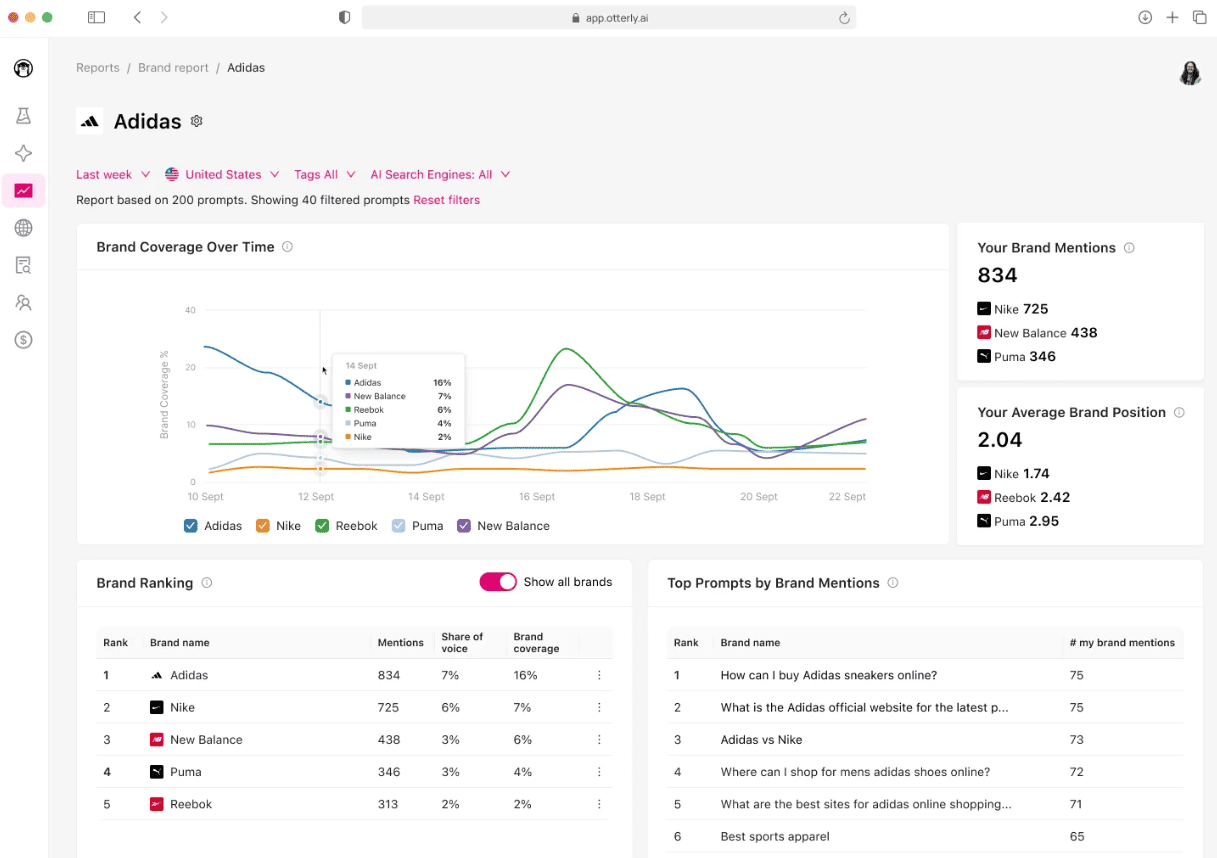
Otterly AI is an AI search monitoring and optimization platform. It tracks brand visibility and helps teams improve citations across major AI engines.
Key features:
- Daily tracking for prompts across supported AI engines.
- Brand mention, citation, and competitor visibility monitoring.
- GEO audits for crawlability and content readiness checks.
- Prioritized recommendations based on tracked prompt performance.
- Prompt research for finding relevant buyer questions.
- Multi-country tracking across more than 50 markets.
Pricing: Lite costs $29/month for 20 prompts. Standard costs $189/month for 160 prompts. Premium costs $489/month for 535 prompts. Every plan tracks any 3 of Otterly's 7 AI platforms.
Pros:
- Unlimited team members are included across paid plans.
- G2 users frequently praise its interface and customer support.
- A free trial runs for 14 days with no payment details required.
Cons:
- Lite allows only 20 prompts and one workspace.
- Every self serve plan tracks only 3 of its 7 engines at a time, and each Claude answer uses 3 credits, which is where many teams start comparing Otterly AI alternatives.
- Lite includes only three recommendations every seven days.
- Some users want deeper reporting and customization options.
Best suited for:
Solo founders and small teams.
Also read: MentionBird vs. Otterly AI
3. Rankscale AI
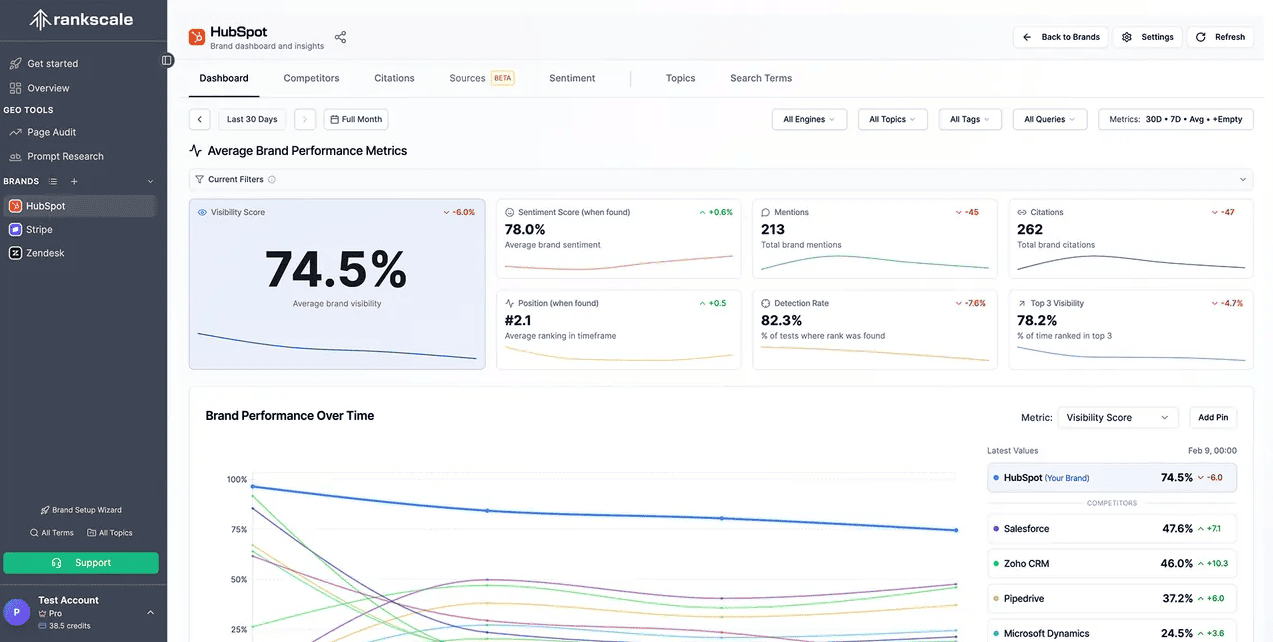
Rankscale stands out for its broad engine coverage, page audits, and credit-based tracking model. It also gives teams more control over how often individual prompts are checked.
Key features:
- Tracking across 17+ AI engines and interfaces, including Mistral AI and Muse Spark.
- Schedule prompt checks from bi-hourly to monthly.
- Unlimited search-term creation with credit-based execution.
- Page audits for AI visibility and accessibility issues.
- Competitor gap analysis across tracked queries.
- Shareable dashboards and Looker Studio reporting.
Pricing: Essentials starts at $20/month. Pro costs $99/month with 1,200 credits. Growth costs $385/month, while Enterprise costs $780/month.
Pros:
- All regions are available on paid monitoring plans.
- Offers one of the broadest AI platform coverage across other AthenaHQ alternatives in this blog.
- Its citation reports are granular, giving insights at the domain, URL, and category level.
Cons:
- Priority support, early access to new features, etc., are all limited to higher tiers.
- It doesn't share detailed (causal) insights into why a page was picked by AI and which pages were crawled as sources.
Best suited for:
- Agencies managing multiple brands, markets, or client accounts with extensive AI search visibility tracking needs
4. Peec AI
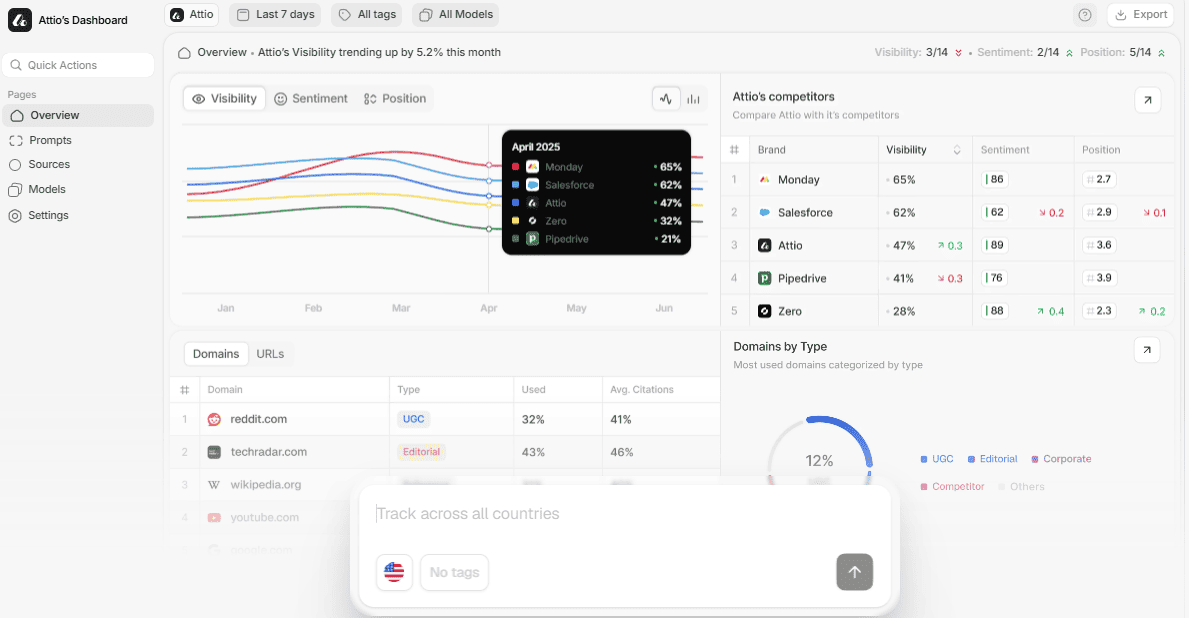
Peec AI measures visibility, position, and sentiment across AI answers. Teams can review brand trends, competitor performance, and citation patterns.
Key features:
- Daily checks across three selected AI models.
- Source categories separate editorial, corporate, and community citations.
- Query fan-outs show searches generated from buyer prompts.
- Shopping analysis tracks product placements inside AI answers.
- Actions prioritize owned pages and external source opportunities.
Pricing: Starter costs $95/month for 50 prompts. Pro costs $245 for 150, while Advanced costs $495 for 350.
Pros:
- Unlimited users avoid additional team seat charges.
- CSV exports support analysis outside the platform.
- Separate agency plans support multiple client projects.
Cons:
- Adding more models increases the monthly cost, which is one reason teams look at Peec AI alternatives.
- Starter supports only one country per project.
- API access requires an Enterprise plan.
Best suited for:
- B2B SaaS and technology companies
- Brand and PR teams
Also read: MentionBird vs. Peec AI
5. Promptwatch
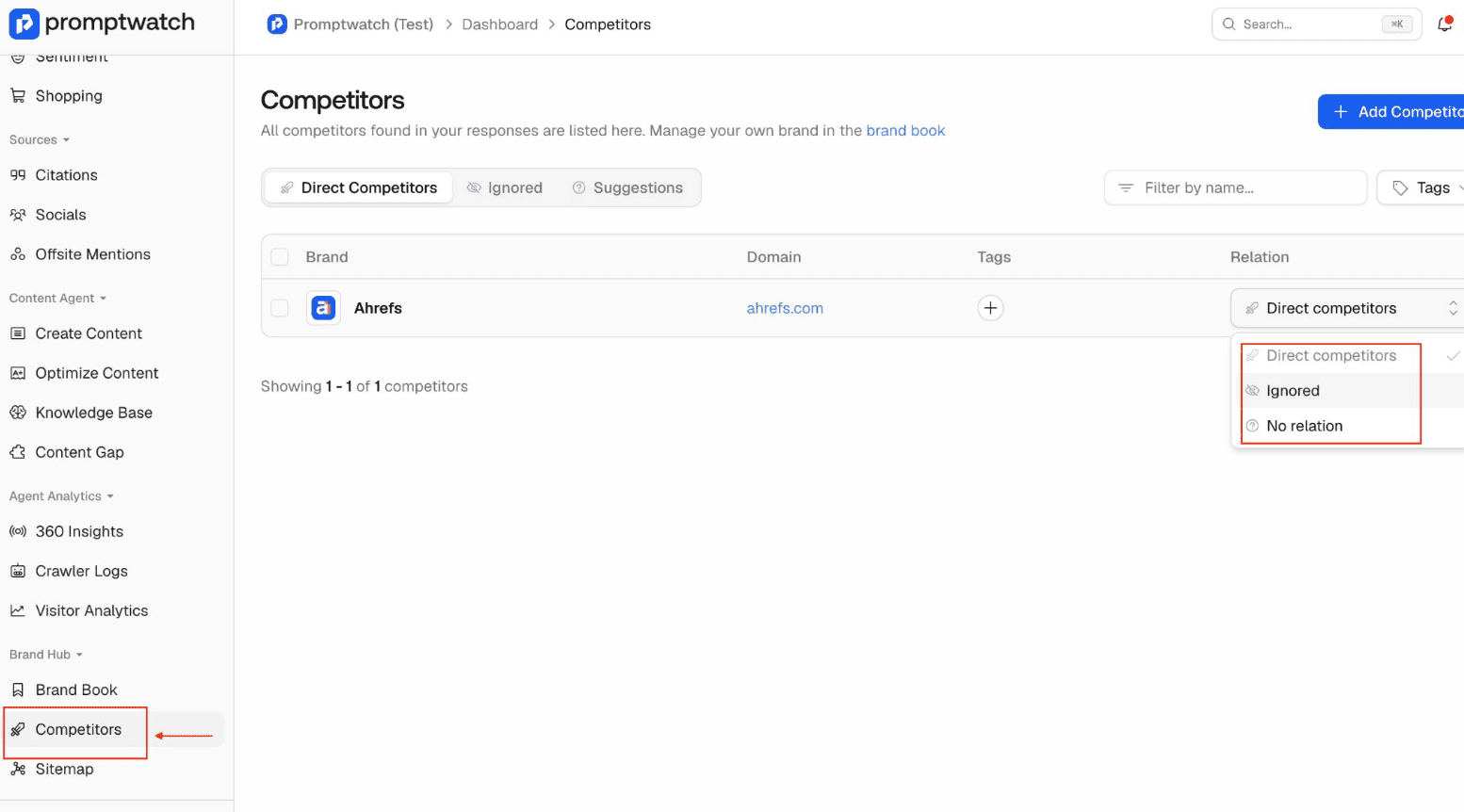
Promptwatch combines AI visibility monitoring with technical analysis and content workflows. Its wider feature set goes beyond basic prompt tracking.
Key features:
- AI crawler logs show which site pages bots access.
- Content agents create articles from identified visibility gaps.
- CMS integrations connect drafts with publishing platforms.
- Country, state, and city targeting supports local analysis.
- Shopping Insights tracks products appearing in AI recommendations.
- Knowledge bases add business context to generated content.
Pricing: Essential costs $95/month, Professional $245/month, and Business $579/month. Paid plans include a free trial.
Pros:
- A 7-day trial lets teams test the platform first.
- Users frequently praise its responsive customer support.
- G2 reviewers highlight its clear dashboards and reporting.
- Users also report frequent product updates and improvements.
Cons:
- You might find its prompt tracking relatively expensive.
- Tokens can deplete quickly with heavier usage.
Best suited for:
- Ecommerce and multi-location brands
6. Profound
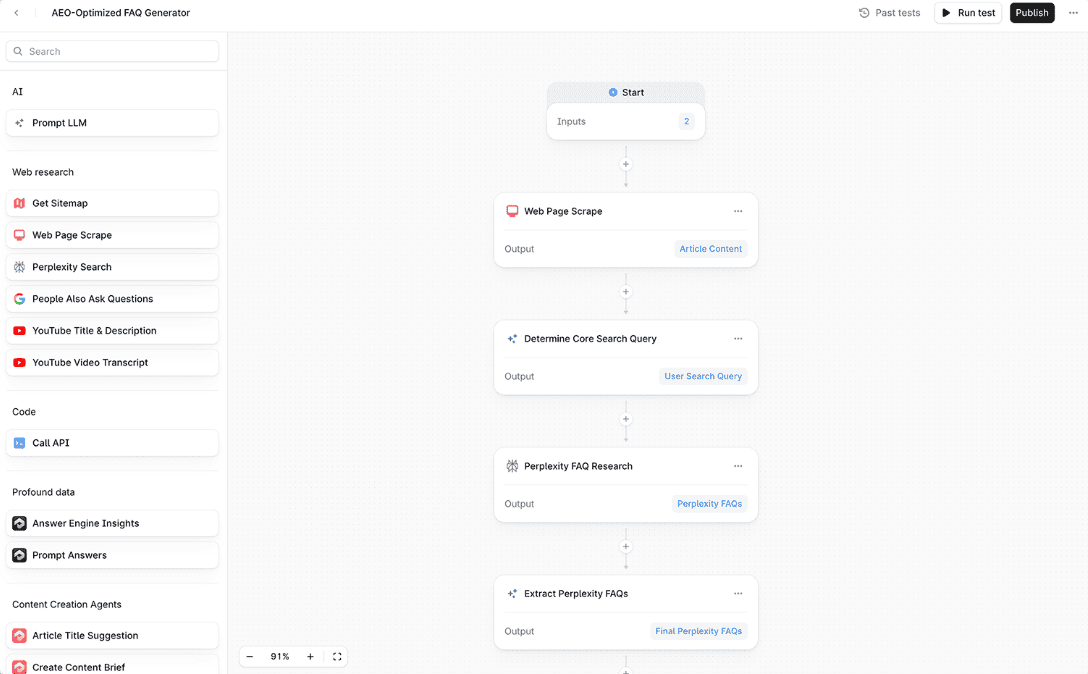
Profound pairs AI visibility tracking with an AI Marketer that does research, writing, and reporting for your brand. It suits teams that want to act on AI search data inside the same platform.
Key features:
- Prompt Volumes show the real demand for the questions users ask AI engines.
- AI Marketer drafts research, content, and reports.
- Reusable Agents automate recurring marketing tasks.
- Profound Sheets runs agents in bulk.
- Agent Analytics ties AI referral traffic to your domains.
- Tracks up to nine engines, including DeepSeek and Exa Search, which also makes it one of the best alternatives to AthenaHQ with wide AI engine coverage.
Pricing: The free trial runs 50 prompts daily for seven days. Enterprise pricing is custom.
Pros:
- SSO/SAML and SOC 2 support security reviews.
- Profound University makes onboarding easier.
- Enterprise includes dedicated Slack and specialist support.
Cons:
- Data-dense dashboards take time to learn.
- Trial prompts can't be customized.
- The trial excludes history and exports.
- There is no self serve paid plan, so teams usually need a custom Enterprise quote after the trial, unlike many Profound alternatives that publish their plans.
Best suited for:
- Enterprise AEO and content teams
- Retail, travel, and pharma brands
Also read:
7. Scrunch AI
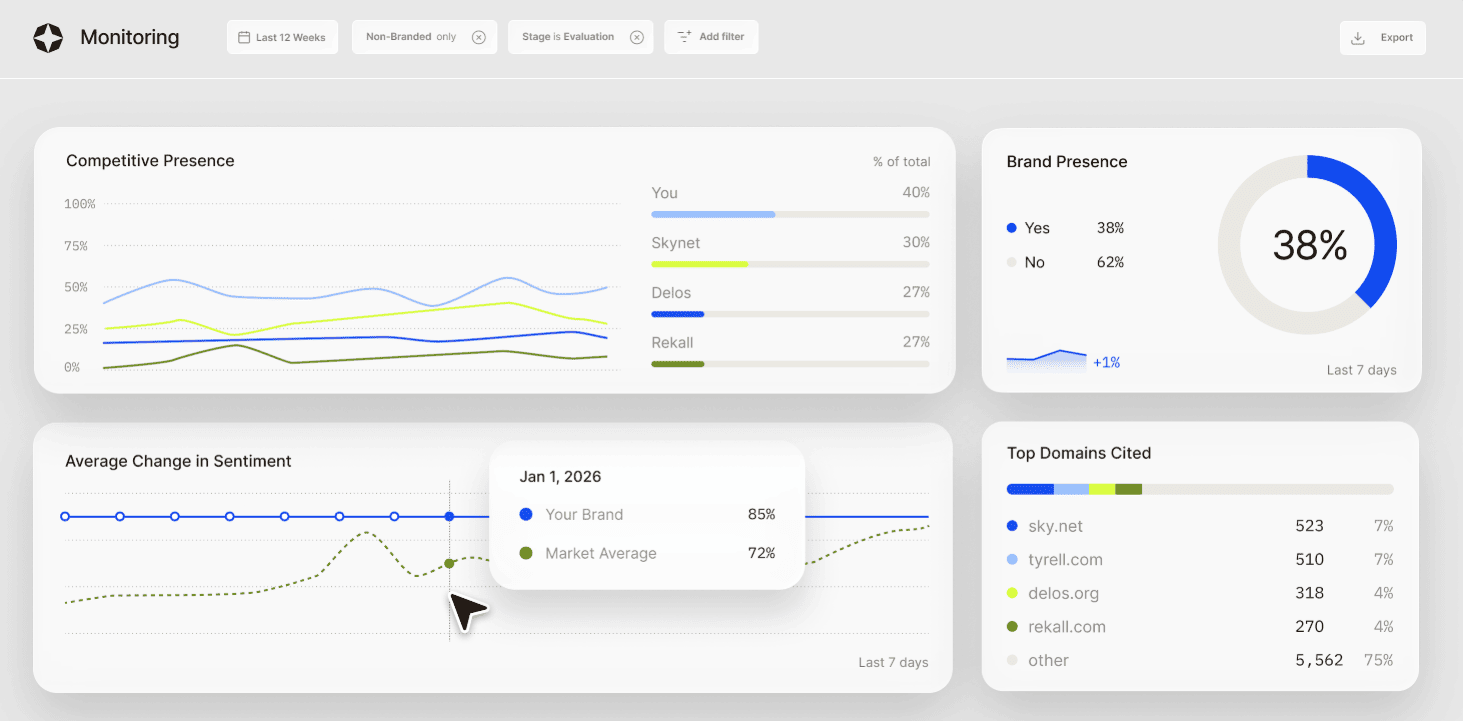
Scrunch AI helps brands understand how AI platforms see them and optimize their websites for AI agents.
Key features:
- AXP serves an AI-optimized page version to bots.
- Path level control over what LLM bots see.
- AI Search Trends tracks topics gaining momentum.
- Recommendations rank pages by optimization impact.
- Bulk prompt actions speed up tracking changes.
Pricing: Core costs $250/month for 125 prompts across four AI platforms. Enterprise pricing is custom. A seven day free trial is available.
Pros:
- Competitor data includes position and sentiment which gives more metrics for evaluation.
- Tests how wording and location change answers.
- Shows why bots crawl each page.
- Clients can get "view only" dashboards.
Cons:
- GA4 integration can prove to be buggy at times.
- Brand mention counts can be inconsistent.
- Personas can't be edited once created.
- Tracking beyond four AI platforms usually requires Enterprise, a gap several Scrunch AI alternatives cover on lower plans.
Best suited for:
- Web and digital experience teams
- Sitecore customers adding AI search tracking
8. Visby AI

Visby.ai is next in our list of AthenaHQ alternatives. It tracks brand visibility across ChatGPT, Claude, and Gemini and generates SEO and GEO tasks to close the gaps it finds. It also writes articles inside the platform, which makes it a fit for teams with limited content bandwidth.
Key features:
- Funnel stage tags split prompts into awareness, consideration, and decision.
- Side by side answers compare how each engine describes your category.
- GEO tasks move through a board from pending to done.
- Monthly article allowance grows with each plan.
- Ahrefs connection brings backlink data into recommendations.
- Shopify app tracks e-commerce store visibility in AI answers.
Pricing: Starter costs $79/month for 15 prompts and 45 analyzed answers. Growth costs $199/month for 90 prompts. Enterprise pricing is custom, and a free trial is available.
Pros:
- Offers an intuitive and simple dashboard, which narrows the tool's learning curve
- A free trial lets users evaluate the platform before subscribing.
Cons:
- Higher plans increase volume without adding engines such as DeepSeek or Grok.
- Generated articles still need human fact-checking, as they can lack consistency and quality.
- Data refresh timing isn't published.
Best suited for:
- Shopify and ecommerce store owners
- SEO teams, content marketers, agencies with a small client portfolio, and brands actively investing in AI discoverability.
9. Quattr
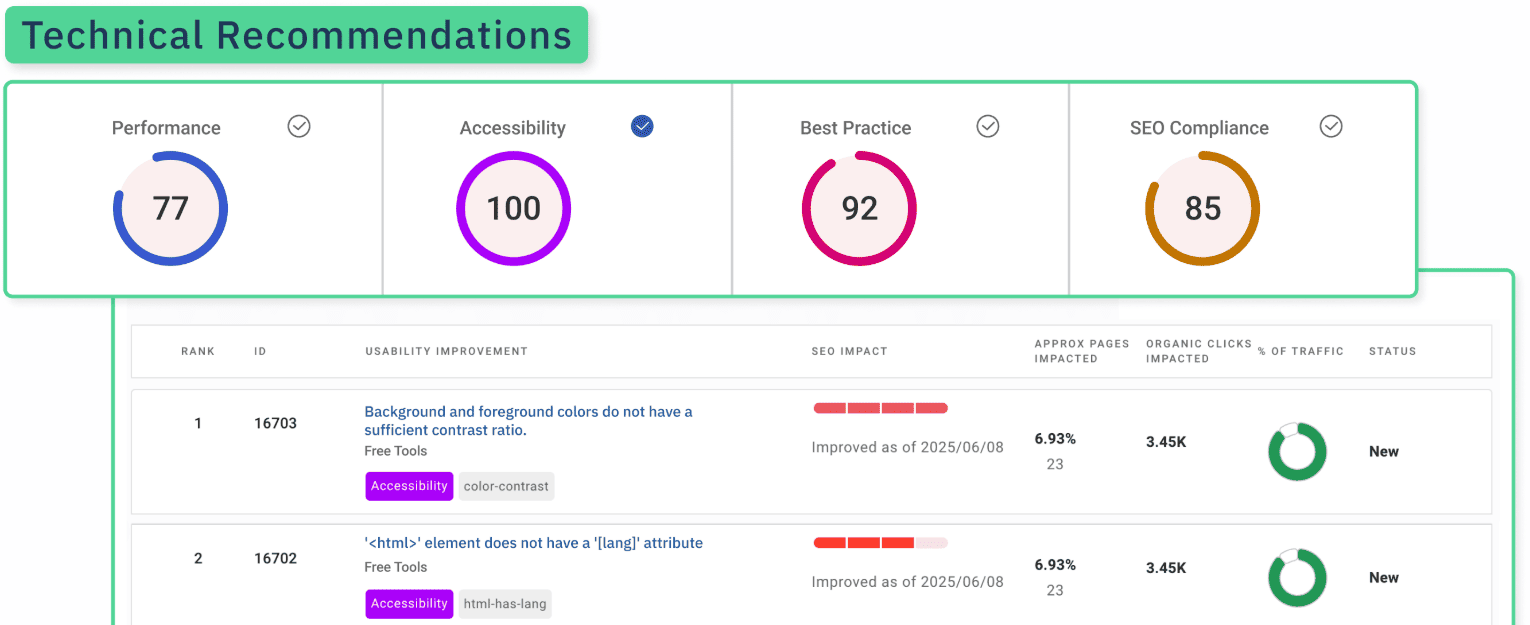
Quattr combines AEO and SEO data to guide what brands should improve next. Its recommendations use first-party search data instead of relying only on AI answer tracking.
Key features:
- Predictive scoring estimates whether content can rank and earn citations.
- GIGA creates and optimizes pages using brand and search data.
- E-E-A-T Intelligence evaluates content quality across trust signals.
- Internal linking automation builds connections between relevant pages.
- First-party data from GSC and GA4 informs recommendations.
- AI visibility covers ChatGPT, Claude, Gemini, Perplexity, and Google AI surfaces.
Pricing: Quattr does not publish standard plan pricing. Access is demo-led, and pricing is provided based on business requirements.
Pros:
- A sandbox previews changes before they go live.
- An SEO Concierge team helps execute the strategy.
- Citation share and market share are tracked next to rankings.
Cons:
- May exceed what smaller teams can operationalize without dedicated resources.
- Assumes strong SEO expertise, so beginners may struggle to set up and use the platform.
Best suited for:
- In-house SEO teams managing large websites
- Healthcare and real estate brands
10. AirOps

AirOps connects AI visibility insights with content production, turning visibility gaps into published fixes within one platform. Its focus is on scaling execution rather than reporting alone.
Key features:
- Grids run workflows across hundreds of pages at once.
- Quill agents act on triggers set in Playbooks.
- A visual builder creates custom automation steps.
- Power Agents offer prebuilt automations to customize.
- Brand Kits keep voice and rules consistent.
- Offsite finds publishers and manages citation outreach.
Pricing: A free Insights tier costs $0. Solo and Pro prices aren't published, but reviews report roughly $200/month and $2,000/month. Enterprise is custom, and a 14-day free trial needs no card.
Pros:
- Failed rows rerun individually instead of restarting the whole batch.
- Approval gates send drafts to Slack for review.
- Agents improve from your team's edits over time.
Cons:
- Solo tracks ChatGPT only.
- Solo and Pro allow just one Brand Kit.
- Task-based billing makes monthly spend hard to forecast.
- Workflows need a dedicated owner to design and maintain.
Best suited for:
- Digital marketing teams focusing on programmatic SEO and brands with large catalog websites
AthenaHQ Alternatives Under $100/Month
If you are looking for some cheaper alternatives to AthenaHQ for GEO and AEO, then these solutions:
- Siftly (Free): Siftly Answers has a free plan with 10 prompts across ChatGPT and Google AI Overviews, so teams can test AI tracking before spending anything. Paid plans start at $79/month.
- ZipTie (from $42.75/month): Instead of fixed tiers, ZipTie lets you build a plan around the prompts and AI engines you actually want to track, with unlimited seats and projects.
- LLMrefs ($79/month): For $79, the All in One plan packs in a lot. It covers 500 tracked prompts, every AI search engine with no extra fees, unlimited team members and projects, and geo-targeting in 50+ countries.
Best AthenaHQ Alternatives by Team Type
| Team type | Tools to consider | Why they fit |
|---|---|---|
| Startups and small teams | Otterly AI, Rankscale AI, MentionBird | Otterly AI offers a 14-day free trial before you pay. Rankscale AI's monthly entry plan keeps commitment low. MentionBird's annual billing includes two months free once you're ready to commit. |
| Agencies | MentionBird, Peec AI, Rankscale AI | MentionBird supports agency setups across multiple brands and 50 plus countries, with priority support. Peec AI offers separate agency plans for multiple client projects, and Rankscale AI makes all regions available on paid monitoring plans. |
| Enterprise teams | Profound and Quattr | Procurement readiness, coordination across SEO, content, and brand teams, and AI visibility data tied to business outcomes |
What Will Your Actual Monitoring Setup Cost?
The price on a pricing page rarely matches what you'll pay. Your real cost depends on how much you track, which you can estimate with one simple formula:
Prompts × AI platforms × checks per month = responses you need each month
Tracking 50 prompts across four platforms every day, for example, means about 6,000 AI responses a month. That number decides which plan you actually need.
Beyond volume, these factors push the final bill up:
- Engine limits and add-ons: Some tools cap or charge extra for specific engines. Otterly, for instance, tracks only any 3 of its 7 engines on each plan, while Peec AI typically charges $35 to $165 a month for each engine beyond its three.
- Credit and response caps: On credit based tools, every response uses a credit. AthenaHQ's Starter includes 3,600 credits a month, where one credit equals one AI response. That covers only about 30 prompts across four platforms checked daily.
- Prompt overages: Going past your allowance can get expensive.
- Regions and seats: Tracking more than one country or adding teammates often requires a higher tier.
To avoid surprises, list the prompts, platforms, and markets you need before comparing the top alternatives to AthenaHQ. Then calculate your monthly response volume and check it against each plan's limits.
Before You Switch, Ask Vendors to Prove These 5 Things
Even the best AthenaHQ alternatives can look similar in a demo. Before signing, ask each vendor to show:
- Real responses: Full AI answers behind every visibility score, not just summary metrics.
- Refresh frequency: How often prompts are actually rechecked on each platform.
- Platform coverage: Which engines your plan includes, without paid add ons.
- Data portability: Whether you can export prompt history and results via CSV or API if you leave.
- Actionable output: A sample recommendation tied to a specific prompt you track.
Ask them to demonstrate each point using your own prompts and competitors, not a prepared demo account.
How to Switch Without Losing Your Reporting Baseline
AI visibility tools calculate metrics differently, so a new tool's numbers won't line up with your old ones on day one. These steps keep your trend lines meaningful through the switch:
- Freeze your prompt set: Move the exact same prompts, competitors, and target regions to the new tool before adding anything new.
- Capture a final snapshot: Record your last AthenaHQ figures for visibility, citations, and competitor share before your plan ends.
- Run both tools in parallel: Keep them running together for two to four weeks to see how their numbers compare.
- Map metric definitions: Note how each tool defines visibility and citations, so stakeholders understand any gaps.
- Mark the switch date: Flag it in every report so future readers know where the old data ends and the new data begins.
Once the overlap period ends, treat the figures from your new AthenaHQ alternative as your fresh baseline.
Conclusion
The right AthenaHQ alternative depends less on headline price and more on whether it tracks the platforms, prompts, and markets that matter to your buyers. Shortlist two or three tools, test them with your own prompts, and choose the one that turns visibility data into clear next steps.
FAQs
1. What is the difference between AEO and GEO tools when choosing an AthenaHQ alternative?
AEO tools help brands earn mentions inside AI answers for buyer questions. GEO tools make content easier for generative AI to find, read, and cite.
2. Which AthenaHQ alternatives track AI visibility in multiple languages?
LLMrefs supports more than 20 languages on its $79 All in One plan, while AirOps reserves multiple languages and regions for its Enterprise plan.
3. Can AthenaHQ alternatives flag inaccurate AI answers about my brand?
Yes, some tools like Scrunch AI, through their knowledge studio, can.
4. How quickly do AI visibility changes show up after optimizing content?
AI visibility can shift within weeks of a content update. Track the same prompts consistently for at least a month before judging results.
5. Do I still need an SEO tool alongside an AthenaHQ alternative?
Usually, yes. Most AI visibility tools don't replace keyword rank tracking or technical audits. Semrush, however, now bundles AI visibility into its SEO and AI Search plans.
6. How many prompts should I track when moving to an AthenaHQ alternative?
Start with 25 to 50 prompts covering real buyer questions across problem, comparison, and purchase stages. Expand once your baseline stabilizes.
7. Which metrics matter most for brand benchmarking across LLMs?
Focus on mention rate, share of voice against competitors, citation rate for your pages, and average answer position. Sentiment adds useful context.

See which buyer questions you are losing in AI answers, and how to win them.
First month $19 with code TRY19, then $79/mo. Cancel anytime.