Average Position
Average position is where your brand typically appears when an AI answer ranks brands in a numbered list, calculated only from the answers that rank you.
- Average position is your brand's typical rank in AI answers that list brands in order, and lower numbers are better.
- Answers that mention brands in prose are left out, since a mention without an order has no position to count.
- Because it rests on fewer answers, average position settles slowly and can swing in the early weeks of tracking.
- A strong average position means little without a healthy mention rate, so always read the two together.
- MentionBird reports average position for every prompt alongside mention rate, prominence, and share of voice across up to 20 AI platforms.
How average position is calculated
Some AI answers rank brands in a numbered list, such as "1. Brand A, 2. Brand B, 3. Brand C." Others mention brands in flowing prose with no order at all. Average position looks only at the ranked answers.
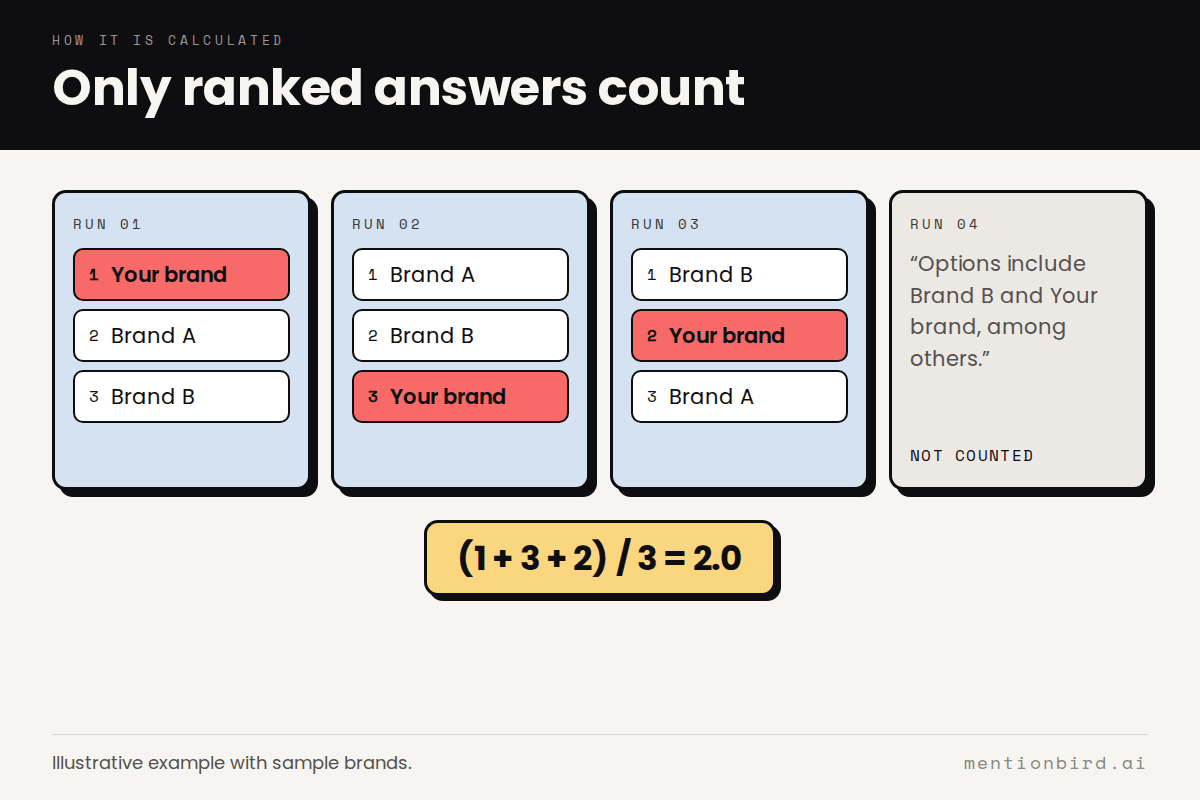
Add up your position in each ranked answer and divide by the number of those answers. Lower is better, and an average position of 1.0 means AI listed you first every time it ranked anyone.
Why prose mentions are left out
A mention inside a paragraph has no position. Counting it as first would flatter you, and counting it as last would punish you for an answer that never ranked anyone. Leaving those answers out keeps the number honest: it answers one specific question, "when AI ranks brands, how high am I?"
The tradeoff is that average position rests on fewer answers than most metrics. It takes longer to settle, and in the first weeks of tracking it can jump around as each new ranked answer comes in. That swing is a sampling effect, closely tied to answer stability, rather than a real change in standing.
Read it beside mention rate
Average position on its own can mislead badly, because it says nothing about how often you appear.

A brand ranked second in the few answers that name it, and missing from almost all the rest, has a strong looking position and very little real reach. A brand ranked fourth in most answers is in a far better place, even though its number looks worse. Mention rate, the share of answers that name you, is what tells the two apart, and it sits at the heart of AI visibility.
See where ChatGPT ranks your brand
Get a free leaderboard of the brands ChatGPT names for five buyer questions in your category, with your spot on it and the pages it cites. No signup.
Run the free scanAverage position vs prominence
The two sound alike but measure different things. Prominence looks at every answer that mentions you, ranked or not, and scores how early your name appears on a scale of 0 to 100. Average position uses only ranked lists and reports an actual rank.
Prominence is the broader read on how much attention you get when named. Average position is the sharper read on how you compare when AI explicitly orders the options.
What moves average position up
- Be the clearest fit for the question: AI ranks the brand that best matches the use case first, so pages that state exactly who you are for help you climb.
- Win the comparisons: When AI ranks options, it leans on how sources compare them. Comparison pages and reviews that explain why you win on specific points carry weight.
- Get ranked highly in the lists AI reads: Placement in best of lists and roundups often carries straight into how AI orders its own answer.
- Close the gap with the brands above you: Look at what the top ranked brand has that you lack, whether that is reviews, coverage, or clearer pricing, and close it.
How MentionBird helps
MentionBird reports average position for every prompt, alongside mention rate, prominence, and share of voice, across the AI platforms in your plan. Seeing them together stops one strong number from hiding a weak one. Starter covers ChatGPT and Gemini, Growth adds Perplexity and Claude, and Custom supports up to 20 platforms: ChatGPT, Gemini, Perplexity, Claude, Grok, Google AI Overviews, Microsoft Copilot, DeepSeek, Google AI Mode, Mistral Vibe, Qwen Chat, Meta AI, Kimi AI, You.com, Ask Brave, Alexa for Shopping, Doubao, ERNIE, Poe, and Duck.ai.
Competitor tracking shows where each rival ranks in the same answers, so you can see exactly which brands sit above you and on which prompts.
Other glossary terms to check out
FAQs
1. Is a lower average position better?
Yes. Position 1 means first in the list, so the closer your average is to 1.0, the higher AI ranks you.
2. What is a good average position?
It depends on how many brands your category usually lists. In answers that rank five options, staying in the top two is strong, as long as your mention rate is healthy too.
3. Is average position the same as a Google ranking?
No. A Google ranking is your page's spot on a results page. Average position is your brand's spot inside an AI answer's own list.
4. Does average position differ by AI platform?
Yes. Each platform builds and orders its lists differently, so you can rank first on one and fourth on another for the same question.
5. Can my average position drop even if nothing changed on my side?
Yes. If a competitor climbs or a new brand enters the lists, every brand below it moves down a place.
See where AI ranks you against every competitor
First month $19 with code TRY19, then $79/mo. Cancel anytime.