Answer Stability
Answer stability is how consistently an AI engine gives the same answer to the same question, naming the same brands, in the same order, with the same sources, each time it is asked.
- The same AI question rarely gets the same answer twice, so the brands named, their order, and the sources cited can all change between runs.
- MentionBird's research found ChatGPT and Gemini replaced 64% of their top five brands from one answer to the next.
- A small set of core sources tends to hold steady for months, while the wider pool around it turns over weekly.
- Reliable measurement comes from a fixed prompt set, repeated runs, and weekly comparisons, with the run count shown beside every rate.
- MentionBird builds that repeated sample automatically across up to 20 AI platforms, so no manual checking is needed.
What answer stability looks like
Ask an AI assistant the same buying question three times and you can get three different shortlists.
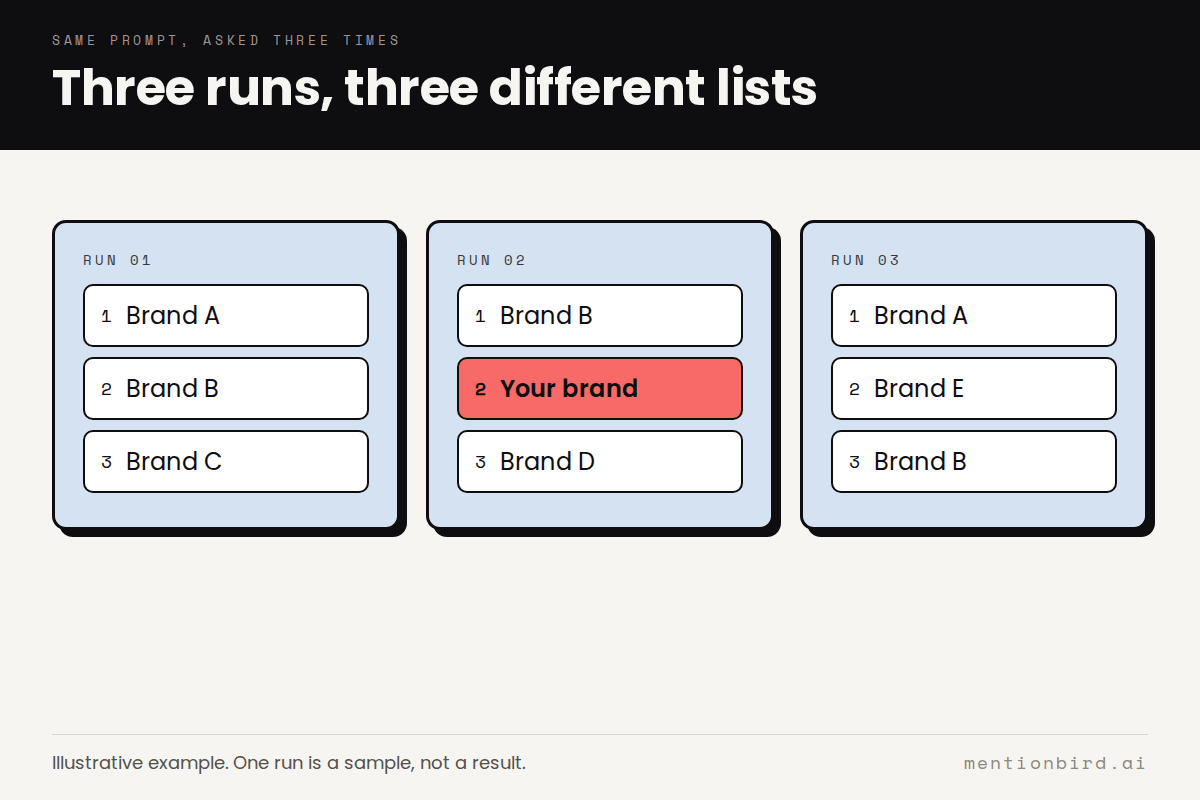
In the example above, your brand appears in one run out of three. A single check would have told you either that you lead the category or that you are missing from it, and neither would be true.
How stable are AI answers?
Not very. In our answer stability study, ChatGPT and Gemini replaced 64% of their top five recommended brands from one answer to the next. You can find the full method, along with our other studies, on the MentionBird research page.
The sources behind the answers move as well. When SISTRIX tracked 82,619 prompts in Google's AI Mode over four months, more than half of the cited domains changed every week.
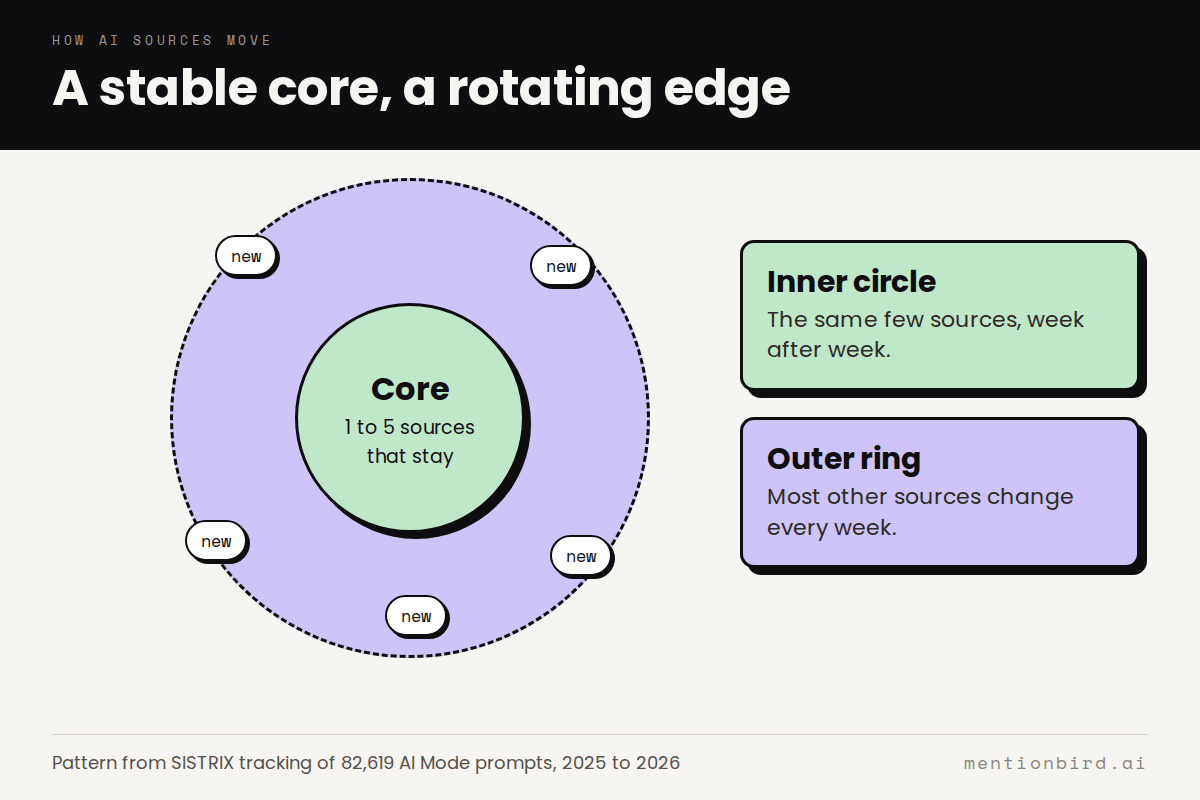
The same research found a useful pattern. Most answers keep a small core of sources that stays for months, while almost everything around it rotates. Brands and pages in that core show up consistently. Everyone else comes and goes.
Why AI answers change
- Each answer is written fresh: AI models build every response from scratch with a degree of randomness, so wording, brands, and order can shift.
- The searches differ from run to run: When an assistant searches the web before answering, it may phrase its searches differently each time and land on different pages.
- Sources keep rotating: New reviews, lists, and articles appear while older ones drop out of the pool AI draws from.
- Models get updated: A new model version can change which brands an assistant favors overnight.
- Context changes the answer: Location, language, and account history can all lead to different results for the same question.
How to measure answer stability
Treat AI answers as samples, not readings. A reliable picture comes from repetition.
- Fix your prompt set: Use the same buying questions every time so changes reflect the answers, not your inputs.
- Run each prompt many times: Repeat every prompt on each platform, across several days, rather than checking once.
- Count appearances per run: Record whether you were named in each run. That gives you mention rate, the core measure behind AI visibility.
- Compare weeks, not days: Weekly totals smooth out the swings that single days exaggerate.
- Keep the count next to the rate: A percentage means little without the number of runs behind it.
See how stable ChatGPT is about your brand
We run five buyer questions three times each, so you see whether ChatGPT names you consistently or only some of the time. Free, no signup.
Get your free AI Visibility ReportWhat it means for reporting
Before crediting a content change for a rise, or blaming it for a drop, check whether your own mentions moved or whether the answers simply rotated. Competitive measures like AI share of voice deserve the same care, since a rival's swing can look like your loss.
It also helps to report each platform on its own. A stable result on one assistant can hide heavy churn on another.
How MentionBird handles answer stability
MentionBird runs your buying prompts every day across the AI platforms in your plan, building the repeated sample that stability demands without any manual checking. Starter covers ChatGPT and Gemini, Growth adds Perplexity and Claude, and Custom supports up to 20 platforms: ChatGPT, Gemini, Perplexity, Claude, Grok, Google AI Overviews, Microsoft Copilot, DeepSeek, Google AI Mode, Mistral Vibe, Qwen Chat, Meta AI, Kimi AI, You.com, Ask Brave, Alexa for Shopping, Doubao, ERNIE, Poe, and Duck.ai.
Prompt tracking shows how often you appear over time, and competitor tracking shows whether rivals are holding steady or swinging, and keyword tracking shows when the searches behind those answers change.
Other glossary terms to check out
FAQs
1. Is answer stability the same as accuracy?
No. An answer can be perfectly stable and still wrong, repeating the same outdated price every time. Stability tells you how consistent AI is, not whether it is right.
2. Is low answer stability bad for my brand?
Not by itself. It mainly means single checks are unreliable. What matters is how often you appear across many runs over time.
3. Should I include branded prompts when measuring stability?
Keep them separate. Prompts that name your brand almost always mention you, so they look stable and can hide real swings in the discovery questions that matter most.
4. Which AI platforms give the most stable answers?
It varies by platform and by topic, and it changes as models are updated. Measure each platform separately instead of assuming.
5. Does answer stability affect my competitors too?
Yes. Every brand in your category faces the same churn, which is why comparing yourself with rivals over many runs is more useful than chasing a single perfect answer.
Track your AI visibility across thousands of runs, not one
First month $19 with code TRY19, then $79/mo. Cancel anytime.