Authority Signals
Authority signals are the cues AI engines use to judge whether a brand or page is trustworthy enough to name, recommend, or cite, such as independent reviews, expert authorship, press coverage, and consistent business details.
- AI can only name a few brands per answer, so it relies on readable evidence of trust to decide which ones belong.
- Authority grows when credible third parties repeatedly validate the same brand claims.
- Reviews, expert authorship, press coverage, original data, and consistent details do most of the work.
- Newer brands should start with the signals they control, while established brands gain most from original data and press.
- MentionBird shows which sources AI trusts in your category and which competitors they favor, so you know where authority is won.
Why AI needs authority signals
An AI answer can only name a handful of brands, and the model has no way to try products or call references. It has to decide who deserves a place based on evidence it can read. Authority signals are that evidence: patterns across the web showing that a brand is established, credible, and consistent with its claims.
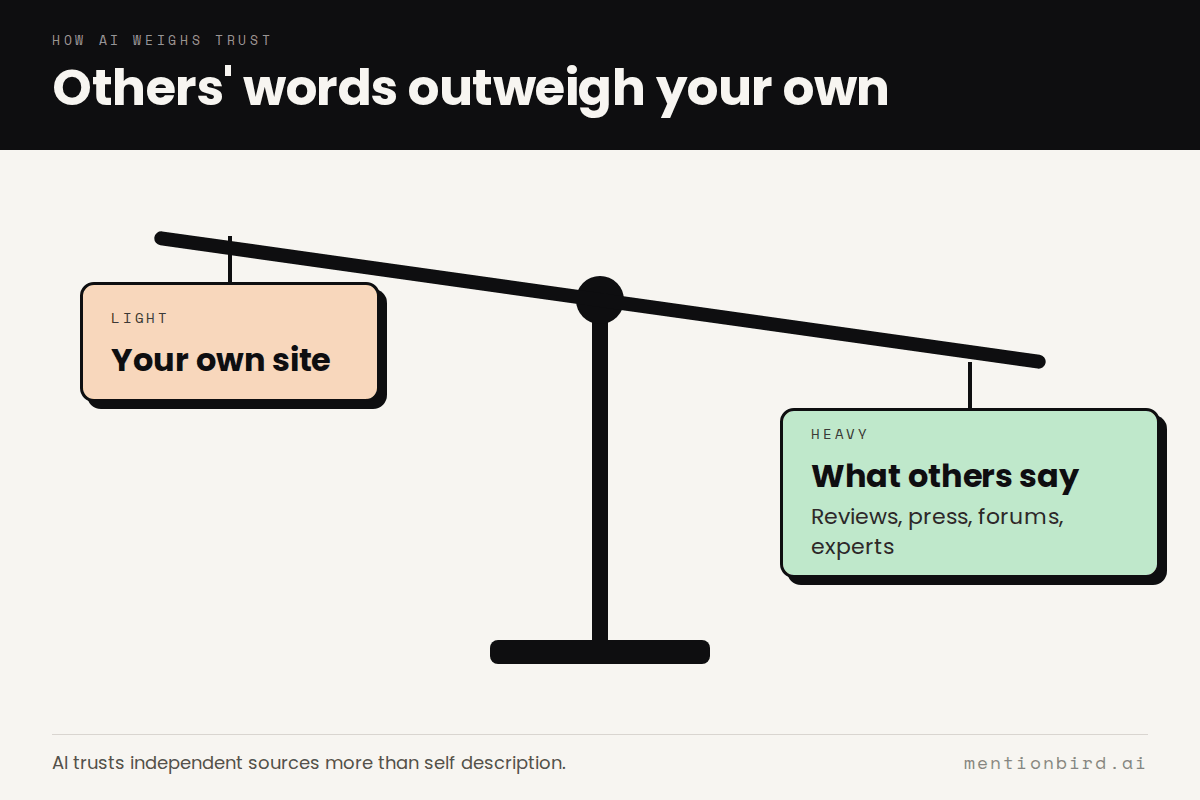
The weight AI gives that evidence is not even. Claims a brand makes about itself count for less than what independent sources say about it.
The signals that carry the most weight
Five kinds of evidence do most of the work, and each one is built differently.
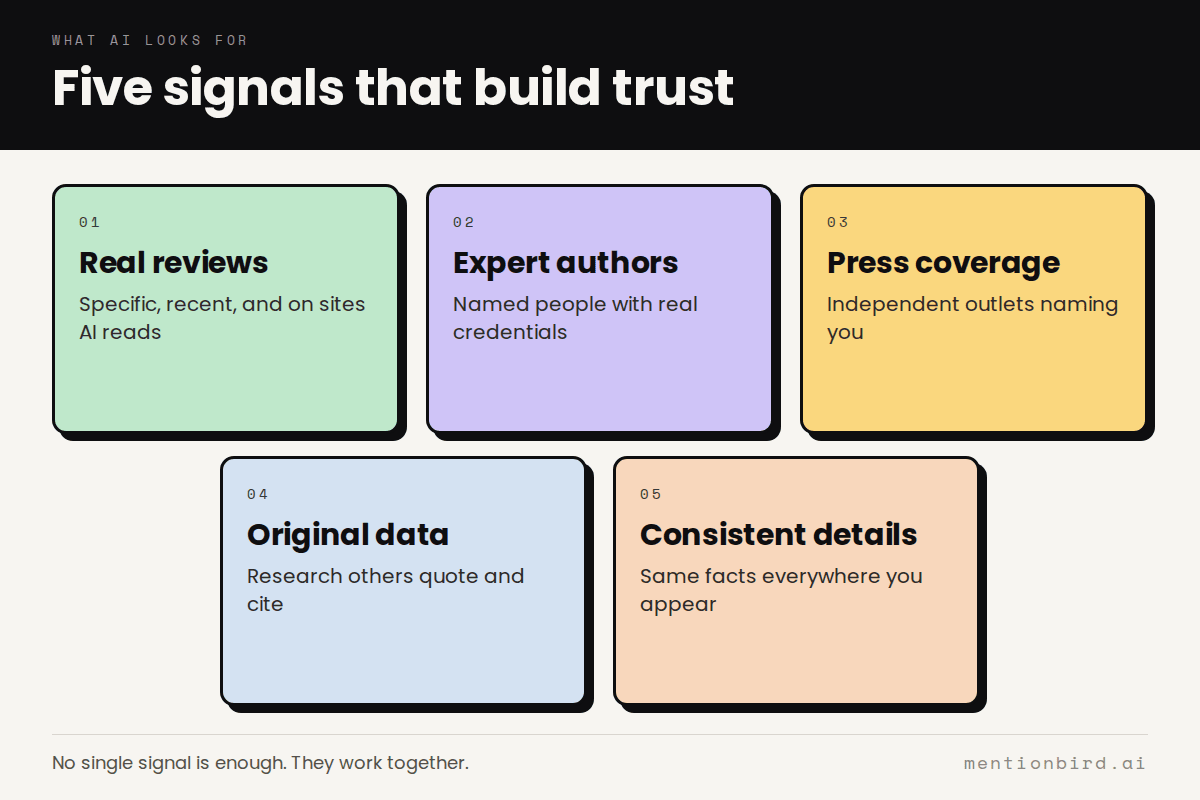
- Real reviews: Detailed, recent reviews on sites AI reads show that customers vouch for you. Ask happy customers to explain why they chose you, not just leave a star rating.
- Expert authors: Content written or reviewed by named people with relevant experience reads as more reliable. Give authors real bios and link them to their profiles.
- Press coverage: Independent outlets naming your brand tell AI that others consider you worth writing about. Pitch stories with a genuine angle rather than announcements.
- Original data: Research that others quote turns your brand into a source rather than one of many voices. Even a small, well run study can earn lasting citations.
- Consistent details: Matching names, descriptions, and facts across your site, profiles, and listings helps AI recognize you as one clear entity.
Where to start
The right first move depends on how established your brand already is.
For a newer brand: Start with consistent details and expert authorship, since both are within your control and make every later mention count. Then focus on earning a first wave of detailed reviews.
For an established brand: The basics are usually in place, so the gains come from original data and press coverage, which turn an existing reputation into a source others cite.
Authority usually builds gradually as new reviews, mentions, and coverage get discovered and incorporated into future answers.
How to tell if it is working
Authority itself is not measurable directly, but its effects show up in how AI treats you. More frequent AI mentions for category questions, warmer AI sentiment in how you are described, and more of your own pages appearing as AI citations all point to stronger signals.
How MentionBird helps
MentionBird shows which sources AI already trusts in your category. Citation tracking lists the review sites, publications, and pages behind every answer across the AI platforms in your plan. Those are the places where earning a mention adds the most weight. Starter covers ChatGPT and Gemini, Growth adds Perplexity and Claude, and Custom supports up to 20 platforms: ChatGPT, Gemini, Perplexity, Claude, Grok, Google AI Overviews, Microsoft Copilot, DeepSeek, Google AI Mode, Mistral Vibe, Qwen Chat, Meta AI, Kimi AI, You.com, Ask Brave, Alexa for Shopping, Doubao, ERNIE, Poe, and Duck.ai.
Competitor tracking shows which rivals those sources favor, so you can see where their authority comes from and where you have room to catch up.
FAQs
1. Are authority signals the same as backlinks?
No. Backlinks are one kind of signal, but AI also reads unlinked mentions, reviews, author credentials, and how consistently your brand is described.
2. Does a high domain authority score help in AI answers?
Third party authority scores are estimates made by SEO tools, not something AI engines use. What matters is the underlying evidence those scores try to approximate.
3. Can a small brand compete with big names on authority?
Yes, especially in a narrow niche. A focused brand with strong reviews and expert content can outweigh a larger brand that is only loosely associated with the topic.
4. Do AI engines follow Google's quality guidelines?
Not directly, but they reward similar things: real experience, expertise, and trust. Content that meets those standards tends to do well in both.
5. Can authority signals be faked?
Short term tricks like fake reviews tend to backfire, since AI weighs patterns across many sources. Signals that hold up are the ones earned from real customers and coverage.
See which sources AI trusts in your category
First month $19 with code TRY19, then $79/mo. Cancel anytime.