AI Prompt Volume
AI prompt volume is an estimate of how often people ask AI assistants about a particular question or topic, the AI counterpart to keyword search volume.
- No AI platform publishes how often each question is asked, so every prompt volume figure is an estimate built from other signals.
- Buyers phrase the same need in many different ways, so demand is best measured across a topic rather than for one exact prompt.
- Estimates come from keyword volume, panel data, and platform share, and each method misses something on its own.
- Use buying intent to pick prompts and estimated demand to decide which to track first.
- MentionBird tracks your chosen prompts across up to 20 AI platforms and shows the searches AI runs behind them.
Why there is no official prompt volume
Search engines have published keyword data for years through tools like Search Console. AI platforms publish nothing comparable. OpenAI has said ChatGPT alone receives around 2.5 billion prompts a day, yet none of that is broken down by question, topic, or brand.
Part of the reason is the nature of prompts themselves. They are often long, personal, and part of an ongoing conversation, which makes them hard to group and sensitive to share. So every prompt volume figure you come across is an estimate.
Why prompts do not map neatly to keywords
A keyword is a short label for a topic. A prompt is a full question, usually wrapped in the buyer's own situation.

Because every buyer describes their needs differently, demand that would sit under one keyword gets spread across countless phrasings, and most individual phrasings are asked only a handful of times. That is why prompt volume is most useful at the level of a topic, not a single sentence.
How prompt volume is estimated
Tools that offer prompt volume rely on one or more of three approaches, each with its own blind spot.

- Keyword volume as a stand in: Search demand for the same topic is the most widely available signal, but people do not ask AI and search engines in the same proportions.
- Panel data: Measuring the AI activity of a sample of real users captures actual prompts, but small samples miss niche and business topics.
- Platform share: Splitting estimated total usage by each platform's popularity shows overall scale, but says little about any one question.
Combining them narrows the range, which is usually enough to compare one topic against another.
How to choose prompts without exact numbers
Since prompt volume can only ever be rough, it works better as a tiebreaker than as a starting point.
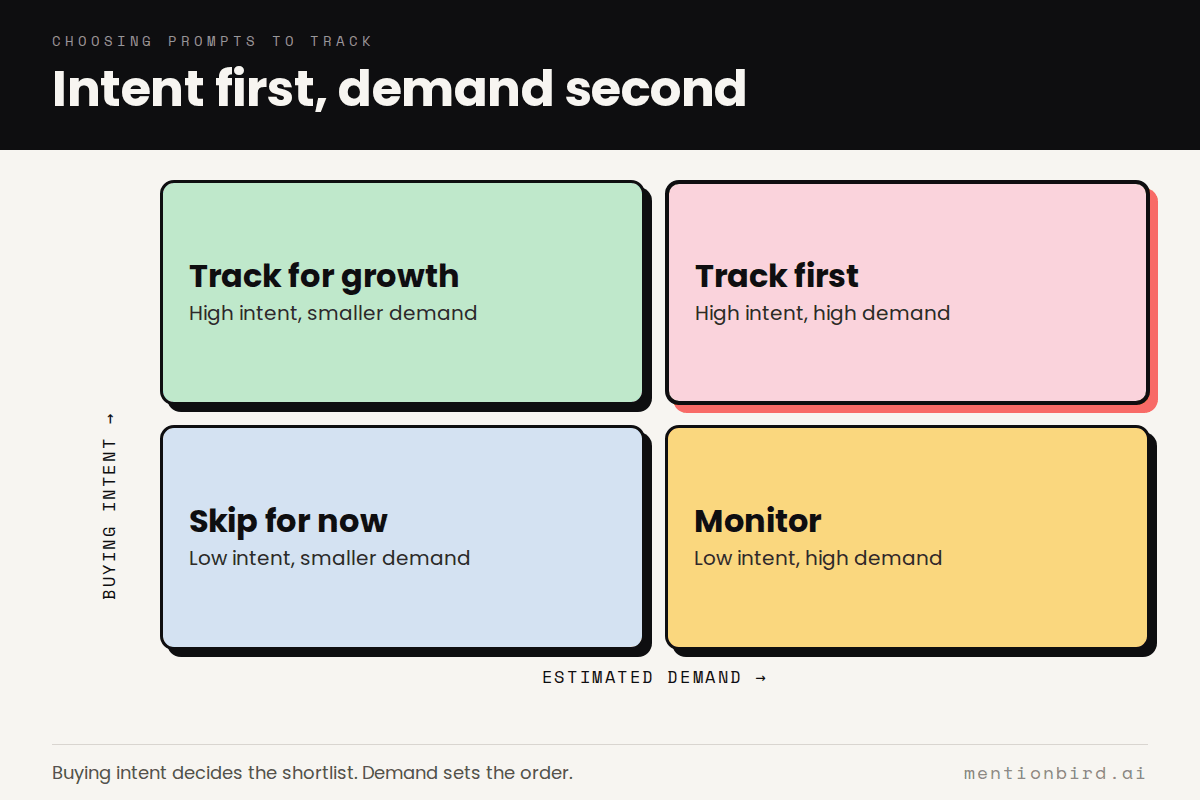
Begin with buying intent: the questions people ask when they are close to choosing a product in your category. Among those, estimated demand decides which to track first. Prompts with high demand but little buying intent, such as general how to questions, are worth watching but rarely decide a sale.
A practical way to build that first list is the free keyword to prompt generator, which turns the keywords you already rank for into the questions buyers ask AI. That grounds your prompts in demand you can already measure.
How MentionBird helps
MentionBird shows an estimated prompt volume for every prompt you track, along with a difficulty score that indicates how hard it will be to win a place in the answer. Together, they show which prompts are worth the effort before you invest in them.
Each prompt also comes with the metrics that show how you’re doing on it: mention rate, average position, prominence, share of voice, and sentiment. All of these are tracked daily across the AI platforms in your plan. Starter covers ChatGPT and Gemini, Growth adds Perplexity and Claude, and Custom supports up to 20 platforms: ChatGPT, Gemini, Perplexity, Claude, Grok, Google AI Overviews, Microsoft Copilot, DeepSeek, Google AI Mode, Mistral Vibe, Qwen Chat, Meta AI, Kimi AI, You.com, Ask Brave, Alexa for Shopping, Doubao, ERNIE, Poe, and Duck.ai. Prompt tracking brings them together, so you can see whether the demand behind a prompt is turning into visibility for your brand or for a competitor.
FAQs
1. Does prompt volume differ between AI platforms?
Yes. Each platform has a different audience, so a topic that comes up often on one assistant can be rare on another.
2. How often does prompt demand change?
Demand shifts with seasons, news, and product launches, so it is worth revisiting your priorities every quarter.
3. How should I word the prompts I track?
Write them the way a buyer would ask, with context such as team size or budget, rather than as short keywords.
4. How many variations of a prompt should I track?
Two or three phrasings per topic is usually enough to see how AI treats it, without spreading your tracking too thin.
5. Will AI platforms ever share prompt data?
Google already reports impressions from its AI features in Search Console, but without the questions behind them. Until platforms share question level data, estimates are the only option.
See which buying prompts name your brand
First month $19 with code TRY19, then $79/mo. Cancel anytime.