BERT
BERT (Bidirectional Encoder Representations from Transformers) is a language model Google brought to Search in 2019 that reads each word in the context of the words around it, so Search can understand what a query means rather than only which keywords it contains.
- BERT taught Google Search to read every word in context, including small words like to and for that often decide what a query means.
- At launch in 2019, Google said BERT would help it better understand about one in 10 English searches in the US.
- BERT reads in both directions at once and learned language by guessing hidden words across huge amounts of text.
- Unlike large language models that generate answers, BERT was built to understand text, which still matters in the search step behind many AI answers.
- Content that answers specific situations in natural language generally suits both BERT and today's AI search.
What BERT changed in search
Before BERT, Google largely matched the important words in a query and often skipped small words like "to," "for," and "without." Those words frequently decide what a person actually means.
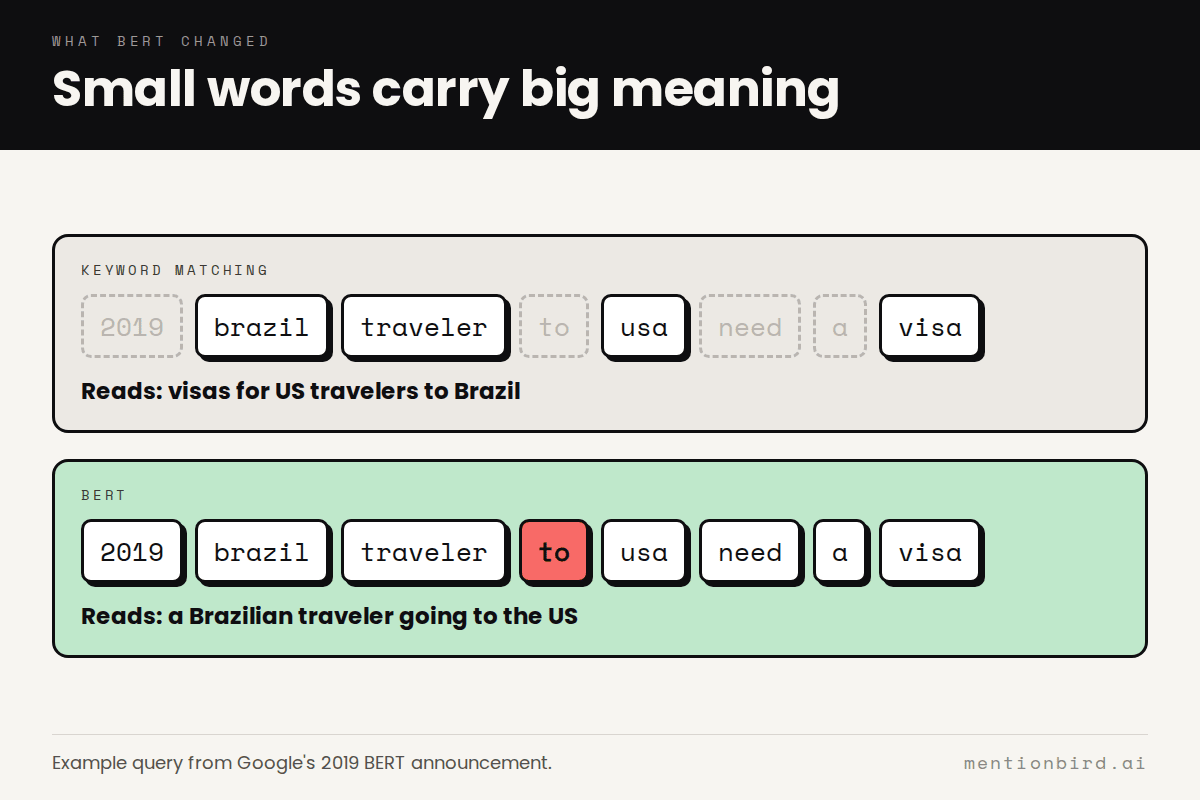
In its 2019 announcement, Google used this query as an example. Keyword matching returned results about US citizens traveling to Brazil, while BERT understood that "to" meant a Brazilian traveler heading to the US. Google said BERT would help Search better understand about one in 10 English searches in the US at launch.
How BERT works
BERT stands for Bidirectional Encoder Representations from Transformers. The key word is bidirectional: instead of reading a sentence one word at a time from left to right, BERT looks at the words on both sides of each word at once. That lets it work out meaning from context, much the way a person does.
It learned this by reading enormous amounts of text with some words hidden and practicing guessing them. Over time, it built a detailed sense of how words relate to each other in real sentences.
BERT vs today's large language models
BERT and the models behind assistants like ChatGPT share the same foundation, the transformer, but they do different jobs. BERT was built to understand text, which made it ideal for matching queries to the right pages. Large language models are built to generate text, which lets them write full answers.
The two still meet in practice. Many AI answers begin with a search step, where understanding a question correctly decides which pages are retrieved, and that is the kind of work BERT pioneered.
What BERT means for content today
Google said at the time that there was nothing specific to optimize for BERT, and that advice has aged well. What BERT rewarded, content written for real people, is generally what AI search rewards too.
- Write the way people ask: Full, natural questions usually match better than lists of keywords.
- Keep the words that change meaning: Words like "for," "without," and "under" often define the exact need, so they belong in your headings and answers.
- Answer specific situations: A page that addresses a particular use case, budget, or audience typically matches the long, detailed queries BERT was built to understand.
- Drop keyword stuffing: Repeating a phrase adds little once search understands context, and it tends to make pages harder to read.
How MentionBird helps
BERT changed search from matching keywords to understanding full questions. AI assistants have taken that shift further, and buyers now ask long, natural questions instead of typing short keywords. Traditional SEO tools track keywords and rankings, so they generally miss what AI says when someone asks a real question.
MentionBird tracks those natural, buyer-intent questions every day across the AI platforms in your plan. It shows whether each answer names your brand, where you appear, and which competitors are recommended instead. Keyword tracking adds the shorter web searches AI usually runs behind each question, so you can connect what buyers ask AI with the searches your pages already rank for. Starter covers ChatGPT and Gemini, Growth adds Perplexity and Claude, and Custom supports up to 20 platforms: ChatGPT, Gemini, Perplexity, Claude, Grok, Google AI Overviews, Microsoft Copilot, DeepSeek, Google AI Mode, Mistral Vibe, Qwen Chat, Meta AI, Kimi AI, You.com, Ask Brave, Alexa for Shopping, Doubao, ERNIE, Poe, and Duck.ai.
When you’re missing from an answer, citation tracking shows which pages AI relied on instead, and ranking advice suggests what to do next, from updating your pages so they answer the question clearly to earning a place on the sources AI trusts. That way, your content keeps up with the natural, meaning first way people now search.
FAQs
1. Is BERT still used in Google Search?
Google has added newer models since 2019, but language understanding of the kind BERT introduced generally remains a core part of how Search interprets queries.
2. Did BERT cause ranking drops?
Not as a penalty. BERT changed how Google understood queries, so some pages naturally gained or lost visibility for searches they had matched by keywords alone.
3. Does BERT only apply to English?
No. Google first applied it to US English searches and expanded it to more than 70 languages within a few months.
4. Is BERT open source?
Yes. Google published BERT as an open source model in 2018, and researchers have since built many variations on it.
5. What came after BERT in Google Search?
Google has since introduced larger models, such as MUM in 2021, and later the Gemini models behind its AI features, each building on the shift BERT started.
Track the questions buyers actually ask AI
First month $19 with code TRY19, then $79/mo. Cancel anytime.