AI Overviews
AI Overviews are AI written summaries that Google shows at the top of some search results, answering the search directly and linking to a few source pages.
- AI Overviews are Google's AI generated summaries that appear above some search results and link to a small set of sources.
- They appear more often for longer, question-style searches that buyers use when comparing products or services.
- AI summaries reduce clicks to traditional results, making visibility inside the overview increasingly important.
- Brands can earn a direct mention, a source citation, or visibility in the organic results below the overview.
- MentionBird tracks Google AI Overviews alongside ChatGPT, Gemini, Claude, Perplexity, etc., including which pages each one cites.
How AI Overviews work
When Google decides a search is better served by a summary, it writes one using a custom version of its Gemini model, drawing on pages from its search index. The summary sits above the regular results and links to a handful of sources.
Not every search gets one. AI Overviews show up most on longer, question style searches, which are exactly the searches buyers type when they are comparing options rather than looking for a specific site.
What AI Overviews change for clicks
Because the answer appears first, fewer people scroll down to the links below it.

In a Pew Research Center analysis of March 2025 browsing data, people clicked a regular result on 8% of visits when an AI summary appeared, compared with 15% when it did not. Clicks on the links inside the summary itself were rarer still. For brands, that shifts the goal: being in the summary matters more than ranking under it.
Three ways your brand can appear
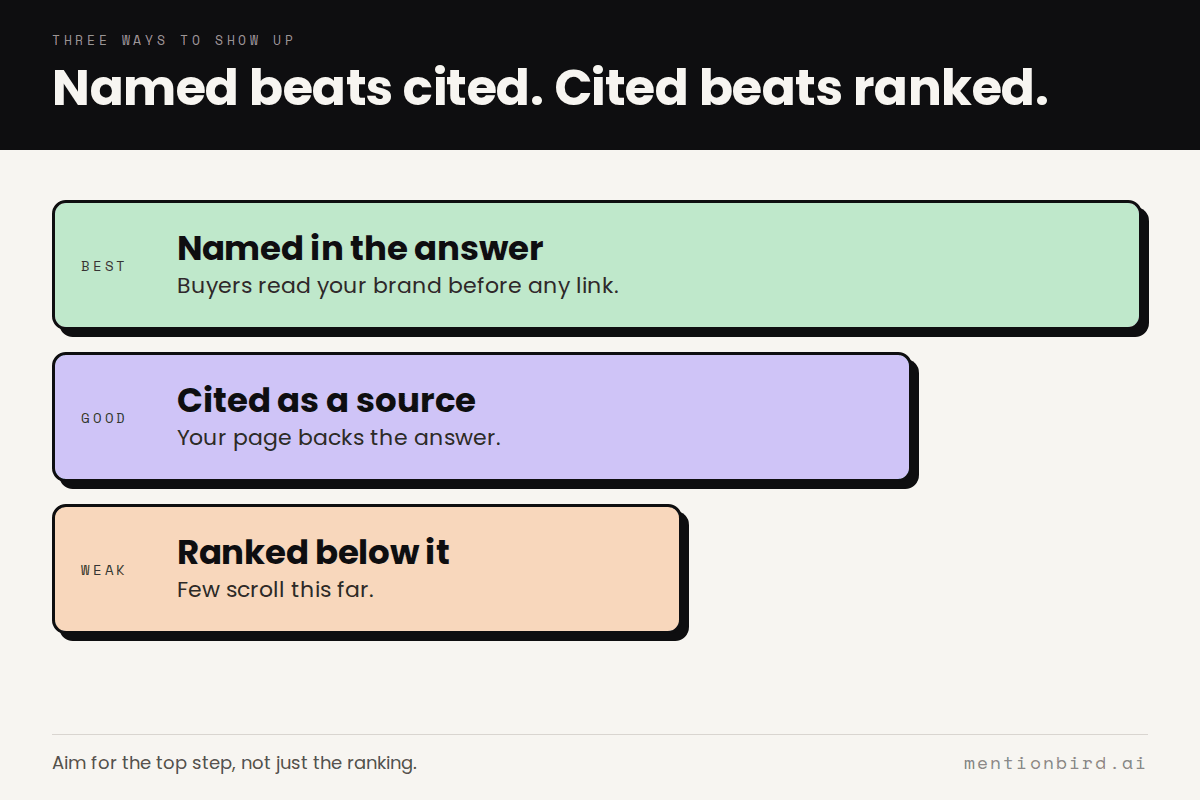
- Named in the answer: The summary mentions your brand by name, so buyers see you before any link.
- Cited as a source: Your page is one of the links behind the summary, which lends you credibility even when you are not named.
- Ranked below it: You appear in the regular results, where far fewer people now look.
Where you land can change from week to week, so it is worth checking each buying search regularly rather than once.
How AI Overviews choose sources
Here's how generally AI Overviews decide which pages to show:
- Indexed by Google first: A page has to be crawled and indexed by Googlebot before an AI Overview can use it. If it isn't in Google Search, it can't appear in the summary.
- Strong rankings for the topic: Cited sources often already rank well for the search or closely related searches, so good SEO still does much of the work.
- A direct, specific answer: Summaries lift clear statements, like a price, a feature, or a direct comparison. Content that buries the answer under long introductions is easier to skip.
- No restrictive snippet settings: Only standard search controls, like noindex or nosnippet, decide whether a page can appear. Google's separate setting for opting out of Gemini training doesn't remove you from AI Overviews.
AI Overviews vs AI Mode
AI Mode is a separate, chat style experience inside Google Search, built for longer questions and follow ups. AI Overviews sit on the regular results page, while AI Mode replaces the results page with a conversation. Both draw on Google Search, and both can name and cite brands.
Together with assistants like ChatGPT and Perplexity, they make up most of what people now mean by AI search.
How to get into AI Overviews
- Target question style searches: Focus on the full questions buyers ask when comparing options, not just short keywords.
- Lead with the answer: Put a direct, specific answer near the top of the page, then add detail.
- Keep facts current and consistent: Prices, features, product attributes, services, business verticals, etc., should match across your site and listings.
- Earn mentions on pages that already appear: Review sites and lists cited in overviews for your category can name you too.
- Check your snippet settings: Make sure key pages are not blocked by noindex or nosnippet rules added long ago.
This is the same work as answer engine optimization, applied to Google's results page.
Use MentionBird to win AI Overviews
MentionBird shows you exactly how Google's AI Overviews treat your brand, and what to change to earn a place in them. Here is how its features fit together:
- Track key buyer prompts daily: Prompt tracking runs your most important buying searches every day across AI Overviews as well as other AI platforms.
- See what each summary says: Read the full AI Overview for every prompt, including which brands it names and how it describes them.
- Find the sources behind it: Citation tracking lists every page Google cites and labels it as yours, a competitor's, or an earned source like a review site.
- Compare against competitors: Competitor tracking shows which rivals get named, how often, and where they rank in the summary compared with you.
- Get a fix plan for every gap: Ranking advice turns what you find into specific steps for each prompt, from pages to update to domains worth earning a backlink from.
Other glossary terms to check out
FAQs
1. Can I opt out of AI Overviews?
Only through standard search controls like nosnippet or noindex, which also limit how your page appears in regular results. Blocking Google-Extended does not remove you from AI Overviews.
2. Do AI Overviews use the same sources as regular results?
Mostly, since they draw on Google's index. Cited pages often rank for the search or for related searches, but they are not always the top results.
3. Are AI Overviews shown everywhere?
Google has expanded them to many countries and languages, but whether one appears still depends on the market and the search.
4. Do AI Overviews send traffic?
Some, but far less than regular results. People rarely click the links inside a summary, so most of the value is being seen and named.
5. How is an AI Overview different from a featured snippet?
A featured snippet quotes one page. An AI Overview writes its own summary from several pages and can name several brands at once.
See whether Google's AI Overviews name your brand
First month $19 with code TRY19, then $79/mo. Cancel anytime.