10 Best LLM Visibility Optimization Tools in 2026
- LLM visibility optimization tools track how AI answers mention and cite your brand, and the strongest options also suggest fixes for prompts where you are missing.
- MentionBird generally suits SaaS teams and agencies that want prompt level action plans, while Profound fits enterprises and Otterly AI or Waikay suit smaller budgets.
- Wellows, Promptwatch, and Trakkr pair tracking with content work, and Yext Scout focuses on brands with many physical locations.
- Free options such as AthenaHQ, Llumo, and Siftly can help teams set a visibility baseline before paying for a full plan.
- Compare LLM visibility tools on platform coverage, prompt limits, add-on costs, reviews, and ease of use, then audit 20 to 30 buyer questions to see where you stand.
Looking for the best LLM visibility optimization tools? You are in the right place. Below, we compare 10 platforms on features, coverage, integrations, pricing, and other key details so you can pick the best solution for your business.
Quick Answer: The Best LLM Visibility Platforms
- MentionBird: Ideal for specific, practical recommendations to win each buyer question where your brand currently doesn’t get featured in AI answers.
- Profound: Best for connecting AI search intelligence with broader marketing operations.
- Wellows: Helps earn citations through publishing and outreach.
- Waikay: Helps brand managers identify inaccurate information within AI-generated answers.
What Is LLM Visibility and How Do Optimization Tools Help
Before you compare the best LLM visibility optimization tools, let’s understand what they measure and how they improve your results.
What Is LLM Visibility
LLM visibility describes whether, how often, and how prominently AI-generated answers mention, recommend, or cite your brand.
Strong LLM brand visibility generally means your business appears consistently for relevant customer questions, ideally near the top of the answer and with a link to your site. Weak visibility, on the other hand, usually means AI platforms skip your brand, mention it only in passing, or cite a competitor’s page instead.
What Are LLM Visibility Optimization Tools
LLM visibility optimization tools, also known as AI visibility tools, track how often AI platforms mention your brand, cite your pages, or recommend competitors. They also suggest specific actions to improve those results.
This guide separates optimization platforms from basic trackers. An LLM visibility tracker reports mentions, citations, and share of voice. An optimization platform goes further and identifies the sources to target, pages to improve, and content gaps to address.
Did you know?
LLM visibility and LLM observability sound alike but mean different things. LLM visibility is about your brand, specifically how often AI answers mention, recommend, or cite it. LLM observability is about software, covering how well an AI app performs once it is live.
The tools differ too. LLM visibility tools help marketers track and improve brand presence in AI search, while LLM observability tools help developers monitor accuracy, speed, and cost. For marketing teams, the first is usually what matters.
How Did We Select These Tools
Seven practical criteria helped us finalize the LLM visibility analysis tools covered in this guide:
- Extensive AI platform coverage: Support for ChatGPT, Gemini, Claude, Perplexity, etc.
- Actionable optimization guidance: Clear recommendations for content, citation, and technical improvements.
- Enough seats and user access: Collaboration allowances appropriate for each tool’s intended customers.
- Reasonable pricing: Useful features at a price suited to the tool’s target customers.
- Good customer support: Evidence of assistance during setup, analysis, and optimization.
- Multi-location targeting: Options for tracking visibility across countries, regions, and languages.
- Robust integrations: Connections with existing analytics, SEO, and content workflows.
Comparison of the Best LLM Visibility Optimization Tools
| Tool | Total prompts | Entry price | Countries supported for targeting | AEO and GEO recommendations | Best suited for |
|---|---|---|---|---|---|
| MentionBird | Unlimited on Custom | $79/mo | 50 plus countries on every plan | Yes. Detailed and clear plans for closing AI visibility gaps | Winning more AI mentions |
| Profound | Custom Enterprise; 50 on trial | Free trial then custom quotes | Custom; 1 on trial | Yes. The Aim agent helps with fixes | Enterprise AI visibility and AEO tracking |
| Peec AI | 350 on Advanced; custom above | $95/mo | 1 country per project on Starter | Yes. Prioritized actions inside the dashboard | Competitor benchmarking and product-level tracking |
| Otterly AI | 535 on Premium | $29/mo | 65+ | Yes, recommendations are available | Affordable AEO and GEO |
| Wellows | 240 prompts on all 5 engines | $29/mo | As many as you can cover with your credits | Yes. Content and outreach opportunities | Earning AI citations through content marketing |
| Waikay | 360 | $24.95/mo | 100+ countries | Available through AIO action plans | Brand fact-checking and reputation management |
| Promptwatch | 350 on Business | $95/mo | Targeting by country and by state is available, though specific numbers are not published | Yes. Answer gap reports plus drafted articles | Managing AI search across multiple brands and product lines |
| Trakkr | Unlimited on the enterprise plan | $100/mo | Not published, though you are charged for adding more markets | Yes. An agent drafts fixes and enhancements | Finding out where AI gets its information, and updating those websites so AI recommends you. |
| Yext Scout | Not published | On request | Per location rather than per country, by design | Yes. Prioritized recommendations | Local SEO and GEO across many locations |
| Botric | 150 on Infinity | Free plan, then $15/mo | Not published | Yes. Content gap analysis feeds a built-in writer | AI visibility tracking and lead capture on a modest budget |
10 Best LLM Visibility Optimization Tools in 2026
We will now look at an in-depth review of all the LLM visibility tools.
1. MentionBird
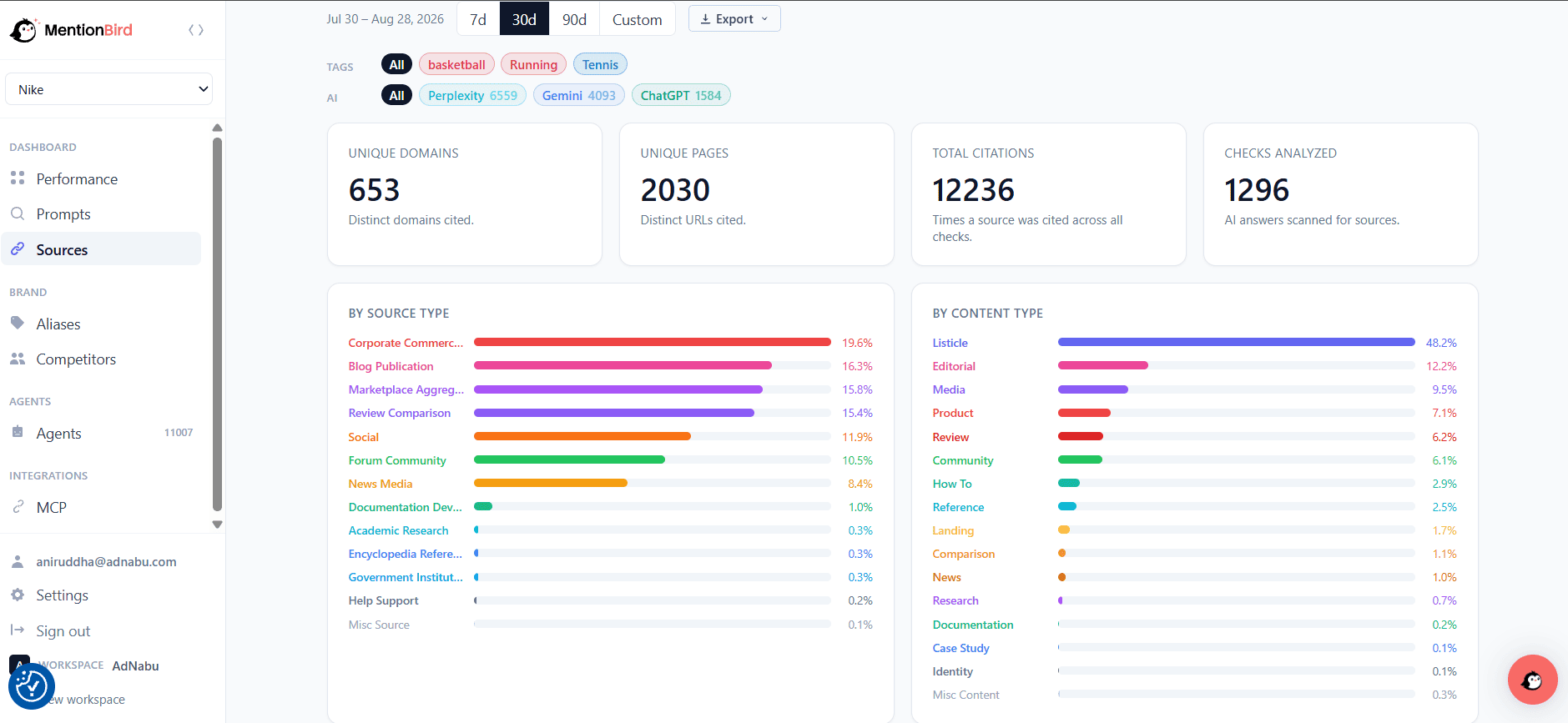
MentionBird is LLM visibility tracking software that helps brands earn more recommendations in AI answers. For each prompt, it shows the sources AI platforms cite and the responses they generate. Then, using the brand context it already has, it turns every missed opportunity into a marketing action plan that helps boost your LLM presence.
Key features:
- Daily prompt tracking checks your selected customer questions automatically.
- Suggests on-page, off-page, and technical SEO and AEO tasks for improving both AI and organic search traffic.
- Competitor tracking compares the brands appearing alongside your business.
- Prompt-level metrics show share of voice, mention rate, average position, and prominence.
- AI Query Fanout Tracking reveals the web searches that supported AI platforms run while building answers.
- Country targeting supports 50+ countries, and you can set a location for each prompt.
AI platforms covered: ChatGPT and Gemini on Starter. Growth adds Perplexity and Claude. Custom supports up to 20 platforms in total: ChatGPT, Gemini, Perplexity, Claude, Grok, Google AI Overviews, Microsoft Copilot, DeepSeek, Google AI Mode, Mistral Vibe, Qwen Chat, Meta AI, Kimi AI, You.com, Ask Brave, Alexa for Shopping, Doubao, ERNIE, Poe, and Duck.ai.
Pricing: Starter costs $79/month, Growth costs $299/month, and Custom supports all 20 platforms with tailored limits for larger needs.
User interface: The intuitive main dashboard places platform filters and tags above well-arranged visibility and prominence charts, which generally makes quick comparisons easy.
Integrations: MCP connects MentionBird data with compatible assistants, including ChatGPT and Claude, while CSV supports bulk imports and exports.
Pros:
- Flexible run allocation lets teams spend their allowance on the platforms relevant to each question.
- Ten Starter seats give strategists, writers, and stakeholders individual access without buying extra seats.
- No website installation lets teams begin without adding tracking scripts or involving a developer.
Cons:
- No permanent free plan.
What real users say: A G2 reviewer values seeing the websites, reviews, and directories behind AI recommendations, since it shows where their brand needs to build visibility instead of only flagging that it’s missing.
Best suited for: Agencies and AEO teams in SaaS, ecommerce, and professional services that need a practical improvement workflow.
2. Profound
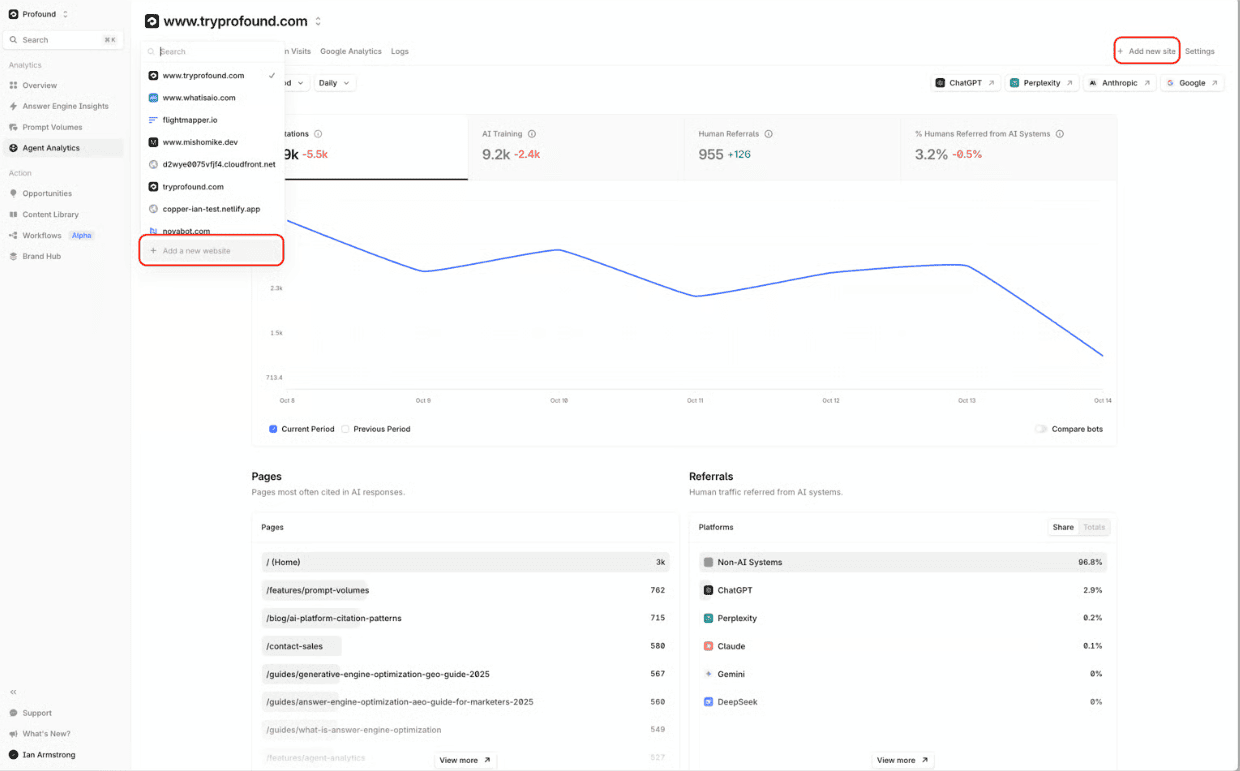
Profound is one of the top enterprise tools for LLM visibility tracking. Beyond monitoring AI answers, it adds deeper analytics and AI agents that handle recurring marketing tasks.
Key features:
- Verified server logs record AI crawler visits to your website.
- Prompt volume for identifying demand
- AI attribution connects answer engine referrals with visits and conversions, adding a layer of AI search analytics most trackers lack.
- Tracks and shares insights on product-level appearances in ChatGPT Shopping.
- Profound Sheets runs reusable agents across batches of marketing work.
AI platforms covered: ChatGPT, Perplexity, Google AI Mode, Gemini, Microsoft Copilot, DeepSeek, Claude, Google AI Overviews, and Exa Search
Pricing: Brands can trial 50 prompts daily for 7 days across ChatGPT, Gemini, and Google AI Overviews. Ongoing brand tracking requires a custom Enterprise package.
User interface: The menu moves neatly from data to next steps, and showing trends beside competitor rankings usually makes changes easy to spot.
Integrations: API, Google Analytics, WordPress, Cloudflare, AWS, Vercel, etc.
Pros:
- Browser-based answer collection more closely reflects consumer-facing sessions rather than relying solely on model API responses.
- SOC 2 compliance and SSO/SAML controls support procurement reviews in regulated organizations.
Cons:
- Its pricing sits behind sales calls and is often called expensive by users on G2, unlike many Profound alternatives that publish their plans.
- All the data it offers, along with the interface, can feel overwhelming at times.
What real users say: One G2 reviewer values its rapid product releases but wants more educational courses and flexible packaging.
Best suited for: Enterprise marketing, SEO, and analytics teams at large retail, financial services, and other complex organizations.
Also read:
3. Peec AI
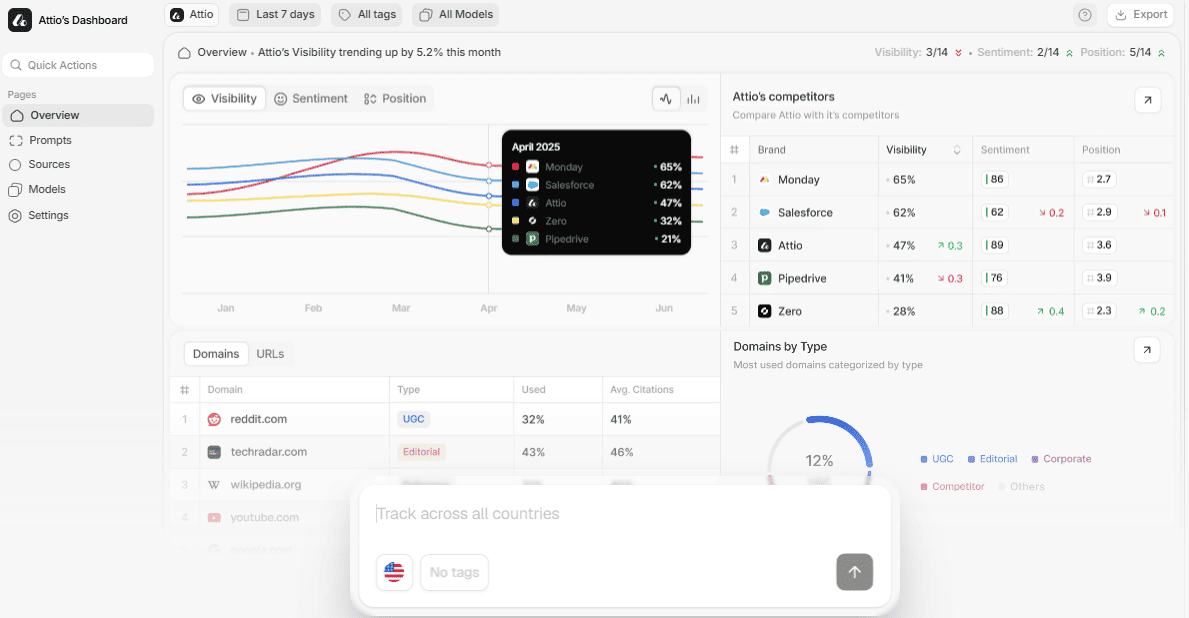
Peec AI is an LLM search visibility platform that helps marketing teams benchmark their brand against competitors across AI-generated answers. It also offers SKU-level shopping analytics, showing which products AI recommends, their quoted prices, and how they perform against competing products.
Key features:
- Answer history saves responses so teams can compare them week to week, which supports long-term AI visibility tracking.
- Identifies advertisers appearing in tracked ChatGPT answers, including their promoted pages and advertising frequency.
- Flexible projects organize tracking for different products, brands, or reporting needs.
- Source analysis labels the domains AI models cite as UGC, editorial, corporate, or competitor sites.
- Shopping fan-out queries reveal the searches influencing product recommendations in ChatGPT's shopping carousel.
AI platforms covered: ChatGPT, Google AI Mode, Google AI Overviews, Microsoft Copilot, Gemini, Naver AI, Perplexity, Claude, GPT 5 Search, Grok, DeepSeek, Qwen, Mistral, and Meta Spark.
Pricing: Starter costs $95/month for 50 prompts, Pro costs $245/month for 150, and Advanced costs $495/month for 350. Enterprise pricing is custom.
User interface: The overview is clean, modern, and shows visibility trends, brand rankings, and labeled source types on one screen, so gaps generally stand out.
Integrations: The Advanced plan includes Looker Studio, and Peec also offers MCP and Enterprise API connections, though access may vary by package.
Pros:
- Role-based access lets admins set permissions across the whole company or for specific projects.
- Self-serve onboarding means users can start without booking a sales call.
Cons:
- Self-serve plans let you choose only three of these models, and most are reserved for Enterprise, which can constrain wider cross-platform studies and is one reason teams look at Peec AI alternatives.
- The “Actions” feature groups recommendations around similar URLs, making it more useful for quarterly planning than identifying specific fixes teams can implement immediately.
What real users say: A G2 reviewer liked discovering unexpected competitors but doubted whether Actions understands the business deeply enough.
Best suited for: Mid-market SEO and growth teams, especially at SaaS brands that regularly report AI visibility to stakeholders.
Also read:
4. Otterly AI
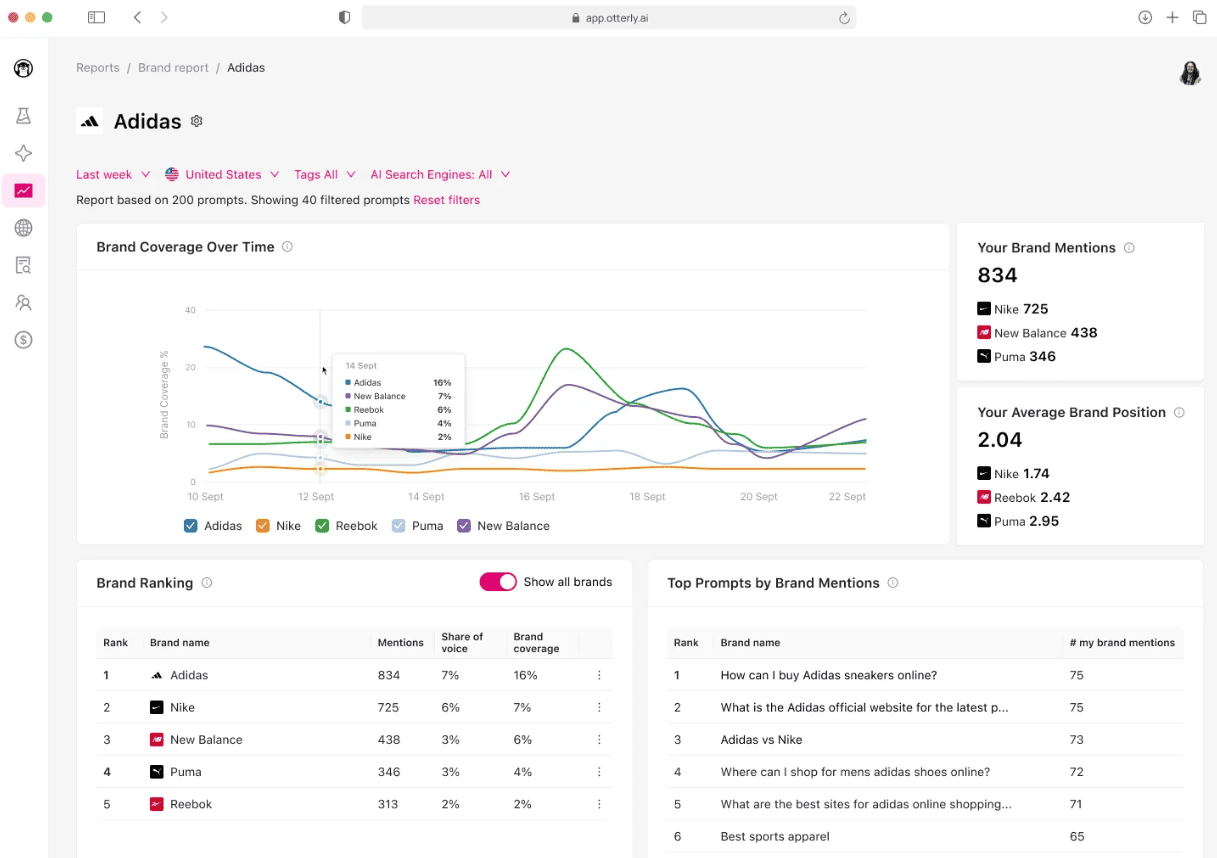
Otterly AI is among the easiest LLM visibility monitoring tools to get started with, since setup typically takes minutes rather than days. Beyond tracking brand mentions and website citations, it audits your pages to show why AI engines may be passing them over.
Key features:
- Brand Visibility Index scores how often and how prominently your brand appears compared with competitors.
- Link citation monitoring shows which domains and pages AI engines cite, and how their positions shift each week.
- GEO Audit checks 25+ on-page factors, including crawlability, that may limit how often a page earns citations. This page-level guidance is what makes Otterly one of the best tools to improve LLM visibility on a small budget.
- AI Prompt Research turns keywords into the questions buyers are likely to ask AI assistants.
- Sentiment analysis classifies each answer as positive, negative, or neutral.
AI platforms covered: ChatGPT, Google AI Overviews, Perplexity, Microsoft Copilot, Google AI Mode, Gemini, and Claude. Any 3 are tracked on each plan.
Pricing: Plans run from Lite at $29/month for 20 prompts to Standard at $189/month for 160 and Premium at $489/month for 535. Enterprise starts at $1,000/month. Every plan tracks any 3 of Otterly's 7 AI platforms.
User interface: Reports like brand coverage, mentions, and top prompts are clearly laid out, and the left menu makes switching between sections quick and easy.
Integrations: Otterly AI offers Google Looker Studio, a REST API, and MCP connections with ChatGPT, Claude, and other compatible assistants.
Pros:
- Every plan allows unlimited team members, which suits larger content and SEO teams.
- A seven-day free trial includes 50 prompts and requires no card.
Cons:
- Every self serve plan tracks only 3 of its 7 engines at a time, and each Claude answer uses 3 credits, which is where many teams start comparing Otterly AI alternatives.
- Lite cannot buy extra credit packs, so most teams outgrow it quickly.
- The jump from Lite to Standard is steep, with no tier in between.
What real users say: G2 feedback includes requests for more granular historical data and more precise sentiment classification.
Best suited for: Solo SEOs and small marketing teams testing AI search for the first time
Also read:
5. Wellows
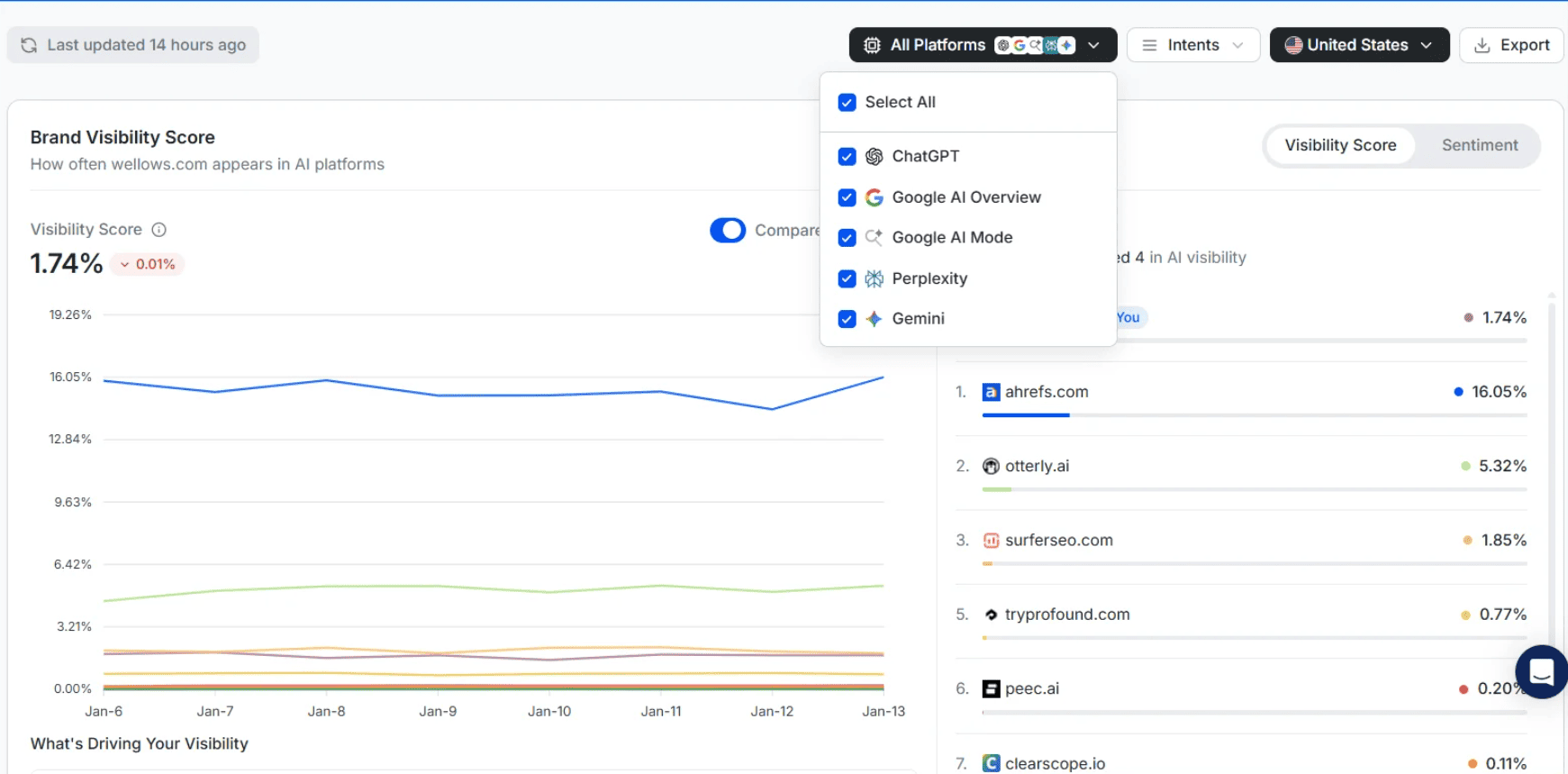
Wellows is an AI search visibility tool with an unusually flexible pricing model. Each plan it offers gives you a monthly balance of AI answers that you can typically spread across any number of prompts, engines, and projects.
Key features:
- Explicit and implicit LLM citations distinguish direct brand references from mentions within pages an AI answer cites.
- Sourced sentiment traces how AI describes your brand back to the page the model read.
- Quick Wins ranks suggested changes by how much they could move your visibility.
- KIVA, the built-in writing agent, drafts pages in the platform using your Google Search Console data.
- Outreach lists the third-party pages AI engines already trust, along with who to contact at each one.
- Performance History keeps every run, so a change in your score can be traced to a specific date.
AI platforms covered: ChatGPT, AI Overviews, Gemini, Perplexity, and Google AI Mode on every current plan.
Pricing: Basic costs $29/month for 1,800 AI answers. Standard costs $97 for 6,500. Growth costs $249 for 18,000. Scale costs $497 for 36,000.
User interface: The layout puts performance data on the right screen at the right time, and the left menu’s clear grouping of planning, outreach, and content tools makes navigation feel intuitive.
Integrations: Google Search Console and a WordPress plugin are included on every plan.
Pros:
- Engines, tracking frequency, and prompt counts can be changed per project mid-cycle.
- White-label client dashboards on Growth and Scale let agencies report under their own brand.
Cons:
- The content feature has room to grow, with one reviewer asking for fewer AI drafts and more detailed briefs based on competitor content.
- Claude, Microsoft Copilot, Grok, and DeepSeek aren’t tracked on any plan.
What real users say: A G2 reviewer at an agency says Wellows turns AI visibility into something measurable, making it easier to build practical strategies for clients.
Best suited for: Content-led growth teams and SEO agencies serving software, consumer services, or research businesses.
6. Waikay
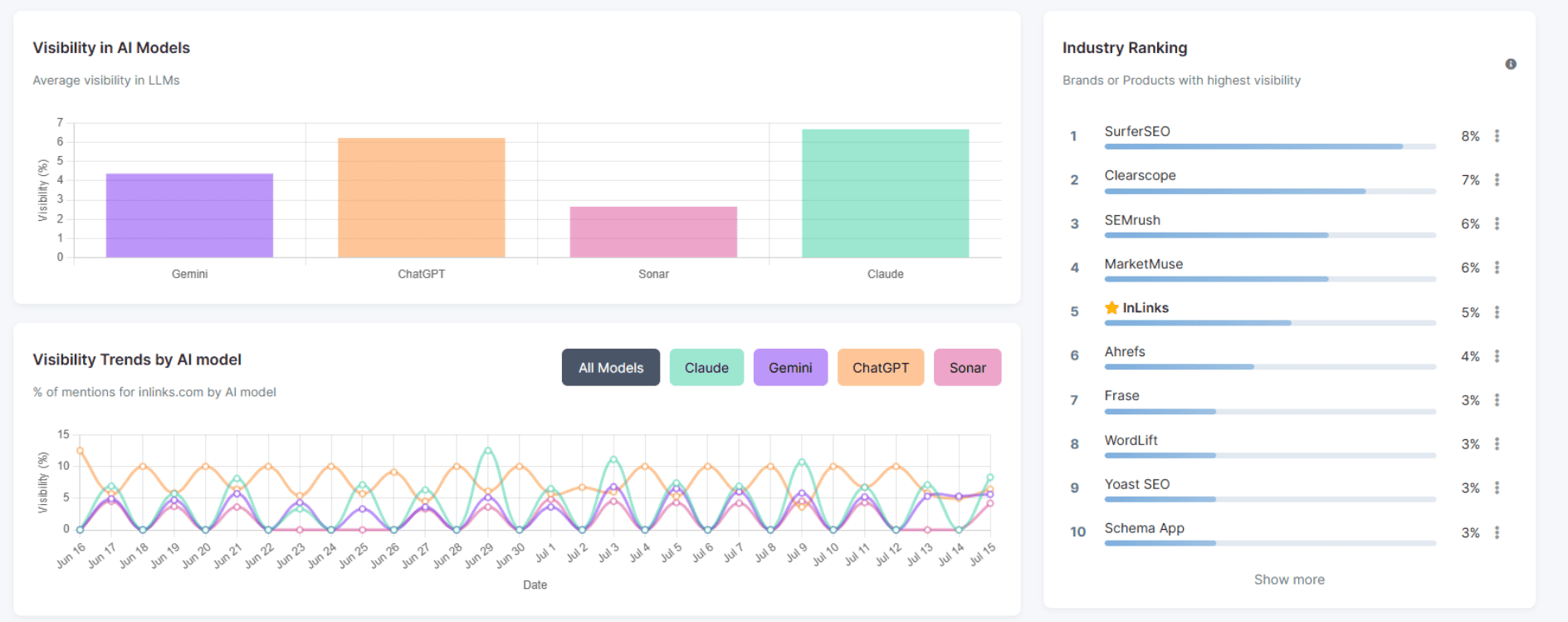
Waikay is an entity optimization platform that goes beyond tracking mentions. It examines what AI models actually know about your brand and which topics they connect it with.
Key features:
- Fact Tracker turns AI-generated brand claims into a verification checklist.
- Knowledge Score assesses how well models understand your business, which goes a step beyond what an LLM visibility platform measures.
- Topic reports map the entities and subjects associated with your brand.
- Grounded versus ungrounded analysis distinguishes answers built from live searches from those based on a model’s existing knowledge.
- Source Tracker shows which pages AI models draw on for each topic.
AI platforms covered: ChatGPT, Gemini, Claude, Sonar, Google AI Mode, and Microsoft Copilot
Pricing: Site Owners and Freelancers starts at $24.95/month, Small Teams costs $69.95/month for up to 120 prompts, and Larger Teams starts at $199.95/month.
User interface: Straightforward and highly actionable, where the platform easily translates complex GEO metrics into actionable insights.
Integrations: Waikay offers API and MCP access, while its sister platform, InLinks, supports related entity and content optimization work.
Pros:
- Custom scheduling lets teams choose a monitoring cadence that matches their reporting cycle.
- Supports 40+ languages and 100+ countries, which makes it one of the best LLM visibility optimization tools on the market.
Cons:
- New features are launched frequently without proper explanations, confusing users.
- Credits can deplete quickly
- Some users have also expressed a desire for deeper integrations
What real users say: A G2 reviewer requests more dashboard customization and reports occasional delays when handling large datasets.
Best suited for: In-house PR and brand teams in healthcare, education, and professional services assessing factual reputation risks.
7. Promptwatch
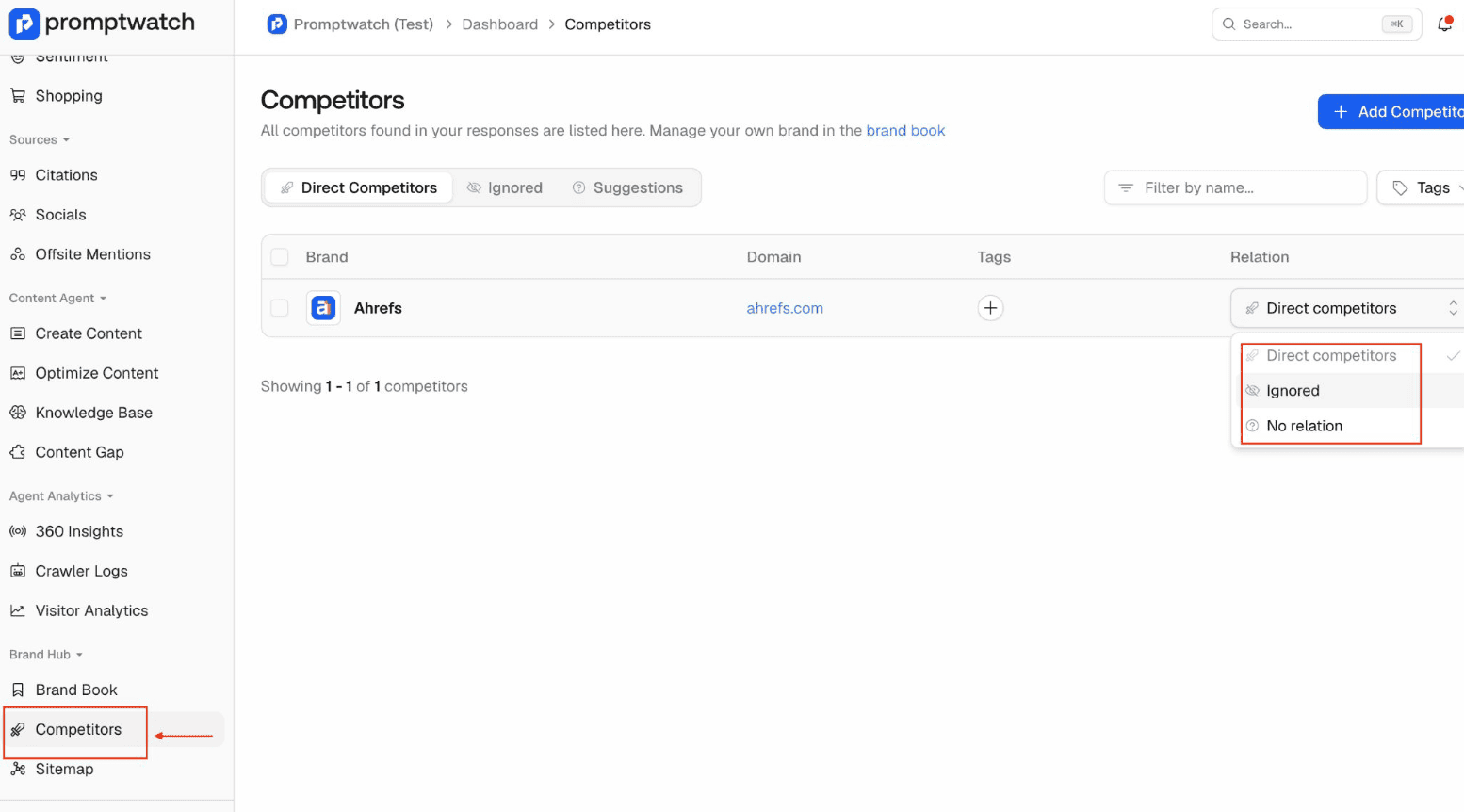
Next on our list of the best LLM visibility optimization tools is Promptwatch, an AI search intelligence platform that also supports conversational analysis. Its Agent Chat lets users explore complex datasets without building reports manually.
Key features:
- The 360 Dashboard combines crawler logs, citations, and human clicks by topic, showing which pages likely drive AI traffic.
- Content agents create new pages and refresh existing ones based on live citation data.
- Off-site citation tracking monitors earned media mentions on third-party websites.
- Claim checks compare what AI says about your products and pricing against your own pages.
- A shared task board splits optimization work between your team and AI agents. This hands-on workflow sets Promptwatch apart from many LLM brand visibility tracking tools, which typically stop at reporting.
AI platforms covered: ChatGPT, Google AI Overviews, Google AI Mode, Microsoft Copilot, Perplexity, Claude, Gemini, Meta Llama, DeepSeek, Mistral, Amazon Alexa, Codex, and OpenCode.
Pricing: Essential at $95/month covers 50 prompts and one project; Professional at $245/month covers 150 prompts and two projects; and Business at $579/month covers 350 prompts and five projects.
User interface: Clear section icons, named dashboard tabs, and large metric cards create an organized workspace for focused comparisons.
Integrations: Webflow, Framer, Google Search Console, Slack, and WordPress connect the platform with marketing workflows.
Pros:
- Every plan tracks all supported models, so coverage doesn’t depend on your tier.
- Daily tracking comes standard on every plan.
- You also get a free trial.
Cons:
- Agent Chat may not always retrieve available data accurately, with one independent test reporting inconsistencies between its answers and dashboard results.
- To get a good deal as an agency, you might be forced into long-term commitments.
Best suited for: Brands looking for LLM visibility tools for marketing that connect AI answers with real site traffic.
8. Trakkr
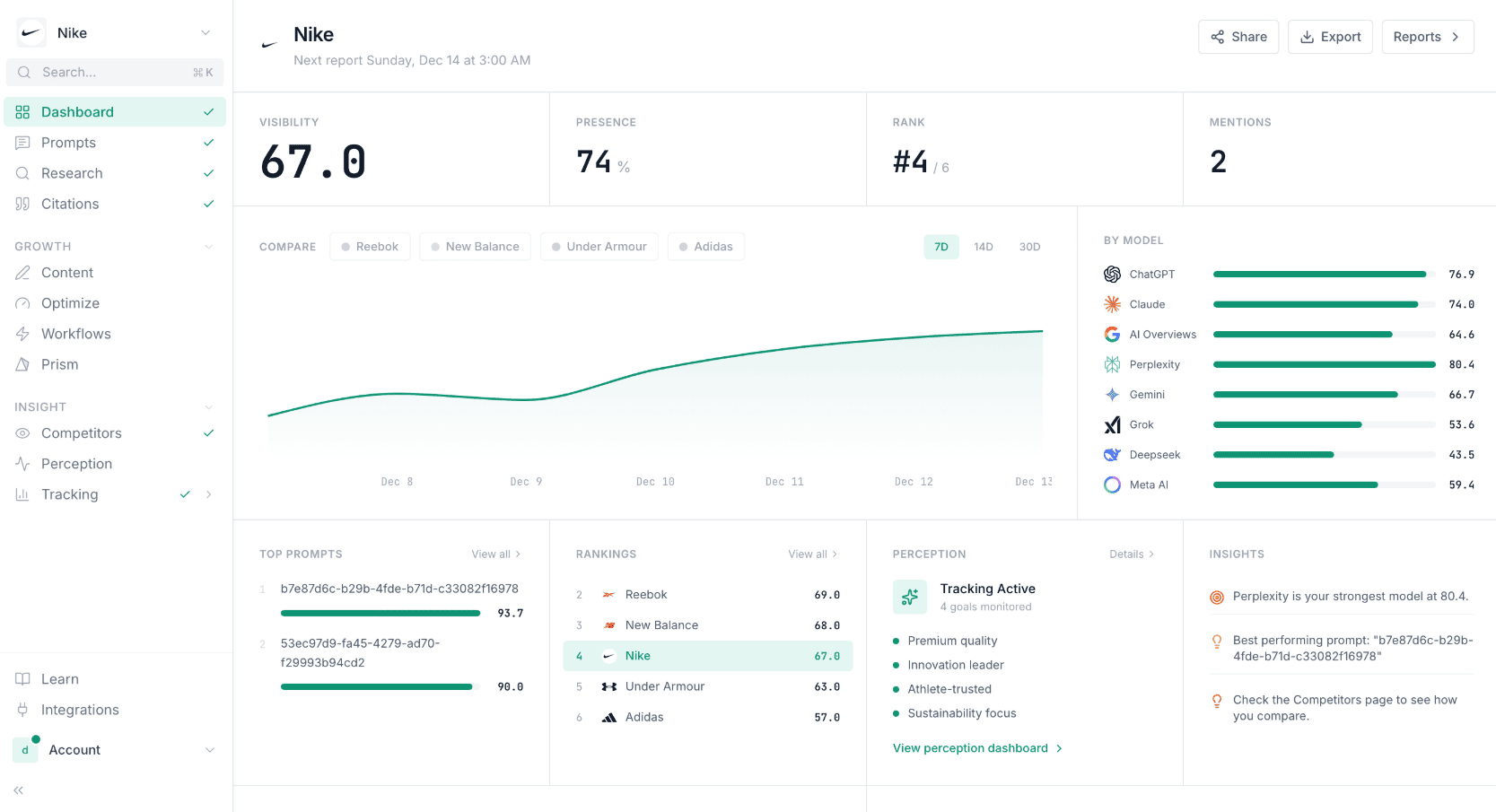
Trakkr is an AI visibility platform that shows not just where your brand ranks, but also how often AI crawlers visit your site and which of your pages get cited in live conversations.
Key features:
- Citation footprint groups the sources AI cites about you into reviews, social, news, and other categories.
- Perception analysis shows how each AI model understands and describes your brand.
- Model-by-model rankings reveal where competitors outperform you on specific engines.
- Actions are sorted by expected ROI, each with a step-by-step playbook. This guidance is what makes Trakkr more than a basic LLM visibility tracker.
- Article credits let teams publish AI-focused content every month, with 25 on Growth and 100 on Scale.
AI platforms covered: ChatGPT, Claude, Gemini, Perplexity, Google AI Overviews, Grok, DeepSeek, and Meta AI.
Pricing: At $100/month, Growth tracks one brand with 50 prompts, while Scale tracks 10 brands for $500/month. Enterprise pricing is custom.
User interface: The polished dashboard preview sensibly gives the trend chart most of the space and keeps a ranked competitor list alongside it, so shifts are easy to follow.
Integrations: MCP, Google Sheets sync, and CSV exports support data sharing. REST API access starts on Scale.
Pros:
- A 14-day trial allows a longer evaluation period than several seven-day alternatives.
- Prompt packs can expand an existing plan without requiring a full tier upgrade.
Cons:
- The jump from $100 to $500 leaves no intermediate published brand tier for modest multi-brand needs.
- Extra markets add charges, increasing the cost of international tracking.
What real users say: Trakkr has only one G2 review so far, which praises how it turns unpredictable AI model behavior into clear daily visibility scores that brands and agencies can act on.
Best suited for: Digital agencies and consumer brands
9. Yext Scout
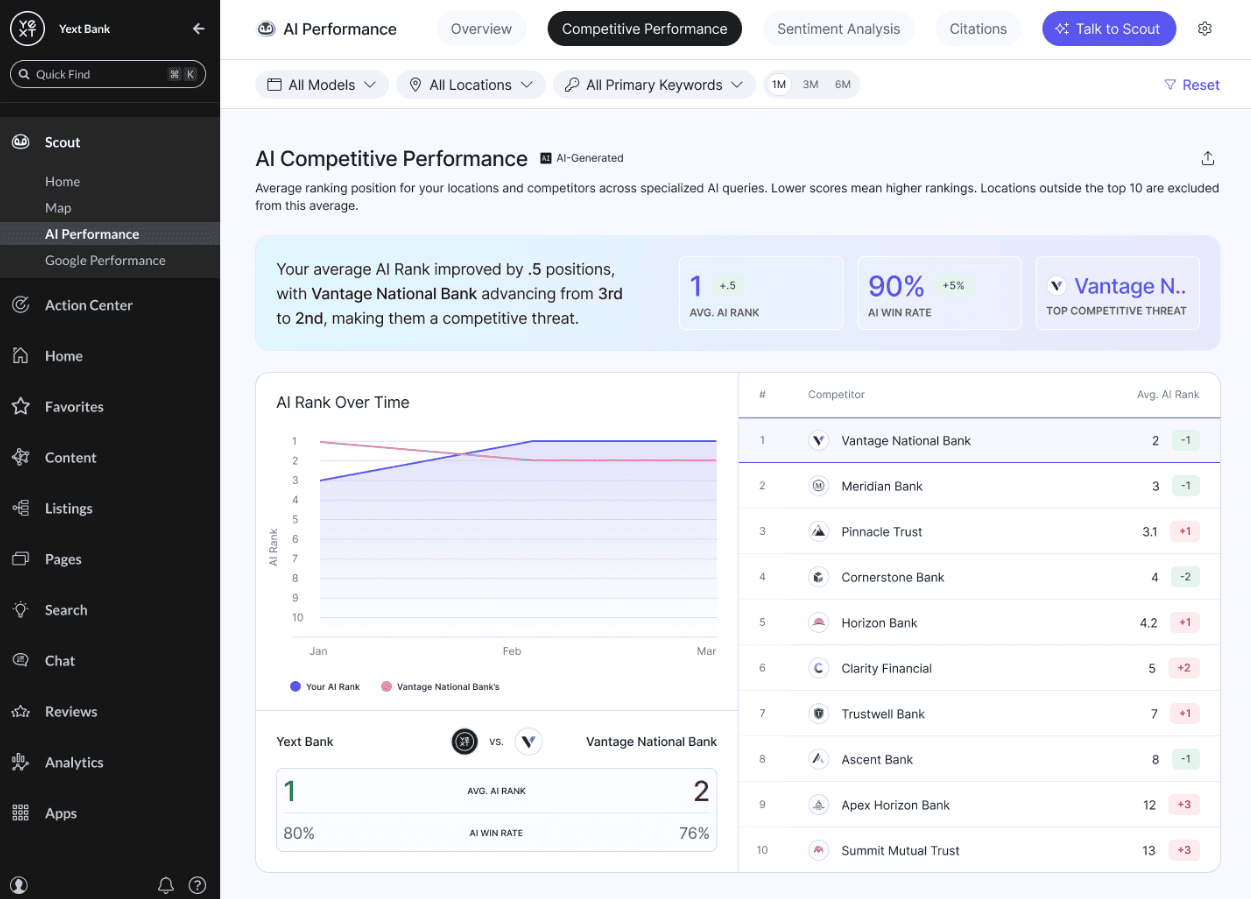
Yext Scout brings LLM visibility tracking to Yext’s local search platform, so brands can see how AI answers present each location alongside its Google performance.
Key features:
- Location-level benchmarking compares each location against up to 20 nearby competitors.
- Hyperlocal query replication runs branded and unbranded searches the way local customers would.
- Combined tracking covers Google Search rankings, Google Maps, AI citations, sentiment, listing accuracy, and review signals.
- Agentic execution lets teams update listings, request reviews, post locally, and optimize local pages at scale.
- The Yext Knowledge Graph keeps location data verified, with data agents resolving inconsistencies automatically. This verified data foundation helps Scout stand out among AI visibility tracking tools for brands with large location networks.
- Brand Scout adds brand-level optimization
AI platforms covered: ChatGPT, Gemini, Claude, Perplexity, and Google AI Overviews, plus Google Search and Google Maps.
Pricing: Custom quotes.
User interface: The sleek main dashboard keeps competitive, sentiment, and citation reports in clearly labeled tabs, while the left menu conveniently groups every Scout view, from maps to Google performance, in one place.
Integrations: Yext connects with 200+ directories and publishers, and its platform is also open to external AI tools through an API and MCP.
Pros:
- Location-level data shows which individual markets need attention, instead of hiding weak spots behind one national score.
- Teams already on Yext can typically add Scout without moving their data to a new tool.
- A free visibility scan lets brands benchmark their locations before speaking with sales.
Cons:
- There’s no public pricing, and multi-year proposals are the default.
- Unlike other LLM SEO tools such as MentionBird, key platforms like Microsoft Copilot and Google AI Mode aren’t supported.
- Brands without physical locations may find much of its depth unnecessary.
- Best value requires the broader Yext platform.
What real users say: A G2 reviewer finds Yext user-friendly and appreciates being able to get help anytime by submitting a request.
Best suited for: Franchises, retailers, healthcare networks, and banks that already manage listings and reviews through Yext.
10. Botric
Botric stands apart from most AI visibility tools by pairing tracking with an AI support agent. Once your brand earns a citation, that agent can chat with the visitors AI platforms send your way and qualify them as leads.
Key features:
- Prompt-level tracking shows how each AI answer mentions your brand, not just a total mention count.
- Citation analysis reveals which sources each platform cites and where competitors appear instead of you.
- The GEO score sums up your overall AI discoverability in a single number.
- AI-ready site audits flag technical issues that may stop models from reading your pages properly.
- Content gap analysis feeds a built-in writer that drafts articles and pages to close those gaps. This close link between findings and fixes makes Botric one of the more practical tools to improve LLM visibility and citations for small teams.
AI platforms covered: ChatGPT, Gemini, Perplexity, Claude, and Google AI Overviews.
Pricing: Beyond a free plan, Bit costs $15/month, Byte $49/month, and Infinity $149/month, with Enterprise pricing on request.
User interface: Botric’s workspace feels approachable, with tracking, citations, and content tools logically grouped so even teams new to AI search can move from finding a gap to fixing it quickly.
Integrations: Google Analytics, Search Console, etc.
Pros:
- A free forever plan lets teams explore the platform without any upfront commitments.
- Easy to use.
Cons:
- All 5 AI platforms and the highest prompt allowance only unlock on the Infinity tier.
- For large brands and agencies, the top-most limit of 150 prompts can be restrictive.
What real users say: A G2 reviewer says Botric’s content agent has helped their company get cited by AI chatbots while also ranking better on Google.
Best suited for: Startups and B2B SaaS companies that want AI visibility tracking and lead capture on a modest budget.
That brings us to the end of our list of best LLM visibility optimization tools. Next, we will look at some of the top LLM visibility tools that are free and categorized by industry.
Best LLM Visibility Optimization Tools: Free Picks
Teams on a tight budget can start with these three LLM visibility software apps:
- AthenaHQ: Free Essential plan with 300 credits, five AI models, and unlimited team members.
- Llumo: Free to use when you bring your own AI provider API keys.
- Siftly: Free plan for tracking 10 unique prompts.
Best LLM Visibility Tools by Industry
| Industry | Recommended tool | Why it fits |
|---|---|---|
| Tools to measure LLM visibility for SaaS brands | MentionBird | Helpful for tracking multiple software apps with ease, organizing workspaces, and turning visibility gaps on category and comparison prompts into ranked fixes |
| LLM visibility tools for SEO teams | Otterly AI | GEO Audit checks on-page factors SEO teams already manage |
| LLM visibility tools for multi-location retail | Yext Scout | Benchmarks every store against nearby competitors |
| LLM visibility tools for ecommerce | Promptwatch | Shopping Insights track how products appear in AI answers |
Best LLM Visibility Tools by Team Size
| Team size | Recommended tool | Why it fits |
|---|---|---|
| Best LLM visibility tools for small businesses | Waikay | Entry plan for site owners and freelancers starts at $24.95/month |
| Best AI visibility tools for mid-market businesses | Peec AI | Shareable dashboards simplify reporting to leadership |
| Best LLM visibility tools for enterprise brands | Profound | Offers all the key features for LLM monitoring and large-scale automation of marketing operations |
| LLM visibility tool for agencies with multiple clients | MentionBird | Easy multi-brand setup, multi-country targeting, and white-label reports on request |
How to Choose the Best LLM Visibility Platform?
Before you compare the best LLM visibility tools and finalize one solution for your brand, consider these five points:
- Requirements: Decide if you need tools for tracking LLM brand visibility or a platform that also suggests fixes.
- Budget: How much of your total marketing budget can you assign to an AI visibility tool right now? Count add-ons, credits, and extra markets, not just the entry price.
- Reviews: Read recent G2 feedback from teams like yours. The best LLM visibility tools carry praise for a majority of aspects, helping you make a quick decision.
- Room to grow: Will the plan still fit when you add more prompts, brands, or markets? Check what the next tier costs before you commit.
- Ease of use: Can your writers and strategists act on the data without training? A tool your team finds hard to use should be ignored.
Together, these factors will help you shortlist the best LLM optimization tools for brand visibility without overspending.
How to Run an LLM Visibility Audit
Here’s how to run an LLM visibility audit with your shortlisted platform:
- Add your prompts: Enter 20 to 30 buyer questions to anchor your AI visibility audit.
- Choose platforms: Select the assistants your buyers use most.
- Add competitors: List rivals to benchmark in every answer.
- Review results: Check mentions, position, sentiment, and cited sources.
- Spot gaps: Most tools for auditing LLM visibility highlight prompts where competitors appear and you don’t.
From there, you can act on these insights or simply track how your standing changes over time.
Run a quick LLM visibility audit for free
See whether ChatGPT names your brand for five buyer questions, which competitors it recommends instead, and which pages it cites. Free, no signup.
Run the free scanLLM Visibility Tools that Didn’t Make the List
- HubSpot AEO: A $50/month tracker that currently covers only ChatGPT, Gemini, and Perplexity.
- Similarweb: It’s mainly a market intelligence suite where AI visibility is just one module.
- Brandwatch: A social listening platform that tracks brand conversations broadly, making it a wider monitoring option rather than a dedicated AI visibility tool.
- LangSmith: An LLM observability platform from LangChain that helps developers trace and evaluate their own AI apps, not brand visibility.
Final Thoughts on the Best LLM Visibility Optimization Tools
AI answers increasingly shape which brands reach a buyer’s shortlist. The best AI visibility tools show where you stand and how to improve. Choose based on your budget, team size, and the AI engines your buyers use. Start with a manageable workflow, then expand when the findings lead to useful decisions.
FAQs
- How can I see if Codex recommends my product?
Track coding-related prompts in a platform that covers Codex, such as Promptwatch, or test those questions in Codex manually.
- Which AI visibility tools track visibility in Claude models?
MentionBird, Profound, Peec AI, Otterly AI, Waikay, Promptwatch, Trakkr, Yext Scout, and Botric.
- Which LLM visibility tools offer an API?
Profound, Peec AI, Otterly AI, Waikay, Trakkr, and Yext Scout.
- Which AI visibility tools measure referral traffic coming from LLMs?
Profound and Promptwatch link AI referrals to site visits, and Google Analytics can also segment traffic from chatbots like ChatGPT.
- Which LLM visibility tools are like AthenaHQ?
MentionBird, Peec AI, and Otterly AI offer similar prompt tracking and recommendations, usually with more affordable entry plans than AthenaHQ.
- Which LLM visibility tools are like Scrunch AI?
Like Scrunch AI, Profound and Peec AI track brand mentions, citations, and competitor visibility across AI platforms, while MentionBird also turns missed answers into prompt-level fixes.

Win the LLM answers your buyers ask for
First month $19 with code TRY19, then $79/mo. Cancel anytime.