
Chunking
Chunking is the way AI systems split long pages into smaller passages, called chunks, so they can find and use only the part of a page that answers a specific question.
- AI retrieval systems usually split pages into passages ahead of time, so a question is matched to the most relevant section rather than the whole page.
- Chunks are matched to questions by meaning, using numerical representations called embeddings.
- Sections compete on their own, so a strong page can still lose a question if the relevant section is weak or depends on earlier context.
- Content chunks well when each section has one job, stands alone, leads with the answer, and keeps specifics in lists or tables.
- MentionBird shows which of your pages AI cites for each prompt, which helps pinpoint sections that need to stand on their own.
Why AI splits pages into chunks
An AI assistant answering a question rarely needs a whole page. It needs the one part that addresses what the person asked. To find that part quickly, retrieval systems usually break pages into smaller passages ahead of time and store each one separately, so a question can be matched to the most relevant passage rather than to the page as a whole.
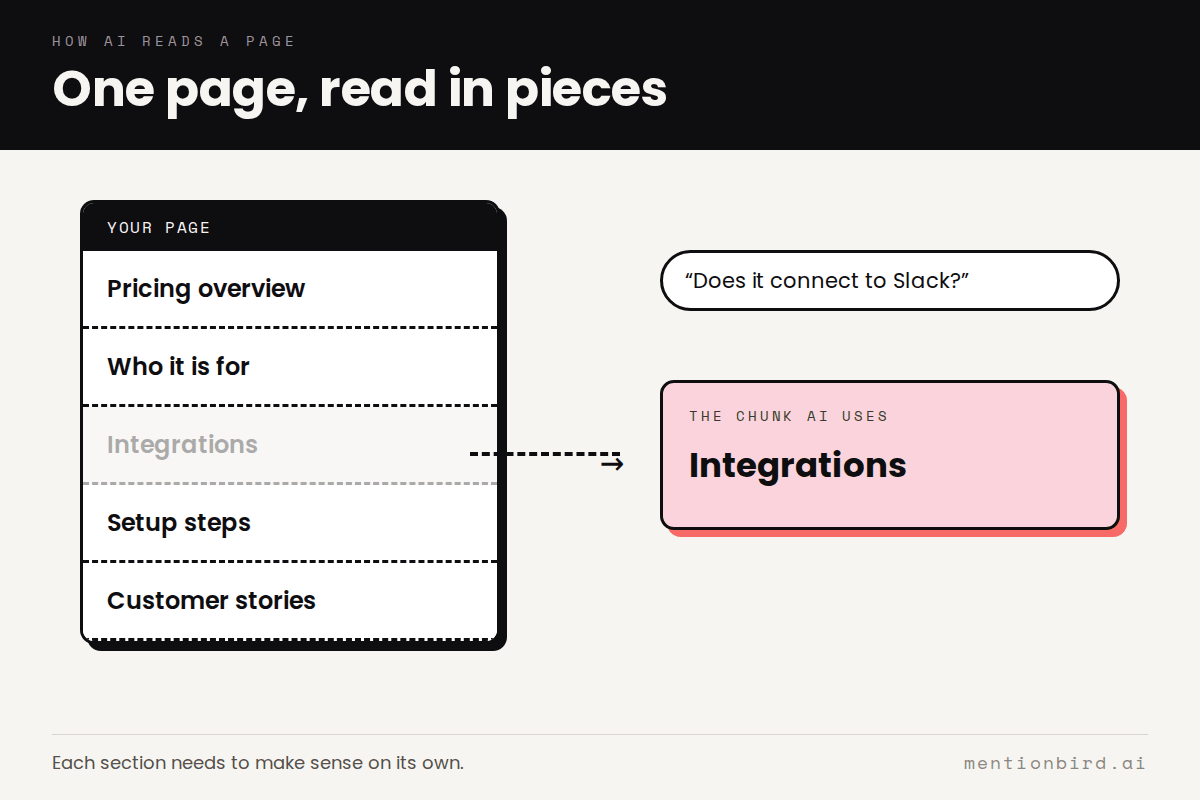
In this example, the buyer asks about a Slack integration, so only the Integrations section is pulled into the answer. The rest of the page still exists, but for this question it plays no part.
How chunks are matched to questions
Each chunk is converted into a numerical representation of its meaning, often called an embedding. When a question comes in, it is converted the same way, and the chunks closest in meaning are retrieved and passed to the model to write its answer. It builds on the same idea of reading for meaning rather than keywords that BERT brought to search.
Chunk sizes vary from system to system, but they are generally a few hundred words, and many systems try to split along headings and paragraph breaks.
Why chunking matters for brands
- Sections compete on their own: A page can perform well overall and still lose a question if the section that covers it is weak.
- Meaning can get lost in the split: A passage that leans on an earlier paragraph, such as one starting "it also works with," may not make sense once it is separated from the rest of the page.
- Buried facts are easy to miss: A key detail tucked into a long paragraph about something else is less likely to end up in the chunk that gets retrieved.
- One page can serve many questions: A well structured page can supply one chunk for pricing questions, another for integrations, and another for setup.
How to write content that chunks well
- Give each section one job: Cover a single question or topic per section, under a heading that names it.
- Make every section stand alone: Name the product and subject within each section instead of relying on "it" or "this" from earlier.
- Lead with the answer: Put the key fact in the first sentence or two of each section.
- Keep sections a manageable length: Split long sections into smaller parts, each with its own heading.
- Use lists and tables for specifics: Structured details like pricing tiers and feature lists tend to stay intact when a page is split.
How MentionBird helps
Chunking happens out of sight, but its results show up in which pages AI chooses to cite. MentionBird’s citation tracking shows which of your pages each platform relies on for every prompt you track, across the AI platforms in your plan. Starter covers ChatGPT and Gemini, Growth adds Perplexity and Claude, and Custom supports up to 20 platforms: ChatGPT, Gemini, Perplexity, Claude, Grok, Google AI Overviews, Microsoft Copilot, DeepSeek, Google AI Mode, Mistral Vibe, Qwen Chat, Meta AI, Kimi AI, You.com, Ask Brave, Alexa for Shopping, Doubao, ERNIE, Poe, and Duck.ai.
If a page covers a question but rarely gets cited for it, the relevant section usually isn’t standing on its own, and that points you to the section to rework rather than the whole page. Ranking advice then suggests what to change for each prompt, such as answering the question earlier in the section or adding the specifics AI tends to quote. You can then keep tracking whether that section starts getting cited.
FAQs
1. Is chunking the same as Google's passage ranking?
They are related but not the same. Passage ranking lets individual sections of a page rank in Google Search, while chunking is the broader technique AI retrieval systems use to split and store content.
2. Do I need to rewrite my whole site?
Usually not. Start with the pages buyers rely on most, such as pricing, product, and comparison pages, and restructure those first.
3. Is a long page a problem for AI?
Not if it is well structured. AI generally retrieves sections rather than whole pages, so a long page with clear, self contained sections can answer many different questions.
4. Can I control how AI splits my page?
Not directly. Clear headings and self contained sections make it more likely the splits fall in sensible places.
5. Does chunking affect Google AI Overviews too?
Google has not published the details, but AI Overviews also tend to draw on specific passages, so the same habits generally help there as well.
See which of your pages AI cites
First month $19 with code TRY19, then $79/mo. Cancel anytime.