Why We Built a Free AI Content Score Tool

- An AI content score tool measures citation readiness, not ranking. It asks whether an engine can lift one sentence from your page and stand behind it.
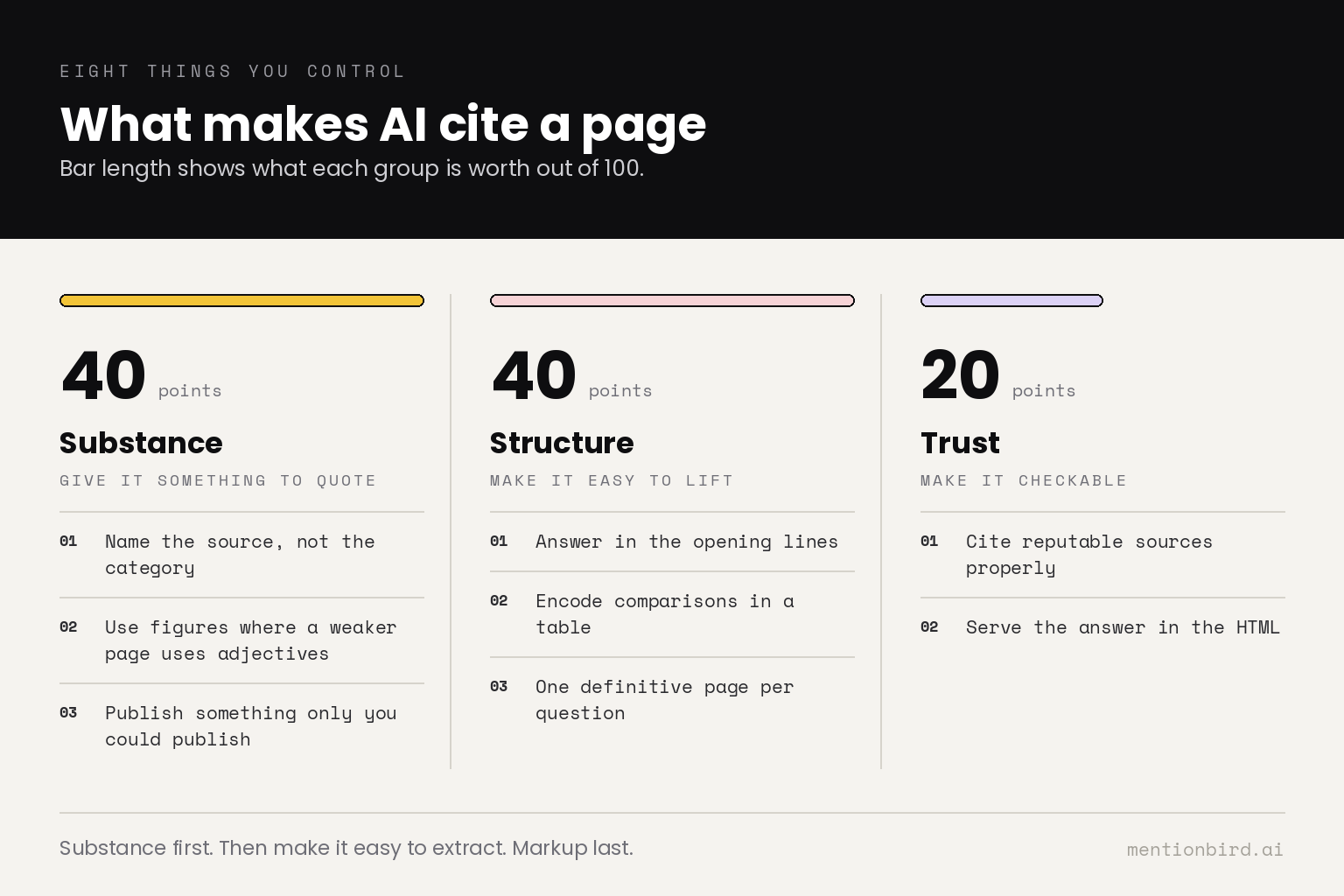
- The 100 points split into substance worth 40, structure worth 40, and trust signals worth 20. Markup verifies a claim, it does not supply one.
- A 1,000 word Ahrefs study scored 72, taking full marks on expert quotes, statistic density, answer first structure and tables, then losing 28 points elsewhere.
- Two pages can share a total and need opposite fixes, so read the individual checks rather than the number.
- A high score removes obstacles. It does not guarantee a citation, because competing sources and the engine's own behavior sit outside the page.
An AI content score tool is a citation readiness checker. It rates any public URL from 0 to 100 on how likely ChatGPT, Perplexity, Gemini, and Claude are to cite it, then names the parts of the page holding that score down. Eight checks run in three groups: substance worth 40 points, structure worth 40, and trust signals worth 20.
We built it because customers could see their AI visibility was low and had no way to tell which part of the page was causing it.
Why your SEO score will not tell you this
Traditional content scores are built to predict ranking, keyword coverage, readability grade, internal links, title length, and so on. All useful, but aimed at a different outcome.
An SEO score and a citation score start from the same place, since clear writing and useful information help either way. They split on what happens next:
- Ranking asks whether the page is relevant to the question
- Citation asks whether one sentence on it can be pulled out and repeated safely
- A page can pass the first test on structure alone. The second needs substance and a few other key elements

How MentionBird's AI Content Score tool works: a real example
The clearest way to explain the checks is to run them on a page nobody would call weak.
We scored the Ahrefs study on Google's discussions and forums results at ahrefs.com/blog/discussions-and-forums-serps. Ahrefs is one of the most cited domains in SEO. The post is 1,000+ words and carries original research.
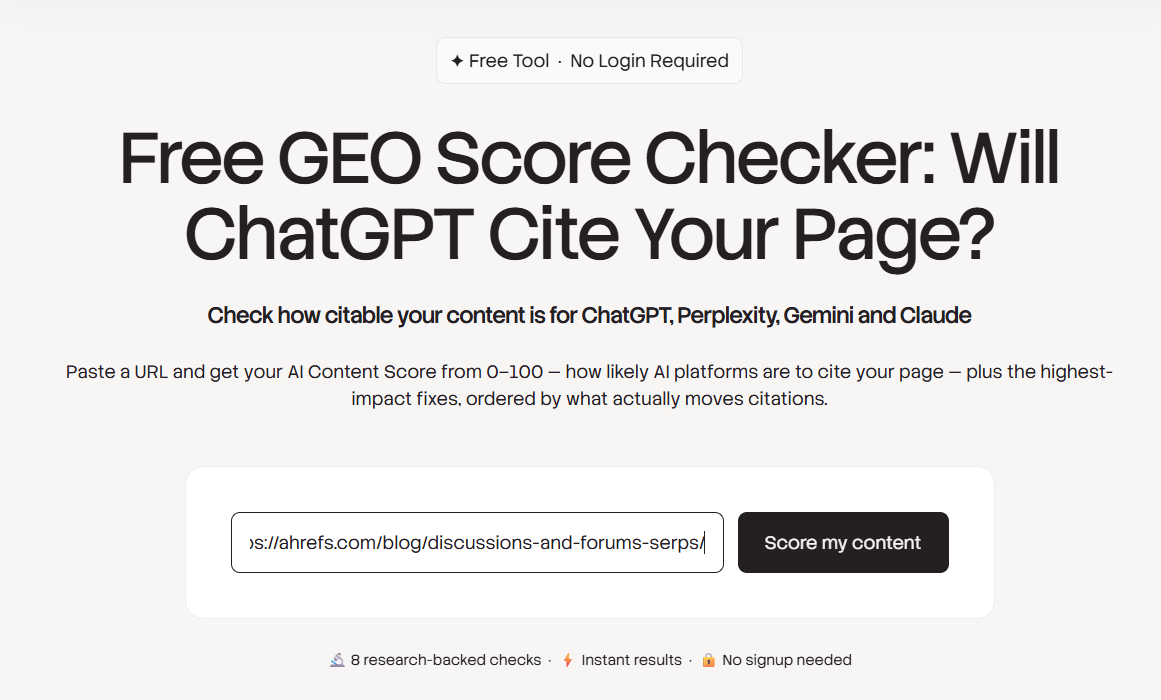
It scored 72 out of 100, in the band marked "Good foundation, clear gaps".
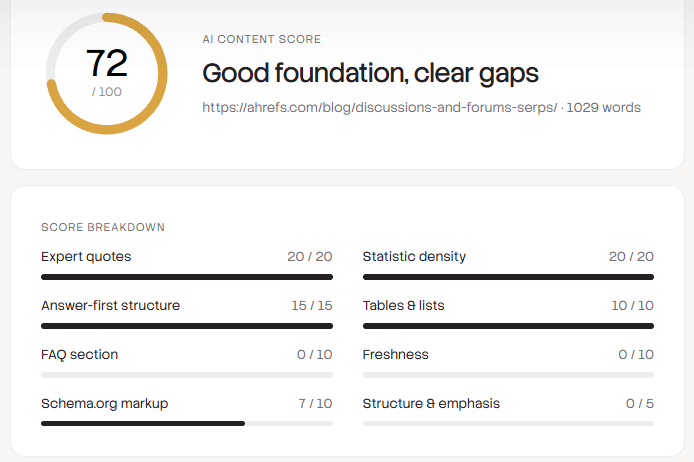
The total matters far less than the distribution. Here are some of the checks and how the page performed across those:
- Expert quotes, 20 of 20. Sources named and attributed
- Statistic density, 20 of 20. Real figures, enough of them
- Answer first structure, 15 of 15. The claim arrives before the setup
- Tables and lists, 10 of 10. The comparison is encoded, not described
- Schema.org markup, 7 of 10. Present, incomplete
- FAQ section, 0 of 10. No question and answer structure
A page that does everything difficult correctly still leaves 28 points unclaimed.
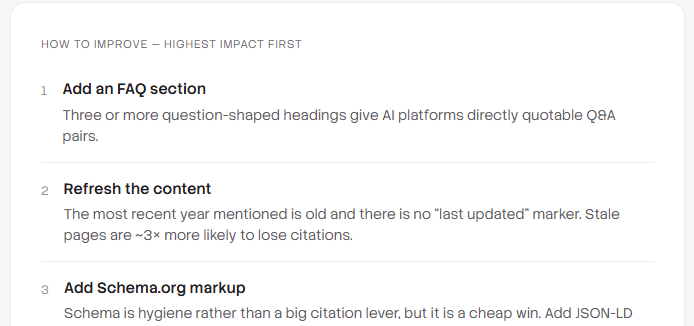
The ordering of those fixes is the part worth copying. An FAQ block ranks first, because a question and answer structure hands AI platforms pairs they can cite directly. Schema ranks last, despite being the quickest item on the list to add.
What your score pattern reveals
Two pages can land on the same total and need completely different work, which is why the shape of a score matters more than the number. Substance, structure, and trust signals each fail differently, so read the breakdown before you change anything.
| Score pattern | Typical total | Likely issue | Best next action |
|---|---|---|---|
| High substance, low structure | 55 to 75 | Valuable information is difficult to extract | Add direct answers, tables, and question-shaped headings |
| Low substance, high structure | 55 to 75 | The page looks organized but lacks evidence | Add original data, statistics, and named sources |
| Strong content, weak trust signals | 70 to 85 | Claims lack supporting context | Add author details, citations, dates, and relevant schema |
| Balanced scores, still no citations | 85 and above | Competitors may hold stronger authority | Compare your page against the pages already being cited |
What makes AI cite a page?
An engine quotes the page that makes quoting easy, which comes down to a handful of things you control:
- Using credible sources: "Experts recommend" is unusable. A named person or organization is quotable, which is why an unattributed quote earns only 8 of the available 20
- Use figures where a competitor just uses adjectives: Density counts up to two statistics per 100 words, then stops paying, so padding gains nothing
- Answer in the opening lines: An engine reading the first 200 words should already have the claim
- Encode comparisons in a table: A table earns the full 10 where lists alone earn 6, because it states relationships a list only implies
- Publish something only you could publish: Original figures, a process described in detail, a position others would not take. Faced with five sources saying the same thing, a model has no reason to prefer yours
- Cite other reputable sites properly: Pages that reference verifiable sources read as checkable rather than self reported
- Serve the answer in the HTML: Content that only appears after JavaScript runs, or that sits behind a registration wall, may never reach the engine at all
- Keep one definitive page per question: Several overlapping posts split the topic and leave a model choosing between your own pages
Which pages should you score first?
Scoring an entire site produces a spreadsheet nobody acts on. The checks repeat enough that the fifth run rarely tells you anything the first four did not, so start narrow and work outward.
Prioritize pages that:
- Answer high value buying questions
- Compare products, services, or alternatives
- Carry original research or proprietary data
- Pull organic traffic but earn few AI citations
- Support an important product or category page
- Compete against sources AI platforms already cite
That last one matters most. A page nobody competes for can win on a modest score, while a contested topic needs every check working.
Score your page against the cited page
The score is more useful as a comparison than as a verdict, because it turns a vague gap into a list of differences. Run it as a citation gap analysis:
- Run an important buyer prompt across several AI platforms
- Record the pages those platforms cite
- Score the competitor page cited most often
- Score your own competing page
- Compare the individual checks rather than the totals
- Fix the largest meaningful difference first
Two pages a few points apart can fail on opposite checks, so the comparison at check level is the part that tells you what to write.
Where the score fits in an AEO workflow
The score is the first of three steps, and the only one you can finish in a browser tab.
- Score: Find out whether the page can be cited and which check is holding it back
- Fix: Change the page, then confirm the individual check moved
- Track: Ask the questions your buyers ask, repeatedly, and watch which sources feed the answers
Most teams do the first two and stop, then wonder why nothing changed.
What the score cannot tell you
Worth stating plainly, because a number invites the wrong conclusion.
A page can score 90 and never appear, because stronger sources already own the topic. A page can score 60 and get cited constantly, because it is the only decent page on a narrow question. The score measures obstacles removed, not a position won.
Two things sit entirely outside its reach:
- Answers move on their own: Our research found ChatGPT and Gemini replace 64% of their top five recommended brands from one answer to the next, so a single citation is not a settled position
- Some answers never look at the web: Nearly one in three ChatGPT answers is generated without a live fetch, which no amount of on page work can influence
Note: Since the score cannot confirm a citation, pair it with ChatGPT brand tracking and Gemini brand tracking to see whether the pages you improve start appearing in real answers.
Other free tools worth running alongside it
Two more free tools sit next to the AI Content Score tool, and both answer questions the score cannot.
- AI crawler accessibility checker. Confirms AI crawlers can reach the page at all. Worth running first, since a blocked page cannot be cited, whatever it scores
- Keyword to prompt generator. Turns a keyword into the questions buyers actually ask an assistant, which tells you which pages are worth scoring
Frequently asked questions
1. Is the AI content score tool free?
Yes. No login, no card, and your page content is not stored after the run.
2. Can I score a page I do not own?
Any public URL works. Scoring the page that currently wins the answer, then your own, is the fastest way to see what is missing.
3. Does the score change if my page sits behind a CDN or needs JavaScript to render?
It can. Aggressive bot rules can block the fetch before the checks ever see your text. If a score looks impossibly low, confirm the page is reachable first.
4. Why did my score move when I did not change the page?
The scoring formula is fixed, but detection uses a model, so runs can differ by a few points. Watch the individual check, not the total.
5. Does raising the score help my Google rankings too?
Indirectly at best. Some checks overlap with what Google rewards, but a page can gain 30 points here without moving a position in search.
6. What score should I be aiming for?
There is no threshold that guarantees anything. A zero on any 10 point check is the thing to fix, and a page with no zeros is in good shape wherever the total lands.
Also read
- How MentionBird works
- Why We Built a Free AI Crawler Accessibility Checker
- Best AEO Tools
- Best GEO Tools
Help center resources

Score your page, then find out if AI actually cites it
First month $19 with code TRY19, then $79/mo. Cancel anytime.