AI Personalization
AI personalization is the way AI assistants tailor answers to the person asking, using signals such as saved memory, location, language, and earlier messages, so two people can get different answers to the same question.

- Personalized AI answers draw on memory, location, language, and conversation history, so the same question can lead to different recommendations.
- Two buyers asking identical questions can see different shortlists, and a brand can lead one while missing from the other.
- Your own account is usually the most personalized one an assistant sees, which makes your manual checks an unreliable guide.
- Clean sessions, checks from your buyers' markets, repeated runs, and newcomer phrasing get closer to what buyers actually see.
- MentionBird runs prompts without personal history across up to 20 AI platforms and can track the same prompts in different countries.
What shapes a personalized answer
An AI assistant never answers a question in isolation. It answers it for a particular person, and it brings whatever it knows about that person into the reply.
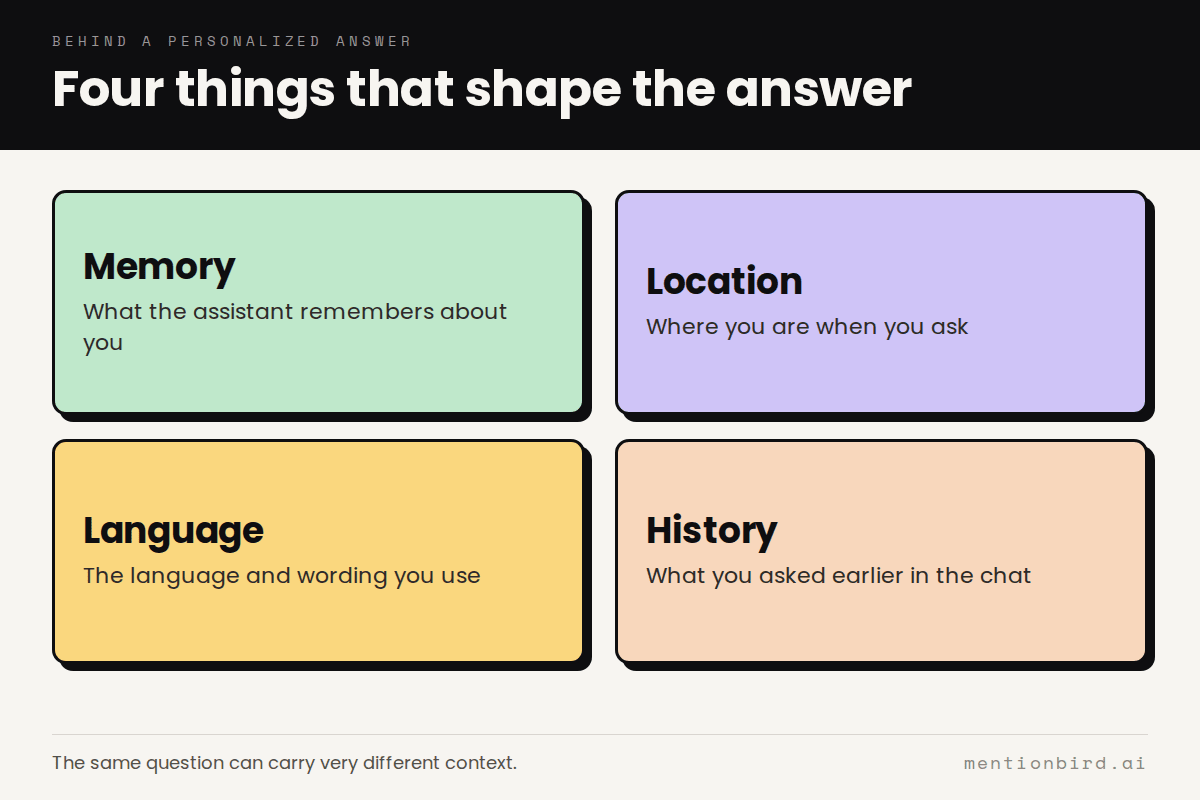
- Memory: Assistants such as ChatGPT and Claude can remember details you have shared, like your job, company, or preferences, and use them in later chats.
- Location: Where you ask from shapes which brands, stores, and services an answer suggests, especially for local or regional purchases.
- Language: The language you write in, and even your phrasing, steers the answer toward sources written for that audience.
- History: Earlier messages in the same conversation narrow down what the assistant thinks you need.
Same question, different shortlists
Put those signals together and two buyers asking the same question can walk away with different recommendations.

Neither answer is wrong. Each reflects what the assistant knows about the person asking, which is why a brand can lead the shortlist for one buyer and be missing for another.
Why your own checks mislead you
The most personalized account an assistant ever sees is often yours. You have probably told it where you work, asked about your own brand many times, and discussed your competitors along the way.
All of that context can pull your brand into answers a new buyer would never see. A strong result in your own account says more about your history with the assistant than about how the market sees you.
How to see what buyers see
- Start from a clean session: Use a logged out window, a separate account, or a chat mode that does not use memory.
- Check from your buyers' markets: Look at answers from the locations your customers are in, not just your own.
- Repeat each question: Answers also shift from one run to the next, as our research on answer stability explains, so one clean check is still only a sample.
- Ask the way a newcomer would: Leave out your brand name and insider terms, and phrase the question as someone new to the category.
What personalization means for brands
No brand can shape every buyer's memory or history, so the realistic goal is to be a strong option across many contexts rather than a perfect fit for one. In practice, that means stating clearly who your product is for, so AI can match you to the right buyers, and keeping location and language versions of key pages accurate if you sell in several markets.
Broad presence on the sources AI trusts holds up across personal contexts in a way no single page can.
How MentionBird helps
MentionBird runs your buying prompts every day across the AI platforms in your plan. The prompts run without any personal memory or account history, so the results reflect what a new buyer is likely to see rather than what your own account shows. Starter covers ChatGPT and Gemini, Growth adds Perplexity and Claude, and Custom supports up to 20 platforms: ChatGPT, Gemini, Perplexity, Claude, Grok, Google AI Overviews, Microsoft Copilot, DeepSeek, Google AI Mode, Mistral Vibe, Qwen Chat, Meta AI, Kimi AI, You.com, Ask Brave, Alexa for Shopping, Doubao, ERNIE, Poe, and Duck.ai.
For brands selling in more than one market, MentionBird can track the same prompts in different countries, showing where your visibility holds up and where it drops. Prompt tracking keeps every answer, so you can compare markets and spot changes over time.
Other glossary terms to check out
FAQs
1. Does personalization affect Google's AI answers?
Yes. Google already tailors results by location and language, and its AI Overviews draw on those same results.
2. Does logging out remove personalization?
Mostly. A logged out session has no memory or history, but location and language still shape the answer.
3. Do all AI platforms personalize answers?
To different degrees. Some keep long term memory across chats, while others rely mainly on location, language, and the current conversation.
4. Is personalization the same as answer stability?
No. Personalization means different people get different answers. Answer stability is about how much answers change for the same person from one run to the next.
5. Can personalization work in my favor?
Yes. A buyer who has already researched your brand may see it more often in later answers, which is one more reason early visibility pays off.
See what AI shows buyers, not just your own account
First month $19 with code TRY19, then $79/mo. Cancel anytime.