10 Best AI Prompt Tracking Software Worth Using in 2026
- AI prompt tracking software shows whether platforms like ChatGPT mention your brand, competitors, and sources for specific buyer questions.
- MentionBird suits agencies needing daily tracking, prompt-specific ranking advice, and ten included seats.
- Peec AI excels at competitor benchmarking, while Otterly.AI and Rankscale offer affordable starting points below $30 monthly.
- Choose based on buyer platforms, prompt volume, market coverage, actionable advice, seat costs, and customer support.
- Track category, comparison, alternative, and problem prompts daily. Review 7-day, 30-day, and monthly trends.
Looking for the best AI prompt tracking software for your brand? You are in the right place.
The best options include MentionBird, which tracks prompts daily across multiple AI platforms and provides ranking advice for each one. Then there’s also Peec AI, which works well for comparing prompt performance against competitors, while Otterly.AI fits smaller budgets.
However, the list does not end with these three options. There are other prompt tracking tools worth considering, and we’ll be covering them, their pricing, features, etc., through this blog.
So, are you ready? Let’s get started.
How We Selected These AI Prompt Tracking Tools
These five factors played a key role in deciding which prompt tracking tools we picked:
- Platform coverage: Which AI platforms can the tool monitor using your selected prompts?
- Prompt allowance: How many buyer questions can you track, and how often does each one run?
- Citation data: Can you view the sources behind each generated answer?
- Competitor tracking: Does the tool show which competitors appear and rank for your tracked queries?
- What happens next: What marketing actions does the tool recommend for earning visibility for a specific buyer question?
AI Prompt Tracking Tools Compared Side-by-Side
| Tool | Starting price | AI platforms tracked | Prompts on entry plan | Prompt run frequency |
|---|---|---|---|---|
| MentionBird | $79/month | 20 in total on Custom: ChatGPT, Gemini, Perplexity, Claude, Grok, Google AI Overviews, Microsoft Copilot, DeepSeek, Google AI Mode, Mistral Vibe, Qwen Chat, Meta AI, Kimi AI, You.com, Ask Brave, Alexa for Shopping, Doubao, ERNIE, Poe, and Duck.ai | 100 prompts | Daily |
| Peec AI | $95/month | 11 in total | 50 prompts | Daily |
| Profound | Free trial, then custom pricing | 3 on the trial, up to 9 on Enterprise | 50 prompts daily for the 7 day trial | Daily |
| Otterly.AI | $29/month | 7 (any 3 per plan) | 20 prompts | Daily |
| Ahrefs Brand Radar | $199/month add on | 6 platform indexes | 2,500 checks a month | Daily, weekly, or monthly |
| Rankscale | $20/month | 17 or more | Up to 160 monthly, 36 weekly, or 5 daily across three 0.25 credit engines, based on the 120 credits included on the Essentials plan | Hourly, daily, weekly, or monthly |
| Orchly AI | $49/month | 3 included, 4 paid add ons | 25 daily prompts | Daily |
| Sight AI | $99/month | 5 platforms | 5,000 shared credits, though the prompt count is not shared | Daily, every other day, weekly, or monthly |
| Bluefish AI | Custom quote | 5 to 6, not cited clearly on their website | Custom | Not publicly disclosed |
| Adobe Brand Visibility | Custom quote | 10 LLM families, including ChatGPT, Perplexity, and Google AI Mode | Not stated clearly on their website | Recurring, exact frequency undisclosed |
See which buyer prompts name your brand
We run five buyer questions three times each and show whether ChatGPT names you, who it names instead, and the sources it cites. Free, no signup.
Run the free scan10 Best AI Prompt Tracking Software Tools
With that, let’s deep dive into the list of tools.
1. MentionBird
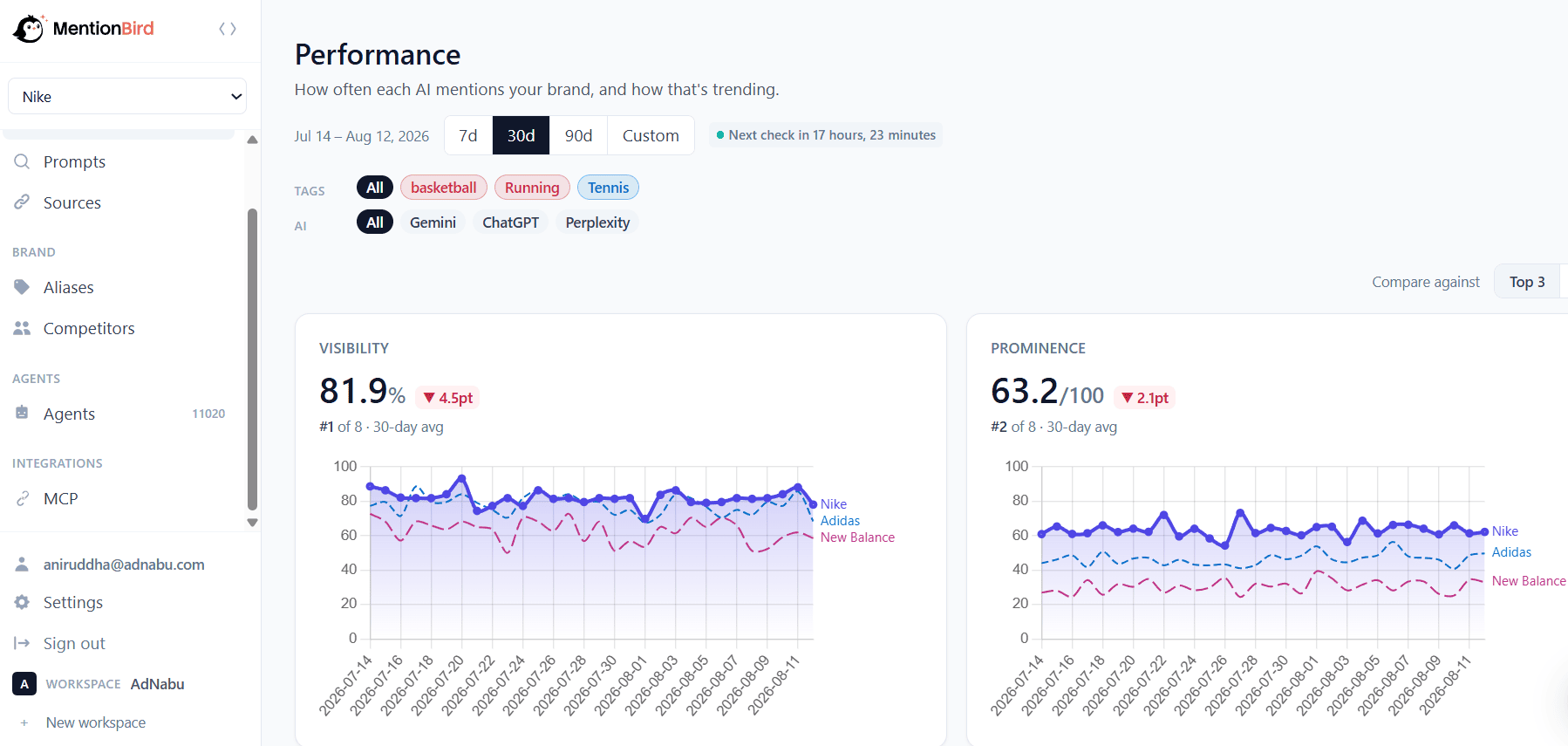
MentionBird is an answer engine optimization (AEO) platform that helps brands track and improve their AI visibility across different platforms such as ChatGPT, Perplexity, Gemini, etc.
Key features:
- Daily prompt runs across up to 20 AI platforms
- Split your daily runs across chosen platforms
- Difficulty and search volume score per prompt
- Citation data broken down by frequency and domain for each prompt run
- Country-specific prompts on every plan
- Prompt-level performance analytics that show key metrics such as your share of mentions, mention rate, average position, etc.
Pricing: Starter is $79 monthly for 100 prompts and runs across ChatGPT and Gemini. Growth is $299 per month and offers 2 more platforms with 400 prompts. Custom offers unlimited prompts along with tracking across up to 20 AI platforms.
Pros:
- Gives automated prompt suggestions to help track relevant queries, saving time and effort
- Shares ranking advice for each prompt across every paid tier
- Offers detailed insights into competitor visibility across each prompt
Cons:
- No free trial
Best suited for:
- Agencies and AEO teams in ecommerce, healthcare, SaaS, Fintech, or any other industry
- Brands that want a prompt-by-prompt plan of action
2. Peec AI
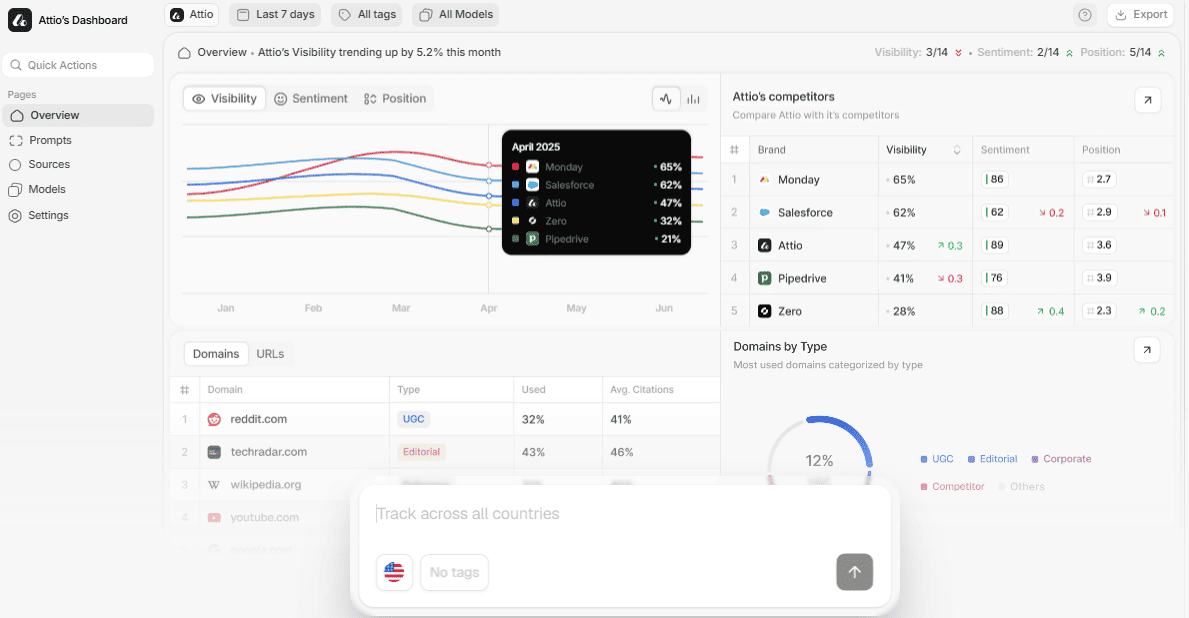
Peec AI is an AI search analytics platform that runs selected prompts daily through consumer-facing interfaces. This method captures the answers that logged-out users may receive.
Key features:
- Suggests buyer-style prompts using your website, industry, and existing questions
- Organizes prompts using topics and tags with AND/OR filtering
- Runs active prompts daily and preserves answer history for comparisons
- Filters performance data by competitor, date range, AI model, and country
- Tracks visibility, position, sentiment, and share of voice for individual questions
- Shows citations and query fan-outs before suggesting related content and outreach actions
Pricing: Starter costs $95 monthly for 50 prompts, three models, one project, and daily tracking. Pro costs $245 with 150 prompts and two projects. Advanced costs $495 with 350 prompts, five projects, multi-country tracking, and Looker Studio.
Pros:
- Includes unlimited users and daily prompt tracking on self-serve plans
- Allows flexible prompt allocation across projects and brands
Cons:
- Limits self-serve plans to three models at once and charges $35 to $165 per month for prompt tracking across additional AI platforms, which is very expensive compared to other Peec AI alternatives
- Reserves API and SSO access for Enterprise plans
Best suited for: Marketing teams comparing their brand against named competitors through consumer-facing AI results.
Also read: MentionBird vs. Peec AI
3. Profound
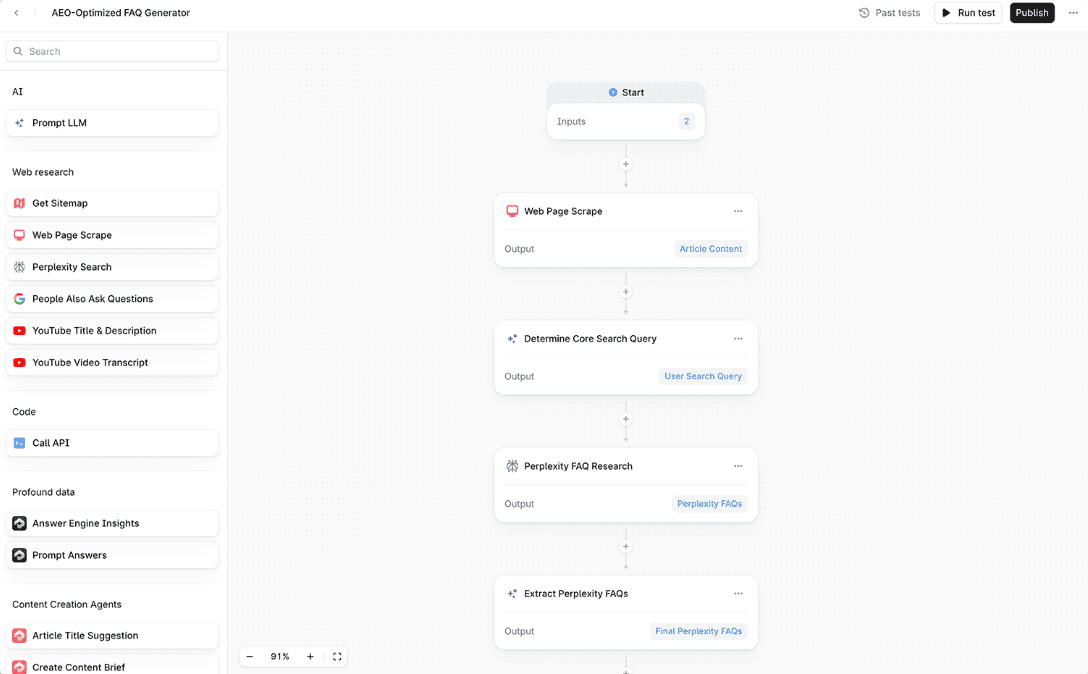
Profound is an enterprise AEO platform that connects tracked AI answers with wider marketing data. This provides a fuller view of AI search performance and its business impact.
Key features:
- Uses Prompt Volumes to find high-demand questions from 1.3 billion real-user conversations
- Reveals which tracked prompts trigger ChatGPT Shopping and which products appear
- Shows how AI rewrites each prompt, including high-share subqueries, freshness signals, and persona differences
- Checks factual claims within tracked answers against your approved brand information
- Sends prompt-level gaps to Agents for content briefs, page updates, or publisher outreach
Pricing: Profound offers a free 7 day trial with 50 prompts run daily across ChatGPT, Gemini, and Google AI Overviews, plus limited AI Marketer credits. After the trial, Enterprise pricing is custom, with a tailored prompt tracking plan and up to nine answer engines.
Pros:
- Holds a 4.6/5 rating on G2
- Supports unlimited domains within Agent Analytics across every plan
Cons:
- There is no self serve paid plan, so teams usually need a custom Enterprise quote after the trial, unlike many Profound alternatives that publish their plans
- The free trial lasts only 7 days and covers three engines
Best suited for: Enterprises with complex AEO reporting, governance, and content workflow requirements.
Also read: MentionBird vs. Profound
4. Otterly.AI
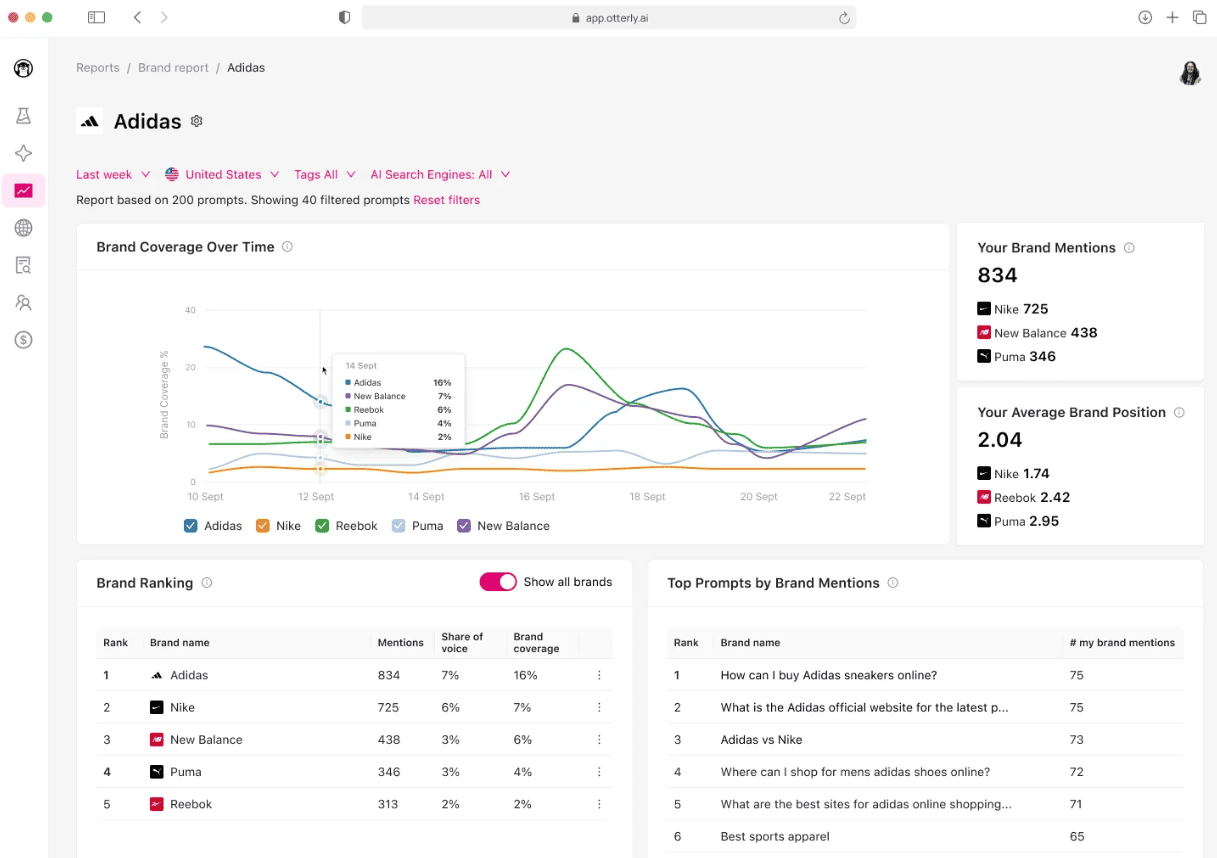
Otterly.AI combines AI search monitoring, reporting, and optimization within a single, unified self-serve platform.
Key features:
- Finds relevant queries and questions to track through AI Prompt Research using a keyword, brand name, or URL
- Displays each tracked query with intent volume, ad activity, and shopping results
- Lets users compare recorded responses across individual AI engines
- Tracks changes among leading brands through its Brand Visibility Index
- Connects visibility data with Looker Studio for custom reporting
Pricing: Lite costs $29 monthly for 20 prompts. Standard costs $189 for 160 prompts, while Premium costs $489 for 535 prompts. Every plan tracks any 3 of Otterly's 7 AI platforms, and every paid plan runs searches daily.
Pros:
- Includes unlimited team members on every plan
- Allows unlimited brand reports across all tiers
Cons:
- Every self serve plan tracks only 3 of its 7 engines at a time, and each Claude answer uses 3 credits, which is where many teams start comparing Otterly AI alternatives
- Lite includes one workspace and only three recommendations weekly
- Lite cannot buy extra credit packs, so outgrowing its 20 prompts means upgrading
Best suited for:
Solo marketers and small teams just starting out with AEO and GEO.
Also read:
5. Ahrefs Brand Radar
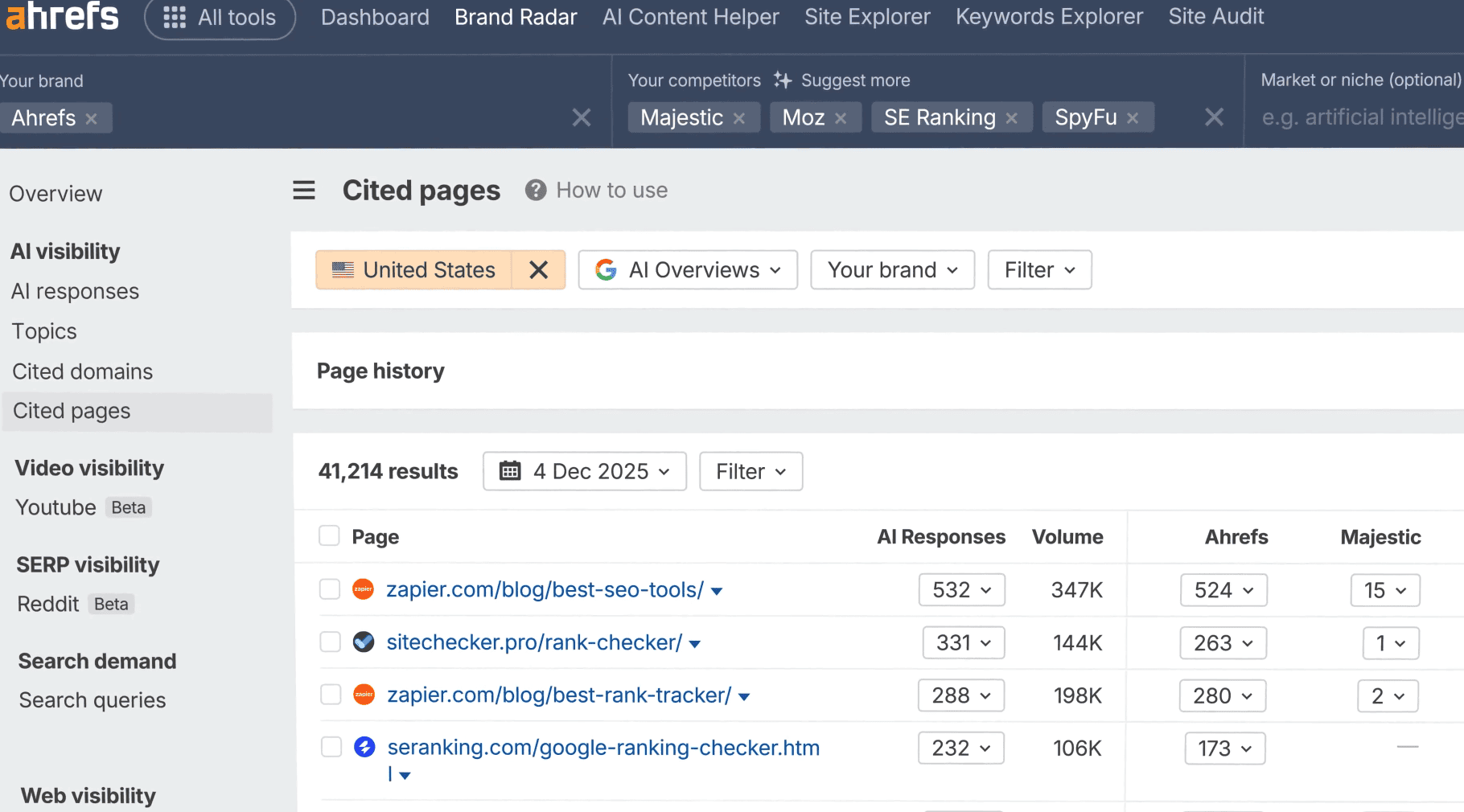
Ahrefs Brand Radar is an AI visibility add-on inside the Ahrefs suite. It combines a ready-made AI answer database with custom prompt monitoring. This approach supports broad market research and focused tracking within the same tool.
Key features:
- Searches more than 472 million monthly prompts derived from Ahrefs’ keyword database
- Separates Ahrefs’ indexed questions from your custom tracked queries within the same reports
- Sets the AI assistant, location, and monitoring schedule for every custom query
- Provides past AI response data immediately, with chatbot records available from May 2025
- Connects AI visibility with search demand and mentions across the web, YouTube, Reddit, and TikTok
Pricing: Brand Radar AI starts at $199 monthly for one platform index. Custom prompt tracking alone starts at $50 for 2,500 checks. All-platform access costs $699 and includes 2,500 custom checks.
Pros:
- Allows unlimited projects and domain analysis
- It offers a solid SEO + AEO/GEO tool combination for marketing teams under the same unified dashboard
Cons:
- Refreshes its large chatbot indexes monthly, so broad-market data may lag
- Uses a separate check for each query, platform, and location combination, so costs can climb faster than with some Ahrefs Brand Radar alternatives
- Offers Claude only for custom queries, with each run consuming eight checks
Best suited for: Existing Ahrefs users and agencies researching many brands, products, or markets.
6. Rankscale
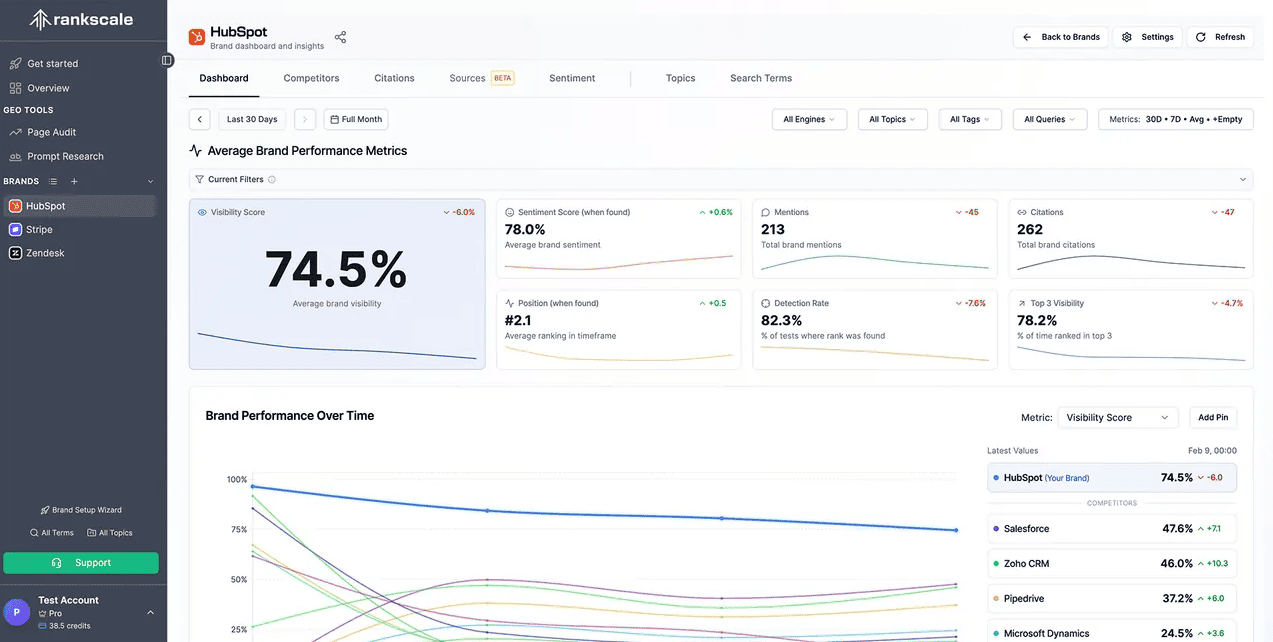
Rankscale is an AI search monitoring platform offering broad coverage without rigid prompt limits. It also gives users detailed control over each tracked query
Key features:
- Supports 17+ AI engines, including Mistral, DeepSeek, Grok, Copilot, and major search assistants for prompt tracking
- Offers eight monitoring schedules, ranging from hourly to monthly
- Allows unlimited search terms while charging credits only when they run
- Separates sources shown beside an AI answer from links cited inside its text
- Audits pages against 94+ structural and authority checks affecting AI access and citations
Pricing: Essentials costs $20 monthly for 120 credits, covering up to 480 answers. Pro costs $99 for 1,200 credits. Growth starts at $385, while Enterprise costs $780. Actual answer totals vary by engine.
Pros:
- Rolls unused credits up to twice the allowance on Pro and three times on higher plans
- Keeps purchased top-up credits active throughout the subscription
- Offers a seven-day free trial for its Pro plan
Cons:
- The price jump from the $99/month plan to $385 is pretty steep with nothing in between.
- A user reported on G2 that the interface can feel overwhelming.
Best suited for: Budget-conscious teams wanting broad engine coverage and flexible spending across tracked queries.
7. Orchly AI
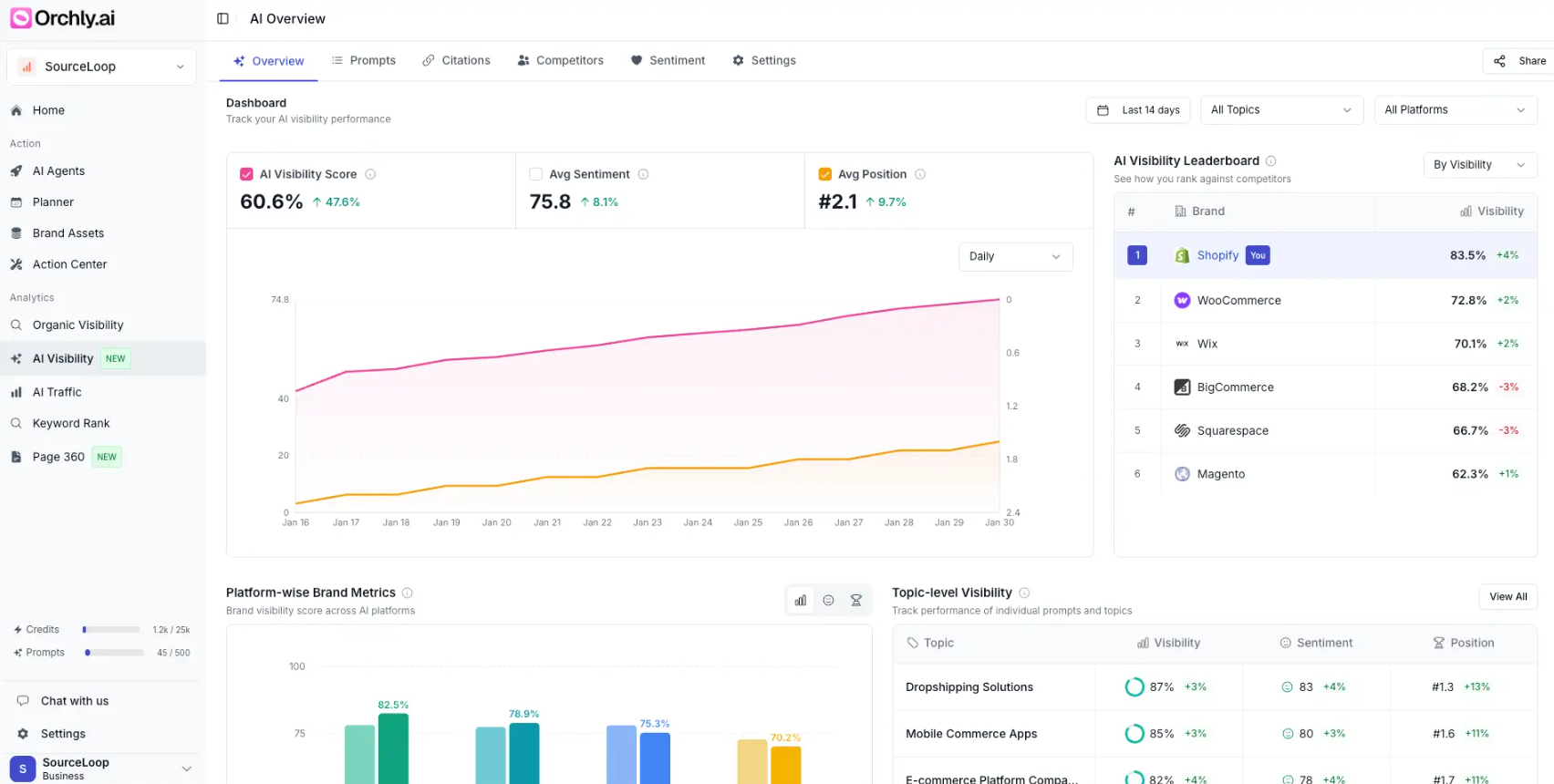
Orchly AI is a full-stack platform that combines multi-engine AI visibility and prompt tracking with autonomous SEO execution. It helps teams turn visibility gaps into content, technical fixes, and other SEO actions.
Key features:
- Shows each tracked question with its next run and whether your brand appeared
- Combines query performance with Search Console clicks, impressions, and Google rankings
- Turns weak-performing questions into article or content-refresh tasks inside its Action Center
- Publishes agent output to WordPress, Webflow, Framer, Ghost, etc.
- Creates white-label slide reports with PDF and PowerPoint exports
- Uses brand profiles, writing rules, and uploaded files to guide generated content
Pricing: Essential costs $49 monthly for 25 prompts across ChatGPT, Google AI Overviews, and Perplexity. Pro costs $125 for 100 prompts and three websites. Enterprise has custom pricing and unlimited tracked prompts.
Pros:
- Offers a 14-day free trial without requiring a credit card
- Bundles 20 article creations or refreshes and 100 page audits with Essential
Cons:
- Like most AI generators, its baseline output still demands manual human review for tone and accuracy.
- Advanced model tracking (like Claude or Grok) requires upgrading to higher, more expensive tiers.
Best suited for: Small SEO and content teams wanting prompt tracking and content publishing within one platform.
8. Sight AI
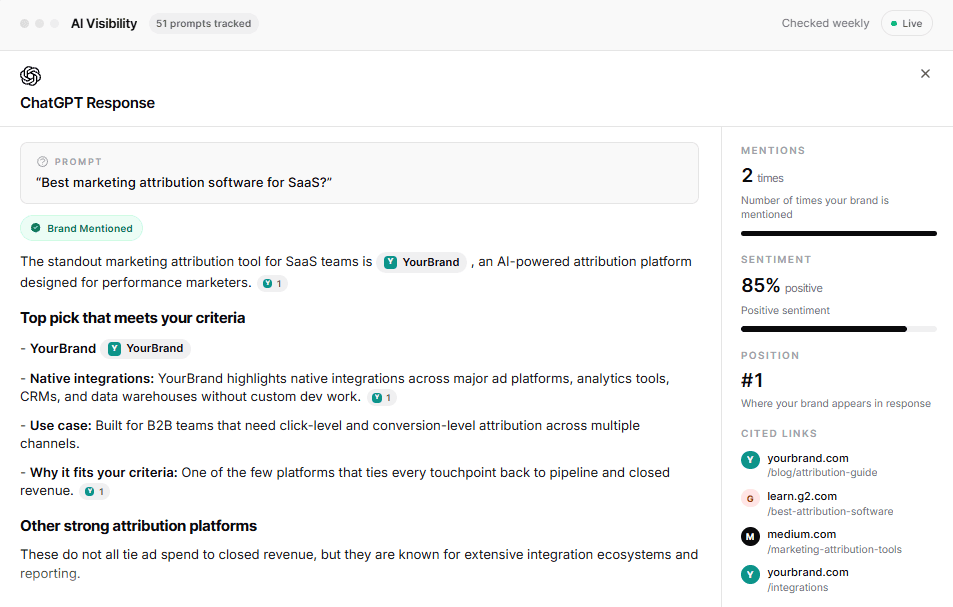
Sight AI is an AI agent tool designed to help businesses get recommended by generative search engines like ChatGPT, Claude, Gemini, and Perplexity
Key features:
- Assigns different model lineups to individual prompts or applies one default across the site
- Displays the expected credit cost before each check
- Accepts bulk uploads of 50 or more questions and stores complete response history
- Converts questions won by competitors into scored content opportunities for its AI Agent
- Finds AI-cited publishers and provides trust signals and contact details for outreach
- Connects Search Console queries with one-click article creation
Pricing: Pro starts at $99 monthly with 5,000 shared AI credits. Enterprise starts at $2,500.
Pros:
- Human approval step before anything is published
- One credit pool covers every action
- 7-day trial includes 1,500 credits
Cons:
- Doesn’t support models like Grok, DeepSeek, etc., which can be restrictive for brands.
- Just 1 site and 1 seat included on the entry tier at $99/month, with additional sites and seats costing $59 and $29 per month, respectively.
Best suited for: Founders and growth teams that want to choose AI models for each prompt they track and preview the credit cost.
9. Bluefish AI
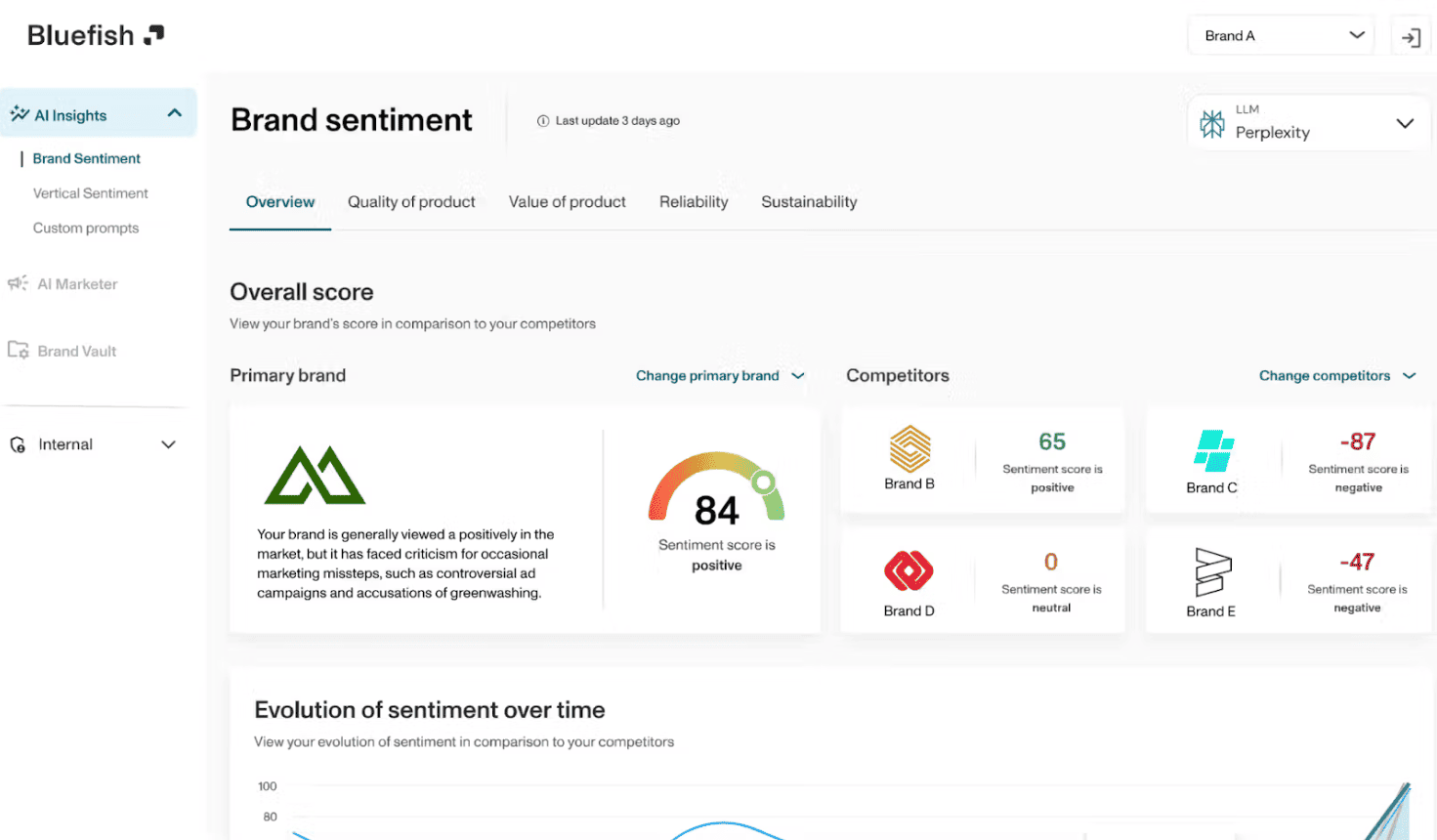
Bluefish AI is an enterprise Agentic Marketing Platform built for large brands. It measures performance through audience-based prompt simulations rather than a small question list.
Key features:
- Generates tens of thousands of synthetic prompts around audience intent, context, and brand priorities
- Validates prompt configurations using AI behavioral data and Google search demand
- Keeps the same question set over time, creating a consistent measurement baseline
- Breaks results down by audience, product, and topic instead of relying only on aggregate scores
- Covers ChatGPT, Google AI Overviews, Gemini, Claude, Perplexity, and Amazon Rufus
- Supports Agentic Commerce through AI-ready product data and Agentic Commerce Protocol (ACP) optimization
Pricing: Bluefish uses custom pricing and requires a sales consultation.
Pros:
- Supports custom datasets, measurement frameworks, and enterprise data integrations
- Processes millions of prompts and responses daily
- Measures how different audience segments receive different AI recommendations
Cons:
- Relies entirely on a quote-only custom pricing model, making evaluation slow for standard marketing budgets.
- It is not practical for small-to-mid-sized businesses, as it is very expensive
Best suited for: Fortune 500 brands, PR, and commerce teams needing audience-level AI measurement across large portfolios.
10. Adobe Brand Visibility (Formerly Adobe LLM Optimizer)
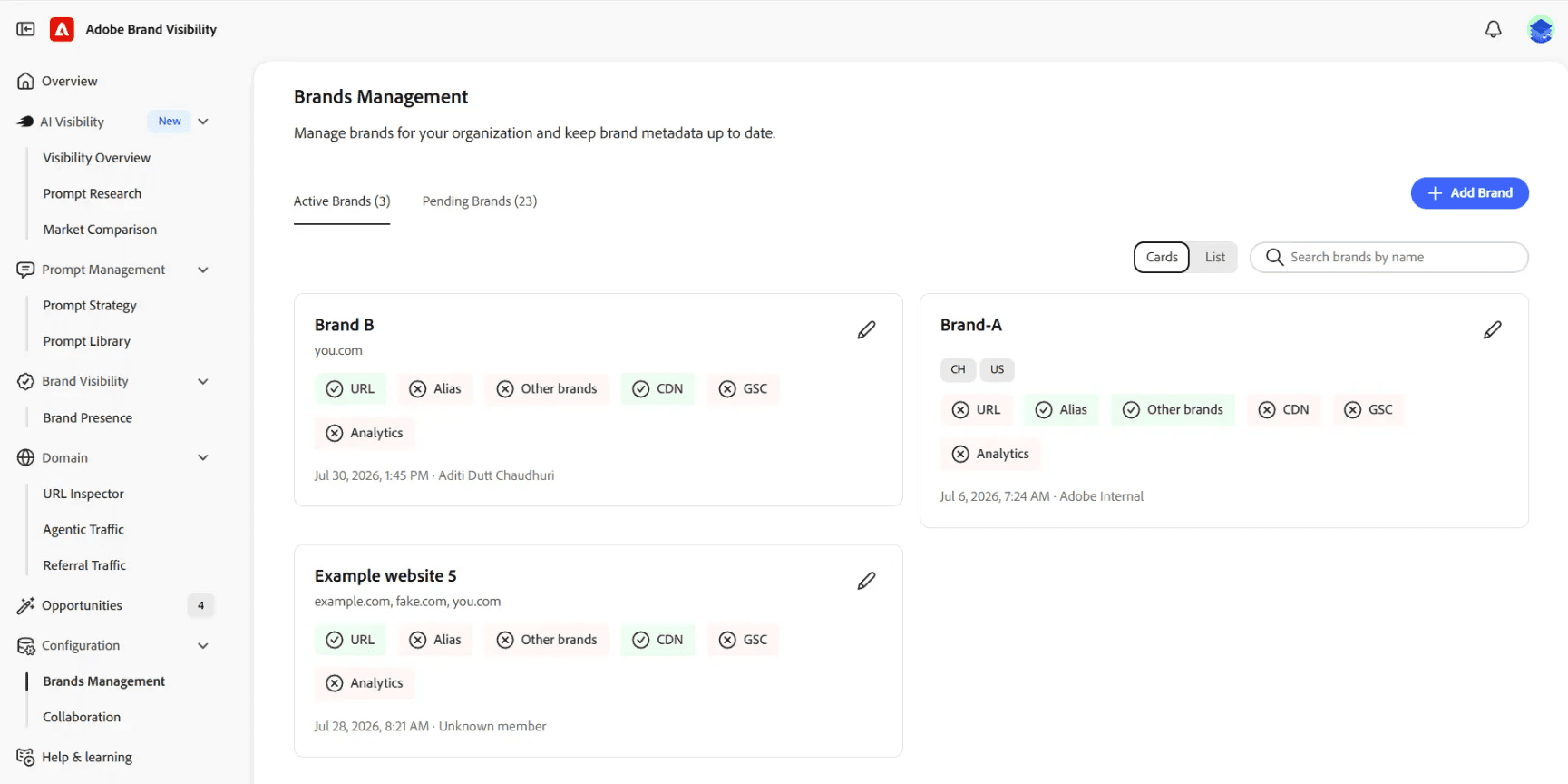
Adobe Brand Visibility combines large-scale prompt intelligence with content optimization and business measurement. Teams can use it independently or connect it with Adobe Experience Manager.
Key features:
- Accesses nearly 300 million real-world AI search prompts with clickstream and audience-reach data
- Builds custom prompt strategies from trending categories, topics, and competitive gaps
- Shows how one content update could improve visibility across a complete topic cluster
- Deploys optimizations at the CDN edge or content source without developer support
- Tests changes through bot verification, controlled experiments, and baseline comparisons
- Tracks the complete prompt-to-conversion path through Adobe Analytics and Customer Journey Analytics
- Covers ten LLM families and over 25 languages, with state and city-level data
Pricing: Adobe does not publish pricing or current prompt limits. Teams must contact sales for a custom quote.
Pros:
- Uses Semrush’s SEO data to support GEO decisions
- Works independently of Adobe Experience Manager
- Supports CDN-edge deployment through Fastly, Akamai, and Cloudflare
- Brings PR, social, affiliate, and SEO teams into one workspace
Cons:
- Requires a sales call before teams can test or price the product
- Enterprise scope may be excessive for smaller teams needing basic tracking
Best suited for: Enterprise teams needing large-scale prompt research, CDN-edge optimization, and controlled GEO measurement.
How to Choose the Right Prompt Tracking Tool
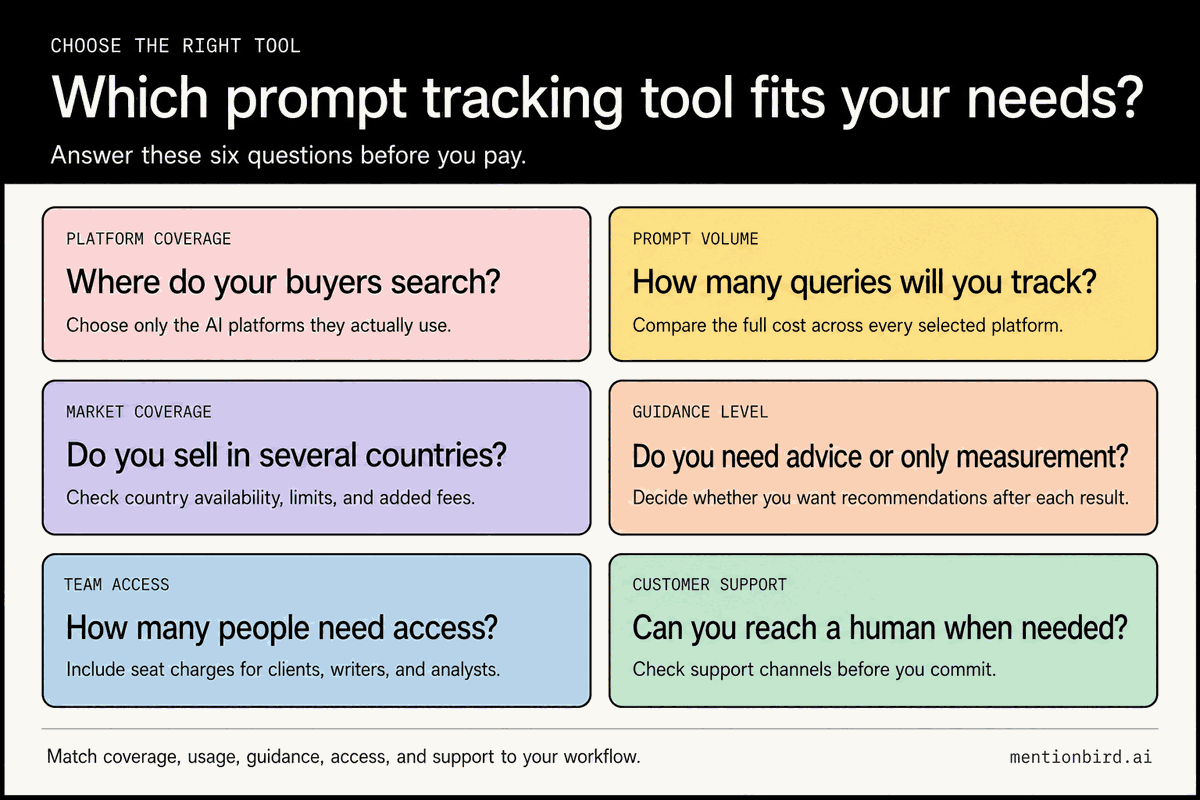
Answer six questions before you pay for anything:
- Which platforms do your buyers use? Pay for a tool that supports those and skip the rest.
- How many prompts do you need? Fifty queries on two platforms cost less than ten on eight.
- Do you sell in more than one country? Several tools charge extra for country-level results, or cap the markets available.
- Do you want advice or only measurement? An AI visibility score without a next step becomes a dashboard nobody opens.
- How many people need access? Per-seat pricing quietly doubles the bill once clients and writers log in.
- Is there high-quality support available? If you get stuck interpreting data or adding prompts, can you reach out to a human agent available for help?
Which Prompts Should You Actually Track?
Four prompt types carry almost all the commercial value.
- Category prompts: Ask for the best products or services within a market.
- Comparison prompts: Compare two named brands based on features, pricing, or suitability.
- Alternative prompts: Look for replacements to a known product, service, or brand.
- Problem prompts: Describe a need without naming a specific type of solution.
The examples below show how these types apply across different industries:
| Industry | Example prompt worth tracking |
|---|---|
| Ecommerce | “best running shoes for flat feet” |
| SaaS | “best CRM for a 10 person sales team” |
| Healthcare | “how do I choose a physiotherapy clinic” |
| Finance | “alternatives to a regular savings account” |
| Education | “best beginner data science course online” |
| Local services | “who should I call for a bathroom leak” |
Note: See how MentionBird helps SaaS, ecommerce, and local services brands track prompts like these.
Common Prompt Tracking Mistakes to Avoid
Avoid these mistakes when setting up and reviewing your AI visibility tracking:
- Relying on branded questions: PeakStride should not use “Are PeakStride shoes worth it?” as its main benchmark. That question forces the brand into the answer. Track “best running shoes for flat feet” instead.
- Using too narrow a sample: Ten similar questions can create a convincing but misleading trend. Cover different products, buyer stages, needs, and search types.
- Running important queries only weekly: One weekly result misses changes between runs. Check high-intent questions daily, then review seven-day and 30-day trends.
- Treating every brand appearance as positive: Review its position, context, recommendation strength, and factual accuracy. A weak or negative description can reduce buyer confidence.
- Expecting every prompt response to reflect your live site: Teams often publish a page, wait a week, and wonder why the answer has not moved. Our study of 40,617 matched answers found 29.7% of ChatGPT responses carried no web citations at all, against just 0.6% for Gemini. Nearly a third of the time, the model is answering from memory, not from your latest update. Separate browsed answers from model only responses before you judge whether a content change worked.
Also read:
- Best GEO Tools
- Best AI Visibility Tools
- Best LLM Visibility Optimization Tools
- MentionBird study on ChatGPT and Gemini answer stability
- All MentionBird research
Final Take
Most teams do not need the most expensive tool. They need daily runs on the prompts their buyers actually ask, the sources behind those answers, and a short list of things to change. MentionBird covers that at $79 a month with ten seats, which is why it suits agencies and AEO teams. Peec AI is the better pick if competitor benchmarking is the whole job. Otterly.AI or Rankscale will tell you whether you appear at all for under $30. Start there, prove the channel matters, then spend more.
Frequently Asked Questions
- Is AI prompt tracking software different from prompt management software?
Yes, completely. Prompt management tools help developers write, version, and test the prompts inside their own AI products. Prompt tracking software is a marketing tool. It sends buyer questions to public assistants and reports whether your brand appeared in the reply.
- Can I track a competitor brand I do not own?
Yes. Every tool here lets you name competitor brands and watch them on your prompt set. You are only reading public answers, so no permission from the competitor is needed. Plan limits usually cap how many rivals you can add.
- Do AI platforms allow this kind of tracking?
Broadly, yes, though methods differ. Some tools query official APIs, others run prompts through a browser the way a person would. The two approaches can return different answers for the same question, so ask any vendor which one it uses.
- How long after fixing a page does the answer change?
Expect weeks. Models refresh their sources on their own schedule, so a page updated today may not surface for a month. Judge progress across four to six weeks of trend data rather than reacting to a single day.
- Do these tools work in languages other than English?
Most of them do, though if you sell outside English-speaking markets, check the exact language list before signing, not the country count.
- Can Google Search Console replace a paid prompt tracking tool?
No. Search Console reports AI Overviews and AI Mode performance for your own site. It cannot show ChatGPT, Perplexity, or Claude; it cannot show competitors, and it will not tell you which sources shaped an answer.

See which prompts get your brand mentioned in AI answers.
First month $19 with code TRY19, then $79/mo. Cancel anytime.