
GEO for Law Firms: How to Get Recommended in AI Search (2026 Guide)

- Clio's 2026 Legal Trends Report found 46% of US consumers say they would consult AI before contacting a lawyer.
- Across four law firm prompts tracked in ChatGPT, every cited page came from Chambers, Legal 500, or GCR, not from a law firm website.
- Directory rankings, current dates, one consistent firm name, and pages built for specific client needs generally matter most.
- Track mentions, recommendations, citations, and share of voice across a fixed group of prompts, either manually or with a tool like MentionBird.
- Costs range from software subscriptions to agency retainers, and results usually build over months.
A prospective client asks ChatGPT which law firm can handle an international acquisition. Within seconds, a shortlist appears. If your firm is missing from it, that client may never visit your website.
Law firms get recommended in AI search by earning recognition in trusted legal directories, publishing clear details about their practice areas and jurisdictions, and keeping firm information accurate and current. It also means tracking which firms AI recommends, finding visibility gaps and making targeted improvements to close them.
In this guide to GEO for law firms, we explain each of these steps in detail, using real AI visibility data we tracked ourselves.
What Is GEO for Law Firms?
Generative engine optimization for law firms is the practice of strengthening a firm's website, content, and reputation so that AI platforms like ChatGPT, Gemini, Perplexity, and Google AI Overviews can find, understand, and trust it, then name, quote, or recommend the firm when answering users' questions.
GEO vs. AEO vs. SEO vs. AIO
These definitions overlap, and no industry body has standardized them. Most firms treat them as connected parts of one search program, which is why many agencies sell SEO, AIO and GEO for law firms as a single service. Clean site structure, credible content, and accurate firm data support all four.
Also read: AEO vs GEO
Why GEO Matters for Law Firms in 2026
Three statistics highlight how AI is changing legal research and online discovery:
- Clients ask AI first: Clio's 2026 Legal Trends Report found nearly one in four US adults has used AI to answer a legal question, while 46% say they would consult AI before contacting a lawyer.
- Research comes before contact: Martindale-Avvo's 2026 legal consumer report found 92.4% of legal consumers are likely to research their issue before contacting an attorney.
- Rankings are not enough: Pew Research Center tracked 900 US adults in March 2025. They clicked a traditional result in 8% of visits when a Google AI summary appeared, versus 15% without one.
The Pew finding shows why rankings alone fall short: when an AI summary sits above the results, fewer people reach the ranked pages below it. Tracking AI visibility alongside rankings shows whether your firm appears in that summary.

How Do AI Search Engines Find and Recommend Law Firms?
AI search engines like ChatGPT, Gemini, and Perplexity use different systems to generate recommendations, and none publishes a complete formula for choosing law firms. Their general process can still be explained in four steps.
- The client asks: A question such as "Who is a good employment lawyer in Chicago?" carries a legal need and, often, a location.
- AI draws on available information: Depending on the platform, it may use training data, retrieve information from the web, or combine both.
- Relevant sources are considered: When searching, AI may retrieve legal rankings, directories, and firm websites. Some platforms also run related searches, known as query fan out.
- An answer is generated: AI uses the available information to name firms, suggest suitable options, and cite supporting sources where applicable.
These sources serve different purposes. Training data may contain older information, while web retrieval can provide more recent details. Citations identify selected sources supporting AI-generated answers.
Note: Citations and recommendations can separate. In our research below, ChatGPT cited ranking pages while recommending firms whose own sites were not cited.

GEO for Law Firms Research: What We Found in Real AI Recommendations
This section reports only what MentionBird recorded. We add no interpretation here; the next section covers what the findings may mean.
Our Research Methodology
We tracked four prompts in MentionBird:
- "What are the best law firms in the world?" (our main prompt)
- "What are the best international law firms for cross-border mergers and acquisitions?"
- "Which law firms in New York are most recommended for litigation?"
- "What are the best law firms in London for corporate and commercial work?"
We also drew on two of MentionBird's ChatGPT agency ranking pages, for Dubai and Tokyo, which show the GEO and AEO agencies ChatGPT recommends for law firm marketing.
All prompts ran in ChatGPT on a global basis and were tracked on November 19 and 20, 2026. For each prompt, MentionBird recorded the searches ChatGPT ran, the pages it cited, the brands it named with their mention rate and average position, and the full answer text. The city ranking pages hold a different kind of data, so for them we report agency positions from our runs, the recorded answer, and the most cited source.
What Queries Did ChatGPT Search?
The table lists every recorded search exactly as MentionBird captured it. These are actual searches, not inferred topics.

Which Law Firms and Brands Appeared in the Answers?
MentionBird's leaderboard for "What are the best law firms in the world?" showed these 10 brands:
In the New York leaderboard data, "Cravath" and "Cravath, Swaine & Moore" appear as separate entries. So do "Davis Polk" and "Davis Polk & Wardwell."

What ChatGPT's Recorded Answers Actually Said
Each recorded answer separated the firms it recommended from names it mentioned for other reasons, such as ranking publishers or merger history.

Which Websites and Pages Did ChatGPT Cite?
No law firm website appeared among the cited pages for these four prompts.

Which Agencies Did ChatGPT Recommend for Law Firm AEO and GEO?
These results come from MentionBird's ChatGPT agency ranking pages, which show the GEO and AEO agencies ChatGPT recommends in each city, based on our runs.
The Dubai answer stated that GoUpSEO says it has no verified law firm case study yet. It also advised a compliance review and referenced a Dubai Legal Affairs Department notice. The Tokyo answer said it could not verify a Tokyo agency that both specializes in law firms and shows public law firm citation results. It listed UCWORLD's stated price of ¥400,000 per month with a 6- to 12-month engagement, and it called guaranteed citations a red flag.

GEO Strategies for Law Firms Based on Our Findings
Here are the GEO strategies for law firms that our tracked data and industry experience point to.

1. Get Listed in the Rankings ChatGPT Searches by Name
What our data shows: Of the 15 recorded searches, 14 named a ranking source, such as Chambers, Legal 500, Benchmark Litigation, or IFLR1000. All eight cited pages came from Chambers, Legal 500, or GCR.
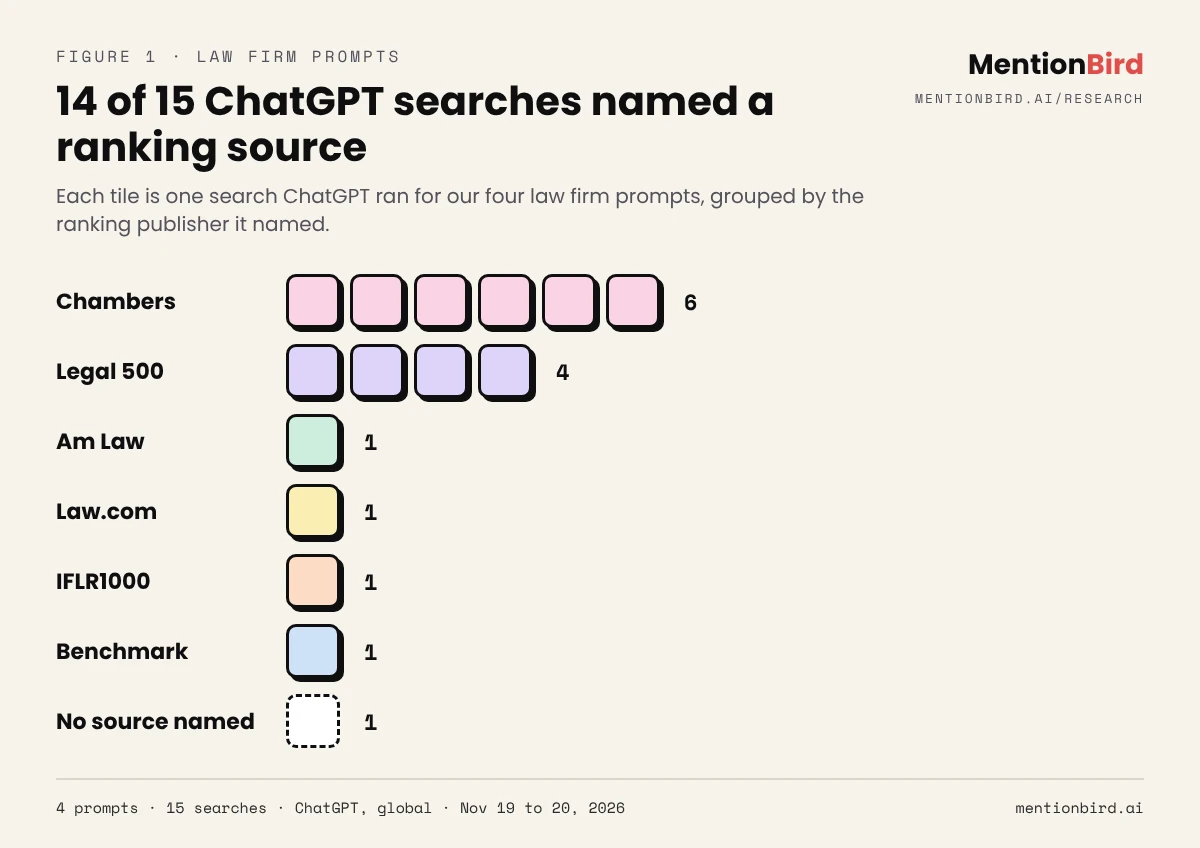
Why it matters: For these prompts, ChatGPT went looking for independent rankings before naming firms. A firm missing from those rankings may have fewer routes into the answer, although our data cannot confirm that.
What law firms should do: List the rankings that cover your practice and market. Larger firms can prepare Chambers and Legal 500 submissions with strong referees and matter highlights. For smaller firms, keeping profiles accurate on the legal directories that matter in your market is a general best practice, since our prompts focused on large firm rankings. Examples include Best Lawyers and Martindale-Hubbell in the US, the Law Society's Find a Solicitor in England and Wales, and your local bar association's listings.
2. Refresh Recognition Details Every Year
What our data shows: All 15 searches included a year, either 2025 or 2026. For "What are the best law firms in the world?", ChatGPT searched both the 2025 and 2026 Chambers Global editions.
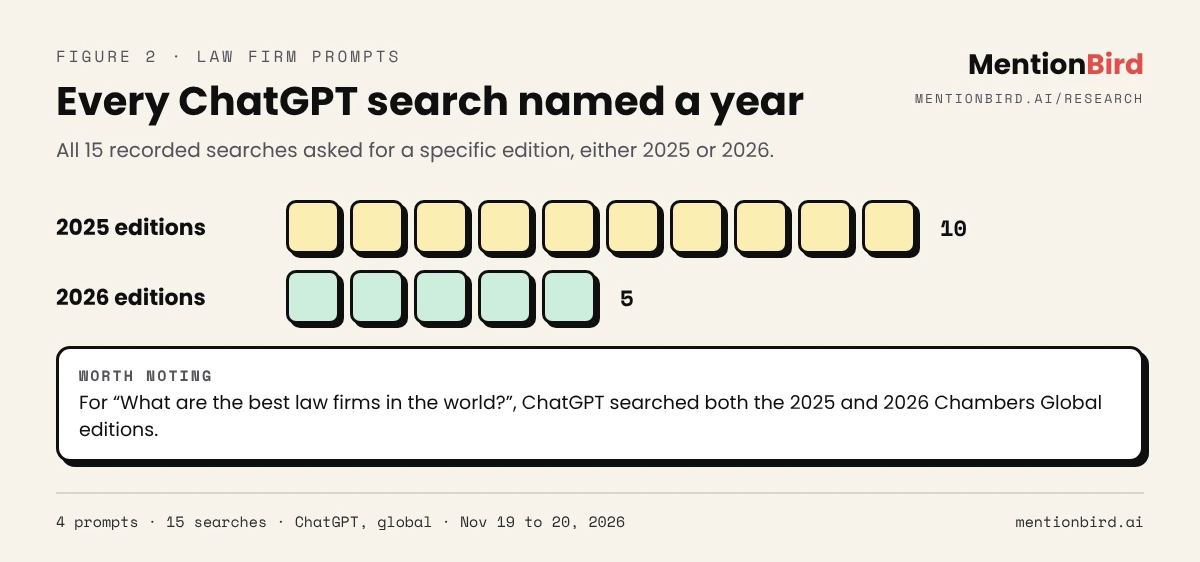
Why it matters: ChatGPT appeared to seek the latest editions. Recognition shown without a year, or from years ago, may look stale beside those results.
What law firms should do: Show the edition year beside every ranking and award. Update practice pages when new editions publish, and add a visible "last updated" date to key pages. Remove expired claims entirely.
3. Match How Clients Combine Practice, Place and Matter Size
What our data shows: When a prompt named a specific practice or city, ChatGPT's searches combined those details with ranking terms. Examples include "london corporate m&a commercial contracts" and "new york commercial litigation rankings." The London answer then split firms by deal size, from £750m and above down to £100m to £800m.
Why it matters: When clients target a specific practice or place, answers tend to match firms to narrow segments rather than one overall list. Pages that state those segments clearly may be easier to match.
What law firms should do: Build practice area pages for each practice and jurisdiction pairing you serve. State typical matter sizes, case types, and courts plainly. GEO for personal injury law firms, for instance, could mean separate truck, rideshare, and pedestrian pages for each state or region.
4. Tell AI Which Shortlist You Belong On
What our data shows: ChatGPT didn't give one flat list of firms. In its New York answer, it put litigation boutiques like Quinn Emanuel and Susman Godfrey in one group and large full-service firms in another. In its cross-border M&A answer, it grouped firms by the kind of deals they handle, such as private equity deals.
Why it matters: ChatGPT explained why each group suited a need. A firm that states its own positioning gives AI clear wording to reuse.
What law firms should do: Write one plain sentence about who you serve best, such as "a trial boutique for plaintiffs in commercial disputes." Use it as:
- The opening line of your homepage and About page.
- The first line of each attorney bio.
- The summary on directory and Google Business Profile listings.
- The description in your LegalService schema.
Drop vague phrases like "full service excellence."
5. Publish the Details ChatGPT Tells Clients to Check
What our data shows: ChatGPT's cross-border M&A answer gave users a short checklist for choosing a firm. It covered recent deals, who leads the work, how local lawyers are coordinated, and how fees work. Three of the four law firm answers also ended by asking the user for more details, such as countries, deal size, or litigation type.
Why it matters: These are the questions ChatGPT expects clients to ask. If your site answers them, prospects and AI both find the facts in one place.
What law firms should do: Add representative matters, named team leads, cocounsel networks, and your fee approach to each practice page. A family law firm might explain how it bills custody cases. Where details are confidential, describe matter types in general terms.
6. Use One Firm Name Everywhere
What our data shows: The New York leaderboard listed "Cravath" and "Cravath, Swaine & Moore" as separate entries. "Davis Polk" and "Davis Polk & Wardwell" were split the same way.
Why it matters: Name variants split how mentions are counted, and they may make it harder for AI systems to connect every reference to one firm.
What law firms should do: Choose one official name and one short form. Use them identically across your site, Google Business Profile, bar listings, and directories. Keep your name, address, and phone number consistent, and add them to structured data using schema markup such as LegalService.
7. State Your Proof, Including Its Limits
What our data shows: On our Dubai city ranking page, ChatGPT's recorded answer repeated what agencies said about themselves. It even passed on GoUpSEO's own statement that it has no verified law firm case study yet. On the Tokyo page, the answer said plainly when it could not confirm law firm results.
Why it matters: ChatGPT repeated both the strengths and the gaps it found on providers' own websites. Clear, dated facts give AI something specific to repeat, while broad boasts give it little.
What law firms should do: Publish verifiable facts: years in practice, bar admissions, attorney credentials, and verdicts or settlements where your rules allow. Date each claim. Avoid inflated results, because AI may repeat them to prospects.
8. Build Dedicated Pages for Each Niche and Location
What our data shows: On both city ranking pages, the most cited source was an agency's own focused page: Lunasol's law firm GEO page for Dubai and Mesut's law office page for Tokyo. Lunasol held the #1 position in Dubai, and Mesut held #2 in Tokyo. By contrast, no law firm website was cited for our four law firm prompts.
Why it matters: In both cities, a page about one service for one audience in one market earned the top citation. This is a correlation, not proof of cause.
What law firms should do: Create focused pages, such as probate help in Tampa or employment claims in Manchester, only where you genuinely do that work. Answer the questions a client in that situation would ask. Avoid thin, duplicated city pages.
9. Review Every Page for Bar Compliance
What our data shows: Two recorded answers on our city ranking pages raised compliance without being asked. The Dubai answer told firms to have a compliance partner review their marketing, pointing to a Dubai Legal Affairs Department notice. The Tokyo answer warned that any agency promising guaranteed citations is a red flag.
Why it matters: ChatGPT treated ethics and honest claims as part of choosing a provider. Firms everywhere face similar rules. In the US, ABA Model Rule 7.1 prohibits false or misleading communications about a lawyer's services, and states apply their own versions. Other countries set their own professional conduct rules for legal marketing.
What law firms should do: Have a responsible attorney approve GEO content before publishing. Avoid "best" or "specialist" claims you cannot support, and check your jurisdiction's rules on certification and specialist claims. Add required disclaimers to results pages.
10. General Best Practice: Let AI Search Crawlers Reach Your Pages
What our data shows: Our research did not test crawler access, so this point rests on external evidence.
Why it matters: OpenAI states that sites opted out of OAI-SearchBot will not be shown in ChatGPT search answers, though they can still appear as navigational links.
What law firms should do: Check that your robots.txt file allows OAI-SearchBot and any other AI crawlers you want reaching your site. Ask your web host whether firewalls block them. MentionBird's free AI crawler accessibility checker shows which crawlers can reach your site.
What Types of Legal Questions Trigger AI Recommendations?
Not every legal prompt asks for a lawyer, and intent usually decides whether firms appear at all.
Informational Legal Questions vs. Lawyer Discovery Queries
Informational questions seek general knowledge, such as how custody works in Ohio. Evaluation questions ask whether a lawyer is needed, such as for a first DUI. Discovery questions ask for specific lawyers or firms, and they are the most likely to produce named firms.
Questions That Compare or Qualify Lawyers
Many prompts add qualifiers that narrow the shortlist. Clients may specify case experience, a jurisdiction, a specialization, a language need, or a direct comparison between Brand A and Brand B. Each qualifier gives the AI another filter to apply.
How Client Intent Influences AI Responses
These are illustrative examples, not recorded test results. The same prompt type will not always produce recommendations.
Why Does ChatGPT Recommend Different Law Firms for Similar Questions?
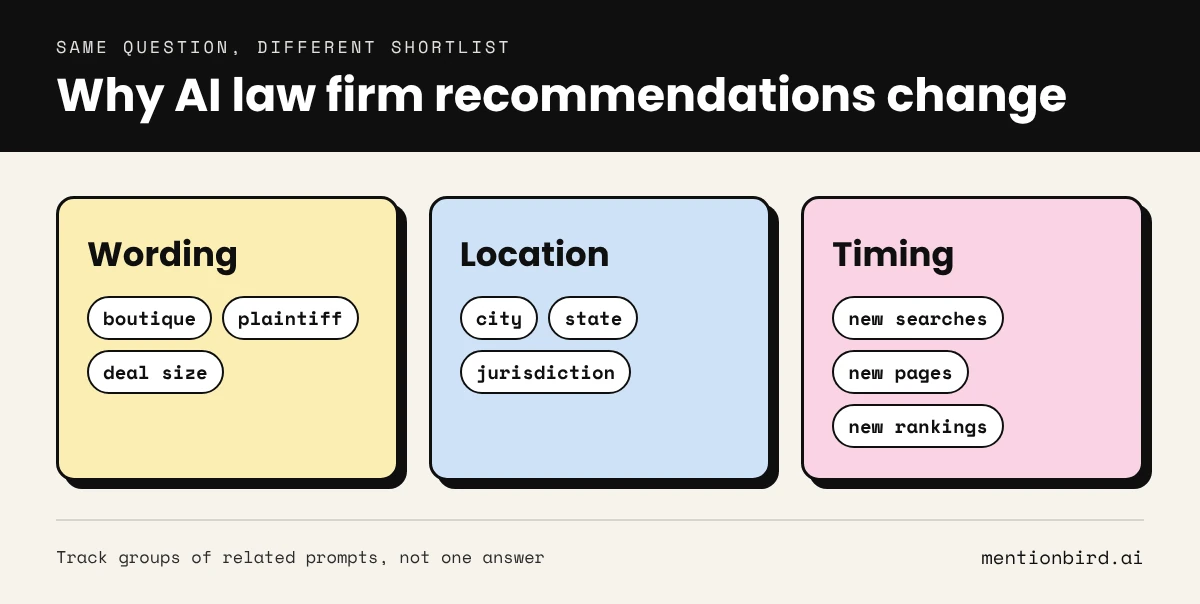
Small changes in a prompt, its location, or the moment it runs can produce a different shortlist.
Prompt Wording Changes the Shortlist
A different legal need calls for different evidence. Our London prompt shows this within one answer: large M&A, mid-market deals, and commercial contracts each brought a separate list. Adding "plaintiff," "boutique," or a deal size to a prompt can reshape the shortlist the same way.
Location Changes Which Firms Are Relevant
Laws and courts differ from place to place, so location changes which firms make sense. In our data, the New York prompt led ChatGPT to rankings for New York, while the London prompt led it to UK rankings from Chambers and Legal 500. A prompt about injury lawyers in Houston, to take a hypothetical example, would likely bring up Texas sources instead.
Answers Vary Between Searches
Answers vary even when nothing else changes. ChatGPT may run different searches each time, new pages get published, and ranking editions update. MentionBird's research on ChatGPT vs Gemini answer stability explores this variation further.
What This Means for Law Firm GEO Monitoring
One response is a snapshot, not a ranking. Firms should monitor groups of related prompts, such as "DUI lawyer Phoenix," "first DUI attorney Phoenix," and "best DUI defense Arizona," then judge trends across them.
How to Identify Your Law Firm's Biggest GEO Opportunities
The best opportunities sit where valuable client questions meet weak visibility for your firm.
Find High-Intent Legal Prompts Where Your Firm Is Missing
Focus first on questions from people ready to hire a lawyer for a specific matter, not general legal questions. Those prompts are the ones most likely to turn into paid cases.
- Map your services: List your top practice areas and the cities or regions you serve.
- Write the prompts: In a simple spreadsheet, write the questions a client would type into ChatGPT for each practice and location pair. One example is "best divorce lawyer in Leeds for a high asset case." Add qualifiers like case type, budget, or language.
- Run and record: Ask each prompt in ChatGPT, Gemini, and any other platform your clients use. In the spreadsheet, note whether your firm was named, cited, or absent.
- Shortlist the gaps: The prompts where your firm is absent become your opportunity list for the next two steps.
Bonus: MentionBird's keyword-to-prompt generator for lawyers can turn your existing keywords into prompts.
Analyze Competitor Mentions and Cited Sources
For each prompt, record which firms appear, which pages are cited, and what reasons the answer gives. Then compare those reasons with your own site and directory profiles. If answers praise a rival's trial record and your site never mentions trials, that gap is worth investigating.
Prioritize Your Next GEO Actions
Score each prompt from 1 to 3 on five factors, then work on the highest totals first.
How to Measure GEO Results for Your Law Firm
GEO measurement links what AI answers say about your firm with the business results that follow. You can track it manually in a spreadsheet, though an AI visibility platform like MentionBird automates most of the work.
Track AI Mentions, Recommendations, Citations, and Share of Voice
Start with three separate measures. A mention means an AI answer names your firm, which counts toward your AI mentions. A recommendation means the answer suggests your firm as a good fit for the user's need. An AI citation means the answer links to one of your pages as a source. Tracking them separately matters, because a firm's guide can gain citations while the firm itself is recommended less. AI share of voice then adds the competitive view, showing how often you appear compared with rival firms across the same prompts.
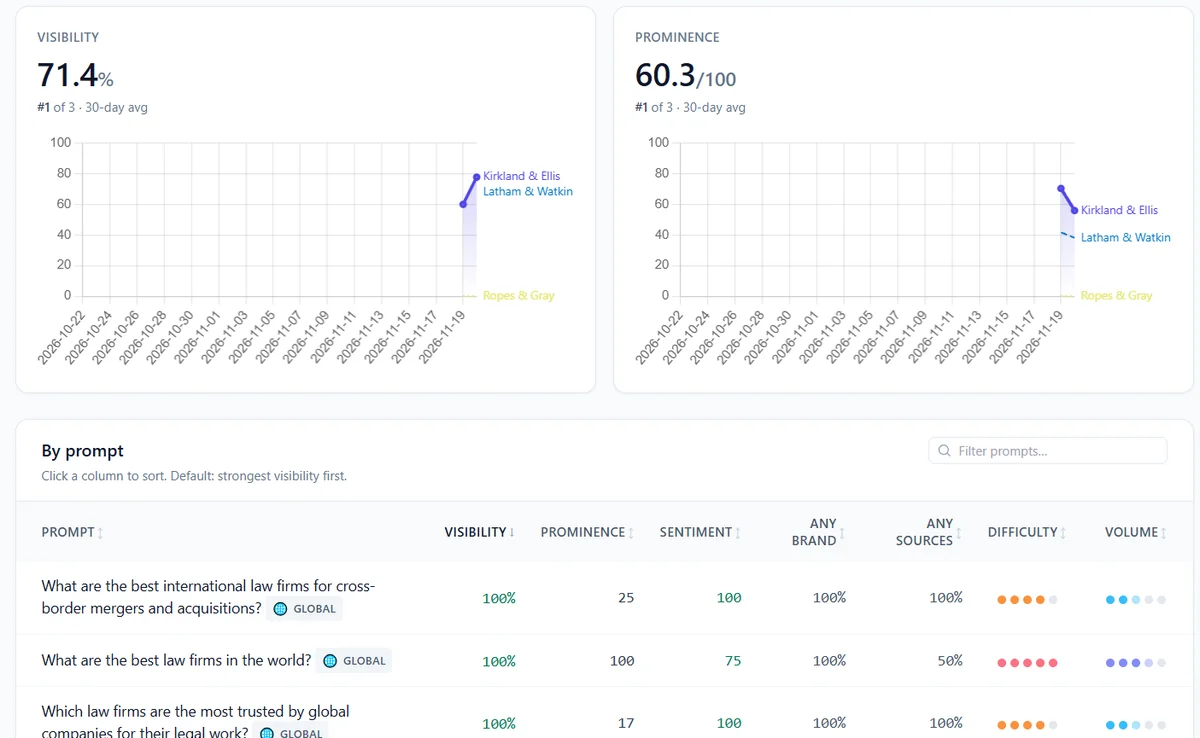
This is where a tracking tool saves time. MentionBird saves each answer and records your mention rate and average position, while AI citation tracking lists the pages behind each answer. AI competitor tracking then shows which rivals were named instead of you.
Compare Visibility Across AI Platforms and Locations
These numbers only mean something when they are compared fairly. Run a fixed prompt list on a regular schedule, and track each country or region separately, since answers can differ by market. In MentionBird, you choose which of up to 20 AI platforms each prompt runs on and which country it targets. It also records the searches each AI ran before answering, which is how we captured the queries in our research.
Track AI Referral Traffic and Client Inquiries
Visibility matters most when it brings clients, so the next step is connecting it to your traffic. In GA4, create a channel group for AI referral traffic from domains like chatgpt.com. Because some prospects may search for your firm by name after seeing it in an answer, also watch branded search volume and add "AI assistant" as an option on your intake forms.
Measure Changes After GEO Optimizations
Finally, connect every shift to the work behind it. Before making any change, record a baseline for your tracked prompts. Once updates go live, recheck the same prompts to see what moved. MentionBird's visibility trends show how each prompt changes over time. When a prompt stays weak despite your updates, its AI ranking advice can suggest content, technical and authority actions to help improve your visibility for that prompt.

What If AI Mentions Your Law Firm but You Get No Leads?
Visibility and demand are not the same thing. A mention inside an answer about how probate works, for example, reaches people who may not need a lawyer yet.
Even when a prompt does show hiring intent, the AI answer is rarely the last step. Potential clients usually check reviews, attorney bios, and fees before calling, so a thin or hard to find page at this stage can stop the mention from ever converting.
That is why the next step needs to be obvious. The page an AI answer links to should match the question, show who handles that matter, and offer a clear consultation path with phone, form, and office hours. A DUI answer that lands on a generic homepage, by contrast, wastes the visit.
Finally, some returns arrive late and through other doors. A prospect who saw your name in ChatGPT may later search for your firm directly, call from a directory listing or ask a friend for your number. A lack of direct AI referrals does not always mean the mention failed.
How Much Does GEO Cost for Law Firms?
GEO costs depend on how much of the work your firm does itself and how competitive your market is.
What Factors Influence GEO Costs?
Five factors usually drive the budget: content production for practice and location pages, technical fixes such as crawler access and structured data schema, ongoing monitoring, local competition, and attorney review time. Attorney review is easy to overlook, yet every page making claims about results or experience needs it.
DIY GEO vs. GEO Software vs. Hiring an Agency
Software and agencies cover different scopes. A subscription supplies data and guidance, while a GEO agency for law firms typically does the work. Many firms combine both, using software to check an agency's results independently.
AI Search Optimization Tools for Law Firms
Our guide to the best GEO tools for law firms compares 10 platforms in depth. These four cover the most common needs:
How Long Does GEO Take to Show Results?
GEO has no fixed timeline. Some fixes can show within days, while others take months, depending on your starting visibility, local competition, and the work involved.
Technical fixes are usually fastest. OpenAI's crawler documentation, linked in the strategies above, notes that ChatGPT search can take about 24 hours to adjust after a robots.txt update. Content changes depend on when crawlers revisit your pages. New directory rankings take the longest, since publishers often research once a year.
Citations may also appear weeks before inquiries, because prospects keep researching before they call. Judge progress across repeated checks, not a single test.
A Practical GEO Checklist for Law Firms
- Audit how AI currently describes your firm and top practices.
- Identify high-intent legal prompts by practice and city.
- Review which competitors and sources appear in those answers.
- Identify the content and source gaps those answers reveal.
- Prioritize fixes by intent, relevance, visibility, competition, and effort.
- Implement changes, then verify crawler access, data accuracy, and bar compliance.
- Track the same prompts monthly against your baseline.
Conclusion
AI search now shapes which firm a prospect calls first. Firms that earn trusted rankings, publish clear details, and track results consistently give themselves the strongest chance of being recommended.
Frequently Asked Questions
1. Does GEO work for small law firms?
Yes, often best in narrow markets. A solo practice can target prompts for one practice in one county, where large national firms rarely compete and local relevance matters more than size.
2. Can GEO help lawyers appear in ChatGPT recommendations?
It can improve the odds, but it cannot force placement. GEO makes accurate, well-sourced information about your firm easier for ChatGPT to find when it builds a shortlist.
3. Which AI platforms should law firms prioritize?
Start with ChatGPT, given its reach: Pew found 34% of US adults had used it by 2025. Then add Google AI Overviews, Gemini, and Perplexity based on client habits.
4. Does GEO replace local SEO for lawyers?
No. Local SEO still drives map results and Google Business Profile visibility. GEO builds on that same foundation of accurate firm data, reviews and practice pages, so both work best together.
5. Can AI generated legal content help with GEO?
Only with attorney review. Unchecked AI drafts can contain outdated rules, wrong jurisdictions or claims that breach advertising rules. Use AI for first drafts, then have a licensed attorney verify every statement.
6. Can GEO guarantee more law firm recommendations?
No. No vendor controls how AI systems choose answers. Ask any provider for baseline data, the exact prompts tracked and dated before and after comparisons instead of promises.

See which law firm prompts AI answers without naming you, and what to fix next.
First month $19 with code TRY19, then $79/mo. Cancel anytime.