AI Hallucination
An AI hallucination is when an AI model states something false or made up as if it were fact, such as a wrong price, a feature that does not exist, or a source that was never written.
- An AI hallucination happens when a model presents false or invented information as if it were true.
- For brands, it can show up as incorrect pricing, product details, stock availability, integrations, etc.
- Most brand errors trace back to real but outdated or conflicting sources, which means they can be fixed.
- Reduce errors by publishing facts plainly, retiring old pages, correcting listings, and keeping details consistent everywhere.
- MentionBird shows what each AI platform says about your brand and the pages behind every claim, so you can trace errors to their source.
What a hallucination looks like for a brand
Most talk about hallucinations is about made-up facts in general. For brands, the damage is more specific: incorrect pricing, incorrect attributes, such as an apparel item's size or color, or a service your business never offered, stated with the same confidence as everything else in the answer.
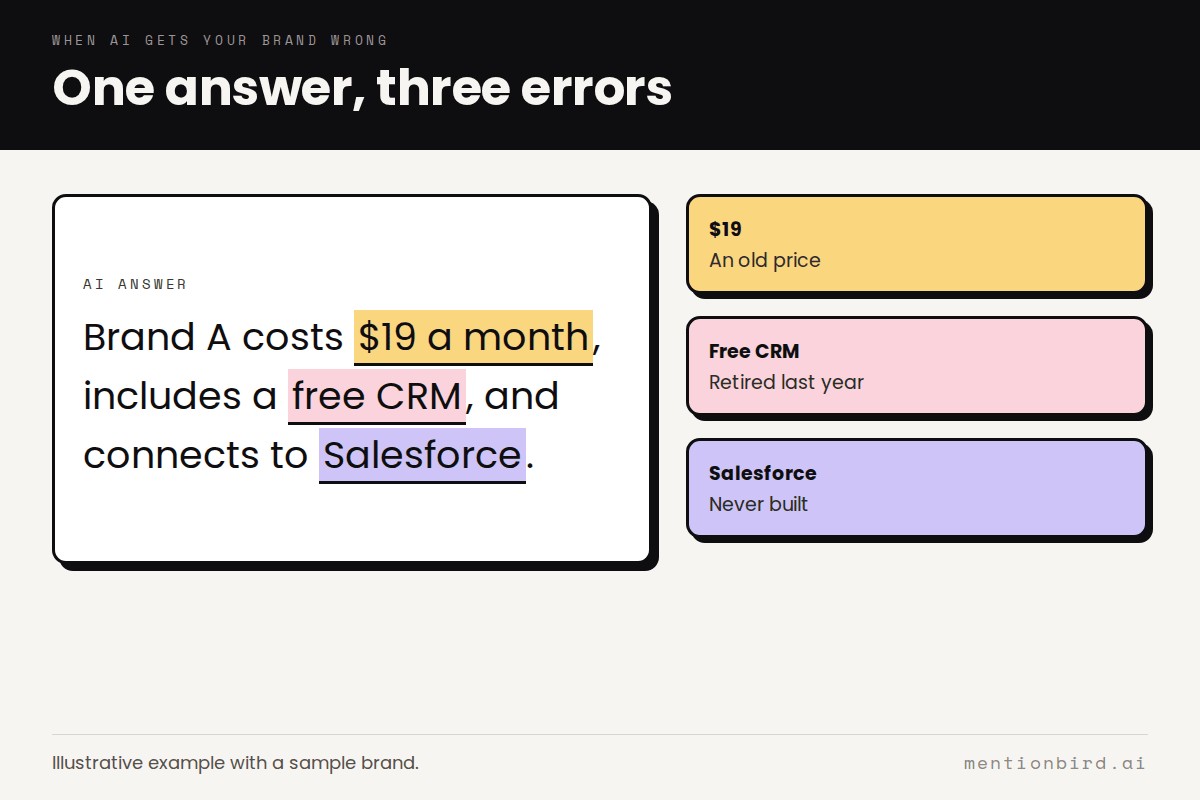
A buyer reading that answer has no reason to doubt it. They may rule you out on price, or expect a feature you do not offer.
How common AI mistakes are
When journalists from 22 public broadcasters reviewed more than 3,000 AI assistant answers about the news for a study led by the European Broadcasting Union and the BBC, 45% of answers had at least one significant issue, and one in five contained major accuracy problems such as invented details or outdated facts.
News is not product research, but the lesson carries over: a fluent, confident answer is not the same as a correct one.
Why AI hallucinates about brands
- Outdated sources: Old pages, reviews, and forum threads (on platforms like Reddit, Quora, etc.) keep repeating details you changed long ago.
- Gaps in what it can read: If AI crawlers cannot reach your pages, the model fills the gap with guesses or with what other sites say about you.
- Conflicting information: When your site, listings, and reviews disagree, AI picks one version, and it may not be the right one.
- Training cutoffs: Answers built from memory reflect the web as it looked when the model was trained.
- Similar brands blending together: Brands with similar names or products can get their details mixed up.
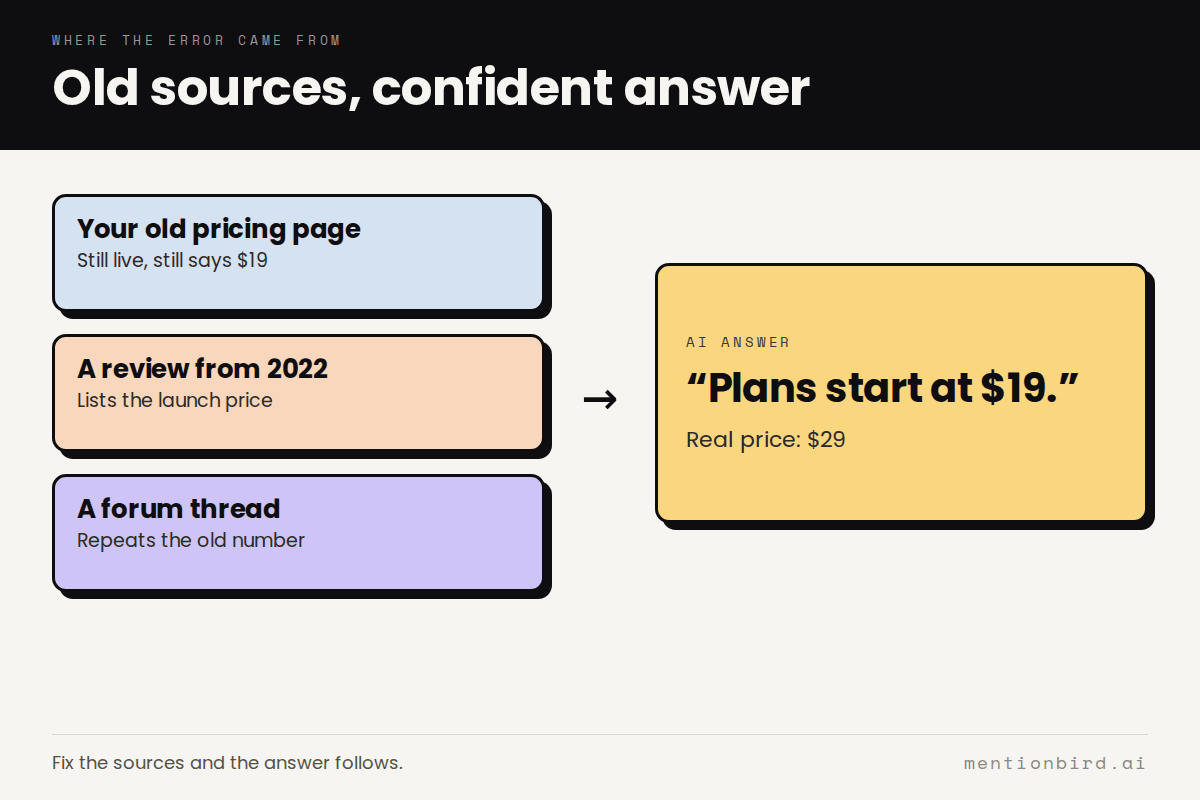
In most brand cases, the AI is repeating a real source, just an outdated or wrong one. That is good news, because sources can be fixed. Looking at the pages behind each answer, your AI citations, usually shows where an error started.
Hallucination vs outdated information vs bias
Hallucination: The AI states something that is not true anywhere, like a feature no source ever mentioned.
Outdated information: The AI repeats something that was once true, like last year's price. This is the most common error brands see.
Bias: The AI's facts are correct, but it consistently favors certain brands or sources over others.
All three change what buyers hear about you, and the fix starts in the same place: the sources AI relies on.
How to reduce hallucinations about your brand
- Publish the facts plainly: Put pricing, features, and integrations on clear, crawlable pages, not only inside images or scripts.
- Retire old pages properly: Update or redirect outdated pricing and feature pages instead of leaving them live.
- Correct third party listings: Fix wrong details on review sites, directories, and marketplaces AI tends to cite.
- Keep facts consistent everywhere: One price, one feature list, and one product name across every page and profile.
- Make sure AI can read the right version: The free AI crawler accessibility checker shows whether AI bots can reach your key pages.
How to catch hallucinations early
You cannot fix what you do not see. Asking ChatGPT about your brand once shows a single answer, and answers change from run to run. Our guide to monitoring brand mentions in ChatGPT covers how to check by hand. More guides like it are on the MentionBird blog.
MentionBird runs your buying prompts every day across the AI platforms in your plan. Prompt tracking shows what each platform says about you, and citation tracking shows the pages behind each claim, so you can trace a wrong detail back to where it came from. Starter covers ChatGPT and Gemini, Growth adds Perplexity and Claude, and Custom supports up to 20 platforms: ChatGPT, Gemini, Perplexity, Claude, Grok, Google AI Overviews, Microsoft Copilot, DeepSeek, Google AI Mode, Mistral Vibe, Qwen Chat, Meta AI, Kimi AI, You.com, Ask Brave, Alexa for Shopping, Doubao, ERNIE, Poe, and Duck.ai.
Check what ChatGPT says about your brand
Get the full answer text for five buyer questions so you can spot wrong claims, plus who ChatGPT names instead and the sources it used. Free, no signup.
Get your free AI Visibility ReportOther glossary terms to check out
FAQs
1. Can I stop AI from hallucinating about my brand?
Not completely, but you can reduce it a lot. Make the correct facts easy to find and fix the outdated sources AI keeps repeating.
2. Can I report a wrong AI answer?
Most AI assistants have a feedback option on each answer. It helps, but fixing the source behind the error usually works better and lasts longer.
3. Do some AI platforms make more mistakes than others?
Yes. Error rates differ by platform and by question, which is why checking each platform separately matters.
4. Are answers with citations always accurate?
No. Citations let you check a claim, but AI can cite a real page and still misstate what it says.
5. How often should I check what AI says about my brand?
At least weekly for your key buying questions, and more often if your prices or product details change frequently.
See what AI says about your brand, and where it came from
First month $19 with code TRY19, then $79/mo. Cancel anytime.